
SOLAR BATTERY STORAGE SYSTEM
30KWh
High-Usage Small & Medium Homes
$6,499*
get a quote
Submit the form below, our expert will contact with you shortly!
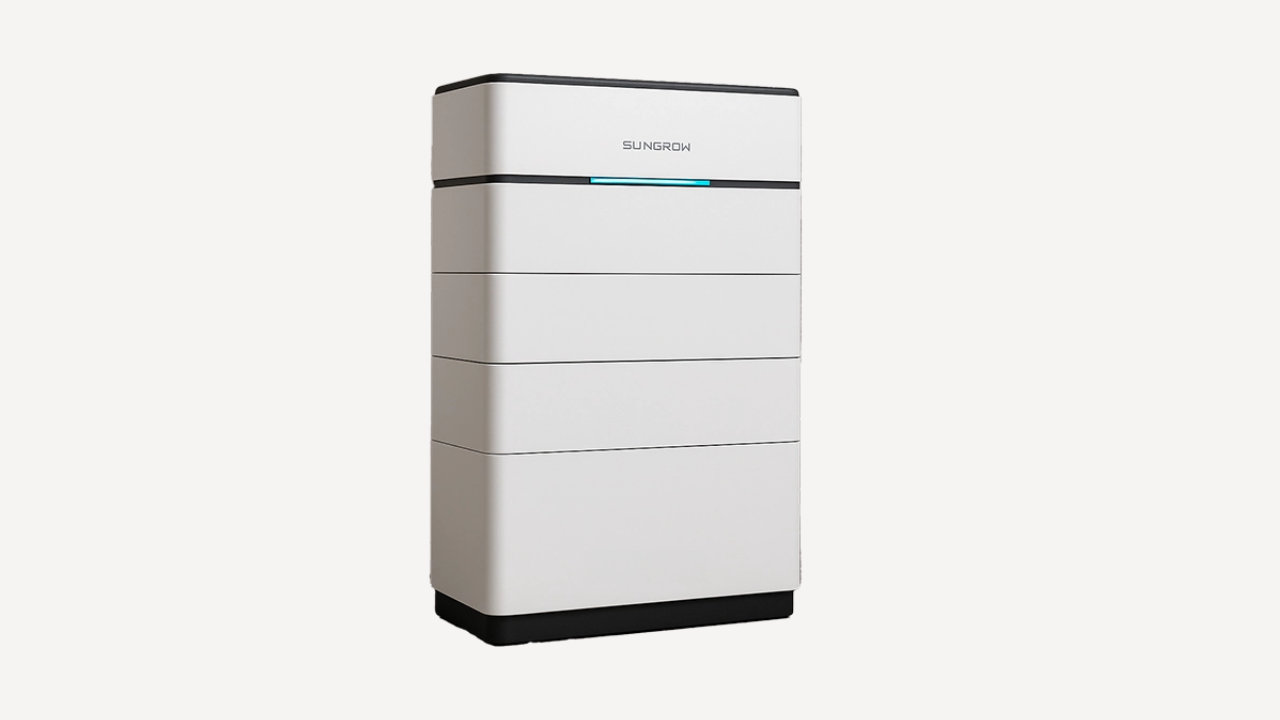
30kWh Solar Battery
As solar energy becomes more mainstream across Australia, bigger battery systems are finding their way into homes and small businesses. A 30KWh solar battery offers serious storage capacity—enough to run high-demand households or support day-to-day operations for small commercial setups.
If you’re looking for more energy independence, backup protection, or a solution that supports EV charging and heavy appliances, this battery size could be the smart move.
DISCOVER THE BEST SOLAR BATTERY FOR YOUR SOLAR SYSTEM
20KWh
Solar Battery
Best for small & medium homes
$
5,799
*
Small Home
- Complete Energy Solution
- 24/7 Power Backup
- Seamless Integration
- High-Quality Energy Storage
30KWh
Solar Battery
High-usage small & medium homes
$
6,499
*
Medium Home
- Complete Energy Solution
- 24/7 Power Backup
- Seamless Integration
- High-Quality Energy Storage
40KWh
Solar Battery
Large homes & small business
$
9,799
*
Large Home
- Complete Energy Solution
- 24/7 Power Backup
- Seamless Integration
- High-Quality Energy Storage
30kWh Solar Battery Explained
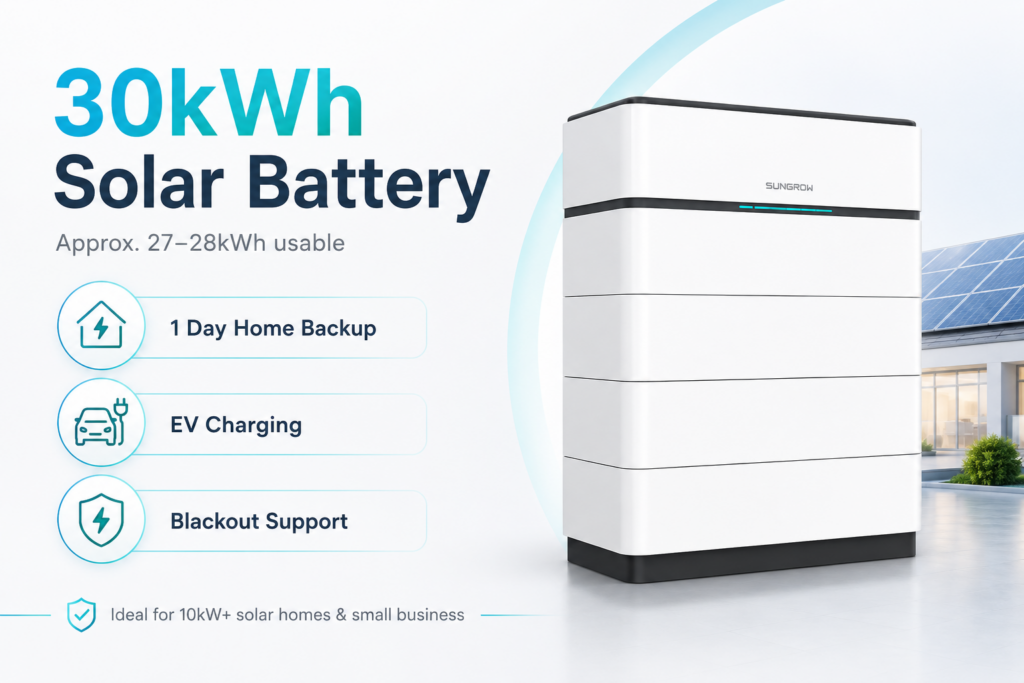
A 30KWh battery means it can store 30 kilowatt-hours of energy. That’s about enough to:
Power an average home for a full day
Charge an electric car once or twice
Run essential appliances for hours during a blackout
Most lithium batteries reserve a small portion as a buffer, so the usable energy is usually around 27–28KWh—still a solid amount. This storage size is ideal for homes with big solar systems (10KW or more) or small businesses wanting better control over their electricity use.
How Many Kilowatt-Hours Do You Need?
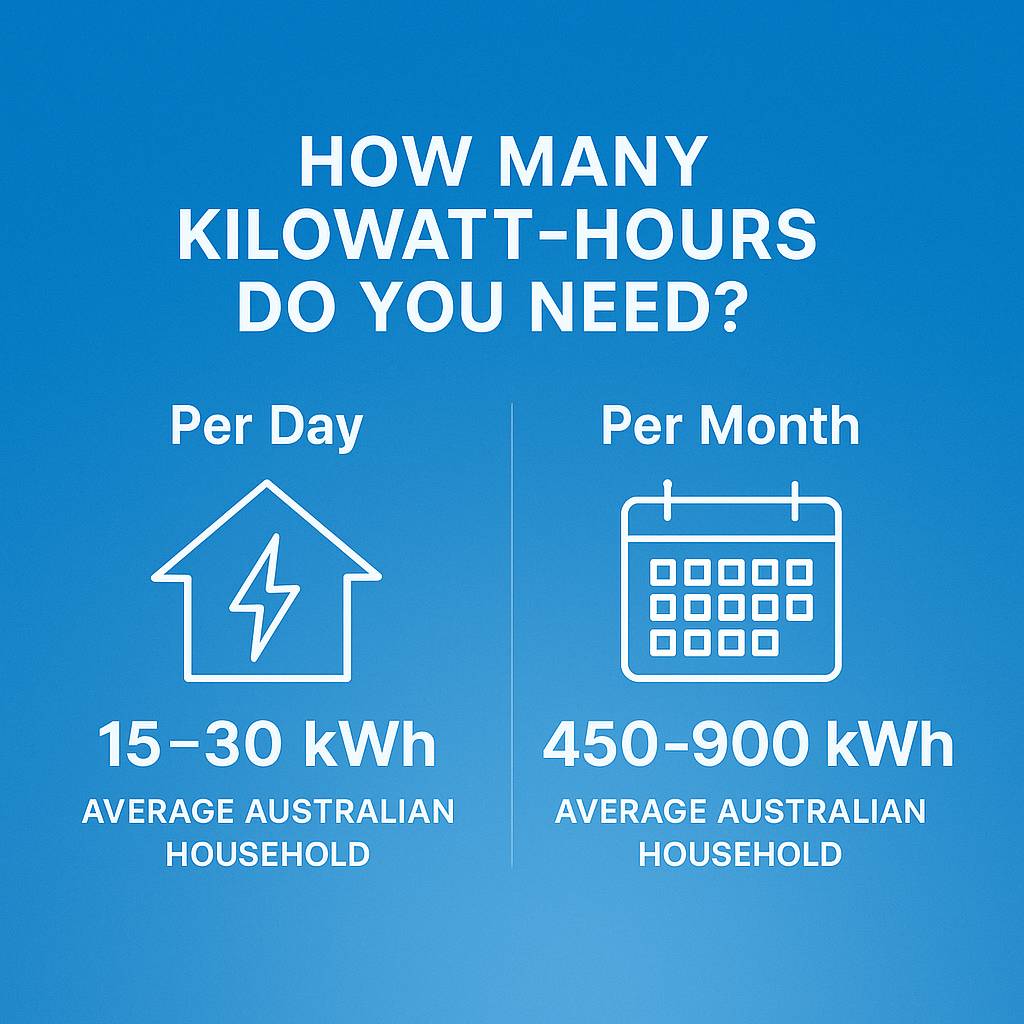
The average Australian household uses around 15 to 30 KWh of electricity per day, which adds up to approximately 450–900 KWh per month, depending on location and lifestyle. According to the Australian Energy Regulator (AER), these numbers vary slightly by state, but a 30kWh solar battery is often enough to cover one full day of usage for a medium to large home.
However, if you’re planning for backup during blackouts or want some off-grid independence, many Australians opt for 90 to 150 KWh of storage—enough to power the home for 3 to 5 days without sunlight. This setup works best when paired with a rooftop solar system that keeps charging the battery during the day.
What does a 30KWh battery provide?
A 30KWh battery doesn’t just sound impressive—it’s a solid storage size for most Aussie households. But before jumping in, it’s important to understand what this capacity actually means.
Energy vs. Power—Know the Difference
A 30KWh battery means it can store 30 kilowatt-hours of energy. Think of it like a fuel tank filled with electricity.
Energy (KWh): This is how much electricity your battery can hold.
Power (KW): This is how fast the stored electricity is used.
So, if your household uses around 30KWh a day (which is pretty standard across Australia), a fully charged battery could, in theory, run your home for a full 24 hours—in perfect conditions.
But in the real world, a few things come into play.
What Impacts the Battery’s Lifespan?
1. Your Appliances’ Demand (Peak vs Steady Usage)
Not all devices use power the same way. Big items like air conditioners or dishwashers pull heavy loads (called peak loads) and will drain your battery quicker than steady, lower-consumption devices like lights or fridges.
2. Usable Capacity (Depth of Discharge)
A battery’s usable capacity depends on its depth of discharge (DoD). For example, if a 30 kWh battery has a 90% DoD, approximately 27 kWh of energy may be usable. The actual usable capacity may vary depending on the battery model, reserve settings, and manufacturer specifications.
3. Solar Charging During the Day
If your battery is connected to solar panels, it can recharge with sunlight during the day. If you balance your usage and solar generation correctly, your battery can last longer—or even indefinitely—on sunny days.
4. Smart Energy Management Helps Too
Modern energy systems can automatically prioritise the important stuff, like lighting and the fridge, while turning off non-essential things temporarily. That way, your battery doesn’t get drained unnecessarily, giving you more hours of backup.
Estimated 30 kWh Battery Backup Time by Household Load
| Average Household Load | Approximate Backup Time |
|---|---|
| 1 kW | Up to 27 hours |
| 2 kW | Up to 13.5 hours |
| 3 kW | Up to 9 hours |
| 5 kW | Up to 5.4 hours |
Note: Estimates are based on approximately 27 kWh of usable energy at 90% depth of discharge. Actual backup time may vary depending on inverter efficiency, appliance usage, battery reserve settings, system losses, and available solar generation.
30kWh Battery Installation & System Integration Tips
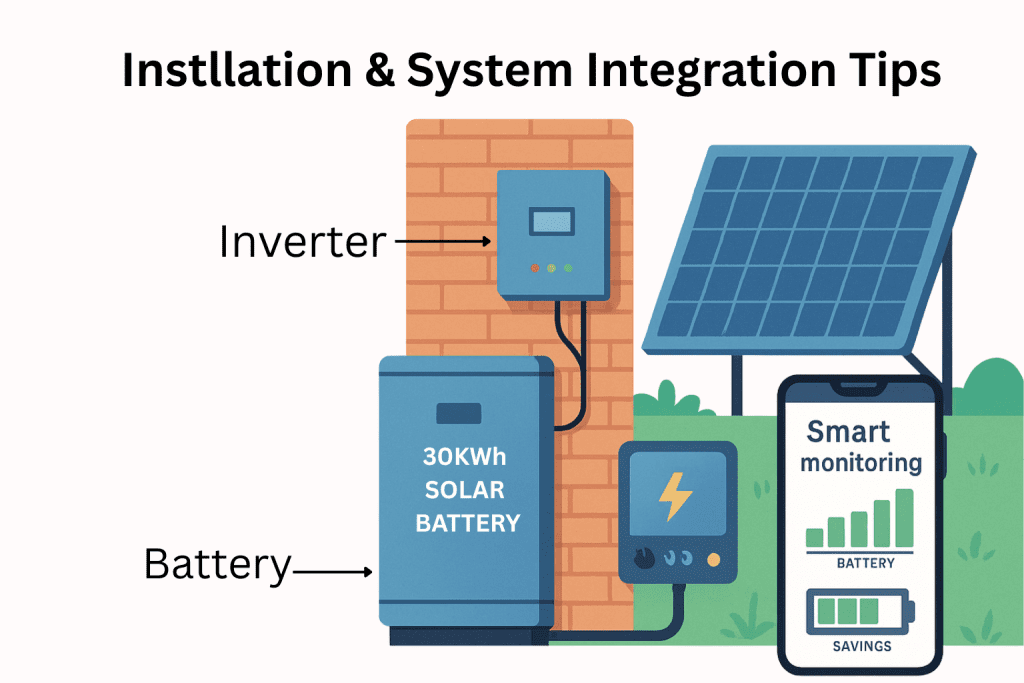
Placement matters: Indoor modular units work well for garages, while larger systems need outdoor weatherproofing.
Inverter pairing: Match with a suitable hybrid inverter to optimise performance.
AC or DC coupling: DC is more efficient but trickier for retrofits; AC is more flexible.
Safety & compliance: Must meet AS/NZS 5139 standards; only trust CEC-approved professionals.
Smart monitoring: Choose a system with app support to track usage, battery health, and savings.
How much does a 30 KWh solar battery cost in Australia?
Installing a 30 kWh solar battery requires a significant upfront investment, but available rebates and incentives can help reduce the overall cost.
Average Solar Battery Cost
In 2026, the 30kW solar battery price in Australia starts at around A$6,499 for a 30 kWh system.
Final cost depends on:
Installation complexity
Number of battery modules
Inverter type
Monitoring systems
For the best price and expert advice, get in touch with us at Aussie Solar Tech. We’ll help you choose the right solar battery and provide a quote based on your home’s actual energy needs.
Comparing Different 30 kWh Solar Battery Options in Australia
Different 30 kWh solar battery systems vary in design, backup configuration, installation method, and weather protection. The table below compares several popular options available for Australian homes and businesses.
| Battery Brand & Model | 30 kWh Configuration | System Design | Blackout Protection | IP Rating |
|---|---|---|---|---|
| AlphaESS SMILE M5 | 6 × 5 kWh Modules = 30 kWh | All-in-One Hybrid System | UPS Backup | IP65 |
| Growatt APX HV | 6 × 5 kWh Modules = 30 kWh | High-Voltage Modular Battery | Available with Compatible Inverter and Backup Equipment | IP66 |
| SOFAR PowerAll | 6 × 5.12 kWh Modules = 30.72 kWh | All-in-One Stacked Energy Storage System | Backup Power Capability | IP65 |
| Sungrow SBH300 | 6 × 5 kWh Modules = 30 kWh | High-Voltage Modular Battery | Seamless Backup with Compatible Hybrid Inverter | IP55 |
| Sigenergy SigenStor | Approx. 30 kWh Modular Configuration | Modular 5-in-One Energy Storage System | Full Backup with Sigen Energy Gateway | IP66 |
| Hinen B5000 / B5000-W | 6 × 5 kWh Modules = 30 kWh | Low-Voltage Modular Battery | Depends on Selected Hinen System | IP65 |
| Fox ESS CQ6 | 5 × 5.99 kWh Modules = 29.95 kWh | High-Voltage Modular Battery | Available with Compatible Fox ESS Hybrid Inverter | IP65 |
| GoodWe ESA Series | 4 × 8.32 kWh Modules = 33.28 kWh | Integrated Energy Storage System | Backup Available with Compatible System | IP66 |
| BYD Battery-Box Premium HVM | Approx. 30 kWh Configured System | High-Voltage Modular Battery | Depends on Selected Hybrid Inverter | IP55 |
| SolaX T-BAT HS 5.1 | Approx. 30.7 kWh Modular Configuration | High-Voltage Modular Battery | Depends on Selected System Configuration | IP66 |
| Hiconics ESS | 30 kWh Configured System | Integrated Modular Energy Storage System | Backup Capability Available | IP65 |
| SolarEdge Home Battery | 3 × 9.7 kWh Usable Batteries = 29.1 kWh Usable | DC-Coupled Battery System | Backup with SolarEdge Backup Interface | IP55 |
Note: Some battery systems may have actual capacities slightly above or below 30 kWh depending on the model and module configuration.
Blackout protection and maximum backup output depend on the selected inverter, gateway, backup equipment, switchboard configuration, and installation design. The right 30 kWh battery system depends on your existing inverter, backup requirements, installation space, and future expansion needs. A professional site assessment is recommended before selecting a battery system.
Australian Federal Battery Rebate
Under the Australian Government’s Cheaper Home Batteries Program, eligible battery systems may receive an upfront discount of around 30%. The final discount is calculated using Small-scale Technology Certificates (STCs) and depends on the battery’s usable capacity, installation date, and current STC value.
From 1 May 2026, the STC support factor is applied in capacity tiers:
| Usable Battery Capacity | STC Support Factor |
|---|---|
| First 0–14 kWh | 100% |
| Capacity above 14 kWh up to 28 kWh | 60% |
| Capacity above 28 kWh up to 50 kWh | 15% |
For example, a 30 kWh usable battery receives the 100% STC factor for the first 14 kWh, the 60% factor for the next 14 kWh, and the 15% factor for the remaining 2 kWh. Eligible batteries must have a nominal capacity between 5 kWh and 100 kWh. However, STCs can only be claimed for the first 50 kWh of usable capacity.
Estimated Annual Savings & Payback Period
Why Australians Are Investing in 30KW Solar Batteries
1. Power for Large Homes
For bigger homes, a 15kW system may work, but a 30kW solar battery delivers serious energy capacity. It can comfortably support an entire household and more, giving homeowners peace of mind during peak usage or outages.
2. Control Over Rising Bills
Electricity costs are unpredictable, and Australians are looking for stability. Pairing solar panels with a 30kW battery allows families to store excess energy and reduce reliance on the grid, keeping bills more manageable.
3. Greater Energy Freedom
A 30kW system offers flexibility. Some homeowners value independence from the grid, others focus on maximizing return on investment, and many enjoy the confidence of having a robust energy backup system.
Is a 30kWh battery right for you?
Whether a 30kWh battery is enough will depend on your home’s energy usage, the installation of solar panels, and how you manage your energy. While it can potentially power an ordinary home for a day, installing it with solar panels or limiting usage to essential systems can significantly extend its performance.
By thoughtfully analyzing your energy needs and leveraging solar power, you can enjoy the benefits of energy independence and reduce your reliance on the grid, all while helping to contribute to a greener future.
Frequently Asked Questions
How long will a 30kWh battery last?
A 30kWh solar battery typically lasts 10–15 years or around 6,000–8,000 charge cycles, depending on usage and brand.
How many solar panels are needed for a 30kW battery?
You generally need a solar array of around 30kW capacity, which translates to approximately 75–100 panels depending on panel wattage.
What is the range of a 30kWh battery?
A fully charged 30kWh battery can power an average Australian home for about 24 hours, depending on energy consumption and appliance usage.
What is the 30kW solar battery cost in Australia?
The 30 kwh battery price in Australia starts from around A$6,499.
Can a 30kWh battery support a whole house?
Yes, a 30kWh battery can power most households for a full day, especially when paired with solar panels for daytime recharge.
WE INSTALL CEC-APPROVED POPULAR SOLAR BATTERIES IN AUSTRALIA






- Tesla Powerwall
Great for storing solar energy at home because it is very efficient and lasts a long time.
- Sungrow Battery
Works well and is affordable. It can be used in homes and businesses.
- Sigenergy Battery
A dependable storage option that focuses on being eco-friendly and simple to use.
- SolarEdge Battery
Works best with SolarEdge inverters and gives you excellent monitoring and control.
- Enphase Battery
BYD Battery
