
☀️ Up to $8,500 Rebates Available
Solar System Prices Australia
Save up to 70% on your energy bills with Australia’s most trusted solar installers. Quality panels, expert service, and transparent pricing.
Solar System Prices Australia 2026: Complete Cost Guide
In Australia, solar system prices are rarely viewed as just an upfront cost. Homeowners usually focus first on how a solar power system will fit into their daily energy use, considering factors like roof space, electricity consumption, and long-term bill savings before looking at the price.
Solar system prices in Australia in 2026 range from $3,999 for a 6.6kW system to $15,000+ for large 20kW+ setups — after government rebates. Whether you’re comparing solar panels prices across brands or calculating your solar system cost against long-term savings, this guide covers everything Australian homeowners need to know.
Across major cities such as Sydney, Melbourne, Brisbane, Adelaide, and Perth, solar system pricing is often compared based on system size, panel quality, and inverter reliability rather than the cheapest quote. When seen as a long-term energy solution, solar system prices in Australia feel more like a smart investment than a short-term expense.
Solar System Cost in Australia 2026: What to Expect
The cost of a solar system in Australia varies depending on several factors, but here’s what you can expect to pay in 2026:
- Small Systems (3-5kW): $3,500 – $7,000 Ideal for small households with 1-2 people or those with modest electricity consumption.
- Medium Systems (6-8kW): $4,000 – $9,000 Perfect for average Australian families with 3-4 people, this is the most popular choice for suburban homes.
- Large Systems (10kW+): $6,000 – $15,000+ Best suited for larger families, homes with pools, or those looking to maximize their solar investment and potentially go off-grid.
These prices include installation and applicable government rebates, making solar more affordable than ever for Australian households.
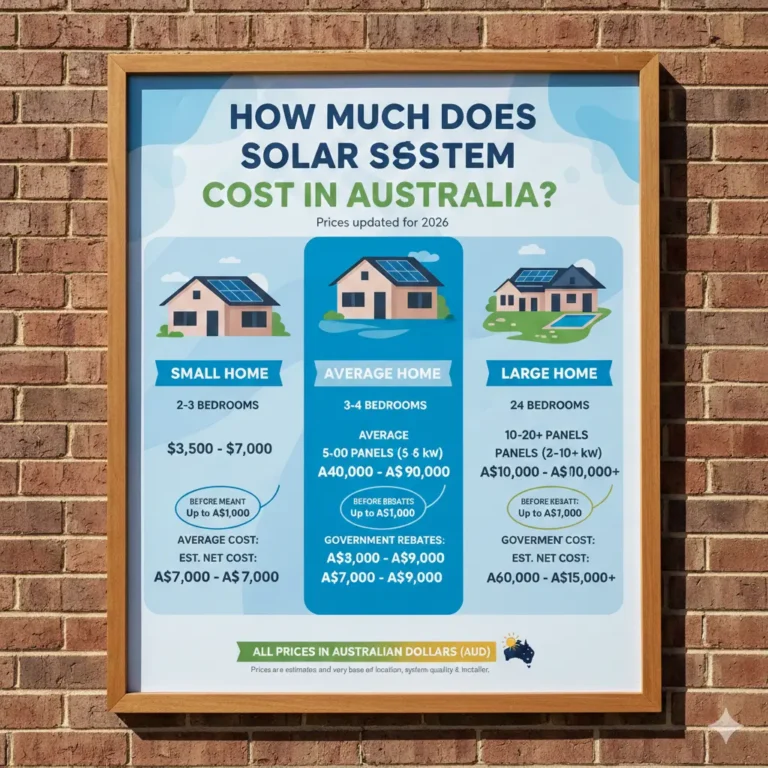
Breakdown of The Average Solar System Costs in Australia for 2026
| System Size | Price (After Rebates) |
|---|---|
| 6.6kW | $3,999 |
| 8kW | $4,599 |
| 9kW | $5,390 |
| 10kW | $5,599 |
| 13kW | $6,999 |
| 15kW | $8,790 |
| 20kW | $10,299 |
| 50kW | $19,599 |
Note: All prices listed are approximate and subject to change. Please request a quote for the most accurate and up-to-date pricing.
What Affects Solar Panel Prices in Australia?
System Size and Capacity
The bigger your system, the higher the upfront cost—but also the greater your long-term savings. At Aussie Solar Tech, we help you find the sweet spot between your budget and energy needs.
Panel Quality and Brand
Not all solar panels are created equal. Premium brands like Jinko, SunPower, and Trina offer better efficiency and longer warranties, while budget options can still provide excellent value. We stock a range of quality panels to suit every budget.
Inverter Type
Your inverter choice significantly impacts both price and performance:
- String inverters are the most economical option
- Microinverters offer better performance but cost more
- Hybrid inverters (compatible with batteries) future-proof your system
Installation Complexity
Factors like roof type, pitch, shading, and accessibility can affect installation costs. Our experienced technicians at Aussie Solar Tech assess your property to provide accurate, transparent pricing.
Location
Solar installation costs can vary between states due to different rebates, labor costs, and market competition. Whether you’re in Sydney, Melbourne, Brisbane, Perth, or Adelaide, we provide competitive pricing tailored to your location.
Solar Panel Prices by Brand (Per-Panel Cost 2026)
In 2026, average per-panel prices in Australia range $100–$350+ (ex-GST/install), with budget Tier 1 under $130 and high-end/AU-made over $250. Prices reflect falling module costs (~15% drop from 2025) offset by rebates and installer margins. The table below shows verified retail estimates by brand, helping weigh value for Australian installs.
| Brand | Model (typical W) | $/W | Approx. Per Panel Cost |
|---|---|---|---|
| Jinko | Tiger Neo 440–475W N-Type | $0.33–0.38 | $145–$180 |
| Aiko | Neostar 470–480W | $0.30–0.33 | $140–$160 |
| LONGi | Hi-MO 6 440–460W | $0.28–0.32 | $125–$150 |
| REC | Alpha Pure 410–430W | $0.65–0.75 | $265–$325+ |
| Trina | Alpha Pure 410–430W | $0.23–0.27 | $100–$130 |
| Sunpower | Vertex S+ 440–470W | $0.45–0.52 | $200–$240 |
| Canadian | TOPHiKu6 440–470W | $0.27–0.32 | $120–$150 |
Note: All prices listed are approximate and subject to change. Please request a quote for the most accurate and up-to-date pricing.
Solar Panels Payback Period: When Do the Savings Start?
One of the most common questions Australian homeowners ask is: “When will my solar panels pay for themselves?” The good news is that your savings start from day one, but understanding the payback period helps you see the full financial picture.
Real Savings Timeline Example
Let’s look at a typical Australian family in Melbourne with a 6.6kW solar system:
- System Cost: $6,500 (after rebates)
- Annual Savings: $1,400 on electricity bills
- Payback Period: Approximately 4.6 years
- 25-Year Savings: $35,000+ (accounting for electricity price increases)
From the moment your system is switched on, you’re reducing your reliance on expensive grid electricity. Every sunny day translates to real dollars saved on your power bill.
When Do You Actually Start Saving Money?
Here’s the exciting part: your savings begin immediately. The payback period simply marks when your cumulative savings surpass your initial investment. After that point, every dollar saved goes straight into your pocket.
Year 1-5: You’re recouping your investment while still enjoying reduced electricity bills. Year 5+: Pure savings. Your system is paid off and continues generating free electricity for 20+ more years.
At Aussie Solar Tech, we provide detailed payback calculations based on your specific circumstances, so you know exactly when you’ll break even and how much you’ll save over your system’s lifetime.
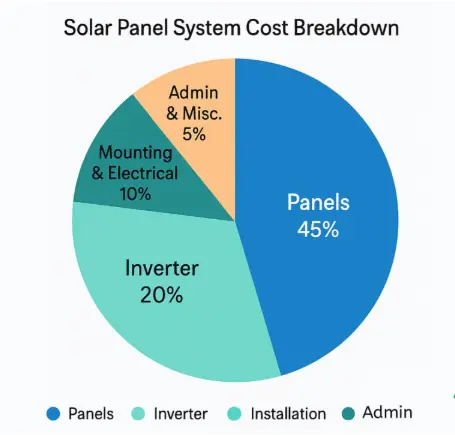
Solar System Cost Breakdown
For a better understanding of solar panel costs, let’s see where your money goes:
a. Equipment
- Solar Panels: 40–50% of total cost
- Inverter: 15–25% (string or hybrid)
- Mounting System: 5–10%
b. Installation
- Labour: 10–20%
- Safety & Compliance: 5–10%
c. Optional Extras
- Battery Storage (e.g., 10 kWh): $8,000 – $12,000
- Monitoring Systems: $200 – $800
- Smart Meters: $400 – $600
Government Rebates That Reduce Solar System Prices
The Australian Government’s Small-scale Renewable Energy Scheme (SRES) provides STCs that cut solar system costs by $1,200–$2,400 (e.g., ~$1,800 for 6.6kW), with values declining through 2030. New federal Cheaper Home Batteries Program adds ~$250–$310/kWh (capped at 50kWh usable, tapering post-May 2026). Select states offer extras:
Victoria: Solar Homes battery/VPP rebates up to $1,400 (eligibility applies).
South Australia: Battery subsidies $2,000–$6,000+.
Queensland: Low-interest loans for solar+battery systems.
NSW: VPP/peak demand battery incentives $400–$1,500.
At Aussie Solar Tech, we manage all STC claims and state eligibility to maximize your upfront savings—get a free quote for exact figures based on your postcode and system size.
What Solar System Size Do I Need?
Choosing the right solar system size is one of the most important decisions for Australian homeowners and businesses. The ideal system depends on your daily electricity usage (kWh), roof space, budget, and whether you plan to add a battery in the future.
At Aussie Solar Tech, we design systems based on your actual energy consumption and future needs — not just what’s cheapest.
Residential Solar System Sizes (Homes)
6.6kW Solar System
Best for: Small to medium households (2–4 people)
Average daily output: 24–28 kWh
Ideal if: Your quarterly electricity bill is moderate and you mainly use power during the day.
This is Australia’s most popular system size and suits standard suburban homes with typical energy use.
Explore details →
8kW Solar System
Best for: Growing families (3–5 people)
Average daily output: 30–35 kWh
Ideal if: You run air conditioning frequently or work from home.
An 8kW system provides extra generation capacity and stronger long-term savings.
Explore details →
10kW Solar System
Best for: Large households or homes with pools
Average daily output: 38–45 kWh
Ideal if: You have high energy usage or want faster payback.
A 10kW system maximises solar production and significantly reduces grid dependence.
Explore details →
13kW Solar System
Best for: High-consumption homes
Average daily output: 50–55 kWh
Ideal if: You plan to add battery storage or an EV charger.
This system suits energy-heavy households wanting long-term independence.
Explore details →
15kW Solar System
Best for: Luxury homes or home businesses
Average daily output: 55–65 kWh
Ideal if: You operate home offices, workshops, or high-load appliances.
It offers strong ROI for households with consistently high electricity demand.
Explore details →
Commercial Solar System Sizes (Businesses)
30kW Solar System
Best for: Small businesses, retail shops, cafes
Average daily output: 110–120 kWh
40kW Solar System
Best for: Medium commercial operations
Average daily output: 150–170 kWh
50kW Solar System
Best for: Warehouses, manufacturing units
Average daily output: 190–210 kWh

Should You Add Battery Storage?
Battery prices have dropped significantly in recent years. A quality home battery system (10-13kWh) costs between $8,000-$15,000 installed. While this increases your upfront investment, it allows you to:
- Store excess solar energy for use at night
- Reduce reliance on the grid during peak price periods
- Provide backup power during outages
- Maximize your solar investment
Our experts at Aussie Solar Tech can assess whether battery storage makes financial sense for your situation.
Is a Solar Battery Worth Installing?
Solar panels offer financial benefits to Australian homes because they decrease electricity expenses and create savings that continue over time. The payback period for solar systems becomes 3-6 years through government rebates while quality solar panels provide at least 25 years of electricity at affordable rates.
Solar panels create the basic structure needed to develop future battery systems although they do not provide backup power by themselves. Australian homeowners who need energy during the day should consider solar panels as their most economical and efficient energy solution.
How to Choose the Right Solar Panel Installers Near You
With many solar companies in the market, choosing a reliable installer is crucial. Here’s what to look for when searching for solar panel installers near me:
1. Experience and Licensing
- Choose SAA-accredited installers.
- Look for proven experience with similar projects.
2. Quality of Products
- Use Tier 1 solar panels and high-efficiency inverters.
- Check warranty terms and product lifespan.
3. Transparent Pricing
- Avoid too-good-to-be-true deals.
- Ensure the quote includes installation, warranty, and grid connection.
4. Customer Reviews
- Read Google and Facebook reviews.
- Ask for references or case studies.
Aussie Solar Tech prides itself on high-quality service, expert installation, and unmatched customer satisfaction. We’re one of Australia’s most trusted solar companies.
Why Choose Aussie Solar Tech
Aussie Solar Tech offers unmatched local expertise and top-tier products from brands like Trina, Jinko, and Canadian Solar. Our SAA-accredited installers ensure compliant and reliable installations. Every system is custom-designed to match your energy needs, and we provide complete post-installation support, including maintenance and monitoring. Trusted across ACT, NSW, VIC, and QLD. We are proud to help Australians transition to clean energy.
Customer Reviews
Posted on Google
 Elizabeth Jenner
Trustindex verifies that the original source of the review is Google.
Very good experience with our solar and battery installation. Great communication, responses were always quick, and pricing was very reasonable.Shah was especially easy to communicate with, knowledgeable, and professional, which made the whole process simple and stress-free. Everything was handled efficiently. Very happy with the service.Great workmanship, professional services.The work was completed on time and exactly within the promised timeframe.Highly recommended!Posted on Google Stuart DukeAfter experiencing a failure with our solar inverter, I contacted numerous solar installers trying to arrange an urgent replacement. Unfortunately, none could offer the prompt assistance we needed. Then I contacted Aussie Solar Tech in Mitchell, and the difference was remarkable! Within just 50 minutes of my call, they arrived at our property. In approximately 40 minutes, they had replaced the inverter and had our solar system fully operational again. From the initial phone call to having everything working took just 90 minutes. Absolutely outstanding! Their responsiveness, professionalism and efficiency were exceptional. After the frustration of contacting so many other installers, it was refreshing to find a company that genuinely prioritises customer service and delivers on its promises. Aussie Solar Tech has set a benchmark for customer service that others should aspire to. I cannot recommend them highly enough. They've certainly earned my trust and future business. Five stars – thoroughly deserved!Posted on Google
 Ryan SwanGreat experience with Shah from Aussie Solar Tech.The installation was quick, smooth and he provided us multiple quotes to select best solar and battery system based on my budget and energy needs. He is a very friendly and knowledgeable. Definitely recommending this company.Posted on Google
 Mason GloucesterHuyen was very helpful from the quote stage through to after installation. Happy to answer many questions.The installers were prompt, polite and friendly. Highly recommend.Posted on Google
 Lucas L'EstrangeShah was straightforward and professional from the beginning. I appreciated that he took the time to understand what I actually needed rather than simply trying to sell me a system.Provide Goodwe battery and Longi Panels at a very competitive prices. Installation was done in a timely manner. We highly recommended no hassle and very helpful.Posted on Google
 Tayla FolingsbyReally happy with Aussie Solar Tech.The new 10kW solar and Sig battery installation went smoothly and the installers were friendly and professional. Everything was left nice and tidy, and they showed us how the system works before they finished. No major hassles at all and highly recommend the team.Posted on Google
 Cody FunnellWe had a small issue with the system connection after installation but the Aussie Solar Tech team helped us to get it sorted instantly just after reporting.They stayed in touch, followed up with us and ensured everything was working properly in the end. Thanks for the immidiate after sales support. Shah is a genius solar expert.Posted on Google
 Scarlett OlsenBest decision ever made to install solar panels and battery through Aussie Solar Tech.The team is very professional, knowledgeable and the turnaround was really quick. Our panels and battery were installed within 2 days after the green loan approval. The price was competitive too. Very happy with the service and would happily recommend the team.Posted on Google
 Sterling BrownWe had an AlphaESS battery installed by Aussie Solar Tech earlier if the last month and the whole process went smoothly. Shah was easy to deal with and is very knowledgeable.The installation was done without any hassle. The installer was expert and efficient, and went out of his way to make sure everything was set up properly.The battery system has been working well since then. We are very happy with the service. Highly recommend them if you are looking new solar battery.Posted on Google
 harinder singhI had a positive experience with the team at Aussie Solar Tech and installed a Sigen battery with EV. Shah and Huyen were both professional, helpful and easy to communicate with. Shah is very knowledgeable. Shah took the time to explain the solar and battery options and answered my questions along the way. The communication and quote was excellent and the whole process was straightforward.
FAQ
Q: What is the average solar system price in Australia in 2026?
A: The average solar system price in Australia is $3,999–$10,299 after rebates.
Q: How much do solar panels cost per kW in Australia?
A: Solar panels cost $514–$605 per kW depending on system size.
Q: What is the cheapest solar system price in Australia?
A: Entry-level 6.6kW systems start at $3,999 after STCs.
Q: How much does a 6.6kW solar system cost?
A: A 6.6kW solar system costs approximately $3,999 after rebates in 2026.
