
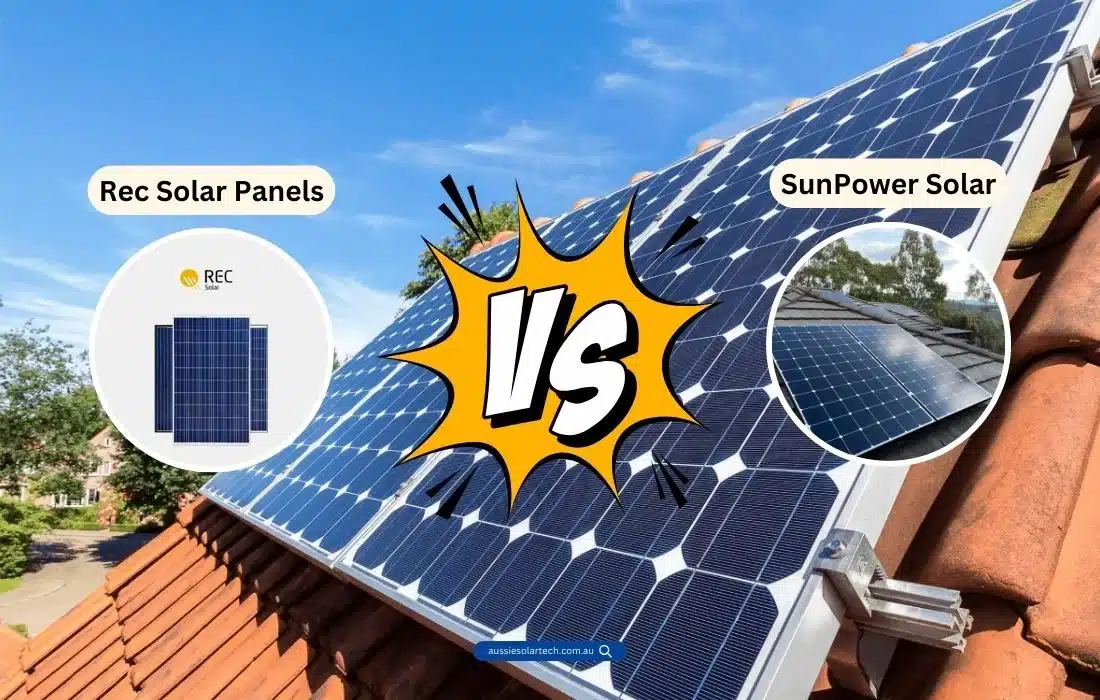
Comparing REC solar panels vs SunPower is one of the most common questions Australian homeowners face in 2026 — and for good reason. Both are genuine Tier 1 manufacturers, both qualify for STCs, and both deliver premium performance. But picking between them is not simply a matter of comparing efficiency numbers on a spec sheet. Pick the wrong panel for your climate, and you will lose 10 to 12 percent of your output on every hot summer afternoon, not because the panel is faulty, but because those spec sheets were written for a European laboratory, not an Australian rooftop.
But the REC Alpha Pure-R vs SunPower Maxeon 6 decision comes down to one thing most comparison reviews ignore: what happens to output when your Australian rooftop hits 65°C on a summer afternoon. Both brands are listed on the Clean Energy Council (CEC) approved product list and qualify for Small-scale Technology Certificates (STCs) under Australia’s Small-scale Renewable Energy Scheme. Getting that decision right from the start directly affects your system’s payback period.
REC Solar Panels vs SunPower: Why Australian Conditions Change Everything
Rooftop Heat Is Where Your Choice Gets Made
Australia pulls in between 4.5 and 6.0 peak sun hours per day across most of the country. That is one of the highest rates in the world. That also means sustained rooftop heat that no global comparison review accounts for. In our experience working across sites in Queensland and inland Western Australia, panel cell temperatures on a standard tin roof hit 60 to 70 degrees Celsius on summer afternoons. That is the real test, and it is not on any spec sheet.
Standard Test Conditions (STC), the benchmark behind every efficiency figure you see, are measured at 25 degrees Celsius. That is a laboratory number. For coastal properties from the Gold Coast to Perth’s northern suburbs, there is a second issue: salt mist corrosion steadily attacks panel frames, junction boxes, and cell connectors. Both brands address this, but through different engineering solutions, which we cover below.
How Grid Export Limits Affect Your Panel Selection
Australia’s 14 Distribution Network Service Providers (DNSPs) each set their own export caps. The Australian Energy Market Operator (AEMO) tracks every grid-connected solar device nationally. Some areas of South Australia and Queensland limit exports to 5 kW per phase under AS/NZS 4777.1. If your roof space is limited, choosing higher-efficiency panels lets you hit your DNSP allowance with fewer panels and a lower total system cost. Oversizing a system without checking your DNSP rules first means paying for output that will be curtailed from day one.
REC Alpha Pure-R vs SunPower Maxeon 6: Side-by-Side Specs(2026 AU Edition)
REC Alpha Pure-R HJT vs SunPower Maxeon 6 IBC: Cell Tech Compared
Both the REC Alpha Pure-R and SunPower Maxeon 6 are built on fundamentally different cell architectures, and that difference matters more than most buyers realise.
REC Alpha Pure-R- Key Features
- Heterojunction Technology (HJT): Layers crystalline silicon between amorphous silicon films to cut charge recombination losses, pushing efficiency higher than conventional cells
- N-type silicon base: Significantly lower light-induced degradation compared to standard PERC cells, meaning less output loss in the first years of operation
- PVEL Top Performer: Independently verified on the Kiwa PVEL PV Module Scorecard, the most credible durability benchmark in the solar industry
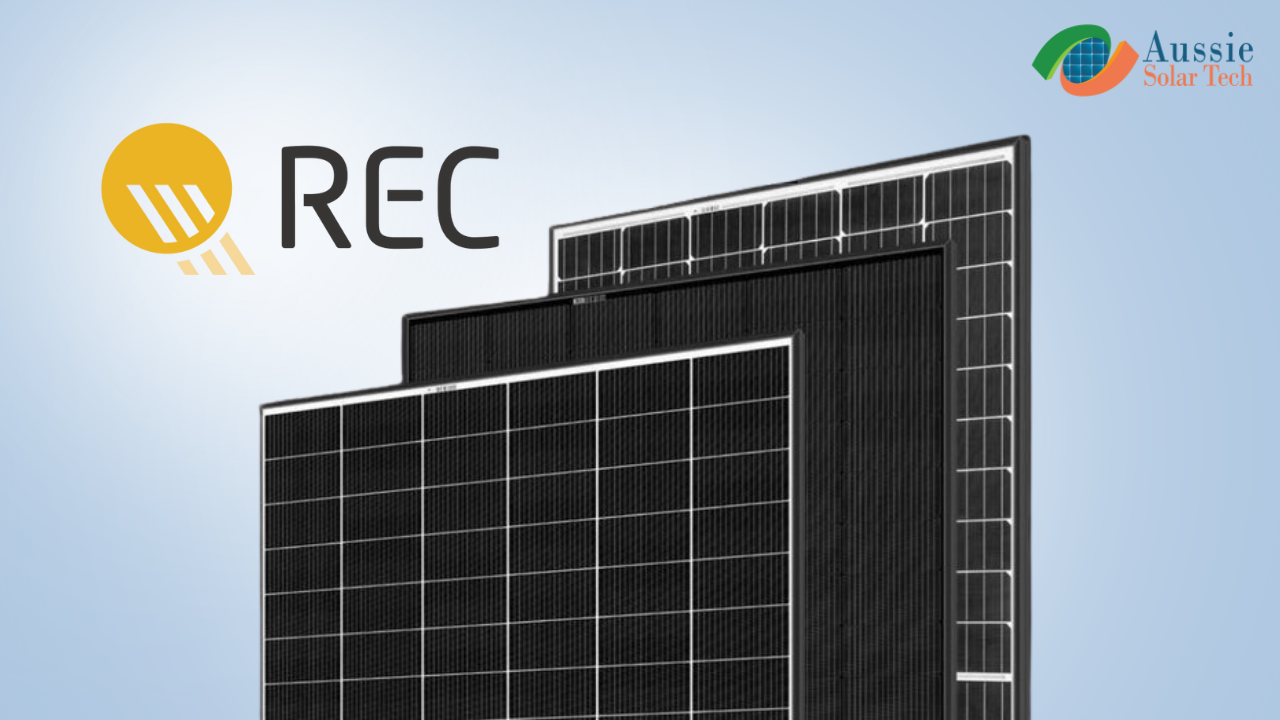
SunPower Maxeon 6, Key Features
- Interdigitated Back Contact (IBC) architecture: All electrical contacts are moved to the rear of the cell, eliminating busbar shading and improving light capture across the full panel surface
- Solid copper substrate: Adds structural durability over the panel’s lifespan, resisting micro-cracking from the thermal cycling that Australian rooftops experience year-round
- N-type silicon base: Same low degradation advantage as REC, with long-term output stability across decades of operation
- PVEL Top Performer: Holds the same independent Kiwa PVEL scorecard recognition as REC, confirming durability claims are backed by third-party testing
Both technologies arrive at high efficiency through different engineering paths. Which architecture suits your roof comes down to your location, shading profile, and how long you plan to hold the property, covered in detail below.
REC Solar Panels vs SunPower: Warranty & 25-Year Output Compared
The REC ProTrust warranty guarantees at least 92% of rated output at year 25. SunPower backs the Maxeon 6 with a 40-year product warranty, currently the longest in the residential market. For a system installed today, that 40-year term runs well past the 25-year financial models most Australian solar calculators default to.
Why Temperature Coefficient Matters More Than Peak Efficiency on Australian Rooftops
The Calculation Every Comparison Review Leaves Out
Every article ranking these two panels leads with efficiency under standard test conditions. We don’t, because STC is measured at 25 degrees Celsius, and your roof is not. The correct benchmark is Nominal Operating Cell Temperature (NOCT), modeled at 45 degrees Celsius cell temperature. Even that understates conditions in inland Queensland or the Northern Territory on a 42-degree day.
Here is what the temperature coefficient looks like at a realistic Australian cell operating temperature of 65 degrees Celsius, 40 degrees above the STC baseline.
|
REC Alpha Pure-R |
|
|
Models |
REC Alpha Pure-R 430W, 440W, 450W |
|
Efficiency |
Up to 22.6% (STC) |
|
Power Output |
430W – 450W per panel |
|
Warranty |
25 years (product, performance & labour via REC ProTrust) |
|
Best For |
Hot inland climates (QLD, WA, NSW, NT) – lowest temperature coefficient in class |
|
SunPower Maxeon 6 |
|
|---|---|
|
Models |
SunPower Maxeon 6 AC, Maxeon 6 Plus |
|
Efficiency |
Up to 22.8% (STC) |
|
Power Output |
420W – 440W per panel |
|
Warranty |
40 years (product warranty backed by Maxeon Solar Technologies) |
|
Best For |
Coastal installs & partial shade – copper-backed IBC cells resist salt mist & micro-cracking |
When SunPower Maxeon 6 Beats REC Alpha Pure-R: Coastal & Shade Installs
In our site work at Aussie Solar Tech, we see the heat disadvantage flip for coastal installs. SunPower’s solid copper backing resists micro-cracking from thermal cycling far better than silver-paste connections, which matters after 20 to 30 years of salt-air exposure. The IBC partial shade performance is also a genuine advantage on roofs with tree cover or complex pitch lines, where uneven shading across a panel otherwise kills output.
The right choice between these two brands consistently comes down to location first, roof geometry second, and price third. Neither brand wins on every site.
Warranties, STCs, and Australian Consumer Protections
REC ProTrust Warranty
REC’s ProTrust warranty covers product, performance, and labour for 25 years. The labour coverage is the part most buyers overlook; a single warranty callout in regional Australia can run several hundred dollars in travel and labour fees before anyone even looks at your panels.
One condition catches people out though. The warranty only holds if your installer is SAA-accredited. Check their accreditation number on the Solar Accreditation Australia register before you sign anything. Skip that step and you lose both the warranty and your STC rebate entitlement.
SunPower’s 40-Year Warranty – What to Check Before You Buy
SunPower offers the longest product warranty in the residential solar market at 40 years, backed by Maxeon Solar Technologies. On paper, that is a compelling number. In practice, there are three questions worth asking your installer in writing before you commit:
- Who handles claims in Australia?
Confirm which local entity processes warranty requests – not just the global parent company.
- Is labour included on replacements?
A panel swap without labour coverage still costs you money out of pocket.
- Does the warranty transfer if you sell the property?
A 40-year term only has full value if a future buyer can rely on it too.
STC Rebates – How Your Location Affects the Numbers
Both REC and SunPower panels qualify for Small-scale Technology Certificates (STCs) under Australia’s federal rebate scheme. Think of STCs as upfront discount certificates – the more your system generates over its lifetime, the more certificates it earns, and the bigger the discount off your install price.
What most people don’t realize is that your location determines how many STCs you receive, not just your system size. Australia is divided into four zones:
- Zone 1 – Darwin, northern Queensland: highest rebate
- Zone 2 – Brisbane, Adelaide, Perth
- Zone 3 – Sydney, Melbourne, Canberra
- Zone 4 – Tasmania, alpine regions: lowest rebate
A 6.6kW system in Sydney generates noticeably more STCs than the exact same system installed in Hobart. The panel brand has no bearing on this, your postcode does. Confirm your STC zone with your installer before finalising your system size, as it directly affects the final price you pay on install day.
Should You Choose REC Solar Panels or SunPower? The Australian Decision Guide
Choose REC Alpha Pure-R
- Your property is in a hot inland region of Queensland, Western Australia, New South Wales, or the Northern Territory, where summer ambient temperatures regularly hit 38 degrees Celsius or above.
- Your roof space is limited, and you need maximum output within your DNSP export cap. The lower temperature coefficient delivers more energy during peak afternoon heat.
- You want a premium panel with a 25-year warranted payback model and a competitive price per watt.
- Your SAA-accredited installer is familiar with the REC ProTrust process and can lock in both your warranty and STC entitlement from day one.
Choose SunPower Maxeon 6
- Your property sits within two to three kilometers of the Australian coastline, where 30 to 40 years of salt mist exposure is a genuine engineering concern.
- Your roof has partial shading from trees or neighboring structures, where IBC’s rear-contact architecture reduces the output penalty.
- You plan to hold the property for 30 to 40 years and want the warranty term to match.
- You need maximum watts from a very small roof area, and the temperature coefficient trade-off suits your location’s climate profile.
Before committing to either panel, confirm your DNSP export limit and STC zone. Both factors have a bigger impact on your system’s financial return than a 0.2 percentage point efficiency gap between these two brands. If you want a site-specific assessment, the team at Aussie Solar Tech can run the numbers for your exact location. Reach us at info@aussiesolartech.com.au or call 02 6182 2877 to book a no-obligation site evaluation.

Shah Tarek is a Solar Energy Consultant with 10 years experience in solar system design and solar consultancy field at Australia. He is now a Director, Operation & Consultancy Division at Aussie Solar Tech, a leading Australian solar retailer and installer. Here he is writing informative and engaging solar content that educates the community on the benefits of solar power. His work supports Aussie Solar Tech’s mission to promote sustainable energy solutions and foster a greener future for Australia.




Seraphim Solar Panels Review: Efficiency, Reliability, and Value Unveiled

Talesun Solar Panels: Honest Review Before You Buy

Sungrow Battery VS Tesla Powerwall : Which is Best in Australia?

Leapton Solar Panels Review: Affordable Energy Solution

REC Solar Panels Review: Outstanding Efficiency & Durability

Best Hybrid Inverters for Home Solar Systems in 2025
Best Solar Battery In Australia 2026 — Complete Guide

Sigenergy VS Fox ESS Battery: Which is The Best Choice for 2026

How Much Do Solar Panel Costs in Australia? (2026 Price Guide)

