
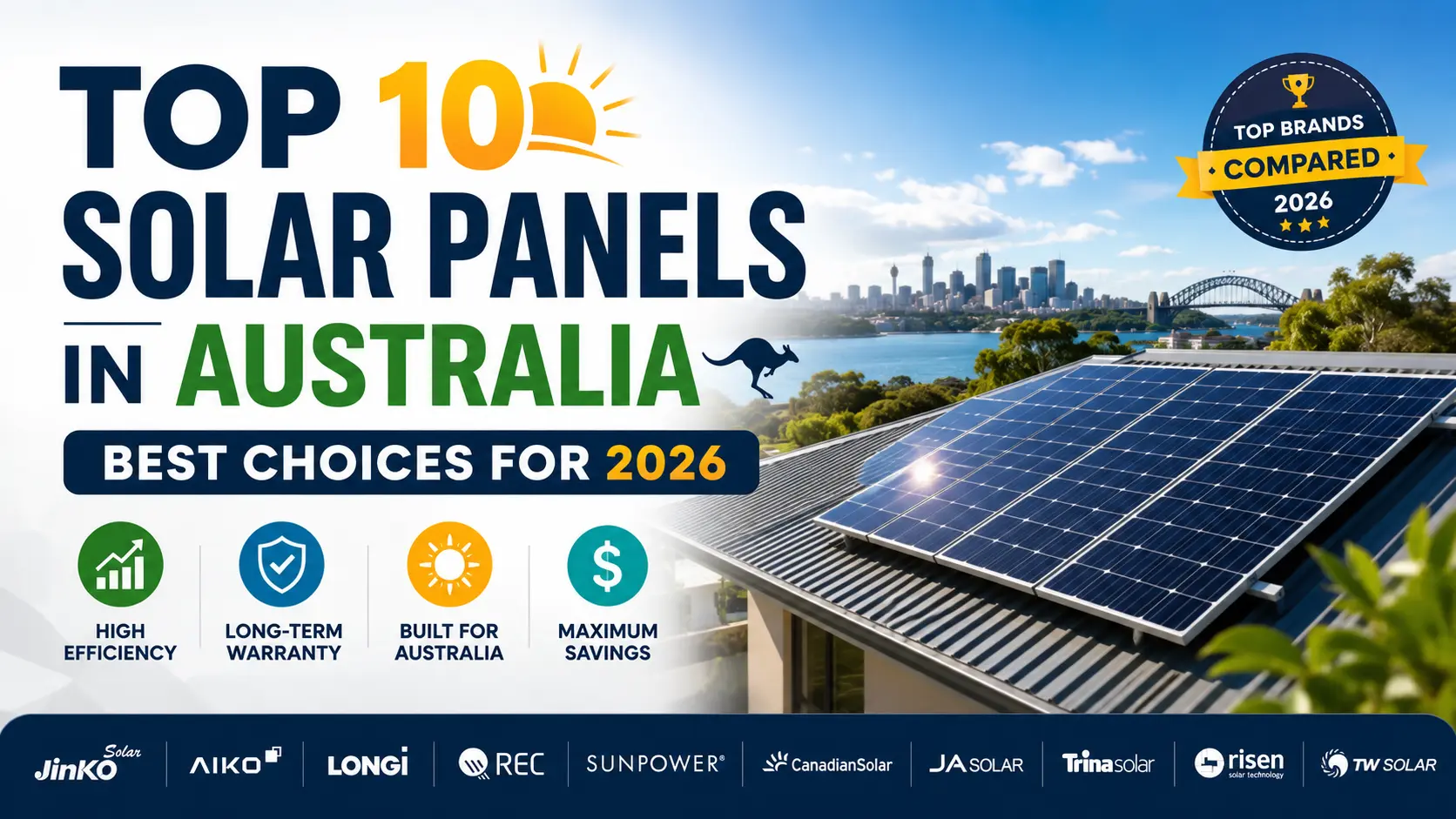
With over 8,500 panels from 150+ brands on the Clean Energy Council’s approved list, choosing the right solar panel for your Australian home has never been more confusing — or more important.
The wrong choice doesn’t just mean slightly less electricity. It can mean a panel that degrades faster in Australian heat, a brand without local warranty support, or a system that pays itself off years later than it should.
At Aussie Solar Tech, we’re a CEC-accredited solar retailer and installer with 7+ years of hands-on experience across ACT, NSW, VIC, QLD, SA, and WA. We’ve installed thousands of systems using every brand in this guide. What follows isn’t a copy-paste spec-sheet comparison — it’s a guide built on real installation experience, current 2026 datasheets, and honest assessments of which panels actually hold up in Australia’s climate.
Below you’ll find our ranked comparison of the top 10 solar panels in Australia for 2026, a full technology explainer, buying tips most guides skip, and a budget-by-budget breakdown so you can find the right panel for your home.
How We Rank These Panels
We assess every panel on five criteria that matter to Australian homeowners:
- Efficiency — power output per square metre of roof space
- Performance ratio/degradation rate — how much output the panel retains after 25 years
- Warranty — product warranty (covers manufacturing defects) AND performance warranty (guarantees minimum output over time)
- Technology — cell type and how it performs in Australia’s heat, humidity, and shading conditions
- Value — the balance of upfront cost vs. long-term generation and savings
Important distinction: The product warranty covers defects. The performance warranty guarantees your panel won’t fall below a set output percentage after 25+ years. Always check both — they’re different documents with different terms.
Top Solar Panels in Australia Comparison at a Glance
| Brand | Efficiency | Warranty | Technology | Price Segment | Best Use | Heat Performance | Degradation | Climate Suitability |
| Jinko | 21%–23% | 25 years | TOPCon / N-type | Mid | Residential + Commercial | Stable | Low | Australia-ready |
| AIKO | 22%–24% | 25 years | ABC Cell | Premium | Premium homes | Very high | Very low | Excellent |
| LONGi | 21%–23% | 25 years | Mono PERC / N-type | Mid | All-round use | Stable | Low | Very good |
| REC | 21%–23% | 25 years | HJT | Premium | Premium residential | Very high | Very low | Excellent |
| SunPower | 22%–23.5%+ | 25–40 years | Maxeon | Ultra Premium | High-end homes | Very high | Very low | Best |
| Canadian Solar | 20%–22% | 25 years | PERC / TOPCon | Budget–Mid | Budget homes | Stable | Medium | Good |
| JA Solar | 20.5%–22.5% | 25 years | Mono PERC | Mid | Residential + Commercial | Stable | Medium | Good |
| Trina | 20%–22.5% | 25 years | Half-cut | Budget–Mid | General use | Stable | Medium | Good |
| Risen | 20%–21.5% | 25 years | Mono PERC | Budget | Small projects | Moderate | Higher | Fair |
| TW Solar | 21%–23% | 25 years | Mono Silicon | Mid | Utility scale | Stable | Low | Good |
We offer all the premium panel brands mentioned above. Contact us today for top-quality products and expert installation service.
Top 10 Solar Panels in Australia 2026
1. Jinko Solar Panel
Jinko is currently one of the world’s largest solar panel manufacturers. It is a popular Tier-1 solar brand. It started in 2006. These panels use monocrystalline technology. Their efficiency is usually around 20%–23%. They are used in both homes and businesses. Jinko’s N-type TOPCon technology is modern and advanced. It is available in several series. It reduces energy loss. It gives good output even in low light. Performance is stable even in hot weather. In countries like Australia, the performance drop is usually around 5%.
Key Features
| Feature | Details |
| Efficiency | 20%–23% |
| Warranty | 25 years (product & performance) |
| Technology | N-type TOPCon / Mono PERC |
| Design | Strong, standard frame design |
| Ideal For | Homes, businesses, large projects |
| Performance | Stable output, low loss |
| Low Light | Works in cloudy weather |
| Heat | Good performance in the heat |
| Durability | Long life, slow degradation |
| Climate | Suitable for tough weather |
2. AIKO Solar Panels
AIKO Solar Panels is a new generation premium solar brand. It is known for its high efficiency and advanced technology. The company uses ABC (All Back Contact) cell technology. This results in more light absorption and reduced energy loss.
Due to this technology, AIKO panels can generally give up to 22%–24% efficiency. This allows more electricity to be generated in less space. Therefore, it is good for small rooftop systems and premium residential use. It is reliable in climates like Australia. Good performance is available for about 25 years.
Key Features
| Feature | Details |
| Efficiency | 22%–24% |
| Warranty | 25 years |
| Technology | ABC (All Back Contact) |
| Design | Full-black simple look |
| Ideal For | Premium homes, rooftops |
| Performance | High output, low loss |
| Low Light | Works in low light |
| Heat | Works in high heat |
| Durability | Long life, low wear |
| Climate | Good in harsh weather |
3.LONGi Solar Panels
LONGi Solar Panels is a trusted Tier-1 solar brand. It is known for its high-quality monocrystalline solar technology. The company has been working in the global solar industry for a long time. It focuses on efficiency and durability.
These panels are widely used in residential, commercial, and large-scale solar projects. It performs well in hot weather. That is why it is very popular in countries like Australia. Stable output is available even in low light. Performance gradually decreases even after long-term use.
Key Features
| Feature | Details |
| Efficiency | 21%–23% |
| Warranty | 25 years |
| Technology | Mono PERC / mono |
| Design | Strong simple build |
| Ideal For | Home, business, solar farms |
| Performance | Stable output, low loss |
| Low Light | Works in cloudy weather |
| Heat | Works in high heat |
| Durability | Long life, slow wear |
| Climate | Good in harsh weather |
4. REC Solar Panels
REC Solar Panels is a premium European solar brand. It was founded in Norway in 1996. Since its inception, the company has been developing high-efficiency, reliable solar technology. REC Group is currently known as a Tier-1 brand in the global market.
These panels are mainly used in premium residential homes and commercial rooftops. REC panels typically offer 21%–23% efficiency. As a result, good power output is available in a small area. It maintains stable performance even in hot weather.
Key Features
| Feature | Details |
| Efficiency | 21%–23% output |
| Warranty | 25-year coverage |
| Technology | HJT (Heterojunction) |
| Design | Premium European build |
| Ideal For | Premium homes, rooftops |
| Performance | Stable output, low loss |
| Low Light | Works in low light |
| Heat | Handles high temperatures |
| Degradation | 0.25%–0.5% yearly |
| Climate | Good for harsh weather |
5. Trina Solar Panels
Trina Solar Panels is a Tier-1 solar brand. It started in China in 1997. They manufacture solar panels on a large scale. They also keep the costs relatively low. They have a strong position in the global solar market.
Trina panels are used in both residential and commercial systems. Their efficiency is usually up to 20%–22.5%. Energy loss is low due to the use of modern half-cut cell technology. The output is stable. It also performs well in hot weather.
Key Features
| Feature | Details |
| Efficiency | 20%–22.5% |
| Warranty | 25 years |
| Technology | Mono PERC / N-type |
| Design | Simple strong frame |
| Ideal For | Home, business, solar farms |
| Performance | Steady output, low loss |
| Low Light | Works in cloudy weather |
| Heat | Works in hot weather |
| Durability | Long life, slow drop |
| Climate | Good in tough weather |
6.SunPower Solar Panels
SunPower is an American solar brand. It started in the United States in 1985. Over time, they have gradually become known for producing advanced technology solar panels.SunPower’s panels are usually used for high-end homes. Its efficiency is around 22%–23.5%. It can produce a good amount of electricity in a small area. It also works well in hot weather.Performance slowly decreases in places like Australia.
Key Features
| Feature | Details |
| Efficiency | 22%–23.5%+ |
| Warranty | 25–40 years (model-based) |
| Technology | Maxeon cell tech |
| Design | Premium full-black look |
| Ideal For | High-end homes |
| Performance | High output, very low loss |
| Low Light | Excellent performance |
| Heat | Stable in high temperatures |
| Degradation | 0.25%–0.4% yearly |
| Climate | Best for harsh weather |
Explore SunPower Solar Panels →
7. Canadian Solar Panels
Canadian Solar Panels is a globally recognized Tier-1 solar brand. It was founded in Canada in 2001. The company provides affordable and reliable solar solutions. It currently holds a strong position in the residential and commercial market.Generally, panels are available with ratings from 400W to 550W. So it is suitable for both homes and businesses.Canadian Solar panels usually offer 20%–22% efficiency. These panels ensure stable performance and good durability. Due to modern cell technology, energy loss is reduced. It also works well in hot weather. In climates like Australia, performance drop is usually limited to about 5%. It also performs well in low light.
Key Features
| Feature | Details |
| Efficiency | 20%–22% |
| Warranty | 25-year product & performance |
| Technology | PERC / Half-cut cell |
| Design | Durable, practical frame |
| Ideal For | Residential, commercial |
| Performance | Stable output, balanced efficiency |
| Low Light | Works in low light |
| Heat | Reliable in high temperature |
| Degradation | 0.5%–0.7% per year |
| Climate | Suitable for Australia & similar regions |
Explore Canadian Solar Panels →
8. JA Solar Panels
JA Solar Panels is a Chinese Tier-1 solar brand. It started in 2005. They produce high-quality solar technology in large quantities. They have a good position in the global market. The efficiency of JA Solar panels is usually 20.5%–22.5%. The output is stable, and the performance is good over temperature. Due to Mono PERC and modern cell technology, energy loss is low. It also works well in hot weather.
Key Features
| Feature | Details |
| Efficiency | 20.5%–22.5% |
| Warranty | 25-year product & performance |
| Technology | Mono PERC / advanced cell |
| Design | Strong, durable frame |
| Ideal For | Residential, commercial, industrial |
| Performance | Stable output, low energy loss |
| Low Light | Good in low light |
| Heat | Works in high temperature |
| Degradation | 0.5%–0.7% per year |
| Climate | Suitable for harsh environments |
9. Risen Solar Panels
Risen Solar Panels was founded in China in 1986. The company is known for its cost-effective and reliable solar technology. A fast-growing Tier-1 solar brand. It has now established a strong position in the global residential and commercial market. Risen panels typically offer 20%–21.5% efficiency. This ensures stable output and decent performance. Energy loss is reduced due to the use of modern mono PERC technology. It also works well in hot weather. In climates like Australia, performance drop is usually limited to around 5%.
Key Features
| Feature | Details |
| Efficiency | 20.5%–22.5% |
| Warranty | 25-year product & performance |
| Technology | Mono PERC / advanced cell |
| Design | Strong and durable frame |
| Ideal For | Residential, commercial, industrial |
| Performance | Stable output, low loss |
| Low Light | Works in low light |
| Heat | Reliable in high temperature |
| Degradation | 0.5%–0.7% per year |
| Climate | Suitable for harsh weather (Australia) |
10. TW Solar Panels
TW Solar Panels Tongwei Solar is a rapidly expanding global solar manufacturer. It began its large-scale operations in China’s solar industry in 2009. The company is mainly known for its silicon production and full solar value chain. TW Solar panels typically offer 21%–23% efficiency. Power loss is low due to the use of advanced monocrystalline technology. Panels range from 400W to 600W. Therefore, it can be used in both residential and commercial applications. It also works well in hot weather.
Key Features
| Feature | Details |
| Efficiency | 21%–23% |
| Warranty | 25-year product & performance |
| Technology | Monocrystalline silicon |
| Design | Strong industrial build |
| Ideal For | Utility, commercial, residential |
| Performance | Stable energy output |
| Low Light | Works in low light |
| Heat | Good in high temperatures |
| Degradation | 0.5%–0.7% per year |
| Climate | Suitable for harsh weather (Australia) |
How to Choose the Right Solar Panel for Your Home
| If you live in… | Prioritise… | Recommended panels |
|---|---|---|
| Hot inland areas (WA interior, NT, inland QLD) | Low temperature coefficient | REC (HJT), SunPower (IBC) |
| Coastal properties | Salt-corrosion build quality | REC Alpha Pure |
| Shaded roofs (trees, buildings) | Back-contact shade tolerance | AIKO (ABC), LONGi Hi-MO |
| Limited roof space | Highest efficiency per m² | AIKO, SunPower Maxeon |
| Large roof, cost-focused | Best value N-type | Jinko Tiger Neo, Trina Vertex S+ |
| Commercial/utility projects | High wattage, supply reliability | TW Solar, JA Solar |
See also our full 17-brand guide
How STC Rebates Reduce Your Upfront Cost
Australia’s Small-scale Technology Certificate (STC) scheme provides an upfront point-of-sale discount on every eligible solar system — your installer deducts this automatically before you pay. The rebate amount depends on your location’s solar zone and system size and is recalculated quarterly.
Combined with state-specific programs, Australian homeowners can currently save thousands of dollars upfront. See our dedicated guides:
- NSW Solar Rebates 2026 — Save Up to $7,000
- QLD Solar Rebate for Renters
- VIC Solar Homes Program Changes — July 2026
- Solar Grants for Homeowners
Conclusion
Solar panels are now considered a strong long-term energy solution. It not only reduces electricity bills. It creates a sustainable option for the future. Although the initial installation cost is a bit higher, it provides significant savings over time.
Choosing the right brand and professional installation is very important. Because it affects performance, efficiency, and lifespan, everything. A good quality panel can provide stable output for 20–25 years.
In countries like Australia, where sunlight is abundant, solar energy is more effective. Therefore, it is considered a practical, reliable, and future-ready investment.
FAQ – Solar Panels in Australia
1. What are the best solar panels in Australia in 2026?
Based on the latest installer surveys and efficiency data, the top-performing panels in Australia for 2026 are AIKO (voted #1 by Australian installers for the second year running), Jinko Tiger Neo, SunPower Maxeon, REC Alpha Pure, and LONGi Hi-MO 7. The best choice depends on your budget, roof size, location, and shading conditions.
2. What is N-type solar panel technology and why does it matter in Australia?
N-type solar panels use a different silicon doping process than older P-type (PERC) panels. N-type cells degrade more slowly over time and perform better in high temperatures — both critical advantages in Australia’s hot climate. Premium N-type technologies include TOPCon (Jinko, LONGi, Trina), HJT (REC), and back-contact designs like IBC (SunPower) and ABC (AIKO).
3. How much do solar panels cost in Australia in 2026?
Panel pricing ranges from approximately $0.25–$0.32/watt for budget brands up to $0.65+/watt for ultra-premium options like SunPower Maxeon. A fully installed 6.6kW system — including inverter, mounting, and labour — typically costs $4,500–$12,000+ after STC rebates, depending on brand and location.
4. Are Tier 1 solar panels the best?
Not necessarily. “Tier 1” is a BloombergNEF financial classification based on manufacturer bankability, not panel quality or efficiency. It’s a useful starting filter, but always compare actual efficiency ratings, degradation rates, and warranty terms. Some excellent panels are not officially classified as Tier 1, and some Tier 1 panels are average performers.
5. What is the difference between a product warranty and a performance warranty?
A product warranty covers manufacturing defects and equipment failures — typically 12–40 years, depending on the brand. A performance warranty guarantees your panel will produce at least a specified percentage of its original output after 25+ years (e.g., 87%–93%). You need both. Never compare products using only one of these figures.
6. Which solar panels are best for hot Australian climates?
For consistently hot regions — inland WA, the NT, outback QLD — panels with HJT cell technology (REC Alpha Pure) typically offer the best temperature coefficient, meaning they retain more output on 40°C+ days. Back-contact designs (AIKO, SunPower Maxeon) also perform well. Look for a temperature coefficient of -0.25%/°C or lower.
7. Are solar panels worth it in Australia in 2026?
Yes — for most Australian homeowners, solar panels remain one of the best financial investments available. With electricity prices continuing to rise across all states and federal STC rebates still available, most well-designed systems achieve payback in 3–7 years and generate net savings for 20+ years after that.
8. How do I know if my solar panels are CEC-approved?
The Clean Energy Council maintains a publicly searchable list of approved modules at cleanenergycouncil.org.au. CEC approval is mandatory to receive STC rebates in Australia. Every panel Aussie Solar Tech supplies is CEC-approved. Always ask your installer to confirm approval before signing a contract.

Shah Tarek is a Solar Energy Consultant with 10 years experience in solar system design and solar consultancy field at Australia. He is now a Director, Operation & Consultancy Division at Aussie Solar Tech, a leading Australian solar retailer and installer. Here he is writing informative and engaging solar content that educates the community on the benefits of solar power. His work supports Aussie Solar Tech’s mission to promote sustainable energy solutions and foster a greener future for Australia.


Seraphim Solar Panels Review: Efficiency, Reliability, and Value Unveiled

Talesun Solar Panels: Honest Review Before You Buy

Trina Vertex Solar Panels Review: Efficiency, Lifespan, and Performance

Sungrow Battery VS Tesla Powerwall : Which is Best in Australia?

Top 17 Solar Panel Brands in Australia 2025

Leapton Solar Panels Review: Affordable Energy Solution

REC Solar Panels Review: Outstanding Efficiency & Durability

Best Hybrid Inverters for Home Solar Systems in 2025
Best Solar Battery In Australia 2026 — Complete Guide

