
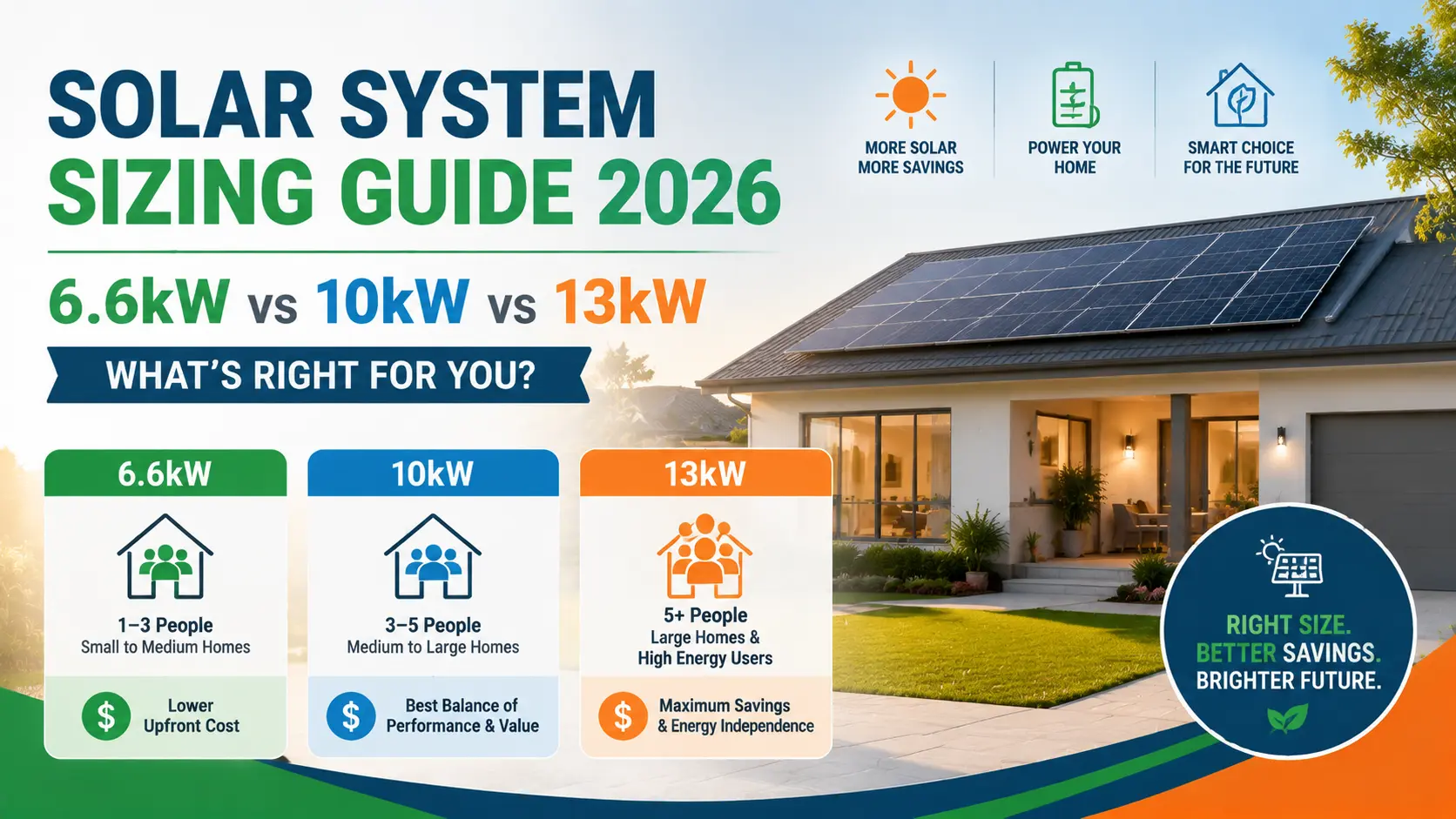
Choosing a solar system size is the single decision that determines everything else — your upfront cost, your daily savings, your payback period, and whether you’ll need to upgrade again in five years. Get it right, and you’ll cut your power bill by 70% or more. Get it wrong, and you’re either still paying big winter bills or you’ve paid for panels you’ll never use.
In 2026, three sizes dominate the Australian residential market: 6.6kW, 10kW, and 13kW (technically 13.3kW). This solar system sizing guide compares all three head-to-head — on cost, daily output, ideal household type, and long-term value — using a proper sizing formula and real 2026 figures, so you can walk into a quote with confidence instead of guesswork.
Solar System Sizing Guide: How to Work Out Your Solar System Size
Before comparing system sizes, work out roughly what you need. Installers use a simple formula:
System size (kW) = (Average daily usage in kWh × 1.25) ÷ Peak sun hours for your area
- Average daily usage — take your last 12 months of electricity bills (not just one quarter — usage can swing 30%+ between summer and winter) and divide total kWh by the number of days.
- × 1.25 — a buffer for system losses (wiring, inverter conversion, panel degradation, shading).
- Peak sun hours — the average hours per day your area gets sun intense enough to run panels at full rated output. This varies by state:
| City | Approx. peak sun hours/day |
|---|---|
| Perth, WA | 5.2–5.5 |
| Brisbane, QLD | 4.6–5.0 |
| Adelaide, SA | 4.5–4.8 |
| Canberra, ACT | 4.2–4.6 |
| Sydney, NSW | 3.9–4.5 |
| Melbourne, VIC | 3.6–4.2 |
Worked example: A Sydney household using 24kWh/day → (24 × 1.25) ÷ 4.2 ≈ 7.1kW minimum — meaning they’d comfortably round up to a 8kW or 10kW system, especially if a battery or EV is on the horizon.
Not sure of your daily usage? See our Solar System Prices guide.
6.6kW vs 10kW vs 13kW: Side-by-Side Comparison
This is the comparison the title promises — and the one no other 2026 guide gives you in one table.
| 6.6kW | 10kW | 13kW (13.3kW) | |
|---|---|---|---|
| Typical inverter size | 5kW | 8–10kW | 10kW (oversized ~33%) |
| Panels needed (440W) | ~15 panels | ~23 panels | ~30 panels |
| Approx. roof space | ~26 m² | ~39 m² | ~51 m² |
| Daily output (Sydney, north-facing) | 24–30 kWh | 36–45 kWh | 47–58 kWh |
| Best for | 2–4 person households, average usage (16–24 kWh/day) | 4–6 person households, homes with a pool, ducted A/C, or planning an EV/battery | Large households, homes running EVs + heat pumps + batteries, or export-friendly three-phase properties |
| Indicative cost (installed, 2026)* | $5,000–$6,500 | $7,500–$9,500 | $9,500–$13,000 |
| Typical payback period | 3–5 years | 4–6 years | 5–7 years |
| Single-phase export limit friendly? | Almost always | Usually, check your DNSP | Often export-limited on single-phase — see below |
*Indicative only — actual pricing depends on panel brand, inverter brand, roof complexity, and your state. Get an exact quote for your home →
Why 6.6kW solar system is still the default choice
A 6.6kW system (usually paired with a 5kW inverter) remains Australia’s most-installed residential size in 2026. It fits almost any roof, sits comfortably under most single-phase export limits, and suits the average 3–4 person household. If your daily usage sits under ~20kWh and you have no immediate plans for an EV or battery, this is usually the sweet spot for cost-per-kWh value.
Why 10kW solar system is the fastest-growing choice
Bigger households, homes with ducted air-con or a pool, and anyone planning a battery within the next few years are increasingly skipping straight to 10kW. The extra panel capacity means more midday surplus to either self-consume or store — which matters more than ever with feed-in tariffs continuing to shrink in 2026.
Why 13kW solar system makes sense for EV + battery households
If you already run (or plan to add) an EV charger, a heat pump hot water system, and a home battery, 13kW (13.3kW of panels on a 10kW inverter) gives you the generation headroom to actually keep those loads running from solar rather than the grid. It’s the size we most often pair with 10kWh+ batteries.
What Adding an EV, Heat Pump, or Battery Does to Your Solar System Sizing
Most households upgrade to solar thinking about today’s usage — then wish they’d sized up once they add:
- Electric vehicle: typically adds 8–10 kWh/day for an average commute — often enough on its own to push a 6.6kW household into 8.8kW–10kW territory
- Heat pump hot water: adds a smaller but steady 2–4 kWh/day
- Home battery: doesn’t add usage, but a bigger solar array gives a battery more midday surplus to store — a 10kW array paired with a 10kWh battery captures meaningfully more value than a 6.6kW array paired with the same battery, because there’s simply more excess solar to redirect into storage instead of exporting it at a low feed-in tariff
Rule of thumb: if you’re planning to add any of the above within 5 years, size up one tier now. Retrofitting extra panels later is possible but adds scaffolding, labour, and inverter-compatibility costs you avoid by oversizing upfront.
Battery Rebate Calculator → Calculate your battery rebate.
Understand Your State’s Export Limits Before You Size Up
Bigger isn’t always better if your Distribution Network Service Provider (DNSP) won’t let you export it. Every state sets its own single-phase export limit, which affects how much of a 10kW or 13kW system you can actually send back to the grid (self-consumption and battery charging aren’t affected — only exports).
| State/Territory | Common DNSP | Typical single-phase export limit |
|---|---|---|
| NSW | Ausgrid / Endeavour / Essential | 5–10 kW (varies by area) |
| VIC | Powercor / CitiPower / United / AusNet / Jemena | 5 kW (fixed, most areas) |
| QLD | Energex / Ergon | 5–10 kW (dynamic in some areas) |
| SA | SA Power Networks | Up to 10 kW (dynamic/flexible exports) |
| WA | Western Power / Horizon Power | 5 kW (typically) |
| ACT | Evoenergy | 5–10 kW |
Even if you’re export-limited, a bigger system usually still pays off — your inverter simply ramps down exports at the cap while self-consumption and battery charging continue unaffected, and export-limiting losses are smaller than most people expect. Three-phase power removes most of these caps entirely, which is worth discussing with your installer if you’re eyeing 10kW+.
A Simple Framework for Choosing Your Solar System Size
- Pull your last 12 months of bills and calculate your average daily kWh usage.
- Apply the formula: daily usage × 1.25 ÷ your area’s peak sun hours.
- Add future loads — EV (+8–10 kWh/day), heat pump (+2–4 kWh/day), or “size up one tier” if a battery is likely within 5 years.
- Check your DNSP’s export limit for your postcode and connection type (single- vs three-phase).
- Round to a standard size — 6.6kW, 8.8kW, 10kW, or 13.3kW are the most common, cost-efficient options installers stock.
Get a personalised sizing assessment → Get a Quote.
Conclusion
There’s no single “right” solar system size in 2026 — only the right size for your household, your roof, and your next five years. A 6.6kW system still suits most average households; 10kW is quickly becoming the practical choice for growing families and future EVs; and 13kW makes sense once you’re combining solar, batteries, and electric everything under one roof.
The fastest way to know for certain is a personalised assessment of your usage, roof, and local DNSP rules — not a generic formula.
Ready to find your ideal system size? Get a free, no-obligation quote from Aussie Solar Tech → Our SAA-accredited team will size your system against your actual bills, your roof, and your state’s export rules — not just a rule of thumb.
Frequently Asked Questions
Is a 6.6kW system still enough in 2026?
Yes, for most 2–4 person households using under 20kWh/day, a 6.6kW system remains a strong, cost-effective choice. If you’re planning an EV, heat pump, or battery in the next few years, it’s worth comparing against 8.8kW or 10kW instead.
How many solar panels do I need for a 10kW system?
With standard 440W panels, a 10kW system needs roughly 23 panels and about 39m² of roof space, though this varies slightly by panel wattage.
What’s the difference between a “10kW system” and a “10kW inverter”?
They’re not the same thing. Installers commonly “oversize” a system by fitting more panel capacity than the inverter’s rated output — for example, 13.3kW of panels on a 10kW inverter. Always confirm whether a quote refers to panel capacity or inverter size.
Should I size up if I plan to add a battery later?
Generally yes. A larger solar array produces more midday surplus for a future battery to store, improving the value of both investments compared to adding a battery to an undersized array later.
Does my roof orientation change what size I need?
Yes. East- or west-facing roofs produce roughly 15–20% less than north-facing roofs, so you may need to size up to hit the same daily output — or split panels across both roof faces to smooth generation across the day.
Will I be export-limited if I install a 13kW system?
Possibly, depending on your DNSP and whether you’re on single- or three-phase power. Export limits cap how much you can send to the grid, not how much you can self-consume or store in a battery — so oversizing can still be worthwhile even with a cap in place.
What’s the current federal battery rebate worth in 2026?
Under the 2026 Cheaper Home Batteries scheme, eligible battery installs attract a per-kWh federal discount, tapering above 14kWh usable capacity. Use our free calculator to estimate your discount.

Shah Tarek is a Solar Energy Consultant with 10 years experience in solar system design and solar consultancy field at Australia. He is now a Director, Operation & Consultancy Division at Aussie Solar Tech, a leading Australian solar retailer and installer. Here he is writing informative and engaging solar content that educates the community on the benefits of solar power. His work supports Aussie Solar Tech’s mission to promote sustainable energy solutions and foster a greener future for Australia.








Seraphim Solar Panels Review: Efficiency, Reliability, and Value Unveiled

Talesun Solar Panels: Honest Review Before You Buy

Sungrow Battery VS Tesla Powerwall : Which is Best in Australia?

Leapton Solar Panels Review: Affordable Energy Solution

REC Solar Panels Review: Outstanding Efficiency & Durability

Best Hybrid Inverters for Home Solar Systems in 2025

Best Solar Battery In Australia 2026 — Complete Guide

Sigenergy VS Fox ESS Battery: Which is The Best Choice for 2026

How Much Do Solar Panel Costs in Australia? (2026 Price Guide)

