
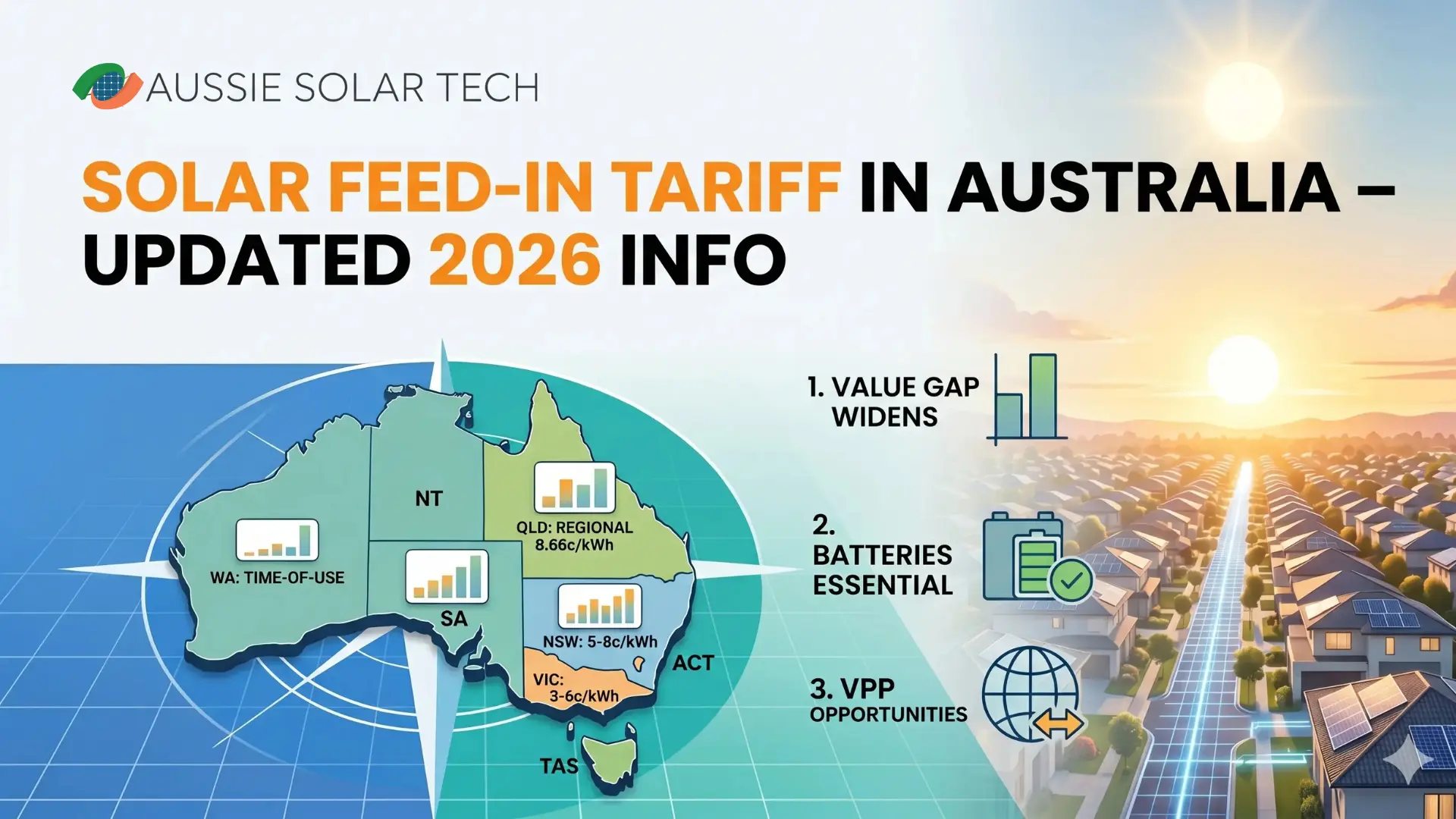
A solar feed in tariff is the credit you receive when excess electricity from your rooftop solar system is sent back to the grid. While feed-in tariffs are still available across Australia, the value of daytime solar exports has generally fallen as more rooftop solar enters the electricity network.
In 2026, solar feed-in tariff rates can vary widely depending on your state, electricity retailer, energy plan and the time you export power. Some plans offer a flat rate, while others use time-based rates or pay a higher rate only for a limited amount of daily exports.
For solar households, this means the highest advertised FiT is not always the best deal. Usage rates, supply charges, export limits and how much solar you use directly at home can all affect the final result.
This guide explains how feed-in tariffs work, how to check your rate and what has changed across Australia in 2026.
What is a Solar Feed-in Tariff?
Governments in different parts of Australia handle solar feed in tariffs differently. Solar feed in tariff is also called solar bonus or buy-back schemes. A solar feed in tariff (FiT) is a payment provided to solar system owners by power companies. The money is paid for surplus solar panel-generated electricity exported to the grid.It is measured in cents per kilowatt-hour (c/kWh), and it appears as a credit on electricity bills, offsetting the cost of grid power. FiT tariffs vary depending on state and retailer in Australia.
How Solar Feed-in Tariffs Work
Your solar panels first supply electricity to your home or business. When they generate more power than you are using, the surplus is exported to the grid and recorded by your electricity meter. Your retailer then applies the solar feed in tariff available under your plan.
Feed-in tariffs may be:
- Flat: The same rate applies throughout the day.
- Time-varying: The rate changes depending on when you export electricity.
- Stepped or capped: A higher rate applies only to a limited amount of exports before dropping to a lower rate.
Because buying electricity from the grid usually costs more than the amount paid for solar exports, using more of your solar directly can often deliver greater value than exporting it.
Solar Feed-in Tariff vs Solar Rebate
A solar feed in tariff and a solar rebate can both improve the financial value of a solar system, but they apply at different stages. A feed-in tariff provides ongoing bill credits for eligible excess solar electricity exported to the grid. The amount you receive depends on factors such as your retailer, electricity plan, location and export conditions.
A solar rebate, on the other hand, helps reduce the upfront cost of installing an eligible solar PV system. Under the federal Small-scale Renewable Energy Scheme, this support is delivered through Small-scale Technology Certificates (STCs) and is commonly passed on as an upfront discount.
In short, STCs can lower the initial cost of going solar, while feed-in tariffs provide ongoing value for the surplus solar energy you export.
👉🏻 Know about the Federal Government Solar Panel Rebate and Federal Government solar battery rebate
How Can I Find Out My Solar Feed-in Tariff Rate?
| Year | ACT | NSW | VIC | QLD (Regional) | SA | WA |
| 2020 | 6–10 | 6–7 | 10.2 (Min) | 44.0 | 7–10 | 7–10 |
| 2021 | 6–11 | 4–6 | 6.7 (Min) | 6.5 (Reg.) | 6–10 | 10p / 2.5op |
| 2022 | 6–11 | 6–10 | 5.2 (Min) | 9.3 (Reg.) | 9–13 | 10p / 2.5op |
| 2023 | 6–11 | 7.7–9.4 | 4.9 (Min) | 13.4 (Reg.) | 10–13 | 10p / 2.5op |
| 2024 | 6–12 | 4.9–6.3 | 3.3 (Min) | 12.3 (Reg.) | 5–12 | 10p / 2op |
| 2025 | 4–10 (Bench) | 4.8–7.3 (Bench) | 3.3 (Min) | 8.66 (Reg.) | 3–12 | 10p / 2op |
| 2026 | 4–8 (Market) | 4.8–7.3 (Bench) | 0–11 (Market) | 8.66(Fixed) | 3–12 (Market) | 10p / 2op |
Note: “p” = Peak (3pm-9pm); “op” = Off-peak. Rates are indicative averages for new customers; legacy premium rates (e.g., 44c) may still apply to a small number of early adopters until 2028-2031.
Key 2026 Observations
- VIC (The “Deregulated” Era): As of July 1, 2025, the Essential Services Commission (ESC) stopped setting a mandatory minimum. In 2026, retailers now set their own rates, with many offering 0.0c during the day (10am–2pm) while rewarding evening exports with up to 6.5c–10c (6.75 average).
- NSW (Benchmark Range): The independent regulator IPART has set a “fair value” benchmark for 2026 between 4.8 and 7.3 c/kWh. While retailers aren’t forced to meet this, most competitive flat-rate offers sit within this band.
- Regional QLD (Fixed Rate): Regional Queensland (Ergon) remains mostly regulated. For the 2025–26 financial year, the QCA set a flat rate of 8.66 c/kWh, down from the previous year due to falling daytime wholesale prices.
- WA (DEBS Scheme): The Distributed Energy Buyback Scheme continues to push for evening exports. In 2026, the standard remains 10c during peak hours (3pm–9pm) and a lower 2c base rate to encourage the use of batteries.
- South Australia (Market-Led): There is no government-mandated minimum FiT in SA. For 2026, retailers have largely shifted to a “solar sponge” model where export rates are extremely low (or 0 cents) between 10 am and 3 pm due to high solar penetration. Some retailers have also begun passing on an indirect “solar tax” via lower base FiTs to account for SA Power Networks’ midday export charges.
- ACT (Competitive Benchmarking): The ACT remains one of the most competitive markets for solar owners. While the government doesn’t set a hard minimum, the Independent Competition and Regulatory Commission’s (ICRC) retail electricity price calibration 2025-26 keeps retailer offers relatively high compared to the mainland.
Australian State-by-State Breakdown of Solar Feed-in Tariff Rates in May 2026
Here’s a simplified look at the solar feed-in tariff rates in each Australian state and territory as of May 2026:
ACT
The ACT continues to operate without a government-mandated minimum solar feed-in tariff (FiT). Rates are entirely market-driven, and individual electricity retailers set them.
Top Retailer Rates (May 2026)
The following are representative rates for the ACT. Note that many high-FiT plans now include “daily caps.” That means the premium rate only applies to a certain amount of export (e.g., the first 10 kWh/day). Afterward, they drop to a lower secondary rate (usually 3-5c/kWh).
Origin Energy: Up to 8c/kWh (typically 3c–8c range).
AGL (Solar Savers): 8c/kWh for the first 10kWh exported daily, then 4c/kWh thereafter.
ActewAGL: Approximately 4.4c – 4.5c/kWh.
Key Notes
Legacy Tariffs: Households that connected their systems before July 13, 2011, may still receive high premium rates of 30c–45c/kWh. These contracts were generally locked in for 20 years, meaning many will remain active until 2031 unless the system is upgraded or the contract is breached. For those of you who joined recently, you will be getting the new lower rates.
NSW
In NSW, the Independent Pricing and Regulatory Tribunal (IPART) sets voluntary benchmark ranges for solar feed-in tariffs (FiTs). While retailers are not required to follow them, they serve as a guide for what constitutes a “fair” rate based on wholesale electricity values.
2025–26 Benchmark Rates
All-day (Flat) FiT: 4.8 to 7.3 c/kWh.
Top Retailer Rates (Market Snapshot May 2026):
Origin Energy: Up to 12c/kWh on “Solar Partner Plus” plans, typically capped at a specific daily export limit (e.g., first 10–12kWh/day).
ENGIE: Offers rates up to 10–11c/kWh for the first 12kWh/day for eligible customers.
AGL: Offers 8c/kWh on “Solar Savers” for the first 10kWh exported daily.
Other Major Retailers: EnergyAustralia, Alinta Energy, and GloBird Energy offer maximum rates ranging from 5c to 10c/kWh, often with minimums starting at 0c/kWh on certain budget plans.
Export Charges (The “Sun Tax”):
From July 1, 2025, Ausgrid and other NSW networks implemented mandatory two-way tariffs for export-ready customers.
Charge: Approximately 1.23c/kWh for exports during peak solar hours (typically 10 am – 3 pm).
Reward: Credits of approximately 3.85c/kWh for exports during evening peak periods (typically 4 pm – 9 pm).
Impact: For a typical 5kW solar system, the net annual impact is estimated at an increase of $6.60, assuming the retailer passes these charges through.
Key Notes
No Mandated Minimum: NSW has no legally mandated minimum FiT; retailers can offer 0c/kWh if they choose.
Legacy Tariffs: The 60c/kWh and 20c/kWh “Solar Bonus Scheme” payments ended in December 2016. No legacy tariffs of 30–45c/kWh remain active for new or existing residents; all current customers are on market-based rates.
Victoria
Victoria’s solar feed-in tariff landscape saw a significant change on July 1, 2025. It was the result of the legislative amendment to the Electricity Industry Act 2000. According to it, the Essential Services Commission (ESC) no longer sets mandatory minimum feed-in tariffs.
Well, the ESC’s final pre-deregulation decision had already set a near-zero minimum flat rate of 0.04c/kWh. Luckily, the market has since stabilized. As of May 2026, the average retailer flat rate in Victoria is approximately 1-4 c/kWh. There are some competitive offers reaching as high as 8c–11c/kWh for initial export caps.
Current Market Rates (May 2026)
Average Flat Rate: 1-4 c/kWh (ranges from as low as 0-0.04c to premium 11c depending on the provider and export limits).
Time-varying Rates: Retailers now set these independently. Typical market ranges see peak rates around 6.5c/kWh and daytime “solar sponge” rates at 0c/kWh.
Post-July 2025 Regulation
Retailers can legally set their own rates. However, they must not fall below 0c/kWh since negative feed-in tariffs still remain prohibited. Many retailers offer credits to remain competitive.
Key Notes: There was a Premium Feed-in Tariff (PFiT) scheme for VIC. It had provided early adopters with 60c/kWh. However, this scheme officially expired on November 1, 2024. So, all former PFiT customers are now on standard market rates like everybody else.
Queensland
Queensland does not mandate a minimum solar feed-in tariff. However, in Ergon Energy’s serviced regional areas, the rate is fixed at 8.66c/kWh for the 2025-26 financial year. There have been proposals for a further reduction in a draft determination by the Queensland Competition Authority (QCA), where they lowered it to 6.153c/kWh for the upcoming 2026-27 period.
Top Retailer Rates:
- Origin Energy (Solar Boost): Offers a tiered rate. They typically provide a higher rate of 10c/kWh to 12c/kWh for an initial daily limit (often the first 8kWh to 14kWh). After that, the rate drops to a standard 5c/kWh.
- Other Retailers: In South East Queensland, rates generally range from 3c to 10c/kWh. Competitive offers from retailers like ENGIE and AGL can reach up to 10-12c/kWh, often with specific conditions or daily export caps.
Key Notes:
- Solar Bonus Scheme: Homeowners who started under the 44c/kWh scheme (pre-July 2012) will keep enjoying the premium rates until it permanently expires on July 1, 2028. However, this number is relatively small since for most participants the scheme ended in 2018.
- Regional Rates: Queenslanders had previously enjoyed higher rates, but since daytime wholesale energy costs are falling, the current QCA determinations reflect a downward trend.
South Australia
South Australia continues to have no fixed minimum solar feed-in tariff. Retailers are free to set their own rates. However, these rates are now significantly influenced by the “solar sponge” window. It is the time of the day (10am-4pm) when the grid is overwhelmed by excess solar energy since there are so many rooftop solar panels being exported in Australia these days.
Top Retailer Rates:
ENGIE: Offers approximately 8c/kWh to 10c/kWh (capped at the first 8kWh/day), with rates dropping to as low as 1c/kWh thereafter.
EnergyAustralia (Solar Max): Offers 7.5c/kWh to 8c/kWh for the first 10kWh/day (averaged over a billing period). For excess exports, they offer a standard rate of roughly 3c/kWh–4c/kWh for excess exports.
Amber Electric: Uses a real-time wholesale model where the FiT can vary from negative (you pay to export due to solar tax) to over 20c/kWh during peak demand.
Key Updates:
Legacy FiT: Customers on the pre-2011 scheme continue to receive 44c/kWh until June 30, 2028.
Export Charges (The “Solar Tax”): The “solar tax”is active now. Homes with smart meters have to pay 1c/kWh when they export more than 9kWh/day during the “solar sponge” window (10 am – 4 pm).
Flexible Exports: Most new solar systems must have “flexible export” capabilities. It allows the network to remotely reduce exports when the grid is overwhelmed with solar power.
Western Australia
Western Australia continues to use the Distributed Energy Buyback Scheme (DEBS). This scheme prioritizes afternoon and evening exports. WA has some of the lowest daytime rates in Australia since retailers don’t have a lot of competition.
Synergy (Perth & SW WA):
Peak (3pm–9pm): 10c/kWh
Off-Peak (9pm–3pm): 2c/kWh (Note: This decreased from 3c to 2c in mid-2025).
Horizon Power (Regional WA):Typically follows the DEBS model (10c Peak / 3c Off-Peak).
Note: The legacy 60c/kWh for premium rates ended in 2020-2021. Customers on that plan were moved to the Renewable Energy Buyback Scheme (REBS), which offered 7c/kWh. This still remains available only to original participants who joined the premium scheme before July 2011. However,if you upgrade your system or shift house, you lose this rate and move to DEBS
Tasmania
As of May 2026, Tasmania has regulated the solar feed-in tariff (FiT) rate, unlike many other states. The solar market here is comparatively new and offers much better FiTs to incentivize homeowners to make the switch. The Office of the Tasmanian Economic Regulator sets a mandated minimum rate. Retailers must pay this to eligible customers for excess solar power.
- Regulated Minimum Rate: 8.782 c/kWh (Valid until June 30, 2026).
- Typical Market Rates: Most retailers, including Aurora Energy and 1st Energy, align closely with this mandated minimum, generally offering 8.7c to 8.9c/kWh.
- Key Regulation: Tasmanian retailers must not offer a rate lower than the regulated minimum. Otherwise, they would not qualify for small-scale systems.
Northern Territory
There isn’t a lot of retailer choice in NT, and Jacana Energy is essentially the main provider. The Northern Territory’s solar feed-in tariff (FiT) landscape changed on July 1, 2025, when Jacana Energy introduced the dual rate system for its customers. As of May 2026, the updated tariffs are
Anytime FiT (Standard Rate): 9.33c/kWh. This is the base rate for exports outside of peak windows.
Super FiT (Peak Rate): 18.66c/kWh. This higher rate applies to electricity exported between 3 pm and 9 pm daily to encourage supply during high-demand periods.
Key Updates for 2026:
The legacy Premium FiT (26.65c/kWh) has effectively ended for most users. Eligible customers were transitioned to the standard rates after four years of participation, with the final transitions to be completed by July 2026.
Updated Retailer Offers (May 2026)
Retailers try to offer the best rates to stay in competition. However, as FiT rates drop overall in Australia, the retailers reflect that in their prices too. These days, they continue to shift toward “capped” higher rates and market-based pricing. Take your time to compare various retailers to find the best deal.
- AGL: Offers remain around 8 c/kWh (e.g., on the Solar Savers plan), typically capped at the first 10 kWh of daily export. For exports beyond this, the rate often drops to 4 c/kWh.
- Origin Energy: Rates vary by state, with premium plans like Solar Boost offering up to 10–12 c/kWh. However, standard market rates can be as low as 1–3 c/kWh in states like Victoria.
- EnergyAustralia: Continues to offer competitive rates up to 8–12 c/kWh on specific solar-focused plans, though minimum rates on standard plans have dropped to roughly 1.5 c/kWh in some regions.
- Red Energy: Provides competitive time-varying or flat rates, with some plans reaching over 10 c/kWh in specific regions, though minimums can be as low as 1–2.1 c/kWh.
- Sumo & Others: In some regions, other retailers like Flow Power or ENGIE have emerged with higher headline rates (up to 11–15 c/kWh) to attract solar customers.
Government Solar Policies, Feed-in Tariffs and Export Charges
Government solar policies are gradually changing the way rooftop solar is rewarded. Instead of relying only on high flat feed-in tariffs, some states and electricity networks are placing more value on when solar electricity is exported.
For example, NSW uses voluntary IPART benchmarks rather than a mandatory minimum tariff. For 2026–27, the all-day benchmark is 3.4–6.5c/kWh, while time-of-day benchmarks place more value on some evening exports than on midday exports.
Other jurisdictions take different approaches. Victoria gives retailers greater flexibility when setting feed-in tariffs, Regional Queensland has a regulated 6.006c/kWh rate for 2026–27, and Tasmania has a regulated minimum of 9.276c/kWh. Western Australia’s DEBS scheme pays more for exports between 3pm and 9pm than during the rest of the day.
Export charges are also becoming part of solar pricing in some electricity networks. These are different from feed-in tariffs: a FiT is the credit paid for exported electricity, while network export pricing can charge or reward exports depending on when and how much electricity is sent to the grid.
The practical takeaway is simple: the value of rooftop solar increasingly depends on when you use and export electricity, not just the headline feed-in tariff.
Is a Higher Solar Feed-in Tariff Always Better?
Not necessarily. A retailer may advertise a high FiT but pair it with higher electricity usage rates, a higher daily supply charge or a limit on how much solar receives the premium rate. For example, a premium tariff might apply only to the first few kilowatt-hours exported each day. Any additional export could receive a much lower rate.
When comparing electricity plans, check:
- the feed-in tariff
- daily premium export limits
- the rate after the export limit
- electricity usage charges
- daily supply charges
- time-of-use periods
- any export conditions or charges.
This matters because the electricity you buy from the grid generally costs much more than the amount you receive for exporting solar. IPART also advises NSW customers to compare the whole energy plan, rather than choosing a retailer solely because it advertises a higher FiT.
How to Get More Value From Your Solar in 2026
Increase Solar Self-Consumption: Run flexible appliances such as washing machines, pool pumps or EV chargers during solar hours. Using your own solar can often save more than exporting it at a low FiT.
Compare the Whole Electricity Plan: Check usage rates, supply charges and export conditions alongside the FiT. A lower feed-in tariff can still be better if the overall plan costs less.
Consider Export Timing: Time-based tariffs can reward exports later in the day. For example, Synergy’s WA DEBS rate is 10c/kWh from 3pm–9pm and 2c/kWh at other times.
Consider Battery Storage: A battery can store excess daytime solar for later use, but a low FiT alone does not make battery storage worthwhile. Consider your energy use, tariffs, battery size and installation cost before deciding.
Conclusion
Solar feed-in tariffs in Australia are changing, but rooftop solar can still deliver strong value when it is used wisely. The best results now come from combining a suitable electricity plan with higher self-consumption, smart export timing and, where appropriate, battery storage.
If you are planning a new solar system or considering a battery, Aussie Solar Tech can help you compare your options and choose a setup that suits your energy use.
Contact Aussie Solar Tech for a free, no-obligation consultation.
Frequently Asked Questions (FAQs)
What is a solar feed-in tariff?
It’s the money electricity retailers pay you for extra solar power your panels send back to the grid. It’s usually shown in cents per kilowatt-hour (c/kWh) on your bill and helps offset your electricity costs.
Why are feed-in tariffs dropping?
Tariffs are falling because more people are using solar, which lowers daytime wholesale electricity prices. Also, governments now want to encourage people to use their own solar power and batteries rather than sending excess power to the grid.
Are high feed-in tariffs still around?
Some old schemes (like Queensland’s 44c/kWh and Victoria’s 60c/kWh until 2024) still give high rates to early adopters. But for new systems, rates are generally lower (0.04–12c/kWh).
How can I get the best feed-in tariff?
Use comparison websites like Solar Choice or WATTever to find retailers with good rates. Look for a plan with high FiTs, low usage charges, and no export limits.
Will export charges affect my savings?
In NSW, export charges could slightly reduce your savings, but you can still save money overall. Keep an eye on your plan’s details.

Shah Tarek is a Solar Energy Consultant with 10 years experience in solar system design and solar consultancy field at Australia. He is now a Director, Operation & Consultancy Division at Aussie Solar Tech, a leading Australian solar retailer and installer. Here he is writing informative and engaging solar content that educates the community on the benefits of solar power. His work supports Aussie Solar Tech’s mission to promote sustainable energy solutions and foster a greener future for Australia.





Seraphim Solar Panels Review: Efficiency, Reliability, and Value Unveiled

Talesun Solar Panels: Honest Review Before You Buy

Sungrow Battery VS Tesla Powerwall : Which is Best in Australia?

Leapton Solar Panels Review: Affordable Energy Solution

REC Solar Panels Review: Outstanding Efficiency & Durability

Best Hybrid Inverters for Home Solar Systems in 2025

Best Solar Battery In Australia 2026 — Complete Guide

Sigenergy VS Fox ESS Battery: Which is The Best Choice for 2026

How Much Do Solar Panel Costs in Australia? (2026 Price Guide)

