
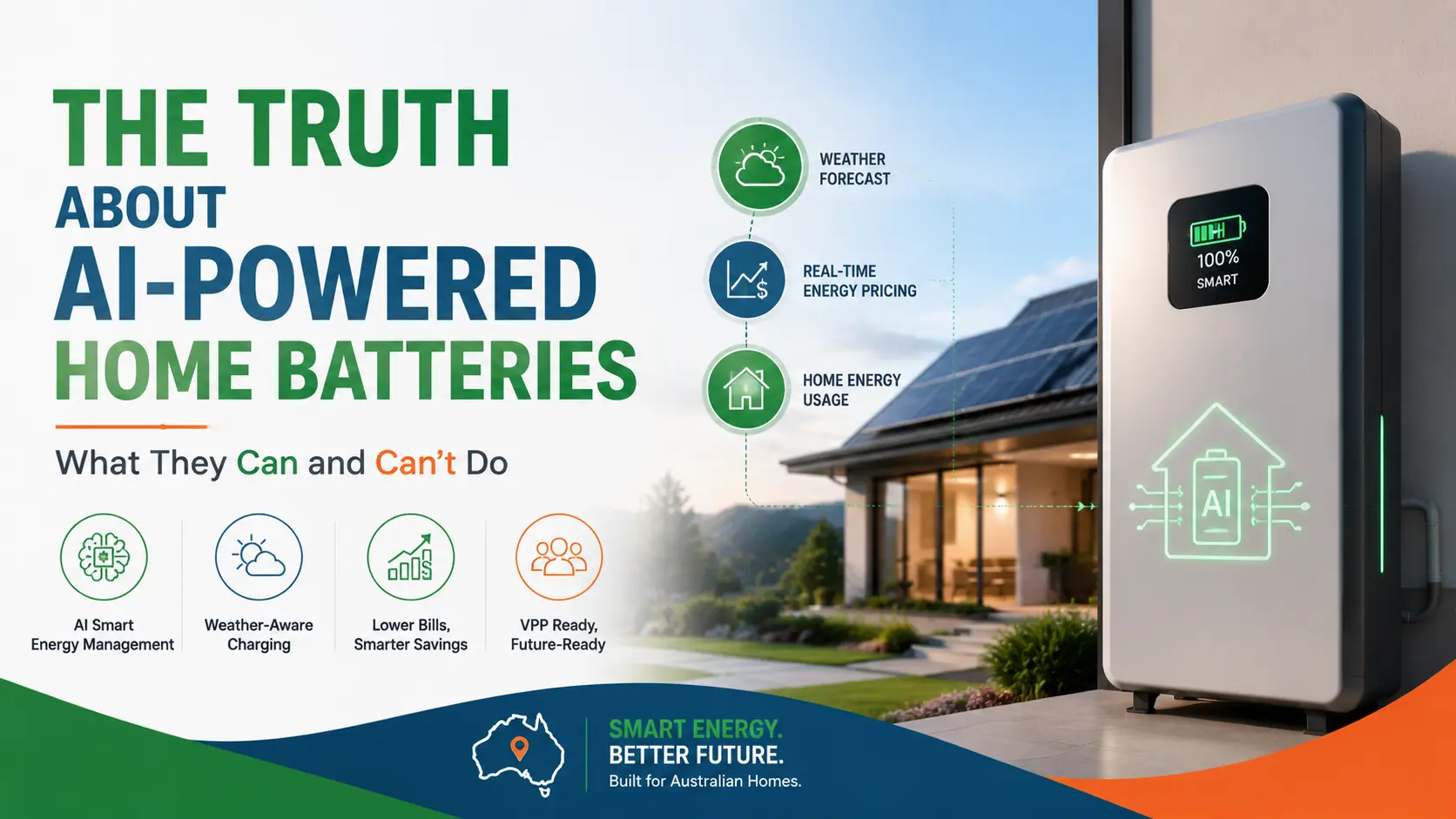
When most people hear AI, they think of tools like ChatGPT. That’s why many Australians assume an AI-powered home battery can chat with them or perform household tasks. In reality, these systems are designed for something far more practical—they intelligently manage your home’s energy to maximise savings and efficiency.
An AI-powered home battery continuously analyses weather forecasts, electricity prices, household energy usage, and grid conditions to make smart, real-time decisions. It can automatically optimise when your battery charges and discharges, take advantage of multi-tariff energy arbitrage, participate in Virtual Power Plants (VPPs), and schedule high-energy appliances to run when electricity is cheapest or when excess solar power is available.
The following guide explains what AI-powered home batteries can—and can’t—do, helping you set realistic expectations and choose a system that delivers the best value for your home.
How Does an AI-Powered Home Battery Work?
An AI-powered home battery contains a cloud-linked computer processor that is highly specialized. It consistently monitors, logs, and analyses how your house consumes energy.
It knows when you wake up or use a high-draw appliance like a kettle or oven. This helps the battery to construct a unique mathematical model of your home’s daily behavior. It’s the machine learning part of the battery’s AI.
Another part of the AI is predictive modeling. The battery doesn’t blindly react to the existing conditions. It is always asking how it can allocate energy in the next 24 hours to ensure the lowest bills and maximum safety. To answer that, it uses weather models and real-time electricity grid pricing.
The battery will use these inputs to execute split-second decisions. For example, it adjusts inverter outputs, throttles EV chargers, or isolates circuits based on live voltage and frequency fluctuations.
AI-Powered Weather-Aware Charging
An AI-powered battery can process real-time external variables like weather with predictive algorithms. It monitors live weather data from the Bureau of Meteorology and cross-checks it with the home’s electricity usage habits.
Suppose the forecast says there will be a heavily overcast afternoon. This tells the battery the solar generation on that day will be low. So, it won’t completely discharge in the morning and reserves the power to save you from costly evening rates. It might also charge from the grid during the cheapest overnight off-peak hours to have better reserve.
An example of this can be the single-phase EcoFlow PowerOcean. The battery’s AI continuously analyzes local weather feeds. This allows it to predict generation dips and intelligently alter its discharge schedule. As a result, you never have to pull expensive “peak” power from the grid during unexpected cloudy periods.
Participate In SSO Plans With AI-Powered Home Batteries
An AI-powered battery constantly cross-references fluctuating grid rules, export limits, and specialized plans like the Solar Sharer Offer.
On an SSO plan, electricity is completely free during the midday window. The rates outside this window are significantly elevated to compensate. An AI battery recognizes this window. It will instantly command the battery to fast-charge directly from the grid at maximum speed. That way, the battery can store up to 24 kWh of zero-cost grid power.The battery’s AI also continuously monitors your local grid’s voltage and export allowances.
If the grid hits an export limit, the system takes immediate action. It automatically redirects your excess solar energy into thermal storage, such as a hot water heat pump. Alternatively, it intelligently throttles your EV charging. These steps ensure that not a single watt of your solar generation goes to waste.
AI Automated Appliance Orchestration
Your home imports expensive energy from the grid when heavy appliances activate during minor dips in solar generation. When there is no intelligent management, these sudden power demands can bypass your battery’s efficiency. This ends up adding to your electric bills during peak tariff periods.
AI-powered batteries solve this problem through a process called automated appliance orchestration. The battery analyzes your household’s usage patterns. The system would then proactively coordinate your high-draw appliances to ensure they operate in perfect sync with your solar production.
This process ensures your home’s heaviest energy users only activate when surplus solar power is available. Thus, prevents unnecessary grid imports. An excellent example of this is the Enphase IQ.The battery’s Energy Management platform integrates directly with Enphase IQ batteries. It also works with smart EV chargers and electric water heaters. The system continuously forecasts your solar production and energy consumption in real-time. It then automatically triggers your heat pump or EV charger to run precisely when solar energy is abundant.
VPP Participation With AI-Powered Home Batteries
Virtual Power Plants (VPPs) connect thousands of home batteries to support the electricity grid. When these batteries are linked up, they act like a single, large power station that provides energy during times of high demand. VPP participation allows homeowners to earn bill credits, rebates, or higher feed-in tariffs.
AI-powered batteries can ease the complex manual effort of VPP participation. Take the example of how the Tesla Powerwall 3 uses its native AI, Opticaster, to handle this process.
Opticaster continuously analyzes your energy usage, local solar generation, and real-time utility pricing. When grid prices spike or a VPP event is signaled, the AI automatically adjusts your battery’s dispatch schedule to maximize financial returns.
This process effectively puts financial arbitrage on autopilot. By charging the battery when electricity is cheap and exporting or using stored energy when prices are high, the system lowers your overall bills. It manages these complex rate structures entirely in the background, requiring no daily manual input.
AI-Driven Thermal Safety & Smart Battery Management
Australia’s harsh climate is a major challenge for home batteries. Summer temperatures often exceed 40°C in cities like Adelaide or Sydney. These extreme conditions can accelerate “thermal degradation,” where high heat slowly damages the battery’s internal chemistry. A smart Battery Management System (BMS) is vital to preventing this damage and keeping your home safe.
For instance, Sigenergy’s SigenStor uses a sophisticated, AI-driven controller to manage these risks. While the system is a powerful, high-voltage design (up to 900V), it uses its “brain” to monitor heat in real-time. On a scorching day, the AI automatically manages thermal cooling. It also throttles fast-charging speeds to reduce stress on the cells.
This proactive approach significantly extends the battery’s lifespan. By ensuring the lithium iron phosphate (LFP) cells stay within safe temperature limits, the system protects your investment and maintains high performance for years. These intelligent safety features are why the SigenStor supports a long design life of up to 10,000 cycles.
The Lies About AI-Powered Home Batteries
Anything with the word AI sells well in 2026. So, “AI” has also become a popular marketing buzzword in the solar home battery industry. Retailers aggressively hype “smart” features to unsuspecting buyers. However, understanding the difference between genuine innovation and marketing noise is vital.
Common Misconceptions about AI- Powered Home Batteries
“The AI runs entirely locally and doesn’t need an internet connection.”
Many buyers believe their battery acts as an independent “brain” in the garage. They assume it will keep optimizing energy regardless of home connectivity.
The reality is that most optimization engines rely on cloud-based computing to run complex algorithms. Your battery acts as an “edge” device, sending data to the cloud for processing and receiving commands back. If your Wi-Fi fails, the system typically defaults to basic, timer-based rules until the connection returns.
“AI optimization is plug-and-play and works perfectly from Day 1.”
Expectations are often high that a new battery will immediately slash power bills to the absolute minimum upon installation.
In truth, machine learning requires a “training phase” to understand your household’s unique habits. For the first 2 to 4 weeks, the system logs your consumption patterns while running on generic, factory-set profiles. Predicting peak savings in the first month is rarely realistic, as the software needs data to improve.
“AI will automatically double my battery’s physical lifespan.”
Some buyers assume “AI-driven cell preservation” magically overrides the physical degradation limits of battery chemistry.
While a smart Battery Management System (BMS) protects cells from extreme temperatures and voltage imbalances, physics remains the final authority. Frequent deep discharges and high heat will still cause natural wear over time. AI can reduce unnecessary stress, but it cannot fundamentally alter the battery’s rated lifespan.
Reality Check: Marketing Claims vs. Technical Truth
| What the Brochure Claims | The Real Technical Truth |
| “100% Autonomous AI Bill-Killing Technology” | Requires continuous internet connectivity. Cloud server outages instantly turn it into a basic, non-AI battery. |
| “AI Self-Learning from Day One” | Often just basic rules-based “if-then” logic rebranded as AI. True machine learning requires a 2–4 week data-learning period. |
| “Unlimited VPP Profits via Smart Trading” | Extreme cycling can compromise long-term battery longevity and occasionally override your personal emergency backup reserves. |
Misleading Marketing Tactics
Rebranding “Basic Rules” as “Advanced AI”
A common trick is labeling standard, decades-old solar logic as “AI.” If a system simply follows a hardcoded “if-then” command—such as charging when solar generation exceeds demand—it is not AI. True AI requires dynamic adaptation to changing variables like weather or real-time pricing without human intervention.
The “Guaranteed VPP Earnings” Trap
Some retailers promote “AI-optimized VPP trading” with inflated promises of passive income. They often fail to mention that to generate those returns, the VPP may cycle your battery aggressively, which can accelerate wear. Additionally, some “smart” systems may prioritize grid trading over your home’s backup security during outages.
Closed-Ecosystem Lock-in
Manufacturers often market “AI orchestration” as a standout feature while hiding that it only works with their proprietary devices. You may find that the battery’s intelligence is “locked out” unless you purchase that specific brand’s smart EV charger, water heater, and energy meters, rendering the software ineffective for third-party appliances.
An Overview Of Top AI-Powered Home Batteries In Australia
| Battery Model | Usable Capacity | Est. Installed Price (Post-Rebate) | AI / Energy Management Platform | Ecosystem & Compatibility | Best Suited For | One Common Problem |
| Tesla Powerwall 3 | 13.5 kWh | $13,500 – $16,500 | Opticaster | Works best with Tesla | Premium, high-load homes needing simple backup. | Single-phase backup only; very heavy to install. |
| Sigenergy SigenStor | 5 – 48 kWh | $12,000 – $15,000 | SigenAgent | “5-in-1” hub; best with their branded chargers/meters. | Smart homes needing 3-phase power & modularity. | Newer brand; less “legacy” history than others. |
| Enphase IQ Battery 5P | 5 – 20 kWh | $8,500 – $10,000 | IQ Energy Management | Needs Enphase microinverters for full functionality. | Retrofitting homes with existing Enphase solar. | Small 5 kWh modules; needs multiple units for large homes. |
| EcoFlow PowerOcean | 5 – 45 kWh | $9,000 – $14,000 | Intelligent Mode | Designed for EcoFlow smart devices (EV chargers/meters). | Budget-conscious households wanting modularity. | Features often locked behind proprietary ecosystem apps. |
Final Words
AI-powered batteries represent the future of energy management in Australian homes. These intelligent systems automate your participation in VPPs and navigate complex tariffs, effectively removing your daily mental load. By relying on predictive algorithms, your home grid stays optimized for both efficiency and profit. Contact the Aussie Solar Tech team if you need to know more.
FAQs
Do I need internet for an AI battery to work?
Not for the battery but for the AI. The battery will still safely store solar power and discharge it to your home offline. However, the advanced “AI” features—like weather-aware predictive charging and automated tariff optimization—will temporarily freeze, causing the system to fall back to standard, non-intelligent timing rules until the connection is restored.
Can an AI battery damage itself by charging too often?
No. Modern AI engines operate within strict limits set by the battery’s local Management System (BMS). Even during volatile wholesale pricing cycles or rapid grid-charging windows like the Solar Sharer Offer, the AI dynamically monitors cell temperatures and voltage balance to prevent rapid degradation and safeguard your warranty.
How does the AI know my personal household routine?
The system utilizes continuous time-series machine learning. It monitors and logs your home’s total electricity consumption at the switchboard every second. Over a two-to-four-week training phase, the algorithm maps out when you typically use heavy appliances, constructing a unique predictive schedule of your weekly energy behavior.
Will the AI override my storm backup preferences?
No. In premium systems, your manual emergency backup reserve is treated as a hard safety threshold. For instance, if you set a 30% minimum reserve, the AI trading algorithms will only utilize the upper 70% of the battery’s capacity, ensuring you are never left vulnerable during a blackout.

Shah Tarek is a Solar Energy Consultant with 10 years experience in solar system design and solar consultancy field at Australia. He is now a Director, Operation & Consultancy Division at Aussie Solar Tech, a leading Australian solar retailer and installer. Here he is writing informative and engaging solar content that educates the community on the benefits of solar power. His work supports Aussie Solar Tech’s mission to promote sustainable energy solutions and foster a greener future for Australia.



Seraphim Solar Panels Review: Efficiency, Reliability, and Value Unveiled

Talesun Solar Panels: Honest Review Before You Buy

Sungrow Battery VS Tesla Powerwall : Which is Best in Australia?

Leapton Solar Panels Review: Affordable Energy Solution

REC Solar Panels Review: Outstanding Efficiency & Durability

Best Hybrid Inverters for Home Solar Systems in 2025
Best Solar Battery In Australia 2026 — Complete Guide

Sigenergy VS Fox ESS Battery: Which is The Best Choice for 2026

How Much Do Solar Panel Costs in Australia? (2026 Price Guide)

