
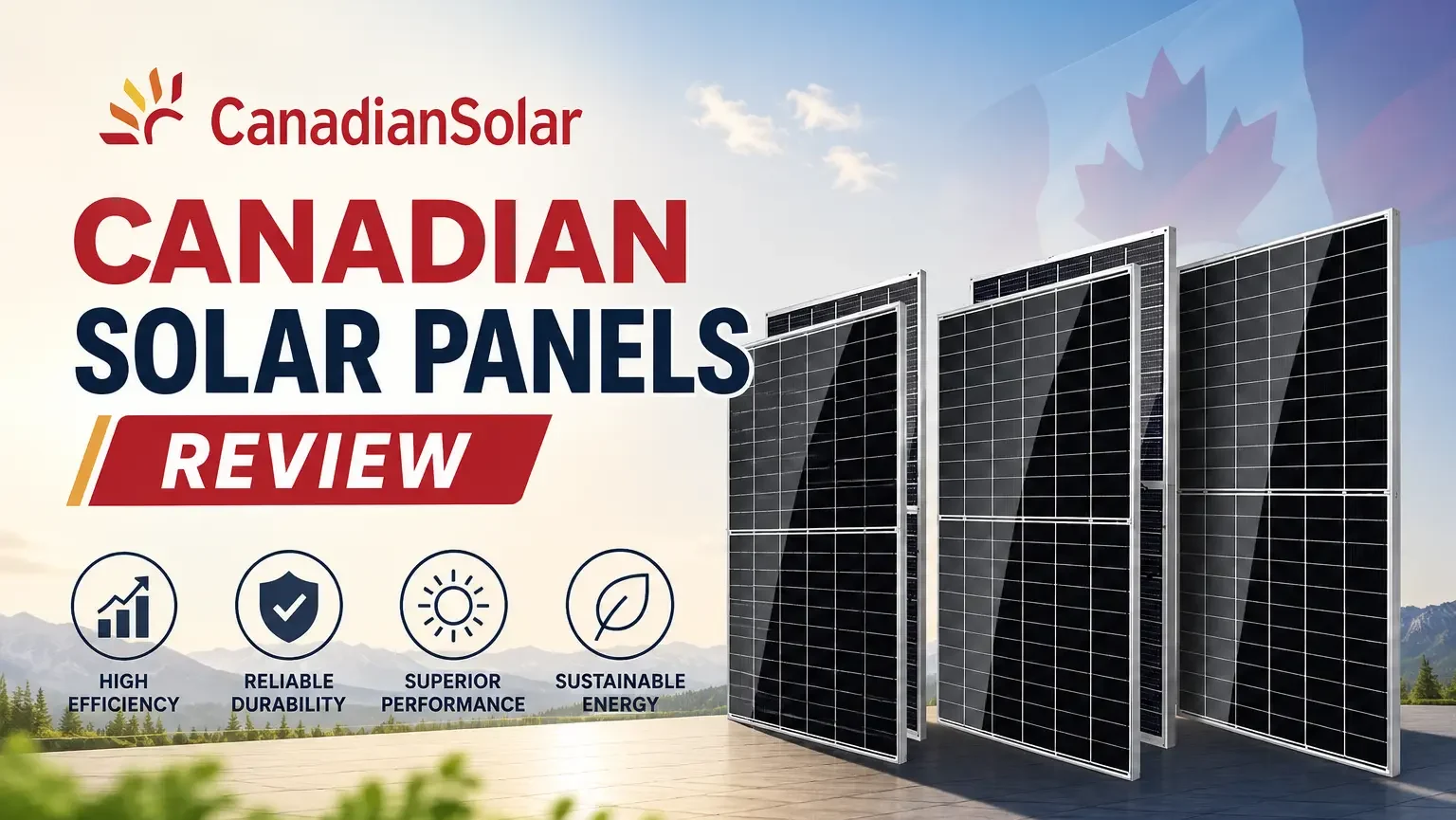
If you walk down a suburban Australian neighborhood, one out of every three houses you might notice has a solar panel on the roof. Among the many types of solar panels, a sleek, dark, all-black panel often catches the eye as it complements the home’s architecture instead of sticking out like an eyesore. Those are Canadian solar panels- one of Australia’s most widely installed solar brands.
Canadian solar panels offer high-performing panels at a comfortable price range. The most expensive and latest panels of the brand barely cross 200 AUD per panel. Meanwhile, Canadian Solar has a long list of older and cheaper panels at prices sometimes as low as 100 AUD per panel, depending on the retailer and how many you buy at once.
The brands’ residential N-type TOPCon panels have an impressive 23.8% efficiency and 470-475 W output on an average day. In lab conditions, the performance is even higher at 24.3% and 485W, although this is almost impossible to deliver in a real-world scenario due to heat and shadows.
If you are planning to install rooftop panels, Canadian Solar is worth considering. The following Canadian Solar panel review is based on the Aussie solar tech team’s field experience with the brand. It might help you reach a decision.
A Brief History of Canadian Solar
An actual scientist founded Canadian Solar Panel. Dr. Shawn Qu was a metallurgist and materials scientist who got his PhD from the University of Toronto. He founded the company in 2001 in Ontario, Canada. At first, they made small-scale solar apps. Their breakthrough was a solar car battery charger for Volkswagen. The founder’s scientific background has made the company especially dedicated to research and development. There are 2,200 global patents in its name. This consistent scientific research helped them design their proprietary large-area N-type Solar cell in 2020, which achieved a record 23.8% efficiency. Canadian solar panels have routinely survived Kiwa PVEL’s intense stress testing, which established their competency in Australian weather. The tier one brand responds to the solar demands of 20 countries around the globe. In Australia, they have a corporate head office on Collins Street in Melbourne. This further establishes the brand’s trustworthiness in the current Australian scenario, where many new imported brands don’t have an office in the country, resulting in weak warranty and local support. Canadian Solar builds a wide range of solar panels for various user categories with different cell technologies. Here is an overview of all the panels this brand has to offer-
Overview of All Canadian Solar Panels
| TOPCon Gen2 210 (CS7N-TB-AG Series) | Next-Gen N-Type TOPCon | Latest Platform | Utility Scale | • Massive 210mm large wafers. • High power up to 725W. • Lowest possible LCOE achieved. • Aggressive, high-heat solar farms. • Maximized utility-scale return. |
| TOPBiHiKu7 (CS7N / CS7L Square Platform) | First-Gen N-Type TOPCon | Active / Mainstream | Utility Scale | • Heavy-duty bifacial layout. • Durable glass-on-glass structure. • Wide 1303mm structural footprint. • Tailored for tracking racks. • Nextracker and Array compatible. |
| TOPCon Gen2 182 Pro (CS6.2-66TB Series) | Next-Gen N-Type TOPCon | Latest Platform | Utility Scale & Commercial | • Rectangular 182 x 210 mm wafers. • Matches shipping container footprints. • Maximizes international cargo density. • Highly optimized logistics footprint. • Efficient large-scale transit deployment. |
| 182 Pro TOP(Bi)HiKu6 (CS6.2-66TB / 66TM / 54TM Series) | Next-Gen N-Type TOPCon | Latest Platform | Commercial & Industrial (C&I) | • Flagship industrial-grade choice. • Rectangular 182 Pro tech. • Reduces roof racking footings. • Trims structural hardware needs. • Lowers system installation labor. |
| 182 Pro TOPHiKu6 Residential (CS6.2-48TD / 48TM) | Next-Gen N-Type TOPCon | Latest Platform | Residential | • Compact residential design layout. • Low-weight dual-glass form factor. • High-density rectangular cell layout. • Maximizes small-roof wattage output. • Optimized for pitched roofs. |
| All-Black 182 Pro (CS6.2-48TD All-Black) | Next-Gen N-Type TOPCon | Latest Platform | Residential | • Highly aesthetic design. • Uniform black anodized frames. • Matching black backing sheets. • Seamlessly blends with architecture. • Top-selling Australian residential panel. |
| Specialized Series Mods (Anti-Dust / Anti-Hail variants) | Next-Gen N-Type TOPCon | Latest Platform | Commercial & Utility Scale | • Niche hardware structural alterations. • Modifies standard 182 Pro. • Frameless bottom-lip dust clearing. • Thickened glass impacts shield. • Absorbs 55mm hail strikes. |
| TOPBiHiKu6 (CS6W-TB-AG Series) | First-Gen N-Type TOPCon | Active / Mainstream | Commercial & Utility Scale | • Baseline bifacial industry standard. • Square 182mm cell setup. • Highly reliable asset builder. • Fixed-tilt commercial racking setups. • Proven long-term tracking record. |
| TOPHiKu6 Monofacial (CS6W-T Series) | First-Gen N-Type TOPCon | Active / Mainstream | Commercial & Industrial (C&I) | • Single-sided glass setup profile. • Conventional white backsheet layer. • Flat commercial metal roofs. • Non-existent backside light reflection. • High cost-to-performance ratio. |
| TOPHiKu6 Compact (CS6R-T Series) | First-Gen N-Type TOPCon | Active / Mainstream | Residential | • First-generation residential N-type. • Square 182mm cell layout. • Low short-circuit current configuration. • Prevents residential inverter clipping. • Easy home microinverter integration. |
| HJT Low Carbon Module / HiHero (CS6.2-66HB Series) | Advanced Silicon Heterojunction (HJT) | Premium Flagship | Commercial & Utility Scale | • Ultra-premium high-performance array. • Micro-thin 110 µm wafers. • Reduced lifecycle manufacturing emissions. • Environmentally conscious construction profile. • Highest 90-95% bifaciality rating. |
| BiHiKu7 / HiKu7 PERC (Legacy CS7N / CS7L Series) | Legacy P-Type PERC | Legacy Platform | Utility Scale | • Massive 210mm cell layout. • Older P-type legacy lines. • Rolling production fulfillment pipelines. • Older construction pipeline contracts. • Field replacements for aging assets. |
| HiKu6 / BiHiKu6 PERC (Legacy CS6W / CS6R Series) | Legacy P-Type PERC | Legacy Platform | Residential, Commercial & DIY | • Classic 182mm square cells. • Dominant pre-2023 market lines. • Discounted warehouse liquidation stock. • Low-cost retail buyer option. • Basic DIY off-grid setups. |
Comprehensive Breakdown of Canadian Solar’s Residential Models
Canadian Solar makes panels for both large-scale industrial and small-scale residential use. Since we are here to help the Australian homeowner, the discussion will mostly focus on the residential models- the TOPHiku6 series. These panels usually have a realistic efficiency of 22-23% and a power output of 455-475W.
These panels usually cost from 150$-200$. The exact price can be slightly lower or higher than this range, depending on the purchase volume and retailers. For instance, if you buy only one TOPHiku6 panel to replace one from your existing system, it can cost around AU$250-300. Your best option is to buy through a solar installer like Aussie Tech since we buy at much lower trade prices and therefore can offer reduced prices than a hardware-only retailer.
TOPHiKu6 – Next-Gen 182 Pro (CS6.2-48TD Series)
The TOPHiKu6-Next-Gen 182 pro is the mainstream residential solar panel for Australian Homes from Canadian Solar. These panels pack more power in the same standard size by using rectangular 182x210mm cells instead of square ones. The panels are around 1.7 m in length and 1.1 mm wide. They weigh around 25 kg, which reduces the overall stress of the entire setup pushing down on your roof.
Panels in this price range typically have a glass front with a plastic backsheet. In contrast, TOPHiKu6 Next Gen 182 Pro has heat-strengthened glass on both sides. This seals the solar cells in a protective casing, preventing moisture buildup and microcracks. As a result, the panel keeps performing at its best, even in harsh weather, for decades.For a panel to survive the Australian climate in the long term, it must have excellent heat tolerance and defense against wind and hail.
The TOPHiKu6 has a heat tolerance of -0.29%/C. This is noticeably higher than the -0.40 to -0.45%/Cthat most panels in this budget range offer. So, even on a hot summer afternoon, Canadian Solar panels can keep running your AC at full power while other brands fail to do so. These panels are also certified to withstand snowballs up to 35mm, which makes it easy for them to survive hailstorms. (datasheet)
TOPHiKu6 “All-Black” – Next-Gen 182 Pro (CS6.2-48TD All-Black)
This is the more aesthetic version of the TOPHiKu6. It has the same dimensions, weight, and lab performance as the former panel. The main difference is in appearance. Mainstream TOPHiKu6 has bright silver frames and a glaring metallic grid pattern in between. This gives the panel a more industrial look, which many aesthetic-conscious homeowners feel doesn’t go with their properties.
The All-Black panels solve this by using black or textured silicon cells within a matte-black anodized frame and a deeply tinted rear glass layer. This makes the panels look like a single sheet of obsidian glass, which perfectly complements modern home aesthetics. This aesthetic issue is especially important for homeowners who plan to sell their property in the future.
Creating an all-black panel requires more work than a typical one. Therefore, these panels can cost slightly more than the silver-frame variants. In some Australian regions, Canadian Solar only offers these black panels. Ironically, the all-black panels have a slightly lower efficiency than their cheaper version. This is because the all-black panels absorb more heat, which can hinder performance. (datasheet)
TOPHiKu6 – First-Gen 182mm Square (CS6R-T Series)
The square cell panels are the older version of the TOPHiKu6. Since it uses square cells, it packs less solar power in the same area. As a result, the efficiency and power output are on the lower side (21-22% and 430-450 W). They also have a high-grade plastic backsheet instead of glass.
Despite all the shortcomings, many homeowners seek these panels for two reasons. Firstly, they are on the cheaper end of the price range for TOPHiKu6 panels. Many retailers are actively looking to clear their inventory and are offering discounts, which bring the per-panel price to almost half of the Next-Gen versions.
Another important reason is that these panels are around 3 kg lighter than the Next-Gen versions since they don’t have a heavy glass back sheet. This can make quite a difference in the total weight of the entire setup. (datasheet)
TOPHiKu6 Mid-Size – 182 Pro (CS6.2-54TM Series)
These things are absolutely huge. We’re talking oversized panels that stretch nearly two meters long. If you are lucky enough to have a massive roof or plenty of regional land space, the Canadian Solar TOPHiKu6 Mid-Size 182 Pro series (CS6.2-54TM) is pretty much a dream come true.
Because they have a larger physical footprint to work with, they pump out a massive amount of power—up to an impressive 520W per panel. That is a serious step up from standard residential gear.
The best part? Instead of cluttering up your roof with dozens of smaller, weaker panels, you can use way fewer of these big guys to build a powerhouse 10kW or 15kW system. It looks cleaner, and because you are installing fewer individual pieces, your installer will need less hardware and fewer hours on your roof. If space isn’t an issue for you, going big with these giants is a no-brainer to slash your power bills. (datasheet)
3 Reasons To Choose Canadian Solar Panels For Australian Homes
The TOPHiKu6 panels offer the latest tech and top performance at fairly low prices. While some models are specialized for more wattage and some for aesthetics, there are four features consistent across all Canadian Solar panels. These qualities make them especially fit for Australian rooftops.
Hotspot Mitigation and Solar Aging
When passing shadows or bird droppings block a solar panel, the covered cells stop making power. Instead, they turn into a roadblock for electricity, heating up rapidly and creating “hotspots.” If left unchecked, this intense heat can actually burn out and permanently ruin the panel.
To solve this, Canadian Solar uses a clever design with 144 half-cut cells and smart IP68 bypass junction boxes. If a spot gets covered, the system instantly detects it and routes the electricity right around the blockage.
Solar panels also deal with a hidden enemy: chemical aging. The two main culprits here are called LID (Light-Induced Degradation) and LeTID (Light and Elevated Temperature-Induced Degradation).
LID hits hard and fast, triggering a chemical reaction during the panel’s first few weeks in the sun that permanently robs it of some initial efficiency. LeTID is even worse; it acts like a slow leak, waking up when intense sunlight combines with high heat to quietly drain power over several years.
Canadian Solar completely bypasses these issues by using premium, highly purified N-type silicon. This advanced material eliminates the defects that cause LID and LeTID, ensuring your system keeps pumping out maximum power for decades.
Maximize Household Financial Savings
In lab conditions, the TOPHiKu6 latest panels have a 24.3% cell efficiency, a 485W output, or a tiny 0.4% annual power drop. Keep in mind that these are measured under strict laboratory conditions.
Testing labs use fixed baselines, like a cool cell temperature of 25°C and perfectly consistent light. While real-world weather, clouds, and seasonal changes mean your actual daily power will fluctuate, these lab ratings are still incredibly important because they guarantee you are getting a premium product. Because these panels pack so much power into a smaller footprint, you can easily maximize a tight, suburban roof space. Packing more punch per panel means your installer needs to mount fewer physical modules on your roof.
Needing fewer panels directly drives down your upfront bill for extra hardware, mounting rails, and labor hours. Plus, Canadian Solar designs its panel dimensions to leave zero wasted air pockets inside shipping containers.By squeezing more wattage into every ocean shipment, they massively lower their global shipping and freight costs. They then pass those savings right along to you, keeping a top-tier system highly affordable.
Coastal Ready
Roughly 87% of Australians live within 50 kilometers of the coastline, where salt air, high humidity, and sea winds are absolute killers for standard solar equipment. Canadian Solar handles this by building its residential panels to meet the strict IEC 61701 Level 6 certification.
This is the toughest marine rating a panel can get. To pass, the modules are blasted with intense salt spray in a testing lab for 112 days straight to prove they won’t corrode. Because they pass with flying colors, Canadian Solar confidently backs its 25-year warranty even on beachfront homes.
Sea air also carries a lot of moisture, which can trigger a nasty phenomenon called PID (Potential-Induced Degradation). On cheap panels, moisture seeps in and creates micro-current leaks across the frame, which can quietly slash your total power output by over 30% in just a few years.
To beat this, Canadian Solar swaps out the standard plastic backsheets for a premium material called POE (Polyolefin Elastomer) encapsulation. Unlike standard plastic, POE is completely waterproof, creating a tightly sealed vault that keeps the system entirely PID-free
This moisture block is paired with a heavy-duty double-glass layout that shrugs off flying sand and harsh salt crusting. Finally, they use extra-thick anodized aluminum frames to stop rust in its tracks, alongside watertight dust caps to keep salt out of the electrical plugs under your roof.
Canadian Solar VS. Other Budget Panels In Australia 2026
This side-by-side comparison evaluates the compact, N-type Canadian Solar TOPHiKu6 against its top Tier-1 residential rivals—Jinko, Trina, JA Solar, and LONGi—in the 470W–475W range. Note that the listed prices reflect standard retail hardware costs per individual panel in Australia, excluding bulk discounts, inverters, and installation labor.
| Specification / Feature | Canadian SolarTOPHiKu6 (CS6.2-48TD) | Jinko SolarTiger Neo III (475N-48HL4M) | Trina SolarVertex S+ (TSM-475NEG9RH) | JA SolarDeep Blue 4.0 Pro (JAM54D40) | LONGi SolarHi-MO X6 Max (LR7-54HTH) |
| Cell / Wafer Technology | N-Type TOPCon
(Rectangular 182 Pro Platform) |
N-Type TOPCon
(Hot 2.0 / Tiger Neo III) |
N-Type i-TOPCon
(210mm Ultra Platform) |
N-Type Bycium+ TOPCon
(Gapless Flexible Platform) |
N-Type HPBC 2.0
(Back-Contact Variant) |
| Max Power Output | 475W | 475W | 475W | 470W | 475W |
| Max Module Efficiency | 23.8% | 22.0% – 22.4% | 23.8% | 23.0% | 23.3% |
| Physical Dimensions | 1762 x 1134 x 30 mm | 1762 x 1134 x 30 mm | 1762 x 1134 x 30 mm | 1762 x 1134 x 30 mm | 1800 x 1134 x 30 mm |
| Physical Weight | 24.6 kg | 22.0 kg | 21.0 kg | 22.0 kg | 21.6 kg |
| Rear Glass Architecture | Dual-Glass (Glass-on-Glass) | Dual-Glass (Glass-on-Glass) | Dual-Glass (Glass-on-Glass) | Dual-Glass (Glass-on-Glass) | Single Glass (Fluorine Backsheet) |
| Short-Circuit Current (Isc) | 10.82 A (Optimized Low) | 15.86 A (High Current) | 15.97 A (High Current) | 14.25 A (Mid Current) | 14.35 A (Mid Current) |
| Temp. Coefficient (Pmax) | -0.29%/°C | -0.29%/°C | -0.30%/°C | -0.30%/°C | -0.28%/°C |
| Yearly Degradation Rate | 0.40% (1st year <1.0%) | 0.40% (1st year <1.0%) | 0.40% (1st year <1.0%) | 0.40% (1st year <1.0%) | 0.35% (1st year <1.5%) |
| Coastal Performance Approval | Certified <500m (<20m custom) | Certified <500m | Certified <500m | Certified Baseline | Certified Baseline |
| Product / Power Warranty | 25 Years / 30 Years | 25 Years / 30 Years | 25 Years / 30 Years | 25 Years / 30 Years | 25 Years / 30 Years |
| Estimated Price Per Panel | $175 – $210 AUD | $180 – $195 AUD | $165 – $185 AUD | $140 – $160 AUD | $150 – $170 AUD |
Verdict
Canadian Solar panels are undoubtedly perfect for those looking to install top-performing N-type TOPCon panels at a lower price range. They strike a rare, ideal balance between cutting-edge tech and everyday affordability without forcing you to compromise on quality. Backed by their established Melbourne headquarters, you can count on rock-solid consumer protection and long-term peace of mind tailored perfectly for Australian conditions. You can also contact us if you have more queries.
FAQs
Are these panels made in Canada, and who handles my warranty in Australia?
Despite the name, Canadian Solar actually builds its panels in high-tech, tier-1 facilities across Asia and the Americas. You don’t have to worry about chasing anyone overseas if something goes wrong, though. Your 25-year residential warranty is fully backed right here in Australia by their permanent, fully staffed national office on Collins Street in Melbourne, operating strictly under Australian Consumer Law.
Can I expand my system using the new rectangular cell panels down the road?
You can, but you’ll want to plan it out carefully with your installer. The rectangular 182 Pro panels are engineered with a lower operating current to keep your inverter from clipping. They will fit perfectly onto standard roof rails, but if you’re mixing them into an older system with higher current panels, your installer will need to put them on separate inverter channels so the old panels don’t drag the new ones down.
Will ocean salt or sand build-up void Canadian Solar’s warranty?
Not at all, as long as you have the right model on your roof. While a lot of standard solar brands explicitly void your warranty if you live near the beach, Canadian Solar’s residential TOPHiKu6 double-glass panels are built for it. They hold a specialized Level 6 Salt Mist Corrosion certification—the highest marine rating possible—which means their full structural warranty completely covers homes sitting within 500 meters of crashing waves.
Does Canadian Solar offer a matching home battery for these panels?
They sure do. They have a dedicated home storage ecosystem called the EP Cube, which just made its official Australian debut at the Smart Energy Conference in Sydney. It’s an all-in-one, stackable battery and hybrid inverter system that you can scale up from 10 kWh to 30 kWh depending on how much power you need. The best part is it plays perfectly with your TOPHiKu6 panels, letting you monitor and manage your whole setup from a single phone app.

Shah Tarek is a Solar Energy Consultant with 10 years experience in solar system design and solar consultancy field at Australia. He is now a Director, Operation & Consultancy Division at Aussie Solar Tech, a leading Australian solar retailer and installer. Here he is writing informative and engaging solar content that educates the community on the benefits of solar power. His work supports Aussie Solar Tech’s mission to promote sustainable energy solutions and foster a greener future for Australia.




Seraphim Solar Panels Review: Efficiency, Reliability, and Value Unveiled

Talesun Solar Panels: Honest Review Before You Buy

Sungrow Battery VS Tesla Powerwall : Which is Best in Australia?

Leapton Solar Panels Review: Affordable Energy Solution

REC Solar Panels Review: Outstanding Efficiency & Durability

Best Hybrid Inverters for Home Solar Systems in 2025
Best Solar Battery In Australia 2026 — Complete Guide

Sigenergy VS Fox ESS Battery: Which is The Best Choice for 2026

How Much Do Solar Panel Costs in Australia? (2026 Price Guide)

