
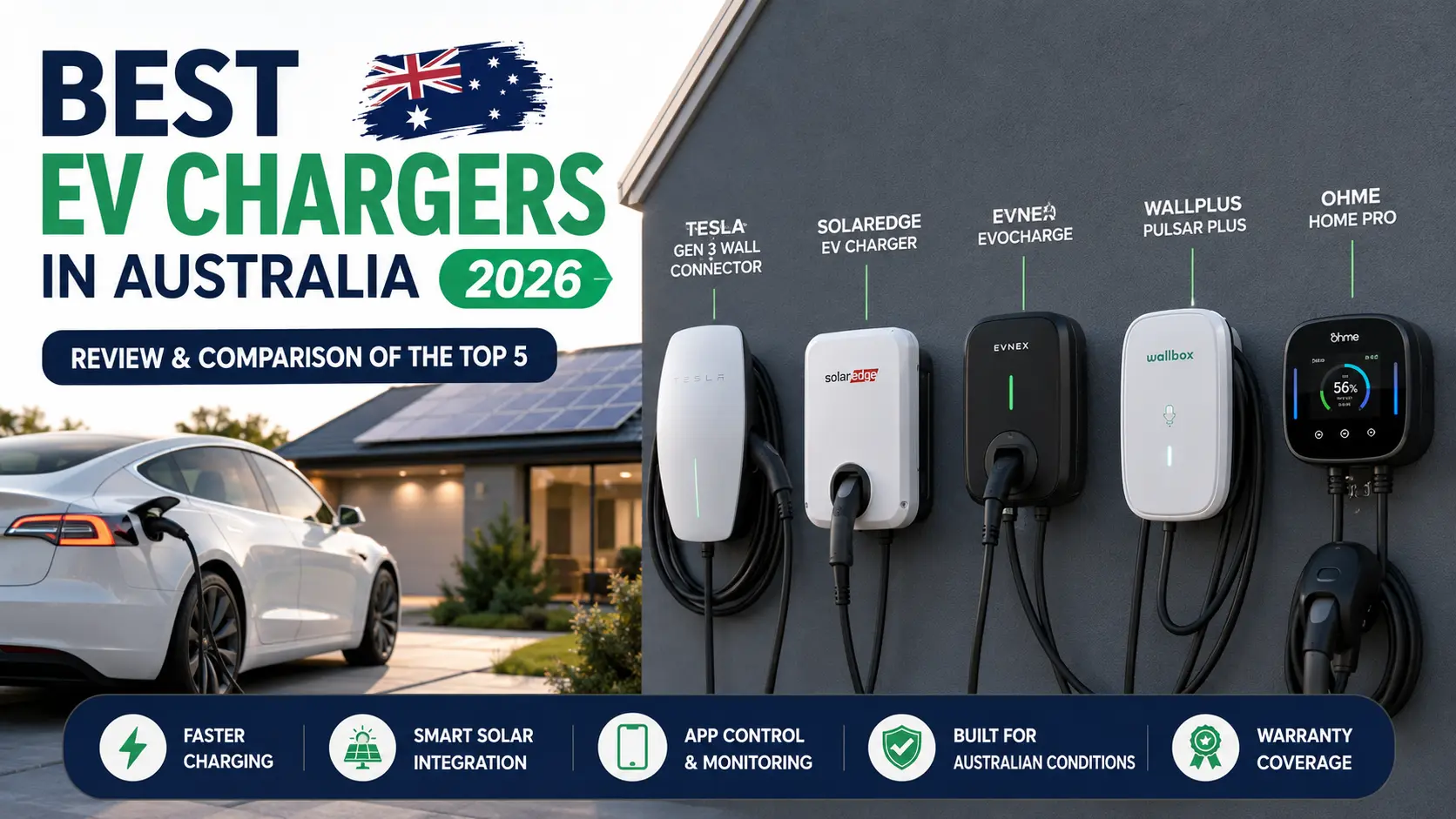
One in every five new cars Australians buy is an electric vehicle, and this rate will only go up. As drivers shift to electric vehicles to protect the environment and reduce fuel costs, EV chargers are becoming a common household appliance. However, choosing one of the best EV chargers in Australia can be confusing for a new EV owner.
Sure, you can charge your EV from a wall socket, but it takes a long time. Normal charging (1.4 kilowatt) only adds 3-5 miles per hour. Meanwhile, a standard home EV charger with 7.4-11 kilowatt power output can add 25-40 miles per hour. That means it takes only 8 hours, or a single night, to power up a typical EV with an EV charger compared to a whole day or more with a wall socket.
However, choosing the right EV charger for your home is extremely important. An incompatible charger might trip your main switch whenever you turn on the AC or induction cooker while the vehicle is plugged in. On the other hand, buying into a locked brand ecosystem will keep you from using rooftop solar power to charge your car.
The solution is to get yourself educated on the best EV chargers in Australia before you make a purchase. We compiled a list of the top five from our field experience and customer feedback at Aussie Solar Tech. It’s best to consider them carefully before making a decision.
Top 5 Home EV Chargers in Australia 2026
The EV chargers we talk about in this list are 7.4 kW – 11 kW chargers built for home or pubic ev charging stations. They are different from commercial chargers, which have a much more massive power output but are not designed for home installation.
The mentioned chargers are compatible with EV’s having a Type 2 port, which is the vast majority of EVs in Australia, such as Tesla, BYD, Hyundai, BMW, and MG. However, their prices, cord length, and general aesthetics differ noticeably from each other.
Tesla Gen 3 Wall Connector
The TESLA Model Y was Australia’s best-selling vehicle in May 2026. This just shows how widely the TESLA company dominates the EV market. As a result, you can’t compile a list of the best EV chargers in Australia without putting the brand in it. Our pick here is the Tesla Gen 3 Wall Connector. This is undoubtedly the best option for those who drive a Tesla EV.
This EV charger hits the balance between budget and quality at the fair price of 800 AU$ (hardware). The Tesla Gen 3 Wall Connector, of course, works best with the vehicles of its brand. There is an integrated handle button that will automatically pop open the EV’s charging port when it’s near the charger. Besides Tesla, this charger also works well with other EV’s with type-2 ports such as BYD Seal, Polestar 2, or Hyundai Ioniq 5.
The chargers come in single and three-phase versions. The single phase has a power output of up to 7.4 kW, which can charge your vehicle at 40-50 km/h. The three-phase version offers power output up to 22 kW. However, most modern Teslas cap at 11 kW. So even with 22 kW, the charging speed will be around 70 km/h.
The current output is 32 amps max. However, your installer can adjust that according to your home’s main switchboard to prevent tripping the main switch.As for the wall footprint, it doesn’t take much space at 345x155x110 mm. Since it only sticks out 11cm from the wall, you can safely install it even in crammed garages without worrying about your car’s mirror hitting it during parking.
One of the biggest conveniences of this charger is the cable. It has a permanently attached cable with an excellent length of 7.3 m. That way, you don’t have to work too much on the parking to align your vehicle with the charger. Just getting your car into the garage will be good enough. You can also install the charger outdoors since it has an IP55 weather rating, attesting to its durability in Australian weather.
The charger also has 2.4 GHz wifi connectivity, which allows it to get automatic Tesla software updates and track your energy habits in real time. This also helps with remote troubleshooting.
Pros: What’s Good About the Tesla Gen3 Wall Connector?
- Fast charging and a long permanent cable
- Built for both indoors and outdoors
- Take Advantage of the Tesla Ecosystem.
- Manage everything from the Tesla Smartphone App.
- Works satisfactorily with other EVs with Type-2 ports
- Fairly low price compared to performance and brand value
- 4-year residential warranty, which is quite generous for an EV charger.
The Cons: What are the Issues with the Tesla Gen3 Wall Connector?
The Tesla Gen 3 won’t automatically integrate with your rooftop solar and use excess solar energy to charge your EV. Your home must have a Tesla Powerwall battery for that. Otherwise, it will just draw from grid electricity. This is the “dumb solar” problem you have to deal with if you haven’t gone full Tesla.
SolarEdge EV Charger
The SolarEdge EV charger also comes with the same single and triple-phase power output options. So, it charges your EV at roughly the same speed as the Tesla wall connector. It has a wide range of compatibility with Type-1 and 2 EVs. However, it is much costlier at AU$1,200-$1,800.
The charger has a smaller wall footprint at 235 mm (H) x 230 mm (W) x 130 mm (D). However, it might feel a little more boxy at 13cm depth. Also, it is untethered, so you have to buy your own cable to use with it.
It has an IP54 Weather Enclosure and IK08 Impact Resistance. So while it can hold its own against the occasional rain and a bump or knock here and there, it isn’t completely waterproof like the Tesla wall connector against storm sprays. So, best to install it indoors in a garage or under shade.
The pro model has Wi-Fi, Ethernet, Bluetooth, RFID, and 4G LTE connectivity to integrate with your home network. Using 4G, it can stay connected to your phone app even without wifi.
Pros: What’s Good About SolarEdge EV Charger
- You can easily integrate the SolarEdge EV charger with your rooftop panels to use the excess electricity to charge your car. All you need is a SolarEdge inverter and smart meter. This is a major advantage compared to the brand lockout you experience with Tesla, which requires their brand battery.
- Quick snap-on bracket installation
- Instead of shutting down, it can switch from triple to single-phase charging if your solar output drops due to clouds or excess heat.
- Track all charging-related stats and info from your smartphone’s mySolarEdge app.
- Requires RFID authentication to prevent strangers from stealing your electricity in shared driveways.
Cons: What are the issues with the SolarEdge EV charger?
- 1,800 AU$ is quite expensive for an EV charger
- Untethered, so you have to buy your own cable, which adds to the cost.
- Shorter 3-year warranty.
Evnex E2 Flex Smart EV Charger
This is another affordable EV charger at AU$799. It’s a single-phase charger with 7.2 kW power output and 32 amps of current flow. It can fully charge a standard EV within an acceptable 8-hour window.
At 286 mm (H) x 185 mm (W) x 66 mm (D), it has a small wall footprint and is incredibly slim. It sticks out only 6.6 cm from the wall. This makes it perfect for narrow driveways and garages. You won’t have to worry about slamming into the charger when you open a car door anymore. It’s also a tethered charger with a decently long 5m cable.
With an IP55 weatherproof rating, it’s as resilient to outdoor heat and storms as the Tesla Wall Connector. So, you can easily go for a dedicated post mount instead of installing it on the garage wall.
One of the best things about the Evnex is that it depends on a CT clamp instead of a brand cloud system to use excess solar power. Tesla and SolarEdge depend on their brand hardware (battery and inverter) to upload solar info to their proprietary cloud server. The cloud then talks to the EV charger and dictates the use of solar energy.
In contrast, Evnex uses a CT clamp. It’s a physical sensor that attaches to the main powerline during the installation. The sensor directly measures the electricity at the switchboard. Thus, it detects and directs excess solar energy to the charger. No need for a brand-specific inverter or battery since there is no need to talk to any brand cloud.
Pros: What is Good about the Evnex E2 Flex EV charger?
- Universal solar compatibility doesn’t lock you into a brand cloud ecosystem like Tesla or SolarEdge.
- Can keep using solar even without internet since it doesn’t need signals from the cloud.
- Tethered with a long cord and slim, small wall-footprint
- Robustly built for outdoor use
- 4-year warranty and excellent local support network
Cons: What are the Issues with the Evnex E2 Flex EV Charger?
- The E2 doesn’t have a three-phase 22 kW version. For that, you have to buy the more expensive X22.
- Although there is no brand lock-in, you have to buy a software subscription to activate its solar charging function. The software unlock fee is 349$.
Wallbox Pulsar Plus EV Charger
The WallboxPulsar Plus retails hardware for $1,100-$1,600 ($1,350 commonly). It has both single-phase (up to 7.4 kW, 32A) and three-phase (up to 22 kW, 32A) versions, which support fast charging.
At 166 mm (H) x 163 mm (W) x 82 mm (D), it’s smaller than a lunch box and almost disappears into the wall. It also has a fully attached 5m type-2 cable. There is also an option for a 7m cable. The faceplate features a multi-colored LED halo that shows you the charging status in real time. With an IP54 weather rating, the charger is mostly meant for indoor use.
Wallbox’s Eco-Smart allows it to use excess solar energy to charge your EV no matter the inverter brand. All you need is a Wallbox-certified power meter and a CT clamp. The clamp reads your home’s raw electricity, and the meter detects excess solar generation, which it relays to the charger. Thus, the Eco-Smart makes sure you get to use 100% of the excess energy to charge your vehicle.
Wallbox also uses a highly compatible OCPP 1.6j standard software. As a result, you can effortlessly pair it with almost any third-party management platform or smart home automation network.
Pros: What is Good about the Wallbox Pulsar Plus?
- Hardware-agnostic solar-charging design works with any solar inverter brand. No brand cloud ecosystem lock-in.
- Eco-smart feature lets you use 100% of the excess solar your panels produce
- Open Charge Point Protocol (OCPP) lets you bypass the native app entirely and connect the charger to third-party smart energy management software like Charge HQ or participate in virtual power plants (VPPs)
Cons: What are the Issues with Wallbox Pulsar Plus?
- The Eco-smart feature requires a Wallbox meter that costs AU$210-$360.
- Loses charging speed if the temperature rises above 40°C.
- Short 3-year warranty.
- Unlike Evnex, the CT clamp doesn’t come in the box; you have to buy it separately.
Ohme Home Pro EV Charger
The Ohme Home Pro sells between AU$1250 and AU$1400 in Australia. It only comes in a single-phase 7.4 kW (32 amp) version, which lets you charge at 40-50 km/h. It’s quite compact and shallow at 170 mm (H) x 200 mm (W) x 100 mm (D). The charger features a permanently attached 5m cord. It has excellent outdoor resilience with a weather rating of IP55.
A unique feature of the Ohme Home Pro is its vibrant and interactive LCD screen. This on-device control screen lets you check real-time charging, see total session costs, or manually override smart schedules directly on the unit without pulling out your phone. It eliminates the need for a smartphone to control your EV charger.
The Ohme App is a market leader in dynamic, smart tariff tracking. You simply input your electricity plan, your desired final battery percentage, and the time you need to leave. No need to guess and set hard start or stop times. The app directly communicates with power grids to automatically pause and resume charging during your specific supplier’s cheapest off-peak windows.
The Home Pro also features dedicated solar tracking via an included, hardwired CT clamp. It monitors your home’s electrical layout to harvest excess power that your solar array would otherwise wastefully dump back onto the utility grid. Using the mobile application, you can easily toggle between two specialized tracking modes depending on your immediate power needs.
Pros: What is Good about the Ohme Home Pro
- No brand cloud ecosystem lock-in; works with all solar inverters since it comes with a hardwired CT clamp.
- On-device control screen reduces smartphone dependency.
- Smart mobile app for advanced tariff integration
Cons: What are the Issues with the Ohme Home Pro
- Strictly single phase
- Doesn’t have multi-stage phase-switching intelligence like SolarEdge
- Short 3-year warranty.
Comparison Between The 5 Best EV Chargers In Australia
Having a hard time deciding among the five? Here’s a side-by-side comparison to make it easier for you. Remember, all the EV chargers in the list are high-performance and use the latest tech. Your choice depends on the budget, garage setup, and the brand ecosystem you are already a part of.
| Feature / Metric | Tesla Gen 3 Wall Connector | SolarEdge ONE EV Charger | Evnex E2 Series (Core/Plus) | Wallbox Pulsar Plus | Ohme Home Pro | Category Leader & Best For |
| Approx. Price (AUD Hardware Only) | ~$800 | ~$1,400 to $1,800 | $1,099 (Core) to $1,399 (Plus) | ~$1,100 (7.4kW) to ~$1,600 (22kW) | ~$1,250 to $1,400 | Tesla Wall Connector(Best for budget-focused hardware value) |
| Phases & Max Power Output | Single-Phase (7.4 kW) & Three-Phase (22 kW) in one unit | Single-Phase (7.4 kW) & Three-Phase (22 kW) variants | Single-Phase strictly maxed at 7.4 kW (Must buy X22 for 22kW) | Single-Phase (7.4 kW) or Three-Phase (22 kW) separate variants | Single-Phase strictly maxed at 7.4 kW | Tesla Wall Connector(Best flexibility out-of-the-box for all house wiring structures) |
| Physical Dimensions | 345 x 155 x 110 mm | 450 x 208 x 150 mm | 286 x 185 x 66 mm | 166 x 163 x 82 mm | 170 x 200 x 100 mm | Wallbox Pulsar Plus(Best ultra-compact footprint for tight garages) |
| Standard Cable Length | 7.3 metres (Tethered) | 6.0 metres (Tethered) | 5 metres (Core) or 8 metres (Plus) (Tethered) | 5 metres (Tethered, 7m upgrade optional) | 5 metres or 8 metres (Tethered) | Evnex E2 / Ohme(Best for long or awkward driveways via 8m extensions) |
| Weather & Environmental Protection | IP55 rated; UV-stabilized casing | IP66 rated; High outdoor protection | IP55 rated; Eco bio-plastic housing | IP54 rated; Carport/awning mounting advised | IP55 rated; UV-stabilized block | SolarEdge ONE(Best structural sealing for completely unsheltered outdoor walls) |
| Maximum Operating Temp Ceiling | Up to 50°C before derating | Up to 55°C before derating | Up to 55°C before derating | Up to 40°C before throttling down | Up to 50°C before derating | SolarEdge / Evnex(Best for surviving unshaded, baking-hot Australian summer walls) |
| Rooftop Solar Integration Method | Requires a Tesla Powerwall battery ecosystem | Requires a SolarEdge Inverter + Smart Meter ecosystem | Universal CT Clamp included (Open to all solar inverter brands) | Requires extra Wallbox Meter purchase (Open to all brands) | Universal CT Clamp included (Open to all solar inverter brands) | Evnex E2 Series(Best hassle-free out-of-the-box open solar diversion) |
| Network & Connection Types | 2.4 GHz Wi-Fi local connection | Wi-Fi only | Wi-Fi local (Core) + Built-in 4G Cellular data (Plus) | Wi-Fi + Offline local Bluetooth control | Built-in 4G LTE Cellular data (No local Wi-Fi required) | Ohme Home Pro(Best network backup with cost-free 4G data bypass) |
| Warranty (Australian Residential) | 4 Years | 3 Years (Extendable via brand option) | 4 Years | 3 Years | 3 Years | Tesla / Evnex E2(Best long-term customer protection coverage) |
Final Words
There is no single best charger for your EV. It depends on multiple factors. For instance, the Tesla Gen 3 Wall Connector is the perfect option for those who drive a Tesla. Using any other charger might complicate things, especially if you want to use solar power. Meanwhile, Evnex and Wallbox seem like greater options for non-Tesla drivers and those who don’t want brand lock-in.
Whichever you choose, hiring a professional installer is a must for proper wiring. Otherwise, you might find you are tripping the main switch every time you run multiple appliances together. You can consider the Aussie Solar Tech team for safe, fast, and cheap installation. Contact us for more info.
FAQs
Can the Tesla Gen 3 Wall Connector “Charge on Solar” without buying a Tesla Powerwall?
No. While Tesla’s marketing highlights a “Charge on Solar” feature, this software automation is strictly locked behind the Tesla ecosystem. The charger itself cannot read your solar generation data natively; it requires a Tesla Powerwall battery to act as the brains of the operation. If you do not have a Powerwall, the Gen 3 Wall Connector will simply operate as a standard charger drawing grid power unless you manually program your vehicle to charge during peak daylight hours using a third-party app like Charge HQ.
Can I buy the SolarEdge ONE EV Charger to use as a standalone high-speed 22 kW charger if I have a different solar system brand like Fronius or Sungrow?
You can physically plug any car into it, but it makes no economic sense. Without an active SolarEdge inverter and smart meter ecosystem, the SolarEdge ONE is entirely blind. It loses all of its headline smart features, including automatic phase-switching and automated excess solar tracking. Stripped of its internal communication framework, it becomes a heavily overpriced, standard “dumb” charger, meaning you are better off buying a cheaper open-source alternative.
Does the Evnex E2 “Flex” model support automatic solar tracking right out of the box?
No, and this catches many budget-conscious buyers off guard. The $799 E2 Flex hardware ships with its solar capabilities software-locked. If you have solar panels today or install them later, you must pay a mandatory $349 AUD digital subscription “unlock fee” to activate the solar diversion functionality. If you want solar tracking immediately, you are better off bypassing the Flex model entirely and purchasing the E2 Core or E2 Plus variants, which include solar tracking out of the box.
Why does the Wallbox Pulsar Plus struggle in hot Australian conditions compared to newer variants like the Pulsar Max?
It comes down to a strict temperature ceiling. The original Wallbox Pulsar Plus has a maximum full-capacity operating threshold of just 40°C. In harsh Australian summers, if the unit is mounted in direct sunlight or a stifling uninsulated carport, it will hit this limit rapidly and “derate”—meaning it dramatically slows down your charging speeds to prevent an internal meltdown. The newer Pulsar Max redesign resolved this major local complaint by upgrading internal components to safely withstand operational heat thresholds up to 50°C.

Shah Tarek is a Solar Energy Consultant with 10 years experience in solar system design and solar consultancy field at Australia. He is now a Director, Operation & Consultancy Division at Aussie Solar Tech, a leading Australian solar retailer and installer. Here he is writing informative and engaging solar content that educates the community on the benefits of solar power. His work supports Aussie Solar Tech’s mission to promote sustainable energy solutions and foster a greener future for Australia.









Seraphim Solar Panels Review: Efficiency, Reliability, and Value Unveiled

Talesun Solar Panels: Honest Review Before You Buy

Sungrow Battery VS Tesla Powerwall : Which is Best in Australia?

Leapton Solar Panels Review: Affordable Energy Solution

REC Solar Panels Review: Outstanding Efficiency & Durability

Best Hybrid Inverters for Home Solar Systems in 2025

Best Solar Battery In Australia 2026 — Complete Guide

Sigenergy VS Fox ESS Battery: Which is The Best Choice for 2026

How Much Do Solar Panel Costs in Australia? (2026 Price Guide)

