
Choosing a home EV charger is not only about finding the unit with the highest power rating. It also needs to suit the home’s electrical supply, the vehicle’s onboard charging limit, the parking location and the owner’s everyday driving routine.
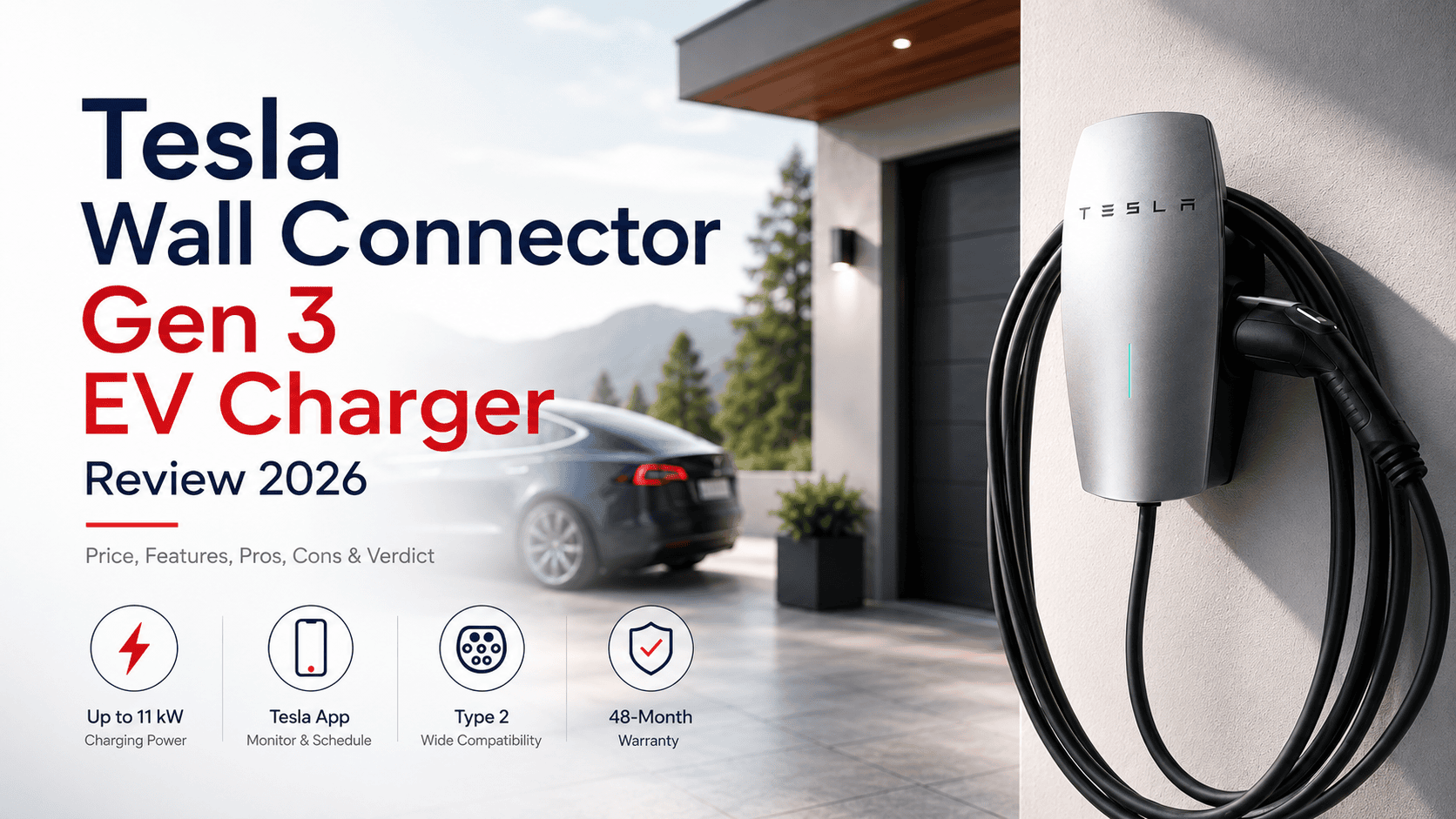
This Tesla Wall Connector Gen 3 EV charger review covers charging speed, app features, solar use, Australian pricing, installation requirements, warranty and compatibility with other EV brands. For buyers researching Tesla Wall Connector Gen 3 Australia, its biggest attractions are competitive pricing, a long-tethered cable and close integration with the Tesla app.
Tesla Wall Connector Gen 3 EV Charger: Quick Verdict
The Tesla Wall Connector Gen 3 EV Charger is a fixed AC charger designed for homes, apartments and workplaces. It supports single-phase and three-phase power, connects to Wi-Fi for app features and software updates, and can share available electrical capacity with other Gen 3 Wall Connectors.
| Category | What buyers should know |
| Connector | Type 2 tethered connection |
| Cable length | 7.3 metres |
| Electrical supply | Single-phase or three-phase |
| Maximum hardware output | Up to 22 kW on a suitable electrical supply |
| Common home output | Up to 7.4 kW on single-phase |
| Tesla three-phase output | Up to 11 kW for compatible current Tesla vehicles |
| App features | Scheduling, live status and charging history |
| Connectivity | 2.4 GHz Wi-Fi |
| Power sharing | Up to six Gen 3 Wall Connectors |
| Installation | Hardwired by a qualified electrician |
| Mounting | Indoor or outdoor |
| Residential warranty | 48 months |
| Commercial warranty | 12 months |
| Hardware price guide | A$750–A$850 |
| Typical installed price | A$1,500–A$2,500 |
| Best suited to | Tesla owners and compatible Type 2 EV drivers |
| Main limitation | Automatic surplus-solar charging requires Powerwall and a compatible Tesla vehicle |
For most households, a Tesla Wall Connector Australia setup provides convenient overnight charging at a competitive price. It is particularly attractive for Tesla owners who want app-based control without paying extra for features they may not need.
What Charging Speed Will You Actually Get?
Home charging speed depends on the property’s electrical supply, the charger setting and the vehicle’s onboard AC charger. The Gen 3 Wall Connector hardware can support up to 22 kW on a suitable three-phase supply. However, compatible Tesla vehicles in Australia typically charge at up to 7.4 kW on single-phase power and up to 11 kW on three-phase power.
| Electrical setup | Output | Typical use |
| Single-phase, 10 A | 2.3 kW | Light daily driving |
| Single-phase, 16 A | 3.5 kW | Overnight top-ups |
| Single-phase, 32 A | 7.4 kW | Common home setup |
| Three-phase, 16 A | 11 kW | Faster Tesla charging |
| Three-phase, 32 A | Up to 22 kW | Compatible EVs only |
When comparing Tesla Wall Connector Gen 3 Australia options, remember that a 22 kW installation does not mean every EV will charge at 22 kW. For most homes, 7.4 kW is already enough for convenient overnight charging.
Key Features of the Tesla Wall Connector Gen 3
Tesla App Control
The Tesla app allows owners to schedule charging, check live charging status and review previous sessions. It can display up to 12 months of charging history, including session duration and the amount of energy delivered to the vehicle.
The app can also be used by owners of compatible non-Tesla EVs, making the Tesla Wall Connector Gen 3 more flexible than many buyers expect.
Wi-Fi and Software Updates
The charger connects to a 2.4 GHz Wi-Fi network for firmware updates, remote diagnostics, access control and app features.
It does not connect directly to 5 GHz or 6 GHz Wi-Fi, so the installation location needs a reliable 2.4 GHz signal. A detached garage or parking area located far from the router may need better Wi-Fi coverage.
Static and Dynamic Power Management
Static Power Management allows the installer to set a fixed charging limit that matches the home’s available electrical capacity.
Dynamic Power Management can adjust the charging rate according to the electricity being used elsewhere in the property. When household demand rises, EV charging slows down. When demand falls, charging can increase again.
Dynamic Power Management requires a Tesla-approved power meter that is purchased and installed separately. It can help some homes achieve faster safe charging without requiring a major electrical upgrade.
Power Sharing for Multiple EVs
Up to six Gen 3 Wall Connectors can share the available electrical capacity. Instead of every vehicle drawing maximum power at the same time, the system distributes the supply between connected cars. This can be useful for multi-EV homes, apartment parking, hotels and workplaces. Dynamic Power Management and Group Power Management are separate features, so the installer should design the setup according to the property’s needs.
Long Tethered Cable
The Australian unit includes a 7.3-metre tethered cable. The extra reach is useful when vehicles are parked in different positions or when the charger cannot be mounted directly beside the charge port. The attached cable makes daily charging simple, although there is no untethered socket version for buyers who prefer a removable cable.
Compatibility With Tesla and Other EVs
The Australian Wall Connector uses a Type 2 connection and can charge Tesla vehicles as well as most compatible Type 2 EVs sold in Australia. The vehicle’s onboard AC charger determines the final charging speed. For example, an EV limited to 7 kW will continue charging at 7 kW, even when the Wall Connector and electrical supply can provide more power. Tesla owners also receive a useful button on the charging handle that can open the charge-port door on a compatible Tesla. Non-Tesla owners can still use the Tesla app to control the Wall Connector, create charging schedules and review charging data, although some Tesla-specific conveniences may not apply.
Indoor and Outdoor Installation
Tesla lists the Wall Connector as suitable for indoor and outdoor mounting. It can be installed on a garage wall, an external wall or a suitable pedestal. A sheltered location is still preferable where practical, especially in areas exposed to intense sunlight, coastal conditions or possible vehicle impact.
Warranty
Normal residential use is covered for 48 months, while normal commercial use is covered for 12 months from the invoice date. The installer’s workmanship warranty is separate. Buyers should confirm who will manage a future claim and what labour is covered before the Tesla Wall Connector Gen 3 installation begins.
Can It Charge From Rooftop Solar?
A Tesla Wall Connector Australia installation can be used at a property with rooftop solar. However, the charger does not independently track changing solar exports through its own CT-based solar-diversion system.
Tesla’s Charge on Solar feature requires:
- A compatible Tesla vehicle
- Tesla Powerwall
- Rooftop solar
- Compatible Tesla app, vehicle and Powerwall software
When these requirements are met, the vehicle can automatically adjust charging to use available excess solar. Charging may wait until at least around 1.2 kW of stable surplus solar is available. Without Powerwall, owners can still schedule daytime charging to coincide with expected solar production. However, the Wall Connector will not automatically follow real-time solar surplus.
This is the main difference between a Tesla home charger Australia setup and chargers designed around independent solar diversion. Tesla vehicle and Powerwall owners receive the most integrated experience, while solar households without Powerwall may prefer a charger with its own solar-monitoring hardware.
Tesla Wall Connector Australia Price 2026
Here is the current Tesla Wall Connector Australia price 2026 guide:
| Cost item | Price guide |
| Gen 3 Wall Connector hardware | A$750–A$850 |
| Single-phase labour and wiring | A$600–A$1,200 |
| Typical single-phase total | A$1,500–A$2,000 |
| Three-phase labour and wiring | A$800–A$1,500 |
| Typical three-phase total | A$1,800–A$2,500 |
These are guide prices rather than fixed packages. The final quote may increase if the installation needs a switchboard upgrade, long cable run, trenching, three-phase work, custom mounting or a separate dynamic power meter.
Final price may vary based on location and installation requirements. Contact us for a personalized quote and expert advice.
Tesla Wall Connector Installation Cost
The Tesla Wall Connector installation cost generally ranges from A$600 to A$1,500 for labour and wiring, depending on the electrical setup and installation complexity.
A standard Tesla Wall Connector Gen 3 installation may include:
- Checking the electrical supply and switchboard capacity
- Installing a dedicated circuit and required protection
- Mounting, hardwiring and commissioning the charger
- Connecting it to 2.4 GHz Wi-Fi
- Testing operation and providing compliance documents
The final Tesla Wall Connector installation cost may be higher if the parking area is far from the switchboard, underground cabling is required or the switchboard needs upgrading. Tesla requires the Wall Connector to be installed by a qualified electrician and properly commissioned.
Approximate Home Charging Times
The following figures show approximate empty-to-full charging times with a small allowance for normal AC charging losses.
| EV battery capacity | At 7.4 kW | At 11 kW |
| 50 kWh | About 7.5 hours | About 5 hours |
| 60 kWh | About 9 hours | About 6 hours |
| 75 kWh | About 11.5 hours | About 7.5 hours |
| 100 kWh | About 15 hours | About 10 hours |
These are calculated estimates rather than guaranteed times. Actual results depend on the vehicle, battery condition, temperature and charging losses. Most drivers also top up their vehicle instead of charging from completely empty, so everyday sessions are usually shorter.
Pros and Cons
| Pros | Cons |
| Competitive hardware price | No independent built-in solar diversion |
| Long 7.3-metre tethered cable | No untethered socket option |
| Tesla app scheduling and charging history | Connected features need 2.4 GHz Wi-Fi |
| Works with compatible non-Tesla EVs | Final speed depends on the vehicle’s onboard charger |
| Static and Dynamic Power Management | Dynamic Power Management needs extra hardware |
| Power sharing for up to six units | Charge on Solar requires Powerwall and a Tesla vehicle |
| 48-month residential warranty | Commercial warranty is only 12 months |
| Indoor and outdoor mounting | Fixed, hardwired installation |
Who Is the Tesla Wall Connector Best For?
A Tesla home charger Australia setup is a strong fit for:
- Tesla owners who want simple app integration
- Homes needing reliable overnight charging
- Buyers looking for a recognized charger at a competitive price
- Properties with single-phase or three-phase electricity
- Multi-EV households considering several Wall Connectors
- Tesla vehicle and Powerwall owners who can use Charge on Solar
- Non-Tesla drivers with a compatible charging inlet
It may be less suitable for renters, buyers who prefer an untethered socket or solar households without Powerwall that want automatic surplus-only charging.
Tesla Wall Connector Gen 3 EV Charger Review: Final Verdict
This Tesla Wall Connector Gen 3 EV charger review finds that the charger remains one of the better-value options for Australian Tesla owners. Its main strengths are the long cable, Tesla app control, charging history, power-management features, support for multiple units and a 48-month residential warranty. It can also work with compatible non-Tesla EVs, providing more flexibility if a household changes vehicle brands later.
The biggest limitation is solar control. A standard Tesla Wall Connector Australia setup cannot independently follow surplus rooftop generation. Tesla’s Charge on Solar feature works only with Powerwall and a compatible Tesla vehicle. Charging speed also needs realistic expectations. Tesla Australia currently lists up to 7.4 kW on single-phase and up to 11 kW on three-phase for compatible Tesla vehicles. For most households, 7.4 kW single-phase charging remains more than adequate for overnight use.
Overall, Tesla Wall Connector Gen 3 Australia is a strong choice for buyers who want a reliable, competitively priced and well-integrated charger without paying extra for standalone solar-diversion features.
Aussie Solar Tech can assess the vehicle, switchboard, electrical supply and parking location before recommending the right setup.
Contact Aussie Solar Tech today for a personalized quote and professional installation.
Frequently Asked Questions
How much does the Tesla Wall Connector cost in Australia?
The hardware is priced at approximately A$750–A$850. Typical complete installations range from A$1,500 to A$2,500, depending on the electrical supply and installation complexity.
Does it need three-phase power?
No. It works with both single-phase and three-phase power. A 7.4 kW single-phase installation is sufficient for most overnight residential charging.
Can it automatically charge from excess solar?
Only through Tesla’s Charge on Solar setup, which requires Powerwall, rooftop solar and a compatible Tesla vehicle. Without this setup, owners can schedule daytime charging, but the Wall Connector will not independently follow changing solar exports.
Can several Gen 3 Wall Connectors share power?
Yes. Group Power Management allows up to six Gen 3 Wall Connectors to share the available electrical capacity.
What warranty does it include?
Normal residential use is covered for 48 months, while normal commercial use is covered for 12 months.

Shah Tarek is a Solar Energy Consultant with 10 years experience in solar system design and solar consultancy field at Australia. He is now a Director, Operation & Consultancy Division at Aussie Solar Tech, a leading Australian solar retailer and installer. Here he is writing informative and engaging solar content that educates the community on the benefits of solar power. His work supports Aussie Solar Tech’s mission to promote sustainable energy solutions and foster a greener future for Australia.








Seraphim Solar Panels Review: Efficiency, Reliability, and Value Unveiled

Talesun Solar Panels: Honest Review Before You Buy

Sungrow Battery VS Tesla Powerwall : Which is Best in Australia?

Leapton Solar Panels Review: Affordable Energy Solution

REC Solar Panels Review: Outstanding Efficiency & Durability

Best Hybrid Inverters for Home Solar Systems in 2025

Best Solar Battery In Australia 2026 — Complete Guide

Sigenergy VS Fox ESS Battery: Which is The Best Choice for 2026

How Much Do Solar Panel Costs in Australia? (2026 Price Guide)

