
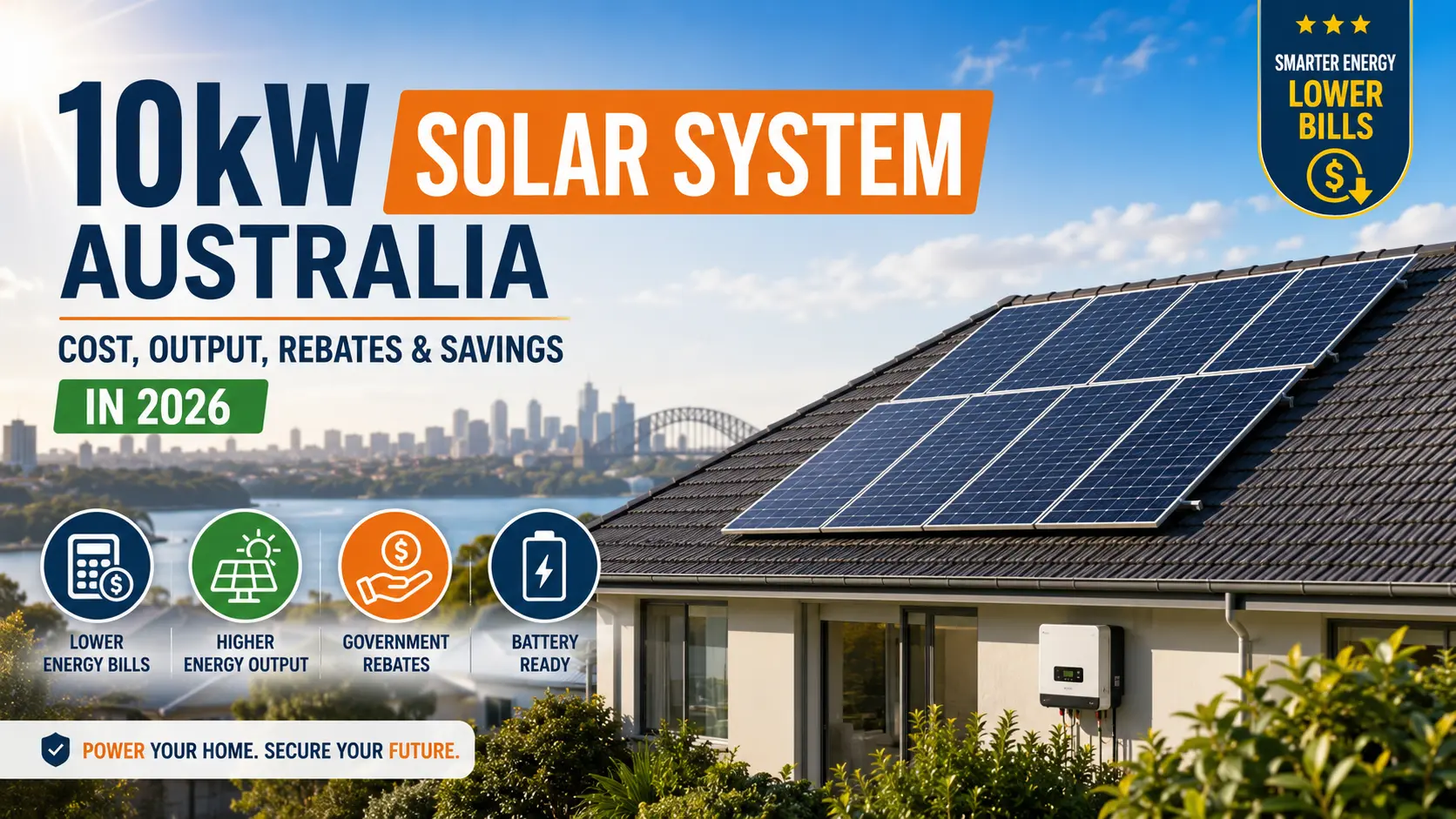
Electricity prices in Australia have climbed 20–30% in many states over the past few years, and most homeowners feel it every quarter when the bill lands. For households running ducted air conditioning, a heat pump, an EV charger, or simply a lot of people under one roof, a standard 6.6kW setup often isn’t enough to make a real dent in that bill. That’s where the 10kW solar system comes in.
A 10kW solar system sits at the upper end of residential solar and the entry point for small commercial installs. It’s big enough to power a large family home through the day, charge an EV, and still leave enough surplus to fill a home battery — all while qualifying for a solid chunk of solar rebates Australia-wide currently offers. This guide walks through exactly what a 10kW solar system costs, how much power it actually generates in your city, and how quickly it pays for itself.
What Is a 10kW Solar System?
A 10kW (10,000-watt) system refers to the combined rated capacity of the solar panels — not the amount of energy produced. A typical setup includes:
- 22–28 Tier 1 solar panels, depending on individual panel wattage
- An 8–10kW grid-connected inverter
- Mounting hardware, cabling, smart monitoring, and grid compliance certification
It’s designed for households using roughly 30–45+ kWh of electricity per day — think large families, homes with ducted air conditioning or heated pools, EV owners, and anyone planning to add battery storage down the track.
10kW vs 10kWh — Don’t Get These Confused
This mix-up trips up a lot of first-time buyers. 10kW is a measure of power capacity — how fast the system can generate electricity at peak sun. 10kWh is a measure of energy — how much electricity is produced or stored over a period of time. A 10kW system doesn’t make “10kWh” of electricity; it typically generates somewhere between 30 and 46kWh per day, depending on your location, season, and panel orientation.
10kW Solar System Costs in Australia
Solar installation cost varies significantly depending on your state, panel brand, inverter type, and roof complexity. As a general guide, a fully installed 10kW system after the federal rebate typically lands somewhere between $5,500 and $9,000, with the market average across capital cities sitting closer to $8,500–$11,000 before shopping around.
| City | Typical Market Price (after rebate) |
|---|---|
| Sydney, NSW | ~$8,150 |
| Melbourne, VIC | ~$8,720 |
| Brisbane, QLD | ~$8,860 |
| Adelaide, SA | ~$8,720 |
| Perth, WA | ~$8,510 |
| Canberra, ACT | ~$7,800 |
Figures are indicative market averages and will vary by installer, panel brand, and roof type. Aussie Solar Tech’s installed price for a 10kW system starts from $5,599 after the STC rebate — well below the typical market range.
What Affects the Price?
- Panel wattage and brand — premium Tier 1 panels cost more but produce more over 25 years
- Inverter type — string inverters are more affordable; hybrid inverters (needed for battery-ready systems) cost more
- Roof complexity — multi-storey homes, tile roofs, and unusual pitches add labour time
- Three-phase power — most Australian distribution networks require three-phase power for systems above 5–8kW; if your home only has single-phase, an upgrade can add $2,000–$8,000
- Location — remote or regional installs may carry higher labour and freight costs
How Much Energy Does a 10kW Solar System Generate?
Daily output depends on peak sun hours, panel orientation, tilt angle, shading, and system efficiency. Based on Bureau of Meteorology solar irradiance data and PVWatts modelling (north-facing array, 20–30° tilt, ~77% system efficiency), here’s what a 10kW system typically produces across major cities:
| City | Peak Sun Hours/Day | Avg Daily Output | Annual Output |
|---|---|---|---|
| Darwin, NT | 5.5 hrs | 38–44 kWh | ~14,900 kWh |
| Brisbane, QLD | 5.0 hrs | 36–41 kWh | ~13,870 kWh |
| Perth, WA | 4.9 hrs | 35–40 kWh | ~13,688 kWh |
| Adelaide, SA | 4.8 hrs | 34–40 kWh | ~13,505 kWh |
| Sydney, NSW | 4.6 hrs | 34–38 kWh | ~13,140 kWh |
| Canberra, ACT | 4.6 hrs | 34–40 kWh | ~13,505 kWh |
| Melbourne, VIC | 4.2 hrs | 31–36 kWh | ~12,045 kWh |
| Hobart, TAS | 3.8 hrs | 28–33 kWh | ~11,315 kWh |
Actual output will vary with shading, dust build-up, panel temperature, and inverter clipping — but these figures give a realistic baseline for planning.
6.6kW vs 10kW Solar System: Which Suits Your Home?
The most common residential solar size in Australia is still 6.6kW–8kW. A 10kW system only makes financial sense if your household genuinely uses enough electricity during the day to soak up the extra generation. Here’s a side-by-side comparison:
| Feature | 6.6kW System | 10kW System |
|---|---|---|
| Typical daily output | 22–29 kWh | 30–46 kWh |
| Best suited for | Small–medium households (2–4 people) | Large households (4–6+), EV owners, small businesses |
| Roof space needed | ~28–34 m² | ~39–46 m² |
| Ideal daily usage | 15–25 kWh/day | 30–45+ kWh/day |
| Phase requirement | Usually single-phase | Often requires three-phase |
| Typical installed cost | $3,500–$6,000 | $5,500–$9,000 |
| Battery-ready potential | Good | Excellent — more surplus to charge a battery |
If your last three electricity bills show daytime usage in the 30–45 kWh range, or you’re planning an EV or battery purchase within the next couple of years, a 10kW system is generally the better long-term investment — even though the upfront solar installation cost is higher.
Solar Rebates Australia: What’s Available for a 10kW System in 2026
The main incentive is the federal Small-scale Technology Certificate (STC) scheme, part of the Small-scale Renewable Energy Scheme (SRES). Here’s how it works in plain terms:
- Your installer calculates a number of STCs based on your system size, your postcode’s solar zone, and the “deeming period” — the number of years left until the scheme winds down at the end of 2030
- Those STCs are sold on the certificate market (currently trading at roughly $37–$40 each) and the value is deducted from your quote as a straight point-of-sale discount — you don’t need to apply for anything separately
- For a 10kW system, this typically works out to $2,500–$4,200 off the upfront price, depending on your location and the STC market price at the time
- The deeming period drops by one year every 1 January, meaning the rebate shrinks a little each year — as of 2026 it sits at 5 years, down from 6 in 2025
Other Rebates and Incentives Worth Knowing About
- Cheaper Home Batteries Program (CHBP) — a federal scheme launched in mid-2025 offering roughly 30% off eligible home batteries (5–100kWh), using the same STC mechanism. If you’re pairing your 10kW system with a battery, this is worth asking your installer about.
- State-based battery rebates and interest-free loans — several states run their own top-up incentives on batteries; availability and amounts vary, so check what’s current for your state.
- Feed-in tariffs (FiT) — retailers pay you for any solar power you export to the grid, typically between 5c and 8c per kWh depending on your state and retailer. This is far lower than the 22c–35c/kWh you’d otherwise pay for grid electricity, which is why maximising self-consumption (using the power as you generate it) matters more than exporting for solar savings.
Solar Savings: What Can You Actually Expect?
The size of your solar savings depends heavily on how much of the power you use during the day versus how much you export. The table below models annual savings and payback for a household using around 35 kWh per day, comparing a conservative 30% self-consumption rate against a strong 60% rate.
| City | Elec. Rate | FiT Rate | Annual Savings (30%/60% self-use) | Payback Period |
|---|---|---|---|---|
| Sydney | 29c/kWh | 7c/kWh | $1,799 / $2,755 | 3.6 / 2.3 yrs |
| Brisbane | 26c/kWh | 6c/kWh | $1,689 / $2,556 | 3.9 / 2.6 yrs |
| Melbourne | 22c/kWh | 5c/kWh | $1,291 / $2,027 | 5.1 / 3.3 yrs |
| Adelaide | 35c/kWh | 8c/kWh | $2,198 / $3,367 | 3.0 / 1.9 yrs |
| Perth | 31c/kWh | 6c/kWh | $1,927 / $3,003 | 3.5 / 2.2 yrs |
| Canberra | 29c/kWh | 7c/kWh | $1,844 / $2,799 | 3.6 / 2.4 yrs |
Practical example: A Sydney household using 35 kWh a day with 60% self-consumption could save around $2,755 a year — meaning the system pays for itself in a little over two years, with 20+ years of largely free electricity afterwards.
Over a 25-year system lifespan, even conservative scenarios typically deliver $45,000–$80,000+ in lifetime savings once the payback period is behind you.
Who Should Buy a 10kW System?
A 10kW system is the right call if you fit into one or more of these categories:
- Large households (4–6+ people) with high daytime electricity use
- Homes with ducted air conditioning, heated pools, or electric cooking
- EV owners or future EV buyers — an EV typically adds 10–20 kWh of daily charging demand
- Households planning to add battery storage — a 10kW system generates enough surplus to charge a battery and extend solar coverage into the evening
- Small businesses or home offices with consistent daytime operating hours
- Households paying $300+ per month in electricity bills
If your daily usage sits under 25 kWh and you’re not planning an EV or battery, a 6.6kW or 8kW system will likely deliver a faster payback and better value for money.
Long-Term ROI: Is a 10kW System Worth It?
Looking purely at the numbers, a 10kW system stacks up well against smaller alternatives when your usage justifies it:
- Upfront cost after rebates: $5,500–$9,000
- Typical payback period: 2–5 years, depending on self-consumption and location
- Estimated 25-year savings: $45,000–$80,000+
- System lifespan: Most Tier 1 panels carry 25-year performance warranties, with inverters typically warrantied for 10–12 years
The return on investment improves substantially the more of your own solar power you use directly, rather than exporting it at low feed-in tariff rates. This is why pairing a 10kW system with smart scheduling of high-draw appliances — or eventually a battery — tends to shorten payback timeframes considerably.
Final Thoughts
A 10kW solar system is a serious investment, but for the right household it delivers serious returns — lower bills, strong protection against rising electricity prices, and a clear path to near energy independence when combined with a battery. The key is making sure your daily usage pattern actually justifies the extra capacity over a standard 6.6kW or 8kW setup.
If you’re not sure which system size fits your home, the best starting point is your last three electricity bills — they’ll tell you far more than a generic online calculator ever could.
Ready to find out what a 10kW system would cost and save at your address? Get a free, no-obligation quote from Aussie Solar Tech and our SAA- accredited team will assess your roof, usage, and rebate eligibility — with a full breakdown of costs, output, and payback for your specific location.
Frequently Asked Questions
How much does a 10kW solar system cost in Australia?
After the federal STC rebate, a fully installed 10kW system typically costs between $5,500 and $9,000, depending on your state, panel brand, and roof complexity. Aussie Solar Tech’s installed pricing starts from $5,599.
How much power does a 10kW solar system generate per day?
Most 10kW systems generate between 30 and 46 kWh per day, depending on your location, panel orientation, and season. Sydney and Brisbane homes typically see 34–41 kWh on a clear day, while Melbourne and Hobart sit slightly lower due to fewer peak sun hours.
Is a 10kW solar system worth it for a normal household?
It’s worth it if your household uses 30–45+ kWh of electricity a day — think large families, homes with ducted air conditioning, EV owners, or anyone planning to add a battery. If your usage is under 25 kWh a day, a 6.6kW or 8kW system usually offers a faster payback.
How much can I save with a 10kW solar system?
Annual savings typically range from $1,300 to $3,400+ depending on your location, electricity rate, and how much of your own solar power you use directly (self-consumption) versus exporting to the grid at feed-in tariff rates.
What rebates apply to a 10kW solar system in 2026?
A 10kW system typically qualifies for $2,500–$4,200 off the upfront cost through the federal STC (Small-scale Technology Certificate) scheme. This is applied automatically as a point-of-sale discount by your installer — no separate application needed.
Do I need three-phase power for a 10kW solar system?
Most electricity networks in Australia require three-phase power for systems above 5–8kW. If your home only has single-phase power, an upgrade may add $2,000–$8,000 to your project — your installer can confirm what applies to your property.
How long does a 10kW solar system take to pay for itself?
Payback typically ranges from 2 to 5 years, depending on your electricity rate, feed-in tariff, and how much power you use during daylight hours. Higher self-consumption significantly shortens the payback period.
What’s the difference between a 6.6kW and a 10kW solar system?
A 6.6kW system suits small–medium households using 15–25 kWh a day and typically costs $3,500–$6,000 installed. A 10kW system suits larger households or those planning an EV or battery, generating significantly more surplus power, and typically costs $5,500–$9,000 installed.

Shah Tarek is a Solar Energy Consultant with 10 years experience in solar system design and solar consultancy field at Australia. He is now a Director, Operation & Consultancy Division at Aussie Solar Tech, a leading Australian solar retailer and installer. Here he is writing informative and engaging solar content that educates the community on the benefits of solar power. His work supports Aussie Solar Tech’s mission to promote sustainable energy solutions and foster a greener future for Australia.






Seraphim Solar Panels Review: Efficiency, Reliability, and Value Unveiled

Talesun Solar Panels: Honest Review Before You Buy

Sungrow Battery VS Tesla Powerwall : Which is Best in Australia?

Leapton Solar Panels Review: Affordable Energy Solution

REC Solar Panels Review: Outstanding Efficiency & Durability

Best Hybrid Inverters for Home Solar Systems in 2025

Best Solar Battery In Australia 2026 — Complete Guide

Sigenergy VS Fox ESS Battery: Which is The Best Choice for 2026

How Much Do Solar Panel Costs in Australia? (2026 Price Guide)

