
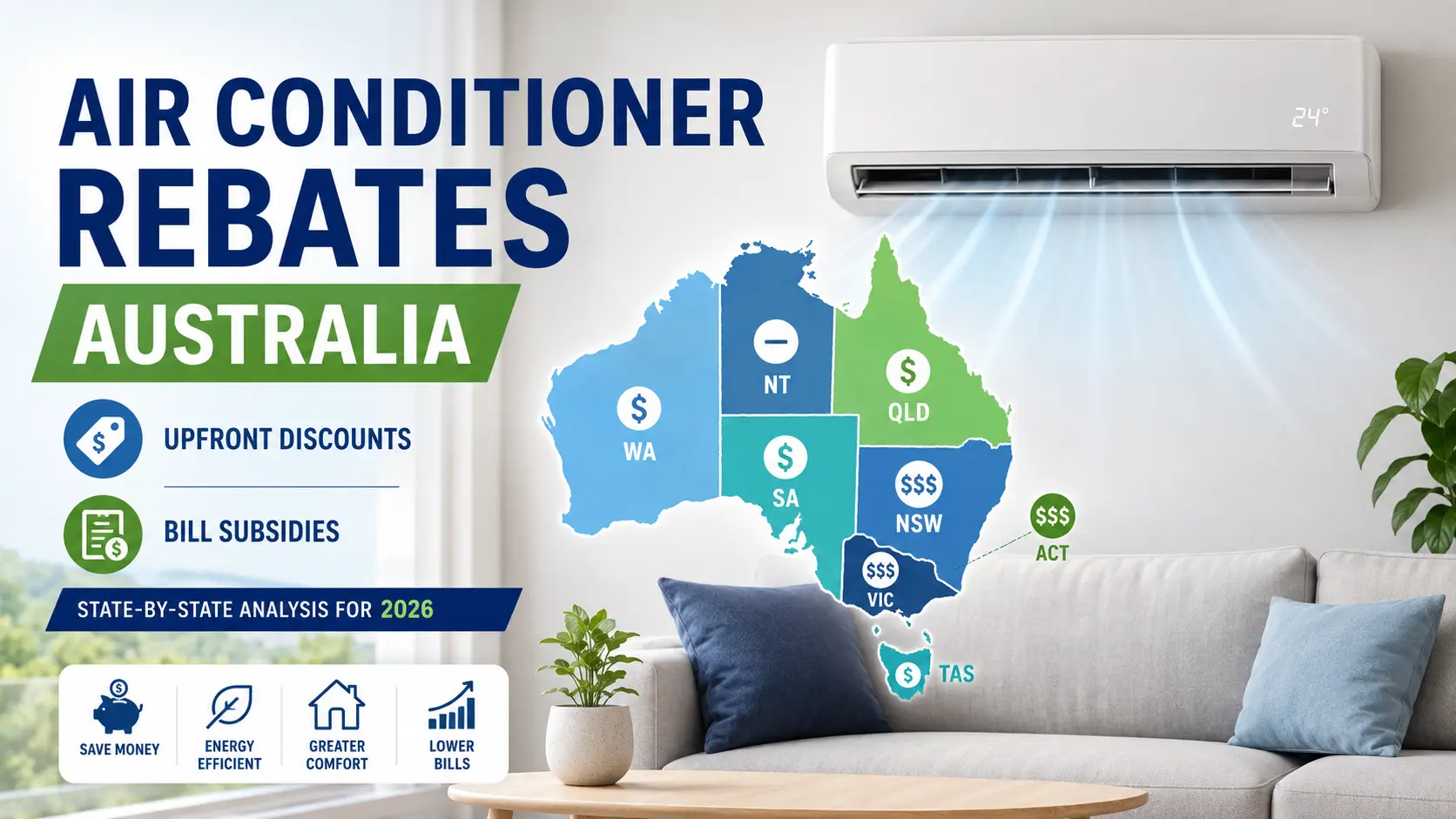
The Australian government offers Air Conditioner rebates to speed up the transition from older systems to new ones. The old ACs rely on an aggressive on-or-off cycle. This puts a massive demand on the grid during seasonal peaks. In comparison, newer reverse-cycle split or ducted systems rely on superior inverter and reversing valve technology. This makes them far more energy efficient than the older models.
There are various air conditioner rebates in Australia to incentivize this change. However, it’s worth noting that there are no dedicated federal rebates for this, like the one that exists for solar panels. Instead, all of the AC rebates in Australia are state-based programs.
These rebates vary widely according to state rules and available schemes. For instance, in states like Victoria, NSW, and ACT, you might get upfront discounts of up to 5000$ or more when you upgrade to a highly energy-efficient system. Meanwhile, some states don’t have any rebate programs at all and only offer medical and electricity bill concessions for target groups.
AC rebates in Australia can get quite confusing since they are not streamlined like the programs for solar panels and heat pumps. Check the following guide to find out what applies to you.
Air Conditioner Rebates In Australia- June 2026
We should clear up one common confusion first. The air conditioner rebates are not a cash-back offer. Instead, it’s an upfront discount based on how much energy your AC saves. These energy savings are translated into tradable certificates, which your seller company is legally obligated to buy. This certificate money becomes a discount on your installation quote. In other words, you get the discount before you even pay.
The other types of rebates are essentially electricity bill concessions, not an actual discount on the purchase. Only certain concession cardholders and people with specified medical conditions are eligible for that.
A similar program was the Federal Energy Bill Relief Fund. While it was not exclusively for AC bills, most people thought it was since these credits were mostly offered during seasonal peaks when the systems ran for longer hours than usual. However, this federal relief program shut down on December 31, 2025. So, as for now, state-based AC rebates in Australia are the only thing available. Let’s see how they work.
Victoria
The AC rebates in this state are available under the Victoria Energy Upgrades program. Specifically, the Heating and Cooling Discount section provides a detailed table of discounts.
When you install a reverse-cycle AC in Victoria, it creates a Victorian Energy Efficiency Certificate (VEEC). One certificate means one tonne of greenhouse gas emissions avoided. So, the more energy-efficient your AC is, the greater number of certificates it generates.
Energy retailers like AGL or Origin must buy a government-specified number of VEECs each year. The payment the government receives from them is returned to the customer in the form of rebates. To legally sell and create these certificates, the AC provider must be accredited by the Essential Services Commission (ESC). That means you can’t just buy the AC from any seller.
How Much Do You Get With Victoria’s AC Rebates?
The rebate amount for replacing an older single-room gas heater with a modern reverse-cycle unit in Victoria is $1,610 (for 3-9 kW units). Take note of the ‘replacing’ part since the main reason the Victorian Government offers these rebates is to get rid of the older gas-based units.
This rebate amount can climb all the way up to $5,530 if you replace a whole-of-home ducted gas system with a ducted reverse-cycle system. The annual bill savings from this change can be around $460-$1,140.
The rebate amount varies greatly depending on the installed and replaced system’s technology. You can find the details for each specific system on the heating and cooling discount page.
However, the amounts mentioned above are the most you can get in that category. The simple rule is that if you replace an electric resistance or gas-based system, you get a greater discount. Also, discounts are naturally higher for larger whole-of-home units.
Victoria does fund brand-new installs with no old system being removed. However, the rebate amount is much lower in this case. It’s up to $140 for a single-room unit, or up to $410 (households) / $1,820 (businesses) for a ducted system. This is listed on the government’s table under “No decommissioned product.”
Eligibility for Victoria Air Conditioner Rebate:
- Any Victorian household or business – including private rental properties, although the applicant will always be the landlord
- The system being replaced must be more than 2 years old.
- The new unit must be on the VEU’s approved product list. In other words, it should be a genuine high-efficiency reverse-cycle model with a minimum 5-year warranty for homes.
- There’s a minimum co-payment you must pay regardless of the discount. It’s generally around $1,000 (incl. GST) for multi-split or ducted systems, or $200 for smaller non-ducted units under 10kW. This can’t be refunded or reduced further.
How to apply:
- Choose an accredited provider from the government’s published list. You might use your own installer, as long as they’re formally partnered with an accredited provider.
- Get a quote. There is no separate application portal for this rebate. Instead, the discount is already built into the installation quote.
- The provider handles installation and all the certificate paperwork on your behalf.
New South Wales
The NSW Air Conditioner rebate, or more accurately, the AC upgrade incentive, works almost the same way as Victoria’s, but under different programs and schemes. The broader Energy Savings Scheme (ESS) backs this rebate.
When a household upgrades to a reverse-cycle system, it creates a certain number of Energy Savings Certificates (ESC). Each certificate represents one MWh of energy saved.
The businesses allowed to deal with ESCs in NSW are the Accredited Certificate Providers. These are providers that are present on IPART’s ACP list. In NSW’s AC rebate case, IPART is the one that runs and oversees everything.
How Much Do You Get With the NSW AC Rebate?
In NSW, the AC rebate amount depends on the system’s size. For instance, a standard 6 kW split system receives a $550 discount for a brand-new installation. The amount is $560 if you are replacing an older technology. NSW’s government doesn’t provide a detailed table like Victoria’s. But the general rule is that bigger and more efficient systems get you greater discounts.
Eligibility:
- All NSW households and small businesses.
- You may not qualify if you already own an efficient AC, since the discount is calculated on the improvement between old and new systems.
- Renters can use the scheme, but need landlord permission since it involves a fixed appliance.
- Small businesses must pay a minimum of $200 (excl. GST) per air conditioner toward the cost, even after the discount.
How to apply:
- Get quotes from a few ACP-affiliated installers (or your own installer, partnered with an ACP)
- Confirm the discount is itemised clearly in writing on the quote.
- Sign a nomination form before installation begins — this formally hands your rights to the energy savings to the ACP; without it signed first, no certificate can legally be created, and you can’t claim the discount retroactively.
Queensland
To put it simply, there are no exclusive rebates for air conditioners in Queensland. Unlike Vic and NSW, there is no certificate-based AC discount here. The closest thing resembling an AC rebate in QLD is a discount on electricity bills, which is only for people with certain medical conditions. Eligible applicants receive it under the Medical Cooling and Heating Electricity Concession Scheme (MCHECS).
Unlike a provider- or installer-based rebate, this medical concession is a straightforward government payment. You get$522.09 per year (including GST), paid quarterly to your nominated bank account.
Eligibility:
- A Queensland address that’s your principal place of residence, with an air conditioner or heater already installed there.
- A doctor-certified qualifying medical condition. These include multiple sclerosis, autonomic system dysfunction, loss of skin integrity or sweating capacity, or hypersensitivity to temperature extremes leading to pain or complications.
- A medical specialist must formally certify in writing on the application form that you need cooling or heating to keep the condition from getting worse.
- You (or your legal guardian, if you’re a minor) must hold a current Pensioner Concession Card (Services Australia or Veterans’ Affairs) or Health Care Card.
- You must be the person responsible for paying the electricity bill.
- You can still receive this if you already get the standard state Electricity Rebate.
- Eligibility is reviewed every 2 years; permanent conditions skip recertification at renewal, but you still confirm card and living-situation details haven’t changed.
How to apply:
- Download the MCHECS application form from the government page
- Have your medical specialist fill in and sign the medical certification section.
- Post the completed form to the address on the form.
- Re-apply every two years
Note: It’s worth mentioning that the Peaksmart AC purchase cashback (400$) offered by Ergon and Energex in QLD is no longer available. The purchase cashback program closed in 2025.
Western Australia
WA doesn’t have an upfront discount on AC installation. Instead, they offer bill subsidy to residents in the genuinely hottest parts of the state — Karratha, Port Hedland, Carnarvon. Residents in these areas face brutal, unavoidable cooling costs for much of the year. Therefore, WA offers a targeted bill concession specifically for those zones. This is bundled into the wider concessions system rather than standing alone as an “upgrade your AC” incentive.
The WA Air Conditioning Rebate, or more accurately the bill subsidy, is delivered through your electricity retailer in the region like Synergy or Horizon Power. If you’re not billed directly by them, then you apply under the Energy Concession Extension Scheme (ECES)
How much do you get?
This rebate is structured as a usage credit, not a flat annual dollar figure. For instance, Synergy offers up to 221.8 kWh of electricity per month for every month it can be claimed. That translates to roughly $71.80 per month for a customer on the standard residential A1 Home Plan tariff.
It’s applied for however many months of the year your particular location is classified as eligible (the hottest, most remote locations get more eligible months than places closer to the boundary). There’s no single confirmed annual total published by WA or Synergy — it depends entirely on how many months apply to your address.
Eligibility:
- You must live north of the 26th Parallel and/or in an area defined by WA’s 50-Day Relative Strain Index. It’s a heat-discomfort measure WA uses to officially draw the eligibility boundary, based on how many days a year the heat is severe enough to physically strain the body. Synergy publishes a list of eligible towns and suburbs.
- On top of the location requirement, you also need to hold:
- A WA Seniors Card plus either a Commonwealth Seniors Health Card, Pensioner Concession Card, or DVA Pensioner Concession Card, or
- Dependent children plus a Health Care Card, Pensioner Concession Card, or DVA Gold Card (no Seniors Card needed in this case)
- Permanent residents of caravan parks can also apply.
- Most Perth metro households simply won’t qualify — this is purpose-built for the hot, remote parts of the state.
How to apply:
- If you’re billed directly by Synergy (Perth/south-west), call them or apply online via “My Account”
- If you’re billed directly by Horizon Power (regional WA), call them or download an application form from their site.
- If you’re billed by someone else — say you’re on a shared “embedded network” in a retirement village, caravan park, or apartment complex, or your retailer is Perth Energy or Alinta Sales — apply instead through the ECES Online Services Portal via RevenueWAConnect.
South Australia
SA runs two separate, unrelated programs. They have a health-based bill concession for people who medically need cooling or heating. Meanwhile, there is also a broader certificate-style scheme that subsidises buying an efficient AC for almost anyone. The program targets low-income and concession-card households.
Medical Heating and Cooling Concession
The SA medical heating and cooling concession offers $281.78 per year for 2025–26, rising to $291.27 from 1 July 2026 (indexed annually). Paid on top of, not instead of, the standard general energy concession.
Eligibility:
- A medical condition certified by a GP or specialist as severely worsened by hot or cold weather
- You actually use an air conditioning unit at your address to manage the condition.
- You’re financially responsible for the energy bill.
- You hold an eligible concession card or Centrelink payment.
How to apply:
- Download the application PDF (or call 1300 735 350 to have one mailed)
- Complete it together with your medical practitioner.
- Scan and email it to MHC@sa.gov.au.
Retailer Energy Productivity Scheme (REPS) — for buying a new AC
According to ESCOSA, the REPS is not a rebate scheme. South Australia’s government doesn’t offer fixed cash rebates here. Instead, the SA government sets annual energy productivity targets, measured in gigajoules, for a defined list of “obliged retailers” (AGL, Origin, EnergyAustralia, etc.).
Each retailer must deliver a certain volume of approved energy-saving upgrades across SA homes and businesses every year to hit its target. They can do it either directly or by contracting with activity providers (companies like MAC Trade Services or Ecovantage) to do it for them.
Since the retailer needs your upgrade to count toward its legal target, it’s willing to discount your installation in exchange. REPS is currently in its second five-year stage, running 2026–2030, so it’s an active, ongoing program.
How much do you get?
No fixed figure — typical savings range from a few hundred dollars for a small split system to well over $1,000 for a large ducted system. As a concrete example, eligible concession card holders or renters paying $500/week or less in rent have been able to get a 7-star efficient reverse-cycle split system installed for as little as $399, fully installed.
Eligibility:
- Open to all SA households and small businesses — no income test overall.
- There’s usually a small, one-off $33 administration fee per property (waived for Priority Group households)
- The deepest discounts go to “Priority Group” (also called Hardship Group) customers, defined as anyone who holds a Pensioner Concession Card, Health Care Card, TPI/War Widows Gold Repatriation Health Card; is on an energy retailer hardship or payment plan; receives an SA Government Energy Concession; was referred by a registered SA Financial Counsellors Association (SAFCA) member; or rents at $400–500/week or less (figures vary slightly by source)
- You can only get the same upgrade activity once per address — e.g. you can’t claim an AC discount twice at the same property.
- Renters need landlord approval before any upgrade.
How to apply:
- Contact a REPS-participating retailer or one of their contracted activity providers directly to check what’s available.
- Get a quote with the discount already built in.
- The installer must show ID and provide a written information statement describing the activity, any required co-payment, and your consumer rights before starting work.
Tasmania
Tasmania, like Queensland, treats AC support almost entirely as ongoing electricity bill relief for medically eligible residents and cardholders. There’s no scheme here that subsidises buying a brand-new unit upfront. Instead, eligible households get a daily discount taken straight off their power bill.
How much you get:
- Medical Cooling or Heating Concession: 52.975 cents/day off your bill (roughly $193/year) — for people billed normally by a retailer such as Aurora Energy
- Medical Cooling or Heating Concession – Embedded Network: a flat $193.36/year for people on shared “embedded network” billing (caravan parks, retirement villages) who can’t access the standard retailer concession
- Annual Electricity Concession: 176.866 cents/day — not AC-specific, but still lowers the overall bill for eligible cardholders
Eligibility:
- You (or someone you live with) need a doctor-certified medical condition.
- Tasmania lists specific “core” conditions that qualify outright on their own: Multiple Sclerosis, Lymphoedema, Parkinson’s Disease, Fibromyalgia, Motor Neurone Disease, Post Polio Syndrome, Scleroderma, Systemic Lupus Erythematosus, and Complex Regional Pain Syndrome.
- If your condition isn’t on that list, you can still qualify by meeting at least one “primary” qualifying condition (e.g. autoimmune dysfunction, loss of sweating capacity, hypersensitivity to temperature extremes) combined with at least one “secondary” qualifying condition (e.g. severe immobility, demonstrated loss of autonomic regulation of sweating, heart rate, or blood pressure)
- You need a Health Care Card or Pensioner Concession Card.
- Medical certification needs renewing every 4 years.
How to apply:
- For the standard concession: contact your electricity retailer directly with the certified application form.
- For the embedded network version: submit the relevant medically-certified PDF form to Service Tasmania
Australian Capital Territory
The ACT has a formal commitment to full electrification and net-zero emissions by 2045. The regional authorities explicitly want gas heaters gone from Canberra homes specifically, not just upgraded to a slightly more efficient AC.
As a result, two separate but complementary incentives run side by side here, and both are noticeably generous compared with most other states, especially for concession card holders.
Home Energy Support Program (HESP)
Under the HESP, ACT offers an AC rebate covering 50% of supply-and-installation cost, capped at $2,500.
This applies to reverse-cycle heating and cooling, which sits inside an overall $5,000 household cap shared with other eligible upgrades (rooftop solar, hot water heat pumps, electric stovetops, ceiling insulation).
Eligibility:
- ACT resident who owns and lives in the home being upgraded
- Holds an Australian Government Pensioner Concession Card, DVA Gold Card, or Australian Government Health Care Card
- Must have attended a free online “Everyday Climate Choices” workshop before applying
- Property’s Unimproved Value (UV) — the government’s valuation of just the land, used here as a rough wealth proxy — must be at or below $750,000 for a freestanding house, or $300,000 for a multi-storey apartment.
How to apply (two pathways):
- Option 1 — rebate only: get a quote from an approved supplier via Brighte’s website → submit application before installation starts → pay the full cost upfront yourself → submit a claim form afterward → rebate paid to you roughly 10 business days later
- Option 2 — rebate plus loan: apply through Brighte directly, who process both the rebate and an optional zero-interest loan of up to $10,000 at the same time (loan requires a standard credit check; rebate-only doesn’t)
ActewAGL Heating and Cooling Upgrade
This one exists because ActewAGL, as the ACT’s main electricity retailer, is legally obligated under the territory’s Energy Efficiency Improvement Scheme (EEIS) to deliver a quota of energy-saving upgrades to ACT customers each year.
This includes a required share that must go to lower-income or vulnerable “priority households”. So, the rebate is essentially ActewAGL fulfilling that legal obligation directly through its own retail channel, separate from the government’s HESP program above.
How much do you get:
- Ducted gas heater → ducted reverse-cycle: $2,500 off purchase + $500 in bill credits (paid as $41.67/quarter over 3 years). Concession card holders get up to $5,000 off + $1,000 in bill credits ($83.33/quarter)
- Fueled gas heater → reverse-cycle: $1,250 off purchase + $500 in bill credits. Concession card holders get up to $2,500 off + $500 in bill credits.
Eligibility:
- Live in the ACT
- Already be an ActewAGL electricity customer.
- Currently have ducted or flued gas heating — this scheme is specifically about getting people off gas, so it won’t apply if you’re just replacing an old electric AC with a newer electric one.
How to apply:
- Request a quote through “Electrify with ActewAGL”
- Choose from their approved installer list.
- Show your eligible concession card plus proof of residence at the time of sale to unlock the bigger concession-card discount — no separate claim form is needed since the discount applies directly at point of sale.
Northern Territory
The NT doesn’t currently run a dedicated AC-purchase rebate at all. What the NT does offer is a general electricity bill concession (not AC-specific) and a payment specifically for medical heating/cooling needs. These are the NT Concession Scheme (general electricity concession) and Essential Medical Equipment Payment.
The concession scheme ismembership-based. You apply via your electricity retailer (Jacana Energy or Power and Water Corporation), referencing your NT Concession Scheme membership number.
How much do you get:
- Up to $1,200 per year off electricity costs (covering up to 8,000 kWh of usage) — this is a general bill concession, not specific to running an AC
- If you exceed that $1,200 cap and have a medical condition that directly affects your electricity consumption (yours or a dependant’s), you can get an additional $154 medical support allowance once the cap is exceeded.
Eligibility:
- Be a member of the NT Concession Scheme (membership itself requires holding an eligible concession card — broadly similar to other states’ Pensioner Concession Card / Health Care Card / DVA card categories)
- Only one member per household can access the electricity concession.
- For the additional medical allowance, you must be responsible for paying the electricity account and have a medically-linked reason for elevated electricity use.
How to apply:
- Register as a member of the NT Concession Scheme first.
- If you’re the primary account holder with Jacana Energy or Power and Water Corporation, give them your NT Concession Scheme membership number, and they will apply the standard concession automatically.
- For the extra medical support allowance, once you exceed the $1,200 cap, fill in the separate medical support allowance form.
Here is a quick comparison between the state-based Air Conditioner rebates in Australia –
| State/Territory | Program name(s) | What you actually get | How it’s funded |
| VIC | Victorian Energy Upgrades (VEU) | $210–$5,530 upfront discount | VEEC certificate retailers must buy |
| NSW | Air Conditioner Upgrade Incentive (under the ESS) | “Up to $550/$560” official example (6kW); varies by size/efficiency | ESC certificate retailers must buy |
| QLD | Medical Cooling and Heating Electricity Concession Scheme (MCHECS); PeakSmart now closed | $522.09/yr cash, paid quarterly | Direct government concession |
| WA | Air Conditioning Rebate (via Synergy/Horizon Power or ECES) | Up to 221.8 kWh/month (~$71.80/month), for eligible months | Direct government concession, location-based |
| SA | Medical Heating and Cooling Concession + REPS | $291.27/yr (medical) + from $399 installed (REPS) | Government concession + retailer productivity targets |
| TAS | Medical Cooling or Heating Concession (+ embedded network version) | ~$193–$245/yr equivalent | Direct government concession |
| ACT | Home Energy Support Program (HESP) + ActewAGL Heating and Cooling Upgrade | $1,250–$5,000 upfront + ongoing bill credits | Government rebate + retailer’s EEIS legal obligation |
| NT | NT Concession Scheme + Essential Medical Equipment Payment | $1,200/yr general electricity concession + $154 medical top-up | Direct government concession (no AC-purchase rebate) |
Final Words
As you can see, only a few states offer certificate-based air conditioner rebates in Australia. The rest are mostly electric bill concessions for targeted groups. If you are in the states that offer rebates, Aussie Solar Tech can help you pick an approved Air Conditioner that helps you get a discount and also an overall fair price. Even if your state doesn’t offer any direct rebate, we can help you choose an AC within the perfect price range and with reduced installation costs. So contact us today.
FAQs
I live in Victoria and rent my home — can I still get the AC discount, or does it only go to the landlord?
Renters are eligible, but the appliance belongs to the property, not you personally. Victoria’s program recommends that landlords and tenants coordinate on the upgrade since the landlord typically owns the new unit while the tenant enjoys lower bills — neither side automatically gets the discount without the other agreeing.
In NSW, why did one installer quote me $560 off and another quote me almost nothing for the same air conditioner?
Because the discount comes from Energy Savings Certificates, and their market price changes daily, plus different installers (ACPs) negotiate different certificate rates and pass on different margins. Always get several quotes; NSW’s government page itself says $550–$560 is just an indicative example, not a guarantee.
I’m in WA but live in Perth, not the far north — can I get the Air-Conditioning Rebate at all?
Almost certainly not. The rebate only applies north of the 26th Parallel or in zones defined by the 50-Day Relative Strain Index — places like Karratha or Port Hedland, not Perth or the south-west. Living in the right postcode is a hard requirement, separate from any concession card you hold.
In SA, is the REPS air conditioner discount the same thing as the Medical Heating and Cooling Concession?
No, they’re completely separate. REPS discounts the upfront purchase of a new AC through your energy retailer, open to almost anyone. The Medical Concession is a yearly cash payment ($291.27 from July 2026) for people with a doctor-certified condition — you can potentially get both, but you apply for each one separately.

Shah Tarek is a Solar Energy Consultant with 10 years experience in solar system design and solar consultancy field at Australia. He is now a Director, Operation & Consultancy Division at Aussie Solar Tech, a leading Australian solar retailer and installer. Here he is writing informative and engaging solar content that educates the community on the benefits of solar power. His work supports Aussie Solar Tech’s mission to promote sustainable energy solutions and foster a greener future for Australia.



Seraphim Solar Panels Review: Efficiency, Reliability, and Value Unveiled

Talesun Solar Panels: Honest Review Before You Buy

Sungrow Battery VS Tesla Powerwall : Which is Best in Australia?

Leapton Solar Panels Review: Affordable Energy Solution

REC Solar Panels Review: Outstanding Efficiency & Durability

Best Hybrid Inverters for Home Solar Systems in 2025
Best Solar Battery In Australia 2026 — Complete Guide

Sigenergy VS Fox ESS Battery: Which is The Best Choice for 2026

How Much Do Solar Panel Costs in Australia? (2026 Price Guide)

