
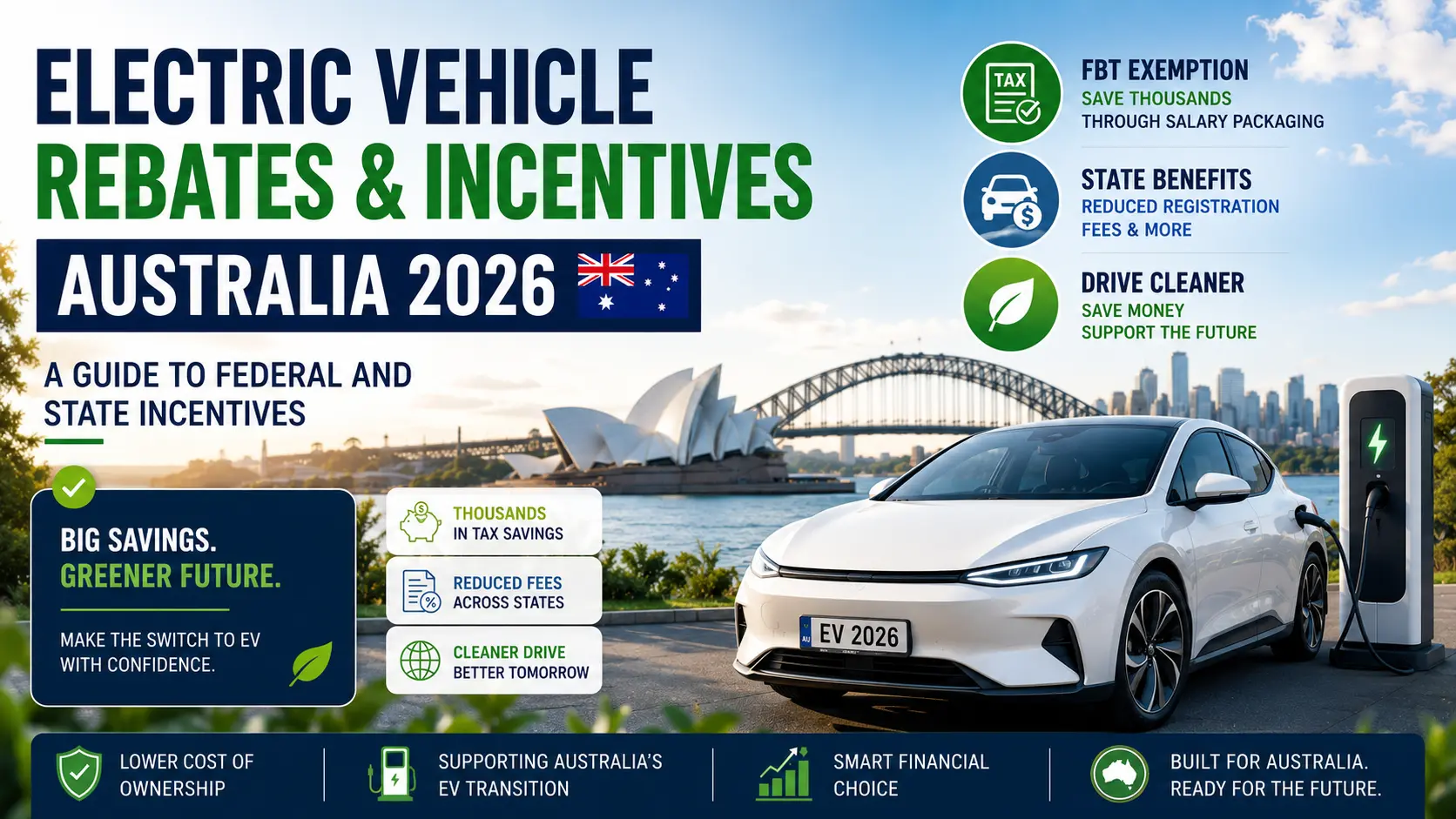
Newer vehicle efficiency standards and rising fuel prices were strong motivations for Australians to choose EVs. They got even more reason to make the change when the government began offering tax and state-specific benefits. As a result, battery electric vehicles (BEVs) are seeing unprecedented demand in mid 2026, capturing nearly 15-16% of the Australian new car sales market.
Most Australian rebates for green tech are split nationwide and state-by-state. Same here. The federal EV incentive is a 100% Fringe Benefits Tax (FBT) exemption. It eliminates the standard 47% FBT liability on an eligible vehicle’s private use. As of June 2026, this means a massive after-tax salary saving of $5,000 to $9,000 per year for a standard 3-to-5-year lease agreement.
To qualify, the vehicle must be zero-emission and should not cost more than $91,387. However, the price cap will become significantly stricter for the full exemption after March 31, 2027, due to the surge in EV sales.
Most importantly, this specific tax break is for EVs within a novated lease structure. That means if you are a self-employed sole trader, this EV rebate is not for you. However, you might be eligible for alternative state-specific benefits. For instance, registration fee concessions remain widely available depending on your location. Find all the details in the following discussions.
Nationwide Electric Vehicle rebates for Australia 2026: The FBT Exemption
The Electric Vehicle (EV) Fringe Benefits Tax (FBT) exemption specifically targets working middle-class Australians. The federal policy allows employees to reduce thousands off the cost of a new electric car through salary packaging. However, after the key updates in the 2026 Federal Budget, the rules are officially changing.
At-a-Glance: The Complete Australian EV Tax Roadmap
| Phase | Timeline | Price Rules | Tax Treatment (FBT) | What You Save | Eligible Car Types |
| The Launch | July 2022 – March 2025 | Under Luxury Tax Limit | 0% Tax (100% Exempt) | Up to $10,000/yr | BEVs (Electric), FCEVs (Hydrogen), PHEVs (Hybrids) |
| Current Phase | April 2025 – 31 Mar 2027 | Under $91,387 (2025–26) Under $91,661 (2026–27) | 0% Tax (100% Exempt) | Up to $10,000/yr | BEVs & FCEVs Only(Hybrids completely removed) |
| Transitional Phase | 1 Apr 2027 – 31 Mar 2029 | Up to $75,000
From $75,001 to Luxury Limit |
0% Tax (100% Exempt)
15% Tax (25% Discount) |
Maximum savings Minor tax reduction |
BEVs & FCEVs Only BEVs & FCEVs Only |
| Long-Term Plan | 1 April 2029 Onward | All cars under Luxury Limit | 15% Tax (25% Discount) | Minor tax reduction | BEVs & FCEVs Only (100% tax-free tier permanently closed) |
The Electric Car Discount 2022
Fringe Benefits Tax (FBT) is a tax on the perks your job offers. When you buy a car through your job, you use your pre-tax salary via a novated lease. The government considers the vehicle as a taxable bonus. This places a heavy FBT liability on your employer. So, he passes that cost onto your paycheck. Thus, wiping out most of your potential tax savings.
To speed up Australia’s transition to zero-emission vehicles, the government turned this tax hassle into a powerful incentive. They established the Electric Car Discount under the Treasury Laws Amendment (Electric Car Discount) Act 2022, applying to eligible vehicles first held and used on or after 1 July 2022.
This legal exemption prevents the ATO from collecting FBT on qualifying vehicles. Since the government sets this specific tax liability to 0%, your employer can legally take out 100% of your car lease and maintenance payments directly from your gross (before-tax) salary.
The policy is open to any permanent full-time or part-time employee whose employer offers salary packaging. When the program initially launched, it covered Plug-in Hybrids (PHEVs) to kickstart the initiative. However, PHEVs became ineligible for the exemption on 1 April 2025. Today, the tax break strictly applies only to full Battery Electric Vehicles (BEVs) and Hydrogen Fuel Cell Vehicles (FCEVs) priced below the fuel-efficient Luxury Car Tax threshold.
The Australian EV Rebate Changes in 2026
In May 2026, the government confirmed they are pulling the leash on this program since it became too expensive for the federal budget. They are breaking the future of the program into three phases.
From right now until 31 March 2027, the original rules will apply. Any eligible EV under the luxury limit gets the full 100% tax-free discount.
However, a price split begins on 1 April 2027 and continues up to 1 April 2029. From April 1, 2027, if your new EV costs $75,000 or less, it stays 100% tax-free. However, if the vehicle’s price is between $75,001 and the luxury limit, you won’t get the full exemption anymore. It will be a much-reduced 25% tax discount. From 1 April 2029 onward, the 100% tax-free tier will be completely gone for new buyers. Every single electric car will permanently switch to just a flat 25% discount on the tax.
Which EVs Qualify For FBT Exemption in 2026
To get the 100% tax exemption today in June 2026, the vehicle has a very specific checklist set by the ATO:
- 100% Battery Electric Vehicle (like a Tesla, BYD, or MG) or a Hydrogen fuel cell car.
- Traditional hybrids and Plug-in Hybrids (PHEVs) do not qualify.
- Passenger car for carrying fewer than 9 people
- Can carry a load of no more than 1 tonne (trucks or heavy vans don’t qualify).
- Retail price must be under$91,387 (current fiscal year).
- The threshold rises slightly to $91,661 for the upcoming 2026–27 financial year.
- The car must have been first imported, bought, or used anywhere in the world on or after 1 July 2022.
How Much Can You Actually Save?
Since your car payments come directly out of your pre-tax money, your overall taxable income drops, meaning you pay thousands less in standard income tax every year.To see how this works in the real world, think of a standard $50,000 electric car packaged through a novated lease.
On day one, you save roughly 10% right out of the gate. This happens because the fleet leasing company can claim back the GST on the purchase price and pass that direct saving on to you, bringing the starting lease balance down to about $45,450.
Where you really save is with the ongoing running expenses. Usually, when you pay for charging electricity, comprehensive insurance, or yearly registration, you use your take-home pay—cash that has already been eaten up by your 30% or 45% marginal income tax bracket.
With the FBT exemption, your employer pays those exact running bills out of your salary before any tax is withheld. You are essentially bypassing the income tax net entirely on every single dollar spent to keep the car running.While the car itself doesn’t legally change price, this tax optimization lowers your overall cost of living so dramatically that driving a $50,000 EV impacts your wallet the same way as owning a much cheaper $25,000 petrol car. For a standard EV, this keeps an extra $5,000 to $6,500 in your annual savings.
Furthermore, if you scale up to a premium, high-end model sitting near the LCT threshold (vehicles priced up to $91,661), those numbers grow even faster. Since those high-end cars incur heavier baseline taxes, eliminating that 47% FBT liability can easily skyrocket your salary sacrifice savings up to a massive $9,000 to $10,000 every single year of the lease agreement.
The RFBA Obligation — What Most People Miss
The RFBA obligation often catches first-time buyers completely off guard. Even though you do not pay a single dollar of Fringe Benefits Tax on your EV, the government still makes it mandatory for your boss to calculate what that tax would have been. This invisible number is called the Reportable Fringe Benefits Amount (RFBA), and it gets printed directly onto your end-of-year tax summary.
You do not pay income tax on this number. However, the government looks at this paper amount when deciding your true financial position for means-tested government programs Because the RFBA inflates your adjusted income on paper, it can heavily affect things like Medicare and Child Support.
If your personal income is $95,000, you don’t normally pay the extra 1% Medicare Levy Surcharge for lacking private health insurance. However, adding a $15,000 RFBA from your EV lease pushes your “paper income” to $110,000, crossing the government threshold and triggering an unexpected tax penalty at tax time.Services Australia calculates child support payments using your adjusted taxable income. If your base salary is $80,000, but an EV lease adds a $14,000 RFBA to your record, the system looks at you as if you earn $94,000.
If you pay child support, this artificial spike can significantly increase your required monthly payments to an ex-partner. For someone who receives child support, it can sharply reduce the amount you receive, while simultaneously slashing your eligibility for government childcare subsidies. So, those who rely on these systems must calculate this financial ripple effect before signing.
What can you do before 31 March 2027?
If you want to maximize your savings—especially if you are planning to buy an electric car that costs more than $75,000—you need to sign the lease before 31 March 2027.The government uses a rule called Grandfathering. This is essentially a legal promise that protects early birds. If you get your lease approved, lock in your contract, and have the car delivered to you before the 31 March 2027 deadline, the government will protect your contract. Even when the law changes for the rest of the country in April 2027 and April 2029, your specific car will remain 100% tax-free for the entire length of your lease (usually up to 5 years).
Comprehensive Step-by-Step Application Process
Step 1: Verify Workplace Eligibility
Speak directly to your internal HR or Payroll department. Confirm they permit salary packaging and ask if they have an exclusive contract with a specific novated leasing provider (like Maxxia, RemServ, or Smartleasing).
Step 2: Request an Obligation-Free Quote
Contact the leasing company. Provide them with your annual salary, your estimated annual driving kilometers, and your target EV model. They will generate a quote breaking down how much money will be deducted from your pre-tax pay versus your post-tax pay.
Step3: Submit Financer Credit Approval
Once you approve the quote, you must formally apply for the lease finance. You will need to digitally upload your driver’s license, your last 2–3 consecutive payslips, 3 months of bank statements, and a copy of your primary employment contract to clear a mandatory credit check.
Step 4: Lock in the Vehicle and Price
The leasing company will use its fleet buying power to source your chosen EV from a commercial dealer network, stripping the upfront GST out of the purchase price. They will provide a formal vehicle order for you to confirm
Step 5: Sign the Deed of Novation
This is the critical legal step. A three-party contract called a Deed of Novation is generated between you, your employer, and the finance company. By signing this, your employer legally agrees to take over the vehicle’s payment obligations directly out of your salary.
Step 6: Confirm Delivery and Payroll Setup
The vehicle is delivered to your home or office. Once you accept the keys, the leasing provider formally triggers the contract, notifying your employer’s payroll team to automatically begin the pre-tax salary deductions before the 31 March 2027 deadline.
State-by-state EV Rebates For Australia 2026
While employee salary packaging can stack these state perks directly on top of the heavy-duty federal FBT tax rebate, state-level incentives are completely open to all buyers. In fact, if you are a non-employed individual buyer, retiree, or sole trader purchasing a vehicle outside of a corporate fleet structure, these localized fee reductions represent the only active government concessions available to help reduce your electric vehicle costs.
Let’s run a scenario across every state using a single baseline vehicle, the Tesla Model 3 Rear-Wheel Drive (RWD). The Baseline Price for this EV is $60,000 AUD (approximate market retail/dutiable value). It’s about 1.7 tonnes and is a Pure Battery Electric vehicle.
Here is how active concessions, closed schemes, and plate mandates break down for this specific car across all jurisdictions as of June 2026. Unmentioned states currently don’t have any incentives.
| State / Territory | Active Concession Type | Exact Value Saved (On a $60,000 Baseline EV) | Notable Closed Scheme | Plate Labeling Mandate |
| ACT | Emissions-based registration | $313 saved every year (Registration drops from $695 to $382). | 2 years’ free registration ended June 2024; stamp duty waivers ended Aug 2025. | Mandatory; blue “EV” triangle or yellow “H” pentagon on> 1 mm metal plate. |
| NSW | Motor vehicle tax weight concession | $30 to $40 saved every year (Concessional low-emissions tier). | $3,000 rebate & complete stamp duty exemption ended 1 Jan 2024. Proposed 2027 RUC under inquiry. | Mandatory; blue “EV” triangle or yellow “H” pentagon on> 1 mm metal plate. |
| NT | Base registration waiver & Stamp duty discount | $1,500 upfront + $91 every year (0% stamp duty up to $50k; active until 30 June 2027). | Home/business EV charger grants closed on 31 Dec 2025. | Mandatory; blue “EV” triangle or yellow “H” pentagon on> 1 mm metal plate. |
| QLD | Low-tier vehicle registration duty | $600 to $900 upfront (Locked into flat 2% tax tier instead of up to 3.5% or higher for ICE). | $6,000 upfront ZEV purchase rebate ended 2 Sep 2024. | Mandatory; blue “EV” triangle or yellow “H” pentagon on> 1 mm metal plate. |
| SA | Grand-fathered registration waiver(Time-limited) | $152/yr but ONLY if first registered before 30 June 2025 (lasts 3 years). $0 for new buyers. | $3,000 purchase subsidy closed on 31 Dec 2024. | Mandatory: blue “EV” triangle or yellow “H” pentagon on> 1 mm metal plate. |
Buying an EV? Don’t Forget Your Home Charging Setup
Most EV owners in Australia charge at home, and a dedicated Level 2 charger can charge significantly faster than a standard power outlet. Government data shows that around 80% of EV charging happens at home.
If you’re planning to take advantage of the EV FBT exemption, it’s also the perfect time to install a smart home EV charger.
Aussie Solar Tech supplies and installs premium EV chargers across Australia, including:
- Tesla Wall Connector
- Ocular IQ
- Zappi
- Wallbox
- Solar-compatible smart chargers
✅ Professional installation
✅ Smart charging features
✅ Solar integration options
✅ Australia-wide support
Get a free EV charger quote today.
Final Words
If you have been thinking about making the transition from petrol-based cars to a low-maintenance, climate-friendly EV, now is the time. Deciding between today and a year from now can mean a difference of paying thousands of dollars out of your savings, especially if you are planning to buy an EV with slightly above-average standards.
You can contact our experts at Aussie Solar Tech with further questions about the EV rebates in Australia. We are happy to help. Plus, buying an EV means you have to set up a charging station. We offer some of the best EV chargers on the market at the fairest retail prices, including installation.
FAQs
Can I stack state EV discounts with the Federal FBT exemption?
Yes. State-level concessions operate independently of federal tax laws. If you purchase an eligible electric vehicle through an employer-provided novated lease, you can fully combine these state incentives with the federal Fringe Benefits Tax (FBT) exemption for maximum savings.
Do I miss out on state EV incentives if I buy a car privately?
No. State registration and stamp duty reductions apply directly to the vehicle itself when it is registered, regardless of your employment status. While private buyers cannot access the employer-reliant federal FBT exemption, they are fully eligible for all active, localized state-level fee concessions and ongoing vehicle tax discounts.
When does the Federal EV FBT exemption officially end?
It is phasing out gradually. The full 100% FBT exemption remains active for all electric vehicles under the Luxury Car Tax threshold until March 31, 2027. After that, a $75,000 price cap applies before transitioning permanently to a smaller 25% FBT discount for all eligible electric vehicles starting April 1, 2029.
Are Plug-in Hybrids (PHEVs) eligible for the same FBT tax breaks as pure EVs?
No, new plug-in hybrid arrangements are no longer eligible. The federal government’s FBT exemption sunset clause officially excluded PHEVs on April 1, 2025. Only existing hybrid lease agreements locked in before that deadline remain grandfathered; all new tax-free concessions are strictly reserved for pure battery electric and hydrogen vehicles.

Shah Tarek is a Solar Energy Consultant with 10 years experience in solar system design and solar consultancy field at Australia. He is now a Director, Operation & Consultancy Division at Aussie Solar Tech, a leading Australian solar retailer and installer. Here he is writing informative and engaging solar content that educates the community on the benefits of solar power. His work supports Aussie Solar Tech’s mission to promote sustainable energy solutions and foster a greener future for Australia.







Seraphim Solar Panels Review: Efficiency, Reliability, and Value Unveiled

Talesun Solar Panels: Honest Review Before You Buy

Sungrow Battery VS Tesla Powerwall : Which is Best in Australia?

Leapton Solar Panels Review: Affordable Energy Solution

REC Solar Panels Review: Outstanding Efficiency & Durability

Best Hybrid Inverters for Home Solar Systems in 2025

Best Solar Battery In Australia 2026 — Complete Guide

Sigenergy VS Fox ESS Battery: Which is The Best Choice for 2026

How Much Do Solar Panel Costs in Australia? (2026 Price Guide)

