
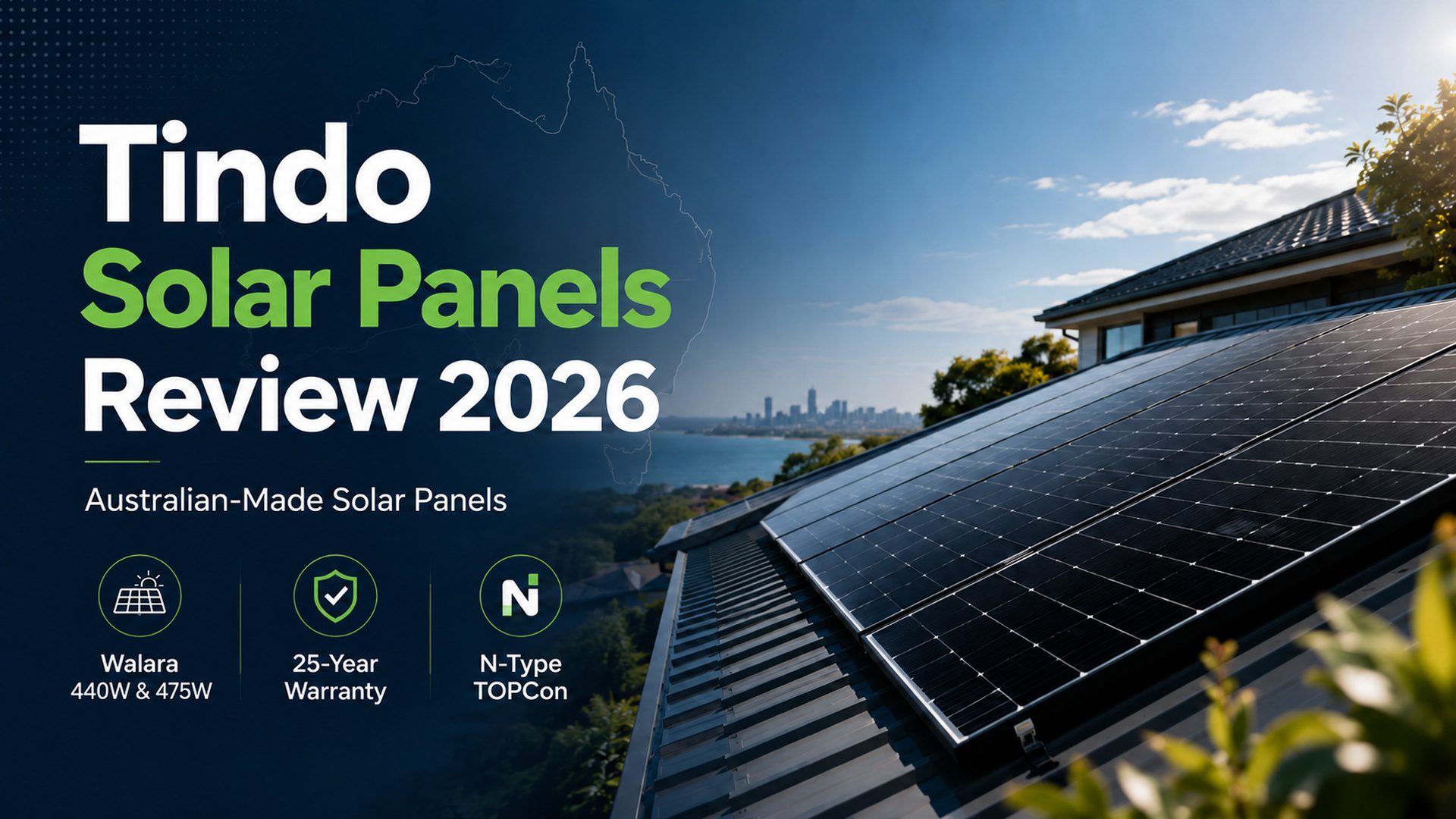
Australia has no shortage of solar-panel options, but Tindo offers something different as the country’s only current solar-panel manufacturer. Its latest Walara modules are manufactured at Mawson Lakes in South Australia, combining local production with modern N-Type TOPCon technology, competitive efficiency and Australian-based technical support.
The current range includes the Tindo Walara 440W and 475W panels, designed for homeowners who value performance, durability and local manufacturing. This Tindo Solar Panels review looks closely at their key features, warranty, pricing and overall value to help Australian buyers decide whether the extra cost is justified.
Tindo Solar Panels: Quick Verdict
Tindo’s ninth-generation Walara G4P range includes the Tindo Walara 440W and the Tindo Walara 475W all-black model. Both use N-Type TOPCon cells, 16-busbar construction, a reinforced 35mm frame and 25-year product and performance warranties.
| Category | What buyers should know |
| Current models | Walara 440W G4P and Walara 475W G4P-BL |
| Cell technology | N-Type TOPCon |
| Cell design | 16-busbar, half-cut cells |
| Module efficiency | 22.6% for 440W; 21.9% for 475W |
| Temperature coefficient | –0.30%/°C |
| Positive power tolerance | 0 to +5W |
| Product warranty | 25 years |
| Performance guarantee | 87.4% of rated output at year 25 |
| Manufacturing | Mawson Lakes, South Australia |
| 440W panel price | Approximately A$190–A$220 |
| 475W panel price | From approximately A$215 |
| Typical 6.6kW installed price | Approximately A$6,500–A$8,000 |
| Best suited to | Buyers prioritising local manufacturing, quality control and support |
| Main drawback | Higher upfront price than many imported panels |
The verdict is positive. For buyers researching Tindo solar panels Australia, the Walara range offers strong specifications and local support, but it is not designed to compete as the cheapest option.
Key Features of Tindo Solar Panels
N-Type TOPCon Cells
Both current panels use laser-cut N-Type TOPCon cells with a 16-busbar design. The additional electrical pathways are intended to reduce internal resistance and support efficient power transfer through the module.
Competitive Module Efficiency
The Tindo Walara 440W reaches 22.6% efficiency, making it the more space-efficient option in the range. The larger 475W model reaches 21.9% efficiency but produces more total power from each module.
Reinforced 35mm Frame
Tindo uses a 35mm no-cut-back aluminium frame designed to limit module flex and help protect the cells from microcracking during transport, installation and exposure to demanding weather conditions.
Positive Power Tolerance
Both models have a positive power tolerance of 0 to +5W. Under standard test conditions, the panel should not be rated below its advertised wattage and may test slightly above it within that range.
Local Quality Control and Support
Tindo states that every current panel passes seven predetermined quality checkpoints before leaving the factory. The company also maintains Australian-based service, warranty and technical teams.
25-Year Warranty and Premium Offer
Current Walara panels include a 25-year limited product warranty and a 25-year performance guarantee, covering at least 87.4% of rated output at year 25.
Eligible original purchasers may also register for Tindo’s A$1,000 Premium Warranty Offer. The payment applies when an approved warranty claim requires replacement of a qualifying N-Type panel. To qualify, the system must be purchased from 1 November 2025 onwards and registered within 60 days of installation. The offer is limited to one A$1,000 payment per installation site.
Buyers should register on time, retain their original purchase invoice and installation documents, and review the full warranty conditions.
Are Tindo Panels Really Australian Made?
Yes. Tindo manufactures, assembles and tests its Walara modules in South Australia. However, Australian-made does not mean that every solar cell and component is produced locally.
The company uses a combination of imported and Australian-supplied inputs, while module manufacturing, assembly and final quality control take place in Adelaide. Independent coverage also notes that Tindo has been increasing local content, including Australian-supplied aluminium for its frames.
The accurate description is that these are Australian made solar panels produced locally using a mix of domestic and imported components.
Local manufacturing gives Tindo closer control over module assembly and testing. It also provides buyers with access to an Australian manufacturer if technical or warranty support is required. Country of manufacture should still be considered alongside efficiency, price, warranty conditions and installer quality.
Tindo Walara 440W vs 475W
The Tindo Walara 440W is smaller and more efficient, while the Tindo Walara 475W provides more output per panel and an all-black appearance.
| Specification | Walara 440W G4P | Walara 475W G4P-BL |
| Rated output | 440W | 475W |
| Module efficiency | 22.6% | 21.9% |
| Cell configuration | 108 half cells | 120 half cells |
| Technology | N-Type TOPCon | N-Type TOPCon |
| Dimensions | 1722 × 1133 × 35mm | 1910 × 1133 × 35mm |
| Weight | 21kg | 23.5kg |
| Temperature coefficient | –0.30%/°C | –0.30%/°C |
| Power tolerance | 0 to +5W | 0 to +5W |
| Appearance | Black frame | All-black |
| Approx. 6.6kW array | 15 panels = 6.60kW | 14 panels = 6.65kW |
| Best suited to | Standard or space-sensitive roofs | Larger roofs and premium aesthetics |
The 440W panel is likely to fit a wider range of residential roofs. Its shorter length may make it easier to arrange around roof hips, vents, skylights and shaded sections.
The 475W panel needs fewer modules for a similar array capacity, but it is longer and heavier. Fewer panels therefore do not automatically mean it will fit a complex roof more easily. The official datasheets confirm the different dimensions and weights.
Typical Panel Numbers by System Size
| Target system size | 440W panels | Approx. capacity | 475W panels | Approx. capacity |
| 6.6kW | 15 | 6.60kW | 14 | 6.65kW |
| 8kW | 18 | 7.92kW | 17 | 8.08kW |
| 10kW | 23 | 10.12kW | 21 | 9.98kW |
| 13kW | 30 | 13.20kW | 28 | 13.30kW |
These figures are a general guide rather than a fixed system design. The correct number of panels depends on usable roof space, orientation, shading, inverter capacity and future electricity needs. Although the 475W model requires fewer panels, its larger dimensions may make the more compact 440W model easier to fit on complex roofs.
Performance in Australian Conditions
Both Walara models have a Pmax temperature coefficient of –0.30%/°C and an official operating-temperature range of –40°C to +70°C. Output will still decline as panel temperature rises, but this coefficient is competitive for current N-Type modules.
The official datasheets also list:
- Thermal cycling from –40°C to 85°C
- Damp-heat testing at 85°C and 85% relative humidity
- PID testing at 1500V DC
- Mechanical-load testing at 5400Pa front and 2400Pa rear
- 25mm hail testing at 23m/s
- Cyclone testing by an Australian structural engineering consultant
These tests do not make the panels immune to extreme weather, physical damage or poor installation. They show that the modules have been assessed for heat, moisture, electrical stress, hail and mechanical loads.
Tindo’s older 410W Karra panel received a 92% expert rating in independent consumer testing and recorded 417W in measured-output testing. This supports the brand’s manufacturing record, but the result applies to the previous Karra model—not directly to the current Walara range.
Tindo Solar Panels Price in Australia
The current Tindo solar panels price is higher than many mainstream imported alternatives. The following figures provide an indicative price guide for Australian buyers.
| Product or system | Indicative price |
| Walara 440W panel only | A$190–A$220 |
| Walara 475W panel only | From approximately A$215 |
| 6.6kW installed system | A$6,500–A$8,000 |
| 8kW installed system | A$8,000–A$9,500 |
| 10kW installed system | A$10,500–A$12,500 |
| 13kW installed system | A$13,000–A$16,000 |
| 20kW installed system | A$20,000–A$24,000 |
These are guide prices rather than fixed packages. The final cost depends on the selected panel, inverter, roof layout, switchboard condition, cable route, location, installation complexity and available STC value. A lower panel price does not always result in a better solar system. Inverter quality, mounting hardware, system design, installation workmanship and after-sales support also affect long-term value.
Final price may vary based on location, installation requirements. Contact us for a personalized quote and expert advice.
How Do Tindo Solar Panels Compare With Imported Panels?
Quality imported N-Type panels can offer similar efficiency and lengthy warranties at a lower upfront price. Tindo therefore does not automatically provide the lowest cost per watt.
Its main value lies in South Australian manufacturing, local technical support, reinforced construction and direct access to the manufacturer. The trade-off is a higher purchase price and a smaller product range than those offered by large international brands.
For buyers specifically seeking Australian made solar panels, Tindo is the clearest current option. Homeowners focused mainly on the lowest initial system price may find stronger cost-per-watt value from a reputable imported brand. Homeowners comparing Tindo with other premium brands can also explore our guide to the best solar panels in Australia.
Pros and Cons
| Pros | Cons |
| Manufactured and tested in South Australia | Costs more than many imported alternatives |
| Modern N-Type TOPCon technology | Uses some imported cells and components |
| 22.6% efficiency on the 440W model | The 475W model is comparatively large |
| Competitive –0.30%/°C temperature coefficient | Smaller manufacturer than global panel brands |
| Reinforced 35mm frame | Limited current model range |
| 25-year product and performance warranties | Premium offer requires registration |
| Australian-based technical and warranty support | Not always the lowest cost-per-watt option |
| Positive 0 to +5W power tolerance | Final results still depend on system design and installation |
Tindo Solar Panels Review: Final Verdict
This review finds that the current Walara range is technically competitive and offers a genuine point of difference for homeowners who value local manufacturing and support.
The Tindo Walara 440W is the stronger all-round residential choice because it combines 22.6% efficiency with a manageable panel size. The 475W version is better suited to larger roofs where greater output per panel and an all-black finish are priorities.
So, are Tindo solar panels good? Yes. Their efficiency, temperature performance, durability testing and warranty compare well with other premium products available in Australia. The main question is whether local manufacturing and Australian-based support justify the additional upfront cost.
For buyers considering Tindo solar panels Australia, the complete system proposal matters more than the panel price alone. Roof layout, inverter selection, installer quality and after-sales support remain essential to long-term performance.
Frequently Asked Questions
Are Tindo solar panels completely made in Australia?
Tindo panels are manufactured, assembled and tested in South Australia using a combination of locally sourced and imported components.
Which Tindo panel is better: 440W or 475W?
The 440W model has higher efficiency and a more compact size. The 475W model produces more watts per panel and has an all-black appearance, but it is longer and heavier.
What is the current Tindo solar panels price?
The 440W panel is approximately A$190–A$220, while the 475W model starts from around A$215. A typical 6.6kW installed system is approximately A$6,500–A$8,000, depending on the inverter, roof and installation requirements.
Do Tindo panels perform well in hot weather?
Both current models have a –0.30%/°C Pmax temperature coefficient. Like every solar panel, their output still declines as cell temperature increases.
What does the Tindo solar panels warranty include?
Current Walara panels include a 25-year limited product warranty and a 25-year performance guarantee of 87.4% at year 25. Eligible customers may also register for the separate A$1,000 Premium Warranty Offer.

Shah Tarek is a Solar Energy Consultant with 10 years experience in solar system design and solar consultancy field at Australia. He is now a Director, Operation & Consultancy Division at Aussie Solar Tech, a leading Australian solar retailer and installer. Here he is writing informative and engaging solar content that educates the community on the benefits of solar power. His work supports Aussie Solar Tech’s mission to promote sustainable energy solutions and foster a greener future for Australia.










Seraphim Solar Panels Review: Efficiency, Reliability, and Value Unveiled

Talesun Solar Panels: Honest Review Before You Buy

Sungrow Battery VS Tesla Powerwall : Which is Best in Australia?

Leapton Solar Panels Review: Affordable Energy Solution

REC Solar Panels Review: Outstanding Efficiency & Durability

Best Hybrid Inverters for Home Solar Systems in 2025

Best Solar Battery In Australia 2026 — Complete Guide

Sigenergy VS Fox ESS Battery: Which is The Best Choice for 2026

How Much Do Solar Panel Costs in Australia? (2026 Price Guide)

