
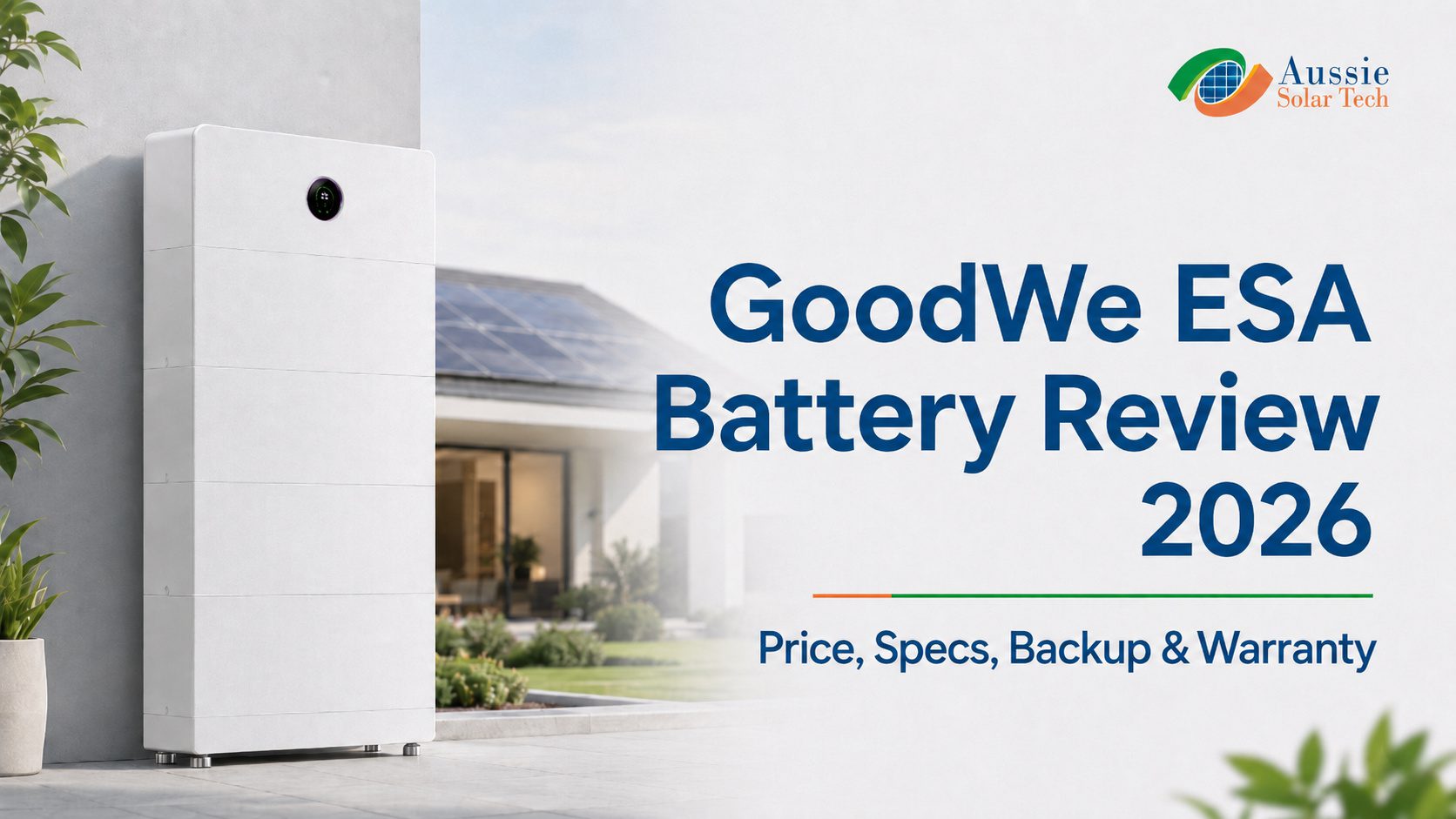
The GoodWe ESA battery is designed as a complete home energy storage system rather than a standalone battery. It combines a hybrid inverter, modular LFP battery storage and energy management in one system, with both single-phase and three-phase options available in Australia.
For homeowners considering battery storage in 2026, the ESA stands out for its expandable capacity, fast charging and discharging, whole-home backup and integrated design. This review covers the GoodWe ESA’s specifications, capacity, safety, warranty, pricing and how it compares with other popular home batteries.
About GoodWe
GoodWe was founded in 2010 and develops solar inverters, batteries, energy storage systems, EV chargers and smart energy management technology. The company was listed on the Shanghai Stock Exchange in 2020 and has an established Australian operation, including local technical support in Victoria.
GoodWe has been particularly active in residential energy storage, offering both integrated ESA systems and modular Lynx battery ranges for Australian homes.
GoodWe Residential Battery and Energy Storage Range
GoodWe currently offers several residential battery and storage options in Australia. The ESA sits alongside the Lynx battery range but takes a different approach by combining the battery, inverter and energy management system into one platform.
| Series | System Type | Capacity / Configuration |
| ESA Single-Phase | All-in-one HV storage system | 3–10 kW / 5–108 kWh |
| ESA Three-Phase | All-in-one HV storage system | 5–30 kW / 5–108 kWh |
| Lynx Home U | Low-voltage battery | 5.4–32.4 kWh |
| Lynx F G2 | High-voltage modular battery | 6.4–28.8 kWh per tower |
| Lynx U G3 | Low-voltage modular battery | 5 kWh module |
GoodWe also continues to support several hybrid and retrofit inverter platforms, but the ESA is its main current all-in-one residential storage solution.
GoodWe ESA Battery Specifications
The latest Australian ESA documentation shows a broad range of system sizes across single-phase and three-phase homes.
| Specification | GoodWe ESA |
| System type | All-in-one high-voltage solar + storage |
| Battery chemistry | LFP / LiFePO₄ |
| Single-phase inverter range | 3–10 kW |
| Three-phase inverter range | 5–30 kW |
| Advertised storage range | 5–108 kWh |
| Battery module options | 5 / 8 kWh plus newer 6 / 9 kWh modules depending on configuration |
| Charge/discharge capability | Up to 1C |
| Battery-to-AC efficiency | Up to approximately 98% |
| Backup switching | Under 4 ms |
| Protection rating | IP66 |
| Battery safety | LFP, multi-layer protection, aerosol fire suppression |
| Monitoring | SEMS+ |
| Installation | Modular, pre-wired design |
| Warranty | 10 years on current single-phase ESA inverter and battery modules |
GoodWe’s June 2026 Australian datasheet lists rated battery modules of 5.12, 6.0, 8.32 and 9.0 kWh, with usable energy depending on the module version.
GoodWe ESA Single-Phase vs Three-Phase: What’s the Difference?
The ESA is available in two distinct versions, so homeowners should not assume the same specifications apply to every installation.
| Feature | ESA Single-Phase | ESA Three-Phase |
| Inverter size | 3–10 kW | 5–30 kW |
| Storage range | 5–108 kWh | 5–108 kWh |
| Battery voltage | 350–550 V | 700–950 V |
| Battery modules | Primarily 5 and 8 kWh configurations | 5, 6, 8 and 9 kWh options |
| Main use | Standard single-phase homes | Larger homes and small businesses with three-phase supply |
| Backup | Whole-home backup with up to 63A bypass | Three-phase whole-home backup, output depends on model |
| Backup switching | <4 ms | <4 ms |
Both the single-phase and three-phase GoodWe ESA are CEC-approved in Australia. The single-phase ESA received approval earlier, while the three-phase ESA secured CEC approval in February 2026.
For a normal single-phase Australian home, the 3–10 kW ESA is usually the relevant range. Larger three-phase homes, high-power equipment and higher solar capacities may make the 5–30 kW version more appropriate.
Battery Capacity and Expandability
Capacity flexibility is one of the ESA’s strongest features.
The current single-phase ESA uses modular battery packs and supports 5–108 kWh of residential storage. A single stack can reach up to 54 kWh, with additional expansion available through supported parallel configurations.
The three-phase version supports 5, 6, 8 and 9 kWh battery module options, with up to 12 modules and a maximum capacity of 108 kWh.
Another useful feature is the ability to mix different-capacity battery modules and, in supported configurations, add newer modules alongside existing ones. This can make future expansion easier as household energy needs grow.
Power Output and Charging Performance
GoodWe promotes the ESA with 1C charge and discharge capability, allowing the battery system to move energy quickly when the battery configuration and inverter are appropriately matched. Actual system power still depends on the selected inverter and battery combination.
For example, the current single-phase range offers inverter output from 3 kW to 9.999 kW, while the 9.999 kW model lists maximum battery charging power of 13.5 kW and maximum battery discharge power of 11 kW.
The three-phase range extends inverter output up to approximately 30 kW, making it more suitable for larger three-phase properties.
So, while the 1C capability is useful, homeowners should still size the battery capacity and inverter power together rather than choosing the largest battery alone.
Battery Efficiency and Depth of Discharge
The single-phase ESA offers maximum inverter efficiency of around 97.5–97.6% and battery-to-AC efficiency of up to 97.8–98%, depending on the inverter model. The three-phase version reaches up to 98.2% maximum efficiency and around 98% battery-to-AC efficiency.
Usable energy is measured under 100% depth-of-discharge test conditions, but the better comparison for homeowners is the published usable capacity rather than treating the system simply as a “100% DoD battery.”
Battery cycle life also varies by module, with around 8,000 cycles for the 5 and 8 kWh variants and up to 10,000 cycles for the newer 6 and 9 kWh modules.
LFP Battery Technology and Safety Features
The GoodWe ESA uses lithium iron phosphate (LFP) battery chemistry. Current Australian technical documentation also lists IEC 62619, IEC 63056 and other applicable battery safety certifications.
Safety features include:
- six-layer battery protection
- integrated battery management
- aerosol fire-extinguishing protection in current battery modules
- surge and electrical protection
- battery reverse-polarity protection
- remote shutdown
- heating support on selected battery variants
- AFCI protection depending on the ESA configuration
The current single-phase technical documentation lists AFCI as integrated, while the three-phase datasheet lists AFCI as optional on applicable configurations.The system is also rated IP66, providing strong protection against dust and water when installed according to GoodWe requirements.
Whole-Home Backup and Blackout Performance
Backup is one of the main reasons the ESA is attractive compared with a simple standalone battery.
The single-phase ESA has an internal 63A bypass designed to support whole-home backup without requiring a separate external gateway. GoodWe also lists backup switching in under 4 milliseconds.
The three-phase ESA also supports whole-home backup with dual output ports and sub-4 ms switching. Backup output increases with the selected inverter model, reaching much higher power levels on larger three-phase systems. This can be useful for homes that want more than a basic essential-load circuit.
However, whole-home backup does not mean every appliance can run indefinitely. Battery capacity, inverter output, appliance starting currents and available solar generation during the outage all affect backup duration.
Solar, Inverter and System Integration
Unlike GoodWe Lynx batteries, which are paired with compatible GoodWe hybrid inverters, the ESA integrates the hybrid inverter, battery and energy-management functions into one system. That approach can simplify a new solar-and-battery installation because fewer separate components need to be selected and matched.
The single-phase ESA supports up to 200% PV oversizing, while the number of MPPTs varies by inverter size. The current 8 kW and 9.999 kW models provide four MPPTs, which can help with larger or more complex rooftop solar layouts.
For an existing solar system, the final design should still be checked by the installer because retrofit requirements depend on the existing inverter, switchboard, phase configuration and network connection.
SEMS+ Monitoring and Smart Energy Management
GoodWe uses SEMS+ as its main smart energy monitoring and management platform. It allows homeowners to view how their solar and battery system is performing from one place.
Through SEMS+, users can monitor:
- Solar energy production
- Battery charging and discharging
- Household electricity consumption
- Grid import and export
- Battery and system status
- Historical energy performance
The platform also supports system notifications and remote monitoring, making it easier to understand how much solar energy is being generated, stored and used throughout the day.
Because the GoodWe ESA combines the inverter, battery and energy management system within the same ecosystem, homeowners can manage their overall energy performance through a single monitoring platform.
Installation, Noise and Outdoor Protection
The ESA uses a modular, pre-wired design intended to reduce installation complexity compared with a system built from several separate components.
Both the current inverter and battery modules carry an IP66 rating. The single-phase power module supports wall or floor mounting, while battery modules can be stacked or mounted according to the applicable configuration.
Noise is also relatively low. The current single-phase datasheet lists up to 30 dB for the 3–6 kW models and up to 35 dB for the larger 8–10 kW models. The smaller models use natural convection cooling rather than a fan.
The three-phase ESA uses smart fan cooling, with GoodWe advertising operating noise as low as 30 dB on the 5–8 kW models.
CEC Approval, 2026 Battery Rebate and Australian Availability
For the Cheaper Home Batteries Program, eligibility depends on the exact battery configuration being on the approved battery list and meeting the other program requirements. The Clean Energy Council notes that its approved battery list is dynamic, so the model should be checked at the time of installation.
From May to December 2026, the federal STC factor is 6.8 per eligible kWh before capacity tapering. Support is applied at:
| Usable Battery Capacity | STC Factor Applied |
| 0–14 kWh | 100% |
| Above 14–28 kWh | 60% |
| Above 28–50 kWh | 15% |
| Above 50 kWh | No additional battery STCs |
Only the first 50 kWh of usable capacity is eligible for battery STCs, even where the installed system is larger.That matters with the ESA because it can scale well beyond the capacity receiving the highest level of federal support.
GoodWe ESA Battery Warranty
GoodWe’s current Australian warranty for the single-phase ESA 3–10 kW system provides a 10-year product warranty for both the ESA power module and the current 5.1 and 8.3 kWh battery modules.
The battery performance warranty covers either:
- retention of 70% of usable energy within 10 years, or
- the specified minimum energy throughput,whichever comes first.
For the current modules, the minimum throughput is:
| Battery Module | Usable Energy | Minimum Throughput |
| GW5.1-BAT-D-G20 | 5.0 kWh | 18.25 MWh |
| GW8.3-BAT-D-G20 | 8.0 kWh | 29.20 MWh |
The warranty also states that coverage is based on capacity equivalent to up to one full cycle per day and requires the battery to be installed away from direct sunlight and used within GoodWe’s specified operating conditions.
For a three-phase ESA quote, the warranty document for the exact inverter and battery-module combination should be checked before purchase rather than assuming every configuration has identical conditions.
GoodWe ESA Battery Pros and Cons
Pros
- Competitive pricing: The GoodWe ESA is generally positioned as a strong-value option compared with many premium home battery systems.
- Strong backup performance: It supports whole-home backup with fast switching when the system is correctly configured.
- Fast charging and discharging: 1C charge and discharge capability helps the battery respond quickly to household energy demand.
- Sub-4 ms backup switching: The very fast transfer time helps keep essential loads running with minimal interruption during a blackout.
- Integrated all-in-one design: The inverter, battery and energy management system are combined into one platform, which can simplify installation.
- Flexible capacity options: The ESA supports a wide storage range, making it suitable for both standard homes and larger energy needs.
Cons
- Less retrofit flexibility: The all-in-one design may not suit homeowners who want to keep an existing inverter or mix components from different brands.
- Installation conditions must be followed: The battery needs to be installed according to GoodWe’s requirements, including protection from direct sunlight.
- Warranty has performance conditions: The 10-year warranty also includes capacity-retention and energy-throughput requirements.
- More ecosystem-dependent: The integrated design works best when the GoodWe system matches the home’s existing solar setup and future expansion plans.
GoodWe ESA Battery vs Other Home Batteries
The ESA competes with several established and newer integrated home energy storage systems in Australia.
| Feature | GoodWe ESA | Tesla Powerwall 3 | Sigenergy SigenStor | Sungrow SBH |
| System approach | All-in-one solar + battery | Integrated solar + battery | 5-in-one energy platform | Modular battery + compatible hybrid inverter |
| Battery capacity | 5–108 kWh | 13.5 kWh per Powerwall 3, expandable | 5–48 kWh home range | 10–40 kWh per battery unit |
| Single / three phase | Both | Primarily single-phase Powerwall architecture | Multiple system configurations | Depends on paired Sungrow inverter |
| Battery chemistry | LFP | Lithium-ion battery system | LFP-based modular storage | LFP |
| Backup | Whole-home capable | Whole-home capable | Gateway-based backup options | Whole-home capability with compatible inverter |
| Monitoring | SEMS+ | Tesla App | mySigen App | iSolarCloud |
| Main strength | Large capacity range + integrated value | Simple integrated ecosystem and strong app | Highly integrated smart ecosystem | Flexible modular battery architecture |
The main difference is that GoodWe ESA offers unusually broad storage scalability within an integrated inverter-and-battery platform. Tesla is simpler around a fixed 13.5 kWh module size, SigenStor puts more emphasis on a highly integrated smart-energy ecosystem, while Sungrow separates the modular battery from its compatible hybrid-inverter range.
Final Opinion
The GoodWe ESA is a strong option for Australian homeowners who want a new solar-and-battery system with high storage flexibility, whole-home backup and an integrated inverter.
Its biggest strengths are the wide 5–108 kWh range, single- and three-phase options, 1C battery capability, sub-4 ms backup switching, IP66 protection and flexible battery expansion. The current Australian pricing also positions GoodWe competitively against many premium integrated storage systems.
It makes the most sense when the complete ESA ecosystem suits the home. If you already have a high-quality solar inverter you specifically want to keep, a modular or AC-coupled battery may provide more retrofit flexibility.
Overall, GoodWe ESA offers a compelling balance of capacity, backup performance, safety and price in 2026, particularly for homeowners installing solar and battery storage together or planning for higher future electricity demand.
Frequently Asked Questions
How much capacity does the GoodWe ESA support?
GoodWe currently markets both its single-phase and three-phase residential ESA ranges from 5 kWh to 108 kWh. The exact battery-module combination depends on the system configuration.
Does the GoodWe ESA provide whole-home backup?
Yes. The single-phase ESA supports up to 63A bypass for whole-home backup, while the three-phase range also supports whole-home backup with output depending on the inverter model. Backup switching is listed at under 4 ms.
What battery chemistry does the GoodWe ESA use?
The ESA uses lithium iron phosphate (LFP/LiFePO₄) battery chemistry.
What is the GoodWe ESA warranty?
The current Australian single-phase ESA warranty provides 10 years of product coverage for the battery and power module. Battery performance coverage is based on retaining 70% usable energy within 10 years or reaching the specified minimum energy throughput, whichever occurs first.
Is the GoodWe ESA eligible for the 2026 battery rebate?
Eligible ESA configurations may qualify when the exact battery is on the approved products list and the installation meets the Cheaper Home Batteries Program requirements. From May to December 2026, only the first 50 kWh of usable battery capacity can receive STCs, with support tapering above 14 kWh.
How much does a GoodWe ESA battery cost in Australia?
Current approximate pricing starts around A$5,149 for an 8.32 kWh configuration, with larger options such as 24.96 kWh around A$6,549 and 49.92 kWh around A$12,929. Final installed pricing varies with the system and site.

Shah Tarek is a Solar Energy Consultant with 10 years experience in solar system design and solar consultancy field at Australia. He is now a Director, Operation & Consultancy Division at Aussie Solar Tech, a leading Australian solar retailer and installer. Here he is writing informative and engaging solar content that educates the community on the benefits of solar power. His work supports Aussie Solar Tech’s mission to promote sustainable energy solutions and foster a greener future for Australia.



Seraphim Solar Panels Review: Efficiency, Reliability, and Value Unveiled

Talesun Solar Panels: Honest Review Before You Buy

Sungrow Battery VS Tesla Powerwall : Which is Best in Australia?

Leapton Solar Panels Review: Affordable Energy Solution

REC Solar Panels Review: Outstanding Efficiency & Durability

Best Hybrid Inverters for Home Solar Systems in 2025
Best Solar Battery In Australia 2026 — Complete Guide

Sigenergy VS Fox ESS Battery: Which is The Best Choice for 2026

How Much Do Solar Panel Costs in Australia? (2026 Price Guide)

