
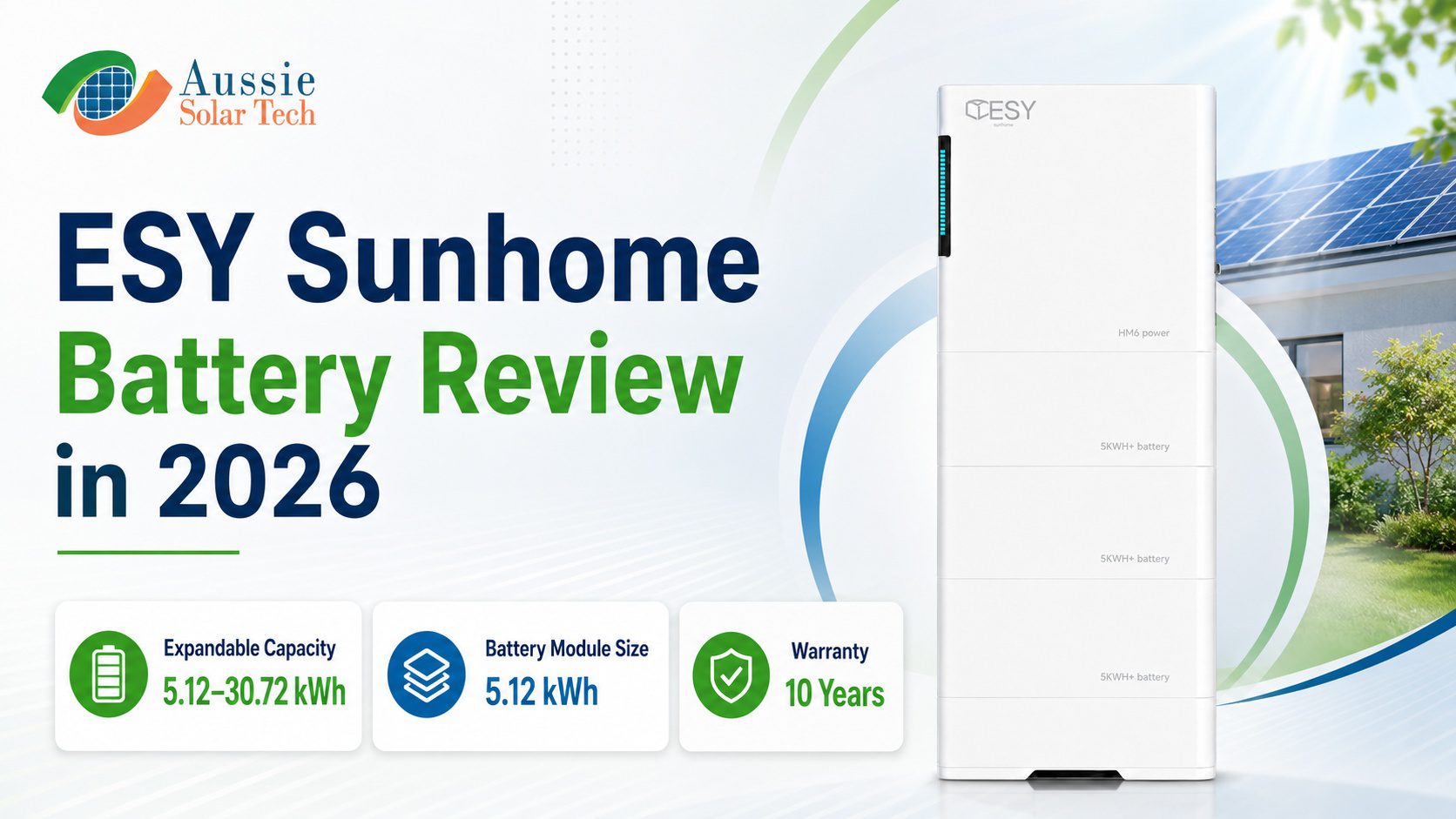
ESY Sunhome Company Overview
ESY Sunhome Battery Residential Models Available in Australia
ESY Sunhome offers multiple residential battery models. The single-phase models support 5–30 kWh battery capacity, while the three-phase models support 10–90 kWh battery capacity.
| ESY Sunhome Model | Inverter Power | Battery Capacity Range | Phase |
| HM5 | 5 kW | 5–30 kWh | Single Phase |
| HM6 | 6 kW | 5–30 kWh | Single Phase |
| HM5-MAX | 10 kW | 5–30 kWh | Single Phase |
| HM10 | 10 kW | 5–30 kWh | Single Phase |
| HM12 | 12 kW | 5–30 kWh | Single Phase |
| HM10-H | 10 kW | 10–90 kWh | Three Phase |
| HM15 | 15 kW | 10–90 kWh | Three Phase |
| HM20 | 20 kW | 10–90 kWh | Three Phase |
For most standard Australian homes, the single-phase models are the main options to consider. The HM6 is a practical choice because it combines a 6 kW output with scalable battery storage from 5.12 kWh to 30.72 kWh.
The three-phase models may suit larger homes, high-energy households, farms, rural properties or properties with stronger power requirements. However, final suitability depends on the home’s phase type, solar system size, daily electricity usage and backup requirements.
ESY Sunhome Battery Specifications
The ESY Sunhome HM6 is the most relevant model for many residential solar battery buyers. It is a single-phase all-in-one energy storage system with modular battery expansion.
| Specification | ESY Sunhome HM6 |
| System Type | All-in-one residential energy storage system |
| Phase Configuration | Single Phase |
| Max Output Power | 6 kW |
| Expandable Capacity | 5.12–30.72 kWh |
| Battery Module Size | 5.12 kWh per module |
| Maximum Battery Modules | Up to 6 modules |
| Protection Rating | IP66 |
| Dimensions | 600 × 305 × 778–1878 mm |
| Weight | 93–343 kg |
| Operating Temperature Range | -25°C to 60°C |
| Monitoring | ESY Sunhome App |
| Warranty | 10 Years |
The HM6 is designed for homes that need flexible battery capacity without making the system too complex. A homeowner can choose a smaller setup for basic evening energy use or a larger setup for higher storage and longer backup support.
The IP66 rating is also useful for Australian conditions because it gives more flexibility for indoor or outdoor installation, depending on site conditions and installer recommendations.
ESY Sunhome Battery CEC-Approved Capacities
CEC listing is important in Australia because battery installations, network requirements and rebate eligibility may depend on the exact approved battery model. ESY Sunhome has standard CEC-listed battery models from 5 kWh to 30 kWh, including ESYSUNHOME 5KWH+ to ESYSUNHOME 30KWH+.
| CEC Listed Model | Battery Capacity | Equipment Category |
|---|---|---|
| ESYSUNHOME 5KWH+ | 5 kWh | Pre-assembled Battery System |
| ESYSUNHOME 10KWH+ | 10 kWh | Pre-assembled Battery System |
| ESYSUNHOME 15KWH+ | 15 kWh | Pre-assembled Battery System |
| ESYSUNHOME 20KWH+ | 20 kWh | Pre-assembled Battery System |
| ESYSUNHOME 25KWH+ | 25 kWh | Pre-assembled Battery System |
| ESYSUNHOME 30KWH+ | 30 kWh | Pre-assembled Battery System |
ESY Sunhome also offers higher-capacity three-phase residential configurations under the 10KWH+H range, with official capacities up to around 94.46 kWh. Before installation, homeowners should confirm the exact ESY Sunhome model number with their installer and current CEC listing.
Battery Capacity and Expandability
Capacity is one of the strongest parts of the ESY Sunhome battery range. The HM6 system can expand from 5.12 kWh up to 30.72 kWh, giving homeowners several storage options based on daily energy use.
A smaller battery can help cover evening usage after solar production drops. A larger battery can store more excess solar energy and provide longer backup duration when the grid is down.
For example, a 10 kWh system may be enough for moderate evening use, while 20 kWh or 30 kWh may be more suitable for homes with higher consumption, electric cooking, larger families or backup power needs. The main benefit of this modular design is flexibility. Homeowners do not have to choose a fixed battery size. They can select a capacity that matches their current needs and budget.
Backup Power and Performance
The ESY Sunhome HM6 offers 6 kW power output and can support selected household loads during normal use or a power outage, depending on the backup circuit design.
Battery capacity and power output are not the same. A larger battery, such as 30 kWh, can store more energy and provide longer backup time, but the maximum output still depends on the inverter and installation setup.
For most homes, ESY Sunhome can support essential loads such as lights, fridge, Wi-Fi, selected power points and small appliances. Larger loads like air conditioners, ovens, hot water systems or EV chargers may need careful planning before being connected to backup.
Efficiency and Energy Performance
The main job of the ESY Sunhome battery is to store excess solar energy during the day and use it later when the home needs power. This can help reduce grid imports and improve solar self-consumption.
Energy performance depends on battery size, solar system size, household usage pattern, electricity tariff and installation design. A well-sized battery can help homeowners use more of their own solar power instead of sending it back to the grid.
For homes with high evening usage, a battery can be especially useful because solar panels produce most of their energy during the day, while many homes use more electricity in the evening.
The best result usually comes from matching the battery size with the home’s actual daily consumption. Too small a battery may not store enough energy, while too large a battery may not be fully used every day.
Smart Monitoring and App Control
ESY Sunhome provides app-based monitoring so homeowners can track their energy system more easily. Through the ESY Sunhome App, users can view battery storage, household load, grid condition and energy usage.
Smart monitoring is useful because it helps homeowners understand how their battery is performing. Users can see when the battery is charging from solar, when it is discharging to the home and how much stored energy is available.
This type of monitoring is helpful for improving energy habits. It gives homeowners better visibility over their solar and battery system instead of guessing how much energy they are using or storing.
Safety and Battery Technology
Safety is an important factor when choosing any home battery. ESY Sunhome uses an all-in-one residential energy storage design with built-in protection features and an IP66-rated enclosure.
The HM6 system is designed to handle a wide operating temperature range from -25°C to 60°C, which gives it strong environmental flexibility. The IP66 protection rating also helps protect the system from dust and water exposure when installed correctly.
The system also includes smart protection features and built-in safety design. However, like any lithium battery system, safe performance depends on correct installation, proper system design and following the manufacturer’s installation guidelines.
Homeowners should always use a qualified solar battery installer and confirm that the selected model is suitable for the installation location.
ESY Sunhome Battery Warranty
The ESY Sunhome HM6 battery comes with a 10-year warranty. Warranty coverage can depend on the selected model, installation conditions, usage, internet connectivity and warranty terms.
Below is a general warranty throughput guide for ESY Sunhome battery capacities.
| Battery Model | Nominal Energy | Minimum Throughput Energy |
| ESYSUNHOME 5KWH+ | 5.12 kWh | 21.5 MWh |
| ESYSUNHOME 10KWH+ | 10.24 kWh | 43.0 MWh |
| ESYSUNHOME 15KWH+ | 15.36 kWh | 64.5 MWh |
| ESYSUNHOME 20KWH+ | 20.48 kWh | 86.0 MWh |
| ESYSUNHOME 25KWH+ | 25.60 kWh | 107.5 MWh |
| ESYSUNHOME 30KWH+ | 30.72 kWh | 129.0 MWh |
When comparing warranties, homeowners should check the warranty period, capacity retention, throughput limit, internet connection requirements and installer support process. A 10-year warranty is useful, but the exact warranty conditions should always be reviewed before purchase.
Pros and Cons of ESY Sunhome Battery
Pros
- Flexible capacity options from 5 kWh to 30 kWh for standard residential systems.
- HM6 offers a practical 6 kW single-phase setup for many Australian homes.
- All-in-one design can make the system cleaner and simpler.
- CEC-listed battery capacities are available from 5 kWh to 30 kWh.
- IP66 protection rating supports flexible installation options.
- App monitoring helps homeowners track energy usage and battery status.
- Competitive pricing compared with many premium battery brands.
- Larger capacity options can support longer backup duration.
Cons
- ESY Sunhome is still less widely known than brands like Tesla or Sungrow.
- Exact CEC model matching should be checked carefully before installation.
- Backup performance depends on system design and selected backup loads.
- Larger systems can be heavy and need proper installation planning.
- Installer availability and local support may vary depending on location.
ESY Sunhome Battery vs Competitors
When comparing ESY Sunhome with other popular solar batteries, capacity, power output, protection rating and expandability are the most important factors to check. The table below compares ESY Sunhome with Sungrow, Sigenergy, GoodWe and AlphaESS.
| Battery | Capacity / Storage Range | Power / Output | Battery Chemistry / Protection | Key Strength |
| ESY Sunhome HM6 | 5.12–30.72 kWh | 6 kW | IP66 | Competitive price, all-in-one design and flexible capacity |
| Sungrow SBR | 6.4–25.6 kWh per unit | 30 A max charge/discharge current | High-voltage LFP battery, 100% usable energy | Strong battery ecosystem with modular design |
| Sigenergy SigenStor BAT | 5.38 / 6.02 / 8.06 / 9.04 kWh modules | 2.5 / 3.0 / 4.0 / 4.6 kW per module | LiFePO4, IP66, natural convection | Premium smart 5-in-one energy system |
| GoodWe ESA Series | 5–108 kWh | 3–10 kW | IP66, 6-level battery protection, AI-driven AFCI 3.0 | All-in-one solar and storage system with strong expandability |
| AlphaESS SMILE5 | 13.3–80 kWh range | 5 kW nominal output | LFP, IP65 outdoor protection | Large expandable capacity and VPP-ready system |
ESY Sunhome is strong for homeowners who want a cost-effective battery with flexible storage capacity. Sungrow SBR is a strong option for homeowners who want a well-known high-voltage battery ecosystem. Sigenergy is more premium and focuses heavily on smart all-in-one energy management. GoodWe ESA Series is suitable for homeowners who want an all-in-one solar and storage system with strong expandability and full-house backup support. AlphaESS SMILE5 is suitable for buyers who want large expandable capacity and VPP-ready storage.
For price-focused buyers, ESY Sunhome may be attractive. For premium smart features, Sigenergy may be better. For strong modular battery ecosystems, Sungrow and GoodWe are strong competitors.
ESY Sunhome Battery Review: Our Verdict
FAQs About ESY Sunhome Battery
Is ESY Sunhome battery CEC approved?
ESY Sunhome battery capacities from 5 kWh to 30 kWh are listed under CEC model names such as ESYSUNHOME 5KWH+, 10KWH+, 15KWH+, 20KWH+, 25KWH+ and 30KWH+. The exact model should be confirmed before installation.
What is the capacity of ESY Sunhome HM6?
The ESY Sunhome HM6 supports expandable battery capacity from 5.12 kWh to 30.72 kWh.
How much does an ESY Sunhome battery cost in Australia?
ESY Sunhome battery price in Australia depends on the selected capacity and installation requirements. Approximate pricing starts from A$1,999* for 5 kWh and goes up to around A$8,199* for 30 kWh.
Does ESY Sunhome battery provide backup power?
Yes, ESY Sunhome battery systems can support backup power depending on battery size, inverter setup, backup circuit design and selected loads.
Is ESY Sunhome better than Tesla Powerwall 3?
ESY Sunhome may be better for homeowners looking for a more affordable and scalable battery option. Tesla Powerwall 3 may be better for homeowners who want a premium integrated system with stronger brand recognition and higher output power.
Is ESY Sunhome better than Sungrow SBR?
ESY Sunhome may suit buyers who want competitive pricing and flexible capacity. Sungrow SBR may suit homeowners who prefer a widely used high-voltage LFP battery with a strong inverter ecosystem.
What size ESY Sunhome battery do I need?
Smaller homes may consider 5 kWh to 10 kWh. Medium homes may consider 15 kWh to 20 kWh. Larger homes or higher energy users may consider 25 kWh to 30 kWh, depending on electricity usage and backup requirements.

Shah Tarek is a Solar Energy Consultant with 10 years experience in solar system design and solar consultancy field at Australia. He is now a Director, Operation & Consultancy Division at Aussie Solar Tech, a leading Australian solar retailer and installer. Here he is writing informative and engaging solar content that educates the community on the benefits of solar power. His work supports Aussie Solar Tech’s mission to promote sustainable energy solutions and foster a greener future for Australia.






Seraphim Solar Panels Review: Efficiency, Reliability, and Value Unveiled

Talesun Solar Panels: Honest Review Before You Buy

Sungrow Battery VS Tesla Powerwall : Which is Best in Australia?

Leapton Solar Panels Review: Affordable Energy Solution

REC Solar Panels Review: Outstanding Efficiency & Durability

Best Hybrid Inverters for Home Solar Systems in 2025
Best Solar Battery In Australia 2026 — Complete Guide

Sigenergy VS Fox ESS Battery: Which is The Best Choice for 2026

How Much Do Solar Panel Costs in Australia? (2026 Price Guide)

