
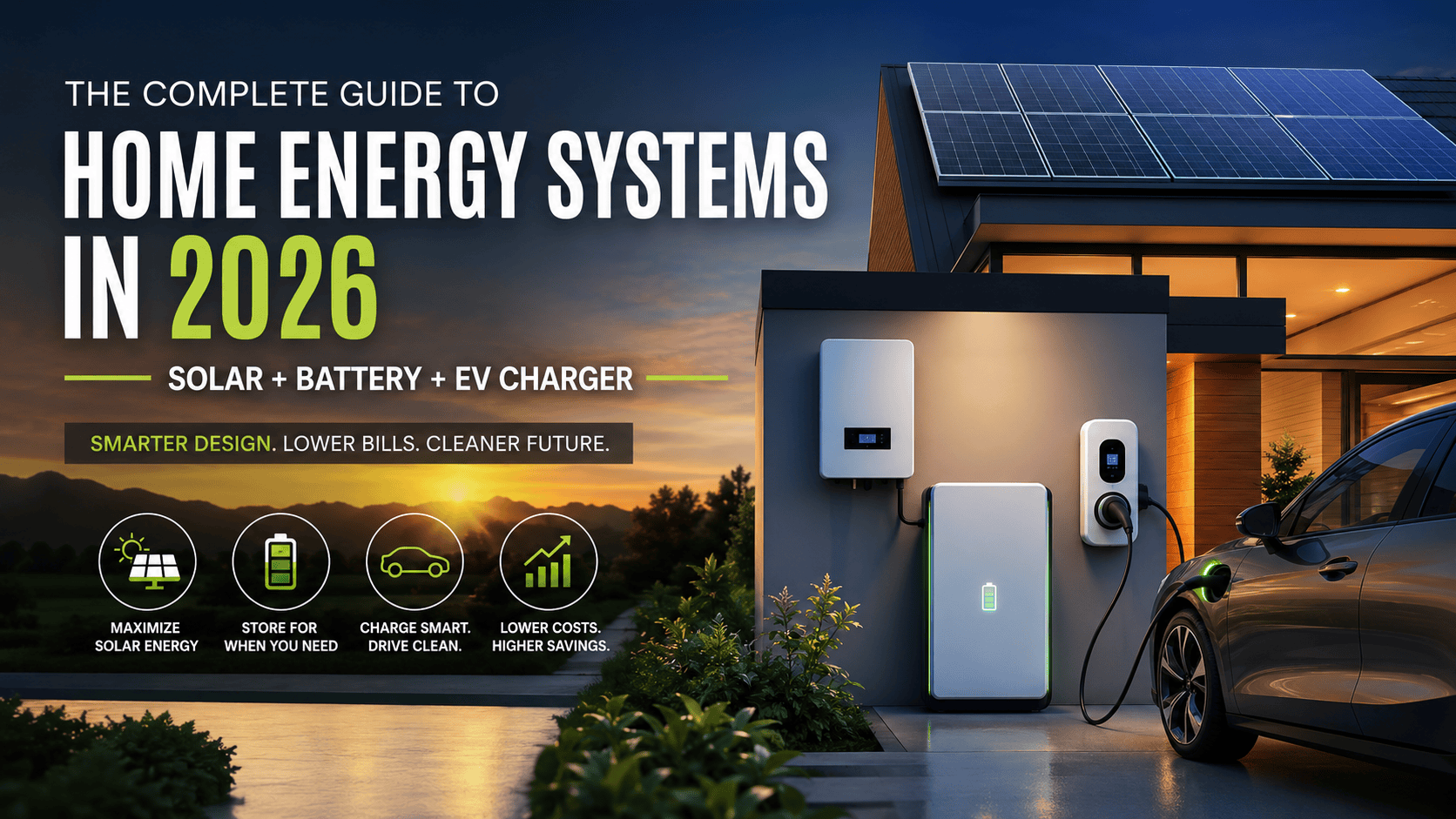
A modern home energy system can do more than generate solar power. Rooftop panels can supply the house, a battery can store surplus electricity for later, and a smart EV charger can use available solar to charge the car. The challenge is making those parts work together.
Designing a home energy system in 2026 starts with the household—not the biggest products available. Electricity use, EV driving, roof conditions, evening demand, electrical supply and future energy needs should all be considered before choosing system sizes.
When properly planned, solar, battery storage and EV charging can operate as one connected setup rather than three separate purchases.
Key Takeaways
- Start with current electricity use and future EV demand before selecting equipment.
- Solar size should reflect roof conditions, household demand, EV charging and network limits.
- Size the home battery around evening use, surplus solar and backup needs—not the capacity of the EV battery.
- A 7–7.4kW EV charger is enough for many homes; 11kW and 22kW charging generally require suitable three-phase power and vehicle support.
- Solar-aware charging and dynamic load management can help use more rooftop solar at home.
- Check inverter, battery, charger and monitoring compatibility before installation.
- Backup capability should be designed rather than assumed.
How Solar, Battery and EV Charging Work Together
Each component has a different role.
| Component | Main role |
| Solar panels | Generate electricity during daylight hours |
| Inverter | Converts solar electricity for household use |
| Home battery | Stores surplus energy for later |
| EV charger | Charges the vehicle at a controlled rate |
| Smart meter / CT monitoring | Tracks household imports, exports and energy flow |
| Energy management system | Coordinates solar, battery, EV and grid use |
A typical daytime energy flow might look like:
Solar → Home → EV or Battery → Grid
The EV and battery do not always need to charge in the same order. A household that wants more blackout reserve may prioritise the battery, while someone with a regular daytime charging opportunity may direct more surplus solar into the car. That flexibility is one of the main benefits of designing the system as a whole.
Design the Energy Flow
Once the main components are sized, the next question is how they should operate throughout the day.
| Time | Typical energy strategy |
| Morning | Solar begins covering household loads as generation rises |
| Midday | Solar powers the home and charges the EV and/or battery |
| Afternoon | Battery and EV charging adjust to the remaining solar surplus |
| Evening | Stored battery energy helps reduce grid purchases |
| Overnight | EV may charge on an off-peak tariff if additional energy is required |
The exact strategy will vary between households. A commuter whose EV is away during the day may have limited opportunity for direct solar charging. A work-from-home household may be able to direct much more surplus solar into the vehicle.
This is where smart monitoring and automation become useful. The aim is not simply to own solar, a battery and an EV charger, but to make them respond to the way electricity is actually used.
Solar Panel Systems: Sizing, Cost & Performance
Solar sizing should start with how much electricity the household currently uses and how that demand may change.
Check recent bills or smart-meter data for:
- Average daily electricity consumption
- Daytime versus evening use
- Air-conditioning
- Electric hot water and cooking
- Pool equipment
- Current or planned EV charging
- Future electrification
Future demand matters because a solar system can remain in service for many years. Adding an EV, heat-pump hot-water system or other electric appliances can significantly increase household electricity use.
The Australian Government solar sizing guidance recommends considering electricity consumption, when energy is used, available sunny roof area, local sunshine, tariffs, budget and network limits when selecting system size.
How Much Solar Does a Home with an EV Need?
There is no single solar size that suits every EV household.
Start with:
Household electricity demand + expected EV charging demand
Then consider:
- Whether the EV is home during solar hours
- Roof orientation and shading
- Seasonal solar production
- Battery charging
- Export limits
- Available roof space
- Future household demand
For some EV households, an 8kW, 10kW or larger solar array may make sense where roof conditions and network rules allow it. A household with lower electricity use may not need the same capacity.
Inverter Sizing Matters Too
Solar panel capacity and inverter capacity are not always identical.
For example, Australian Government guidance notes that a 6.6kW solar array is often paired with a 5kW inverter. Panels rarely operate at their full rated output for long periods, although the final design must remain within manufacturer specifications and scheme requirements.
When solar, battery storage and EV charging are combined, inverter output, battery power, phase connection and network limits should be considered together.
Solar System Cost in 2026
Current Aussie Solar Tech pricing provides the following planning guide:
| Solar system size | Current guide price | Typical planning context |
| 6.6kW | A$3,999 | Small to medium household demand |
| 8kW | A$4,599 | Higher daytime use or growing demand |
| 10kW | A$5,599 | Higher-use homes or regular EV charging |
| 13kW | A$6,999 | High household use, battery storage or EV demand |
| 15kW | A$8,790 | Larger high-use homes where site conditions allow |
Prices are current guide prices after applicable rebates and may vary according to equipment and installation requirements.
See the Aussie Solar Tech solar system prices guide for current package options.
The largest system that fits on the roof is not automatically the best design. Local network connection and export limits also need to be considered.
Battery Storage: Sizing, Cost & Backup in 2026
A home battery should not be sized according to the capacity of the EV battery.
The stationary battery normally has a different job: storing surplus solar for later household use, reducing grid purchases and providing backup where the system is configured for it.
Battery sizing should consider:
- Evening and overnight electricity use
- Available surplus solar
- Backup requirements
- Electricity tariffs
- Battery power output
- Future household demand
- Budget
Battery capacity is measured in kWh, while battery power output is measured in kW. Both matter. A battery can have enough stored energy for the evening but still be unable to run several large appliances simultaneously if its power output is too low. Australian Government guidance specifically distinguishes battery capacity from rated power output for this reason.
Battery Cost in Australia
Current Aussie Solar Tech estimates provide a useful capacity-based comparison:
| Battery capacity | Example inverter capacity | Approx. installed guide price |
| 5kWh | 5kW | A$3,499 |
| 10kWh | 5kW | A$5,099 |
| 15kWh | 8kW | A$5,799 |
| 20kWh | 8kW | A$6,799 |
| 25kWh | 10kW | A$7,299 |
These are estimated installed prices including an inverter. Brand, configuration, location, backup hardware and installation complexity can change the final cost. For additional capacities and brand comparisons, see the Aussie Solar Tech solar battery price guide.
Should the Home Battery Charge the EV?
It can, but routinely discharging a relatively small home battery into a much larger EV battery may leave little stored electricity for the house.
When the EV is parked at home during daylight hours, direct surplus solar charging can often make more sense.
If the vehicle arrives home after sunset, another strategy is to preserve battery energy for household loads and charge the EV during a cheaper overnight tariff where available.
The best approach depends on electricity tariffs, driving patterns, solar generation and backup priorities.
Battery Rebate in 2026
Eligible battery systems connected to new or existing rooftop solar can receive support through the Australian Government’s Cheaper Home Batteries Program.
From 1 May 2026, the STC factor became tiered according to usable battery capacity:
| Portion of usable battery capacity | STC factor applied |
| 0–14kWh | 100% |
| Above 14kWh to 28kWh | 60% |
| Above 28kWh to 50kWh | 15% |
The STC factor also declines every six months. The changes are intended to maintain an upfront discount of around 30% across eligible battery sizes as battery costs change, although the actual dollar value depends on capacity, STC settings and installation date.
See the Clean Energy Regulator battery rebate guidance for the current rules. A larger battery should therefore be selected because the household can use the additional storage—not simply because a larger system is available.
Backup Power Needs to Be Designed Separately
Having a battery does not automatically mean every appliance will continue operating during a blackout.
| Backup design | What it generally means |
| Essential-load backup | Priority loads such as refrigeration, lighting and internet |
| Selected-circuit backup | A chosen group of household circuits |
| Whole-home backup | Most or all household loads where system power allows |
Actual backup capability depends on:
- Battery state of charge
- Battery discharge power
- Inverter output
- Backup hardware
- Circuit configuration
- Appliances operating at the same time
Australian Government guidance confirms that a battery must be configured for blackout backup and that some systems support the whole property while others only support selected circuits. High-power appliances such as an EV charger, large oven or powerful air-conditioner may be excluded unless the system has specifically been designed to support them. Backup requirements are best decided before installation because adding backup circuits later can require additional electrical work.
EV Charger Design: 7kW, 11kW or 22kW?
The fastest charger is not automatically the right charger. A standard household power point can charge an EV at up to around 2.4kW, while dedicated home chargers generally operate between 7kW and 22kW.
Home EV Charging Options
| Charging option | Typical maximum power | Electrical setup | Often suited to |
| Standard power point | Up to 2.4kW | Standard 240V outlet | Low daily kilometres or occasional charging |
| 7–7.4kW charger | 7–7.4kW | Usually single-phase dedicated circuit | Most everyday home charging |
| 11kW charger | 11kW | Usually three-phase dedicated circuit | Higher daily charging demand |
| 22kW charger | Up to 22kW | Three-phase dedicated circuit | High demand where the EV supports 22kW AC |
Actual charging speed is limited by:
- Charger output
- Available electrical supply
- The EV’s onboard AC charger
- Vehicle and battery conditions
Installing a 22kW charger does not mean every EV will accept 22kW. Government guidance notes that Type 2 AC charging can provide up to 22kW, while some vehicles accept only 11kW AC. For many households, a 7–7.4kW charger already provides plenty of capacity for overnight top-ups.
Single-Phase vs Three-Phase
Single-phase power is suitable for many residential solar, battery and EV systems.
Three-phase becomes more useful where the property has several large electrical loads or genuinely requires higher-rate 11kW or 22kW AC charging.
Before deciding on a charger, an electrician should assess:
- Existing electrical supply
- Main switch capacity
- Solar and battery inverter output
- Other large household loads
- EV onboard charger limit
- Network requirements
For a new build or major renovation, planning the charger cable route, conduit and switchboard capacity before walls, landscaping or driveways are completed can also reduce additional work later.
EV Charger Cost
Several home EV charger options are available at different power levels and price points:
| EV charger | Power options | Guide hardware price |
| Myenergi Zappi | 7.4kW / 22kW | From A$1,245 |
| SolarEdge EV Charger | 7.4kW | Around A$1,300–A$1,800 |
| Sigenergy Sigen EV AC Charger | 7kW / 11kW / 22kW | From around A$1,239 |
| GoodWe EV Charger | 7kW / 11kW / 22kW | From around A$840 |
Installation costs vary with cable length, switchboard condition, phase configuration and any additional electrical work.
Solar Surplus Charging and Dynamic Load Management
A solar-aware EV charger can monitor energy flowing through the property. When rooftop generation exceeds household demand, more power can be directed into the vehicle. If solar generation falls or another large appliance switches on, charging can reduce. This can increase solar self-consumption instead of exporting surplus electricity during the day and buying more electricity later for EV charging.
It is better described as low-cost surplus solar charging rather than automatically calling it free, because exported solar may otherwise have earned a feed-in tariff.
Dynamic Load Management
Dynamic load management helps keep total household demand within the available electrical capacity. For example, if the EV is charging while an oven and air-conditioner are operating, a compatible charger can temporarily reduce charging power. When household demand falls, charging can increase again.
This can be more practical than selecting the highest-powered charger and upgrading the entire electrical supply simply to accommodate its maximum output.
System Integration: AC/DC Coupling and Compatibility
Solar and battery storage can generally be integrated in two ways.
| Design | Often suits | Main consideration |
| DC-coupled / hybrid | New solar + battery installations | Solar and battery generally share a hybrid inverter |
| AC-coupled | Adding a battery to existing solar | Existing solar inverter can often remain |
Australian Government guidance says either arrangement can be used when installing solar and a battery together, while AC coupling is the usual arrangement when adding a battery to an existing solar system.
Neither approach is automatically better.
The decision should consider:
- Existing solar equipment
- Battery compatibility
- Inverter limits
- Backup requirements
- Future expansion
Using equipment from one ecosystem can simplify monitoring and energy control. Mixing brands can provide greater flexibility, but compatibility should be checked before purchase.
A charger described as solar compatible does not necessarily communicate directly with every battery or inverter. Some chargers instead use CT monitoring at the switchboard to measure imports and exports and adjust charging accordingly.
V2H and V2G: Worth Future-Proofing For?
Vehicle-to-home (V2H) allows a compatible EV to provide stored energy back to a home.
Vehicle-to-grid (V2G) can allow a compatible EV and bidirectional charger to send electricity back to the electricity network.
Australia is continuing to develop V2G and smart-charging capability, but it should still be treated as a future-proofing consideration rather than a standard feature available to every household in 2026.
Compatibility can depend on:
- EV model
- Bidirectional charger
- Approved equipment
- Electrical system
- Retailer and network requirements
Do not pay extra for assumed bidirectional capability unless the intended EV and charger combination is confirmed to support it.
Example Home Energy System Designs
These are planning examples rather than fixed packages.
| Household profile | Solar | Battery | EV charger | Main goal |
| Moderate-use home + short EV commute | 6.6–8kW | 5–10kWh optional | 7–7.4kW | Increase daytime solar use |
| Family home + regular EV charging | 8–10kW | Around 10–15kWh | 7–11kW | Balance EV and evening demand |
| High-use all-electric home + EV | 10–13kW+ where suitable | 15–20kWh+ if justified | 11kW where suitable | Manage several large electrical loads |
| Very high-use home or multiple EVs | 13–15kW+ where suitable | 20–25kWh+ if justified | Up to 22kW where suitable | Manage higher demand and future electrification |
These ranges should not replace a site-specific design.
A property with limited roof space may rely more heavily on off-peak EV charging. Another home with a large sunny roof and an EV parked there during the day may benefit from more rooftop solar and need less stationary storage.
The household’s actual energy profile should determine the final design.
Common Home Energy System Design Mistakes
| Mistake | Better approach |
| Choosing products before analysing electricity use | Check current and future demand first |
| Installing the largest solar system without checking network limits | Confirm inverter and export limits first |
| Sizing the home battery from the EV battery | Base storage on household use and surplus solar |
| Looking only at battery kWh | Check both capacity and power output |
| Installing the fastest EV charger available | Match charger power to the EV and electrical supply |
| Assuming a battery means whole-home backup | Define backup circuits before installation |
| Mixing equipment without checking compatibility | Confirm monitoring and control requirements first |
| Ignoring dynamic load management | Consider smart control where several large loads operate |
| Designing only around today’s demand | Allow for future EVs and electrification |
Final Verdict: How Should You Design a Home Energy System in 2026?
The best home energy system is not necessarily the biggest one. Start with household electricity consumption and future EV demand. Choose enough solar to cover a useful share of that consumption, while considering roof conditions and network limits. Then size battery storage around surplus solar, evening use and backup requirements. For EV charging, match the charger to the vehicle, electrical supply and actual driving pattern instead of assuming that faster is always better. Finally, make sure the components can work together.
A properly designed solar, battery and EV charging system can increase solar self-consumption, reduce unnecessary grid purchases and provide room for future electrification without paying for capacity the household may never use.
The financial return also depends on how the system is operated. A household that can charge an EV from daytime solar and use stored solar after sunset may reduce more grid purchases than a similar property that exports most of its generation.
Frequently Asked Questions
What Size Solar System Do I Need With an EV?
There is no universal size. It depends on household electricity consumption, driving requirements, roof conditions, available daytime charging, battery plans and network limits. Future EV demand should be included rather than sizing solar only from the current electricity bill.
Is a 7kW EV Charger Enough for Home Charging?
For many households, yes. A 7–7.4kW charger is suitable for regular overnight charging. An 11kW or 22kW charger becomes more useful where the vehicle supports the higher AC rate and the property has a suitable three-phase supply.
How Big Should a Home Battery Be With an EV?
Do not size the home battery from the EV battery capacity. Focus on evening household use, available solar surplus, electricity tariffs, backup requirements and battery output power.
Can I Charge My EV Using Solar?
Yes. A compatible solar-aware charger can adjust charging according to available rooftop solar and household demand. The amount of surplus solar available will vary throughout the day and across seasons.
Can I Add a Battery and EV Charger to Existing Solar?
Usually, yes. The existing inverter, switchboard, electrical supply, network connection and equipment compatibility should be assessed first. AC coupling is commonly used when a battery is added to an existing solar installation.

Shah Tarek is a Solar Energy Consultant with 10 years experience in solar system design and solar consultancy field at Australia. He is now a Director, Operation & Consultancy Division at Aussie Solar Tech, a leading Australian solar retailer and installer. Here he is writing informative and engaging solar content that educates the community on the benefits of solar power. His work supports Aussie Solar Tech’s mission to promote sustainable energy solutions and foster a greener future for Australia.




Seraphim Solar Panels Review: Efficiency, Reliability, and Value Unveiled

Talesun Solar Panels: Honest Review Before You Buy

Sungrow Battery VS Tesla Powerwall : Which is Best in Australia?

Leapton Solar Panels Review: Affordable Energy Solution

REC Solar Panels Review: Outstanding Efficiency & Durability

Best Hybrid Inverters for Home Solar Systems in 2025

Best Solar Battery In Australia 2026 — Complete Guide

Sigenergy VS Fox ESS Battery: Which is The Best Choice for 2026

How Much Do Solar Panel Costs in Australia? (2026 Price Guide)

