
About Fox ESS
Fox ESS was founded in 2019 and develops solar inverters, battery-storage systems, EV chargers and smart energy-management technology. The company established sales and service operations in Australia in 2022 and now provides a dedicated Australian product range, warranty policy and local support network.
Its residential storage ecosystem combines modular high-voltage batteries with compatible Fox ESS hybrid inverters and the FoxCloud 2.0 monitoring platform. This gives homeowners one connected system for solar generation, battery status, household consumption and grid import or export.
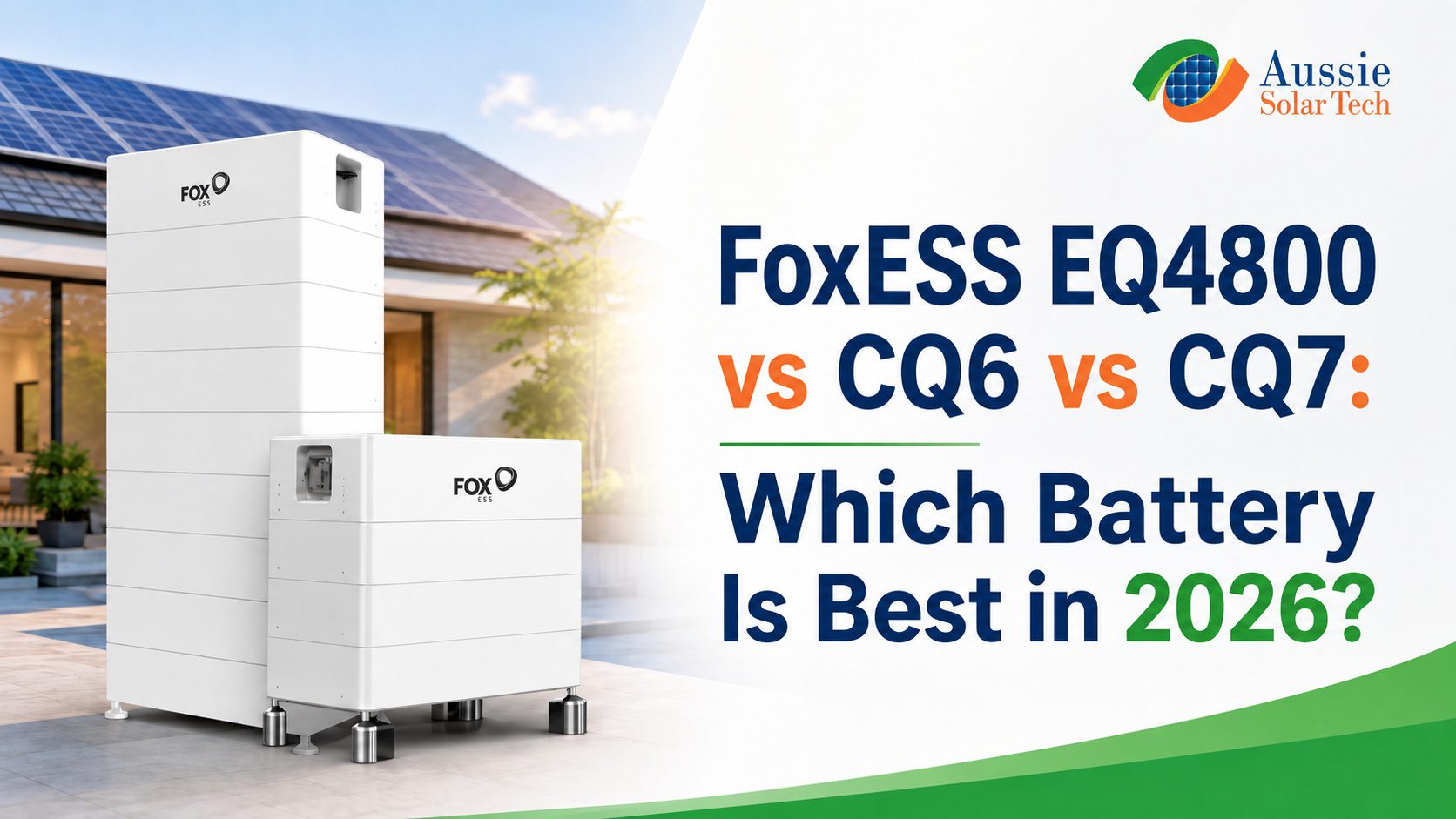
FoxESS EQ4800 vs CQ6 vs CQ7: Side-by-Side Comparison
| Feature | FoxESS EQ4800 | FoxESS CQ6 | FoxESS CQ7 |
| Battery type | High-voltage modular battery | High-voltage modular battery | High-voltage modular battery |
| Battery chemistry | LFP | LFP | LFP |
| Capacity per module | 4.66 kWh | 5.99 kWh | 6.96 kWh |
| Minimum system capacity | 9.32 kWh | 11.98 kWh | 13.92 kWh |
| Maximum system capacity | 41.93 kWh | 83.86 kWh | 97.44 kWh |
| Modules per stack | 2–9 | 2–14 | 2–14 |
| Depth of discharge | 100% | 100% | 100% |
| Round-trip efficiency | Above 95% | Above 95% | Above 95% |
| Maximum charge/discharge current | 50A | 50A | 80A |
| Rated DC power range | 4.48–20.16 kW | 5.76–40.32 kW | 9.22–64.51 kW |
| Communication | CAN | CAN | CAN |
| Protection rating | IP65 | IP65 | IP65 |
| Installation | Indoor or outdoor, floor stand | Indoor or outdoor, floor stand | Indoor or outdoor, floor stand |
| Fire-protection function | Not separately stated in AU datasheet | Not separately stated in AU datasheet | Yes |
| Maximum stack height | 1,352 mm | 2,280 mm | 2,280 mm |
| Maximum stack weight | 356.5 kg | 705.2 kg | 711.5 kg |
| Standard warranty listed in AU policy | 10 years | 12 years | 10 years* |
| CEC listed | Yes | Yes | Yes |
*The current AU warranty policy contains inconsistent wording for CQ7. This is explained in the warranty section below.
FoxESS EQ4800 vs CQ6 vs CQ7 Price Comparison
Fox ESS battery prices vary depending on the model, selected capacity, inverter requirements and installation conditions. The prices below provide an approximate comparison of selected EQ4800, CQ6 and CQ7 battery sizes available in Australia.
| Battery model | Capacity | Approx. price |
| FoxESS EQ4800 | 9.32 kWh | A$4,285* |
| 23.30 kWh | A$5,900* | |
| 41.90 kWh | A$10,585* | |
| FoxESS CQ6 | 11.98 kWh | A$3,909* |
| 17.97 kWh | A$4,359* | |
| 29.95 kWh | A$7,879* | |
| 41.93 kWh | A$10,979* | |
| FoxESS CQ7 | 13.92 kWh | A$5,529* |
| 27.84 kWh | A$6,589* | |
| 41.76 kWh | A$10,029* |
The EQ4800 offers the smallest starting capacity, while the CQ6 currently has the lowest entry price among these listed options. The CQ7 starts with a larger 13.92 kWh configuration and may suit homes that need more storage from the beginning. Buyers should compare usable capacity, compatible inverter, backup inclusions and total installation cost rather than choosing by battery price alone.
Final price may varies based on location, installation requirements. Contact us for a personalized quote and expert advice.
Battery Capacity, Module Size and Expandability
The most obvious difference between these batteries is the amount of storage provided by each module.
The EQ4800 uses 4.66 kWh modules and starts with two modules, giving a minimum usable capacity of 9.32 kWh. It can be expanded to nine modules and 41.93 kWh. This range is broad enough for many households that mainly want to store daytime solar and use it during the evening.
The CQ6 increases the module size to 5.99 kWh. It starts at 11.98 kWh and can accommodate up to 14 modules for 83.86 kWh. This provides significantly more expansion room for larger homes, growing families, electric-vehicle charging or properties with high overnight consumption.
The CQ7 uses even larger 6.96 kWh modules. Its capacity starts at 13.92 kWh and extends to 97.44 kWh. That upper limit is well beyond the needs of an average home, but it may suit properties with substantial loads, multiple EVs or light-commercial energy requirements.
A larger maximum capacity does not automatically make a battery better. The right size is normally the smallest configuration that comfortably covers expected evening and overnight consumption while leaving sensible room for future changes.
Charging and Discharging Performance
The EQ4800 and CQ6 have a maximum charge and discharge current of 50A. The CQ7 increases this to 80A and also offers the highest battery-side rated DC power across its supported configurations.
This gives the CQ7 an advantage in systems designed around larger loads and higher-power compatible inverters. However, installing a high-capacity CQ7 stack does not guarantee that the home can draw the battery’s full theoretical DC output. The hybrid inverter remains the main limit on the AC power delivered to household appliances.
For a typical home, inverter size and backup-circuit design may matter more than the battery’s maximum current rating. High-power appliances such as ducted air conditioning, induction cooking, pool equipment and EV chargers should be considered during system design rather than relying on battery capacity alone.
Battery Efficiency and Depth of Discharge
All three batteries have a stated battery-pack round-trip efficiency above 95% under the test conditions given in their Australian datasheets. They also offer 100% depth of discharge.
A 100% depth of discharge means the stated usable capacity can theoretically be accessed within the battery-management limits. For example, a 13.92 kWh CQ7 configuration is listed with 13.92 kWh of usable capacity rather than requiring part of the battery to remain permanently unavailable.
Actual energy delivered through the complete system will be slightly lower because power also passes through the inverter and other system components. Temperature, battery state of charge, power demand and cable losses can also affect real-world performance.
Battery Technology, Fire Protection and Safety
Temperature Performance and Outdoor Protection
All three systems carry an IP65 protection rating and are listed for indoor or outdoor installation on a floor stand. IP65 provides protection against dust and water jets, but it does not remove the need for a compliant location with suitable ventilation, drainage and protection from environmental extremes.
Their standard operating ranges are similar:
| Operating condition | EQ4800 | CQ6 | CQ7 |
| Charging temperature | 0°C to 55°C | 0°C to 55°C | 0°C to 55°C |
| Discharging temperature | −10°C to 55°C | −10°C to 55°C | −10°C to 55°C |
| Storage temperature | −10°C to 35°C | −10°C to 50°C | −10°C to 50°C |
| Optional warm-up version | No option stated | No option stated | Charging and discharging from −25°C to 55°C |
The optional CQ7 warm-up models are the strongest choice for unusually cold locations. For most Australian households, however, protection from direct summer sun and poor airflow may be more important than extreme cold performance.
Inverter Compatibility and Smart Monitoring
The EQ4800, CQ6 and CQ7 are not compatible with every Fox ESS inverter. Compatibility depends on the inverter model, phase type, battery voltage and number of modules. Fox ESS provides separate Australian compatibility guidance, including configurations for H1, AC1 G2, KH, KA and larger three-phase systems.
All three use CAN communication and support FoxCloud 2.0 monitoring for solar generation, battery status, home consumption, grid flow and energy scheduling. Available controls depend on the inverter and system setup.
Installation, Dimensions and Space Requirements
The EQ4800 has the smallest footprint of the three, measuring approximately 570 mm wide and 380 mm deep. Its height ranges from 386 mm for the smallest configuration to 1,352 mm for the full nine-module stack.
The CQ6 and CQ7 share a larger 660 mm by 360 mm footprint. Their height starts at 420 mm and can reach 2,280 mm with 14 modules. At full capacity, the CQ6 weighs approximately 705.2 kg, while the CQ7 reaches about 711.5 kg.
This matters because a system that is technically expandable may not be physically practical in every garage or utility area. A 2.28-metre tower requires adequate ceiling height, working clearances and a suitable supporting surface. Large configurations may also be better arranged according to the compatible inverter’s approved multi-stack design rather than simply building the tallest available tower.
The EQ4800 is therefore easier to accommodate when space is limited. The CQ6 and CQ7 offer much greater energy density per stack but require more careful planning at their upper configurations.
CEC Approval, VPP Compatibility and Australian Availability
The CEC approved-battery list includes EQ4800-L2 to L9, CQ6-L2 to L14 and CQ7 configurations. For Australia’s Cheaper Home Batteries Program, both the battery and inverter must be CEC listed at the time of installation.
Fox ESS also supports VPP participation, including Origin Loop for eligible customers. Access depends on the inverter, communication setup, retailer, plan and location.
All three ranges are available through Fox ESS Australia. The EQ4800 is the more established option, while the CQ6 and CQ7 are newer, higher-density models.
Warranty and Long-Term Reliability
The current Fox ESS Australian battery warranty policy lists:
| Battery | Standard performance-warranty period | Capacity-retention target |
| EQ4800 | 10 years | At least 70%, subject to throughput and conditions |
| CQ6 | 12 years | At least 70%, subject to throughput and conditions |
| CQ7 | 10 years in the warranty-period section and throughput tables* | At least 70%, subject to throughput and conditions |
The battery must be registered and connected to the Fox ESS warranty platform when commissioned. Coverage is also limited by the specified energy-throughput allowance and requires the system to be operated according to the product manual.
There is an important inconsistency in Version 2.7 of the AU warranty policy. The warranty-period section and CQ7 throughput tables identify a 10-year term, but a separate performance-warranty sentence refers to CQ6 and CQ7 retaining 70% for either 12 years or the applicable throughput limit. Because these statements conflict, CQ7 buyers should obtain written confirmation of the exact term from Fox ESS or their installer before purchase.
Based on the clearest model-specific wording, CQ6 currently offers the strongest warranty position, while EQ4800 is clearly listed at 10 years.
Which FoxESS Battery Is Right for Your Australian Home?
Choose the EQ4800 if:
You have moderate evening consumption, limited installation space or want the lowest starting capacity. Its 9.32–41.93 kWh range is already sufficient for many residential applications, and the shorter maximum stack makes it easier to install in garages with limited height.
Choose the CQ6 if:
You want the strongest all-round balance of module size, expansion and warranty. Its 11.98–83.86 kWh range covers ordinary residential systems as well as larger homes, EV charging and future load growth. The clearly listed 12-year warranty is also a major advantage.
Choose the CQ7 if:
You genuinely require a high-capacity or higher-power battery system. Its 80A maximum current, 97.44 kWh upper capacity, integrated fire-protection function and optional warm-up models give it the strongest technical specification of the three. However, the larger minimum capacity, tall maximum stack and CQ7 warranty-document inconsistency should be considered carefully.
Learn more on our Fox ESS Battery product page.
Final Verdict: EQ4800, CQ6 or CQ7?
There is no single winner for every property.
The FoxESS EQ4800 remains a practical choice for homeowners who want a smaller entry capacity, compact installation and enough storage for regular evening use.
The FoxESS CQ6 is the best all-round option for many Australian homes. It offers larger modules, significantly more expansion than the EQ4800, over 95% battery-pack efficiency and the longest clearly stated warranty.
The FoxESS CQ7 is the technical leader for capacity, current and safety features. It is best reserved for properties that will actually use its extra power and storage rather than choosing it simply because it has the largest number on the datasheet.
For most homes comparing FoxESS EQ4800 vs CQ6 vs CQ7, the CQ6 is the most balanced starting point. Smaller households may get better value from the EQ4800, while the CQ7 makes sense for genuinely demanding residential or light-commercial applications.
Frequently Asked Questions
What is the main difference between FoxESS EQ4800, CQ6 and CQ7?
The main difference is module size and maximum system capacity. The EQ4800 uses 4.66 kWh modules and reaches 41.93 kWh. The CQ6 uses 5.99 kWh modules and reaches 83.86 kWh. The CQ7 uses 6.96 kWh modules and reaches 97.44 kWh.
Which Fox ESS battery has the best warranty?
The current AU warranty policy clearly lists CQ6 with a 12-year standard performance warranty. EQ4800 is listed at 10 years. CQ7 is listed at 10 years in the model-specific warranty-period section and throughput tables, although another clause in the same document refers to 12 years, so written confirmation is recommended.
Can Fox ESS batteries be expanded later?
They are modular and support multiple modules in series. The EQ4800 supports up to nine modules, while CQ6 and CQ7 support up to 14. Future expansion remains subject to inverter compatibility, permitted configurations, product availability and Fox ESS installation requirements.
Can these batteries join a VPP?
Fox ESS systems can participate in supported Australian VPP programs, including Origin Loop for eligible customers. Participation depends on the compatible inverter, software connection, energy plan and location rather than the battery model alone.

Shah Tarek is a Solar Energy Consultant with 10 years experience in solar system design and solar consultancy field at Australia. He is now a Director, Operation & Consultancy Division at Aussie Solar Tech, a leading Australian solar retailer and installer. Here he is writing informative and engaging solar content that educates the community on the benefits of solar power. His work supports Aussie Solar Tech’s mission to promote sustainable energy solutions and foster a greener future for Australia.





Seraphim Solar Panels Review: Efficiency, Reliability, and Value Unveiled

Talesun Solar Panels: Honest Review Before You Buy

Trina Vertex Solar Panels Review: Efficiency, Lifespan, and Performance

Sungrow Battery VS Tesla Powerwall : Which is Best in Australia?

Top 17 Solar Panel Brands in Australia 2025

Leapton Solar Panels Review: Affordable Energy Solution

REC Solar Panels Review: Outstanding Efficiency & Durability

Best Hybrid Inverters for Home Solar Systems in 2025
Best Solar Battery In Australia 2026 — Complete Guide

