
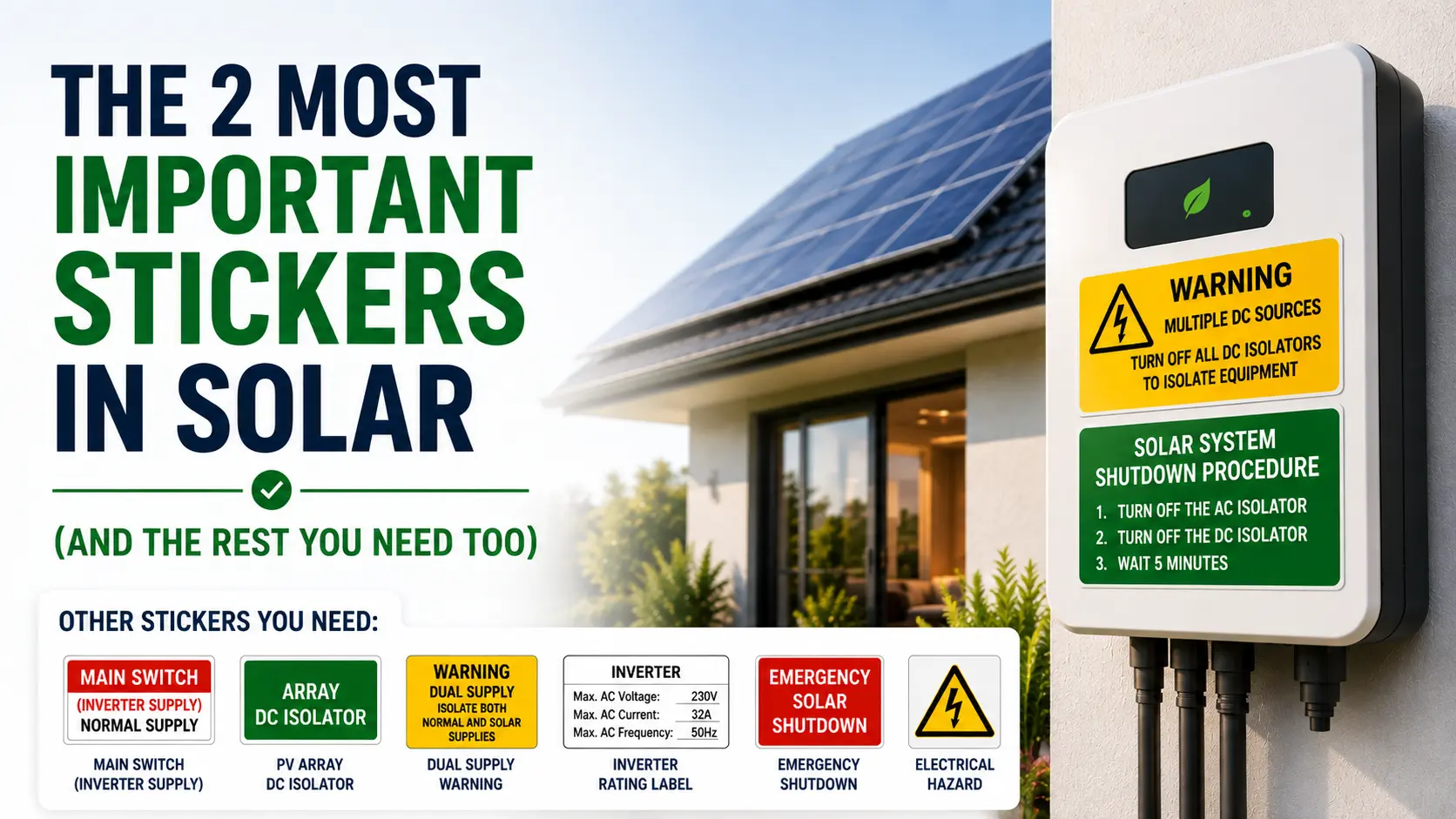
Quick answer: Every Australian solar and battery installation needs two green, circular, reflective switchboard stickers — a PV sign (AS/NZS 5033) and an ES sign (AS/NZS 5139) — both mounted on or beside your main switchboard where emergency workers will see them first. They’re the two most important labels on the job, but they’re not the only ones your system legally needs.
Why Two Small Green Stickers Matter More Than the Rest of the Kit
A typical solar and battery install comes with a small library of warning labels — danger signs, arc flash warnings, shutdown procedures, isolator labels. Most of them are mounted on or near the equipment itself, which means they only help someone who has already found the danger.
The PV and ES stickers are different. They’re the only labels required to sit at the one place every person interacting with your electrical system starts: the main switchboard. That’s what makes them, functionally, the most important labels in the entire kit — everything else assumes you already know there’s solar or a battery on site. These two are what tell a firefighter, a future electrician, or a new homeowner that hazard exists before they go looking for it.
The 2 Most Important Stickers In Solar
Sticker #1: The Green “PV” Sign
AS/NZS 5033:2021 Clause 5.4 requires every grid-connected solar installation to carry a circular, green, reflective sign — at least 100mm in diameter — with the letters “PV,” mounted on or immediately adjacent to the main switchboard and metering panel. It must be clearly visible to an approaching emergency worker.
Underneath “PV,” a sub-code tells responders what kind of isolation the system uses:
| Sub-code | Meaning |
|---|---|
| AC | Low-voltage DC (under 120V), panels close to the inverter — lower risk (common with microinverters) |
| SW | A load-break switch is fitted, which can be flipped to isolate the array |
| DP | A disconnection point exists that can be physically pulled apart — the most common configuration |
Sticker #2: The Green “ES” Sign
AS/NZS 5139:2019 Clause 7.3 requires every battery storage installation to carry the same style of sign — green, circular, reflective, minimum 100mm — this time with the letters “ES” (Energy Storage), again mounted on or immediately next to the main switchboard.
Underneath “ES” goes a UN number identifying the battery chemistry, which links directly to SAA/SNZ HB 76 — the hazardous materials reference first responders use on-site:
| UN number | Battery chemistry |
|---|---|
| UN 3480 | Lithium-ion (including polymer) — most home batteries |
| UN 3090 | Lithium metal |
| UN 2794 | Flooded lead-acid |
| UN 2800 | VRLA / AGM / gel lead-acid |
| UN 3496 | Nickel-metal hydride |
Getting this right matters: a lithium-ion thermal event is handled completely differently to a lead-acid electrolyte spill, and the UN code is how responders know which procedure to follow before they open the battery enclosure.
The Most Common Mistake: Right Sticker, Wrong Location
The failure pattern installers see most often isn’t a missing sticker — it’s a misplaced one. The battery gets plastered with every label in the kit, including the ES sign, while the switchboard is left bare.
That defeats the entire purpose. A green ES sticker stuck to the side of the battery only helps someone who has already found the battery and is standing in front of it. Placed on the switchboard instead, it does its actual job: warning someone before they start working on the system at all.
If you’re checking your own installation, the two-minute test is simple: stand at your main switchboard. If you can’t see a green PV sign (and a green ES sign, if you have a battery) from there, they’re in the wrong place — even if they exist somewhere else on the property.
The Other Labels Your System Needs (Beyond the Two Green Stickers)
The PV and ES signs are the most important because of where they sit, but AS/NZS 5033 and AS/NZS 5139 mandate a broader set of labels across a typical installation. A compliant residential system should also carry:
- DC isolator labels — at the array and at the inverter, warning that DC cabling may remain live during daylight even when the AC side is isolated
- AC isolator / main switch labels — identifying the isolation point between inverter and switchboard
- Shutdown procedure labels — the correct sequence for de-energising the system, usually mounted at the inverter
- Battery hazard and emergency isolation labels — mounted directly on or near the battery enclosure itself (in addition to, not instead of, the switchboard ES sign)
- Dual-supply warning labels — where a consumer unit is fed by both mains and PV/battery supply
- Arc flash and restricted access warnings — for higher-voltage commercial or larger residential systems
Commercial and larger residential systems typically need more of these than a simple rooftop-only install — extra DC isolators, junction box labelling, and expanded emergency switching instructions are common on multi-array or hybrid systems.
What Happens If the Stickers Are Missing or Wrong?
This isn’t just a tidiness issue. Incomplete or incorrectly placed signage can affect:
- Compliance sign-off — installations are inspected against AS/NZS 5033 and AS/NZS 5139; missing switchboard signage is a common defect noted at inspection.
- STC and rebate claims — under the Clean Energy Council accreditation framework, non-compliant installations risk issues with STC creation, which underpins solar and battery rebates.
- Insurance and resale — a building or contents insurer, or a buyer’s pre-purchase inspector, may flag missing safety signage as a defect during a claim or sale.
- Emergency response time — the practical, human cost: a firefighter or electrician who doesn’t know a battery is on-site before opening a switchboard is working with incomplete information in a genuinely hazardous situation.
Where to Get Compliant Replacement Stickers in Australia
Labels fade — reflective vinyl exposed to Australian UV for a few years is a common failure point, and a peeling or illegible UN code is functionally the same as no sticker at all. If yours has faded:
- Ask your original installer first — many keep compliant label stock and can replace them during a routine service visit.
- Source AS/NZS-compliant replacements from an Australian electrical safety signage supplier (not a generic UK or US label supplier, since the standard, sign format, and required wording differ from other regions’ PV signage rules).
- Have a licensed electrician re-apply them if your board also needs any other compliance check — it’s a two-minute job when it’s already been actioned as part of other electrical work.
FAQs
Q: What are the two most important stickers on a solar and battery installation?
A: The green circular “PV” sign (required under AS/NZS 5033:2021) and the green circular “ES” sign (required under AS/NZS 5139:2019), both mounted on or immediately next to the main switchboard where emergency workers and electricians will see them first.
Q: Where should the PV and ES stickers be placed?
A: On or immediately adjacent to the main switchboard and metering panel — not on the battery, not on the inverter, and not tucked away in a cupboard. They must be readily visible to someone approaching the switchboard, including emergency responders.
Q: What does the UN number on the ES sticker mean?
A: It identifies the battery chemistry so first responders know how to handle it safely — for example, UN 3480 for lithium-ion, UN 2794 for flooded lead-acid, and UN 2800 for VRLA/AGM/gel batteries. Different chemistries carry different hazards and require different emergency procedures.
Q: Are the PV and ES stickers the only labels my solar system needs?
A: No. They’re the most important because of where they’re mounted, but a fully compliant system also needs DC and AC isolator labels, shutdown procedure labels, battery hazard labels at the battery enclosure itself, and dual-supply warnings where applicable.
Q: What happens if my solar stickers are missing or faded?
A: It can be flagged as a compliance defect at inspection, may complicate STC/rebate claims or insurance assessments, and — most importantly — leaves emergency responders without the information they need before working on your system. Faded or missing switchboard stickers should be replaced as soon as you notice them.
Q: Can I replace faded solar safety stickers myself?
A: You can source AS/NZS-compliant replacement labels from an Australian electrical safety signage supplier, but having a licensed electrician apply them (especially alongside any other switchboard work) ensures correct placement and compliance.

Shah Tarek is a Solar Energy Consultant with 10 years experience in solar system design and solar consultancy field at Australia. He is now a Director, Operation & Consultancy Division at Aussie Solar Tech, a leading Australian solar retailer and installer. Here he is writing informative and engaging solar content that educates the community on the benefits of solar power. His work supports Aussie Solar Tech’s mission to promote sustainable energy solutions and foster a greener future for Australia.





Seraphim Solar Panels Review: Efficiency, Reliability, and Value Unveiled

Talesun Solar Panels: Honest Review Before You Buy

Trina Vertex Solar Panels Review: Efficiency, Lifespan, and Performance

Sungrow Battery VS Tesla Powerwall : Which is Best in Australia?

Top 17 Solar Panel Brands in Australia 2025

Leapton Solar Panels Review: Affordable Energy Solution

REC Solar Panels Review: Outstanding Efficiency & Durability

Best Hybrid Inverters for Home Solar Systems in 2025
Best Solar Battery In Australia 2026 — Complete Guide

