
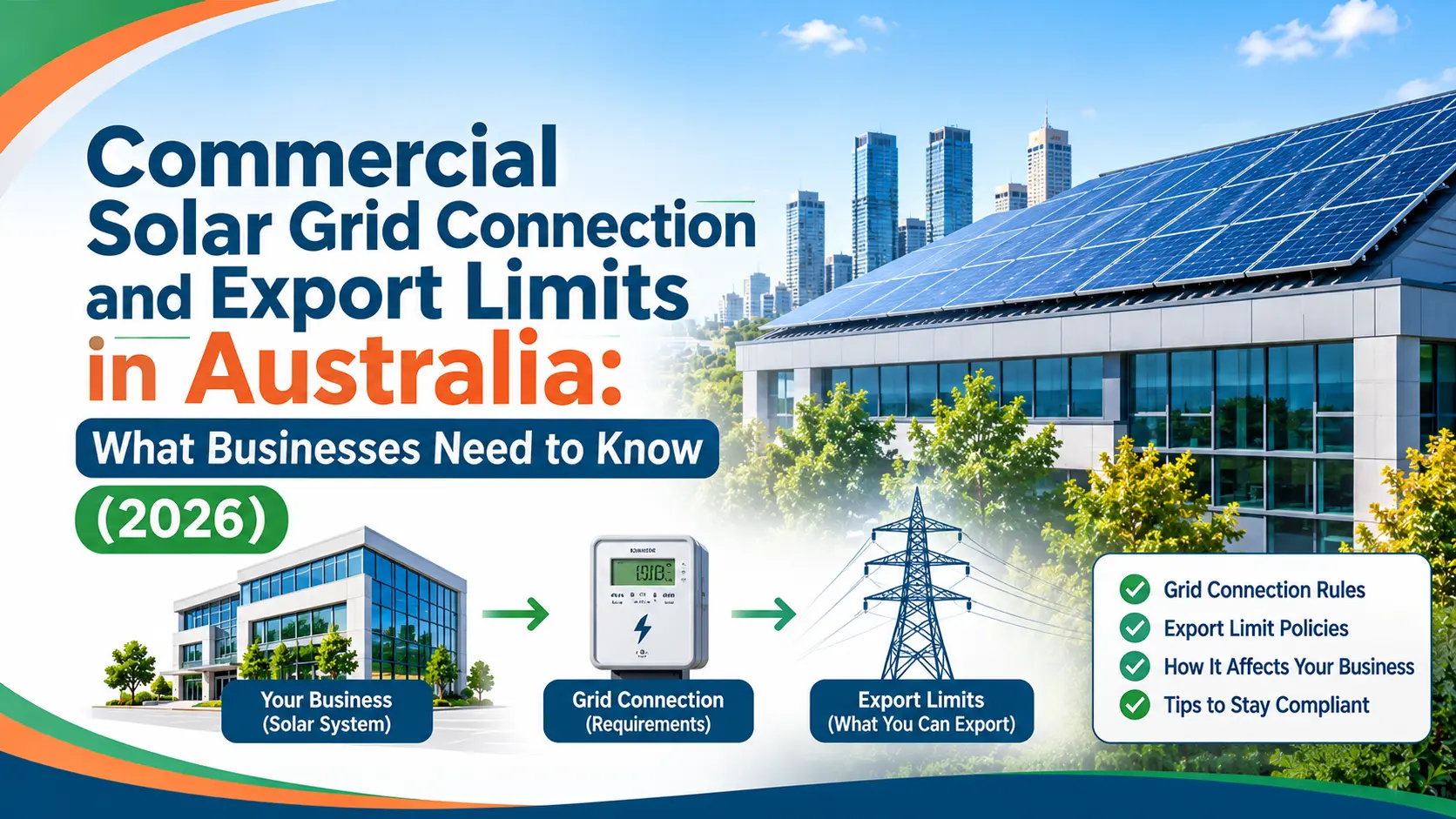
A commercial solar system can significantly reduce the operating costs for your business. However, your system needs to have proper approval to connect to the grid. Plus, you need to design it around the limits your network sets. In Australia, the DNSP, or the local operator, deals with these technicalities, and the rules regarding them are changing fast in 2026.
For instance, Western Australia introduced a new connection framework for small commercial systems on 1 May 2026. New South Wales is rolling out its emergency backstop requirements from late 2026. Meanwhile, the CSIP-AUS tightened its certification from 1 October, and the federal solar rebate now reaches much larger commercial systems. Miss any of these, and you risk delayed approval, a system that cannot export, or inverters that need replacing.
Commercial Solar Grid Connection and Export Limits: The Short Version
Every commercial solar system needs approval from your local network, which also sets any export limit. Thresholds near 30 kW, 100 kW and 200 kW change the process, and most businesses lose very little value to export caps. The table below gives the essentials.
| Topic | At a glance |
| Who approves | Your DNSP (local network company) approves the connection and sets export limits, not your retailer |
| Size thresholds | Each threshold triggers different rules. Around 30 kW, streamlined approval gives way to a standard commercial application, fees, and a formal network assessment. Around 100 kW, rebate treatment changes: the upfront STC discount used to stop here, and since 1 October 2026 it extends to 1 MW. Around 200 kW, the standard NSW backstop route ends (above it, the network agrees the technology with you), and you can expect network studies, interface protection and monitoring or SCADA |
| Zero export | Tightly regulated for small systems; cannot be imposed where suitable dynamic technology is available |
| Equipment | CSIP-AUS v1.2 and emergency backstop capability are becoming standard across the National Electricity Market and WA |
| Money impact | A well-designed export-limited system still saves strongly, because most commercial solar is used on site |
| Approval time | Days for small systems; weeks or months for larger or constrained sites, so apply early |
| Best move | Engage the network early, choose compliant equipment, and keep documents and commissioning records tight |
What Changed for Commercial Solar Grid Connection in 2026?
In 2026, four rules changed for commercial solar: Western Australia’s connection framework, NSW emergency backstop, the CSIP-AUS v1.2 requirement and the federal rebate, which now covers systems up to 1 MW. The table compares each with the previous position.
| Area | Before 2026 | From 2026 | What it means for you |
| WA standard connection | Western Power’s standard connection allowed up to 5 kVA of aggregate inverter capacity | Since 1 May 2026, up to 30 kVA, with either remote disconnect and reconnect capability or a fixed 1.5 kW export limit | Larger WA rooftops can use the standard process, but export depends on capability and connectivity |
| NSW emergency backstop | No backstop requirement for new NSW systems | From late 2026, new and upgraded systems up to 200 kW must use CSIP-AUS compliant equipment registered through the CER Installer Portal (Ausgrid from 23 November 2026) | Equipment choice and installer registration now affect NSW approvals |
| NSW commissioning | Approved systems could be commissioned without backstop | Approved systems must be commissioned by the network’s cut-off (Endeavour 31 December 2026; Ausgrid 22 May 2027 for systems approved before 23 November 2026) or reapply | Delays after approval can force a new application |
| CSIP-AUS version | v1.1a certification accepted | From 1 October 2026, v1.2 (SA TS 5573:2025) required | Check that your inverter or gateway is certified to the right version before buying |
| Federal rebate (SRES) | STCs only for systems up to 100 kW; larger systems earned LGCs over time | For systems installed on or after 1 October 2026, STCs available up to 1 MW with a fixed five-year deeming period | Mid-size commercial systems can get an upfront discount instead of waiting for LGCs |
Key Takeaways on Commercial Solar Grid Connection and Export Limits
- Every grid-connected commercial solar system needs DNSP approval, even if you never plan to export.
- Export limits cap what you send to the grid. They do not cap how much solar you can use on site.
- Most businesses use the bulk of their solar during the day, so sensible export limits rarely hurt returns.
- From late 2026, new and upgraded NSW systems up to 200 kW need CSIP-AUS-compliant equipment for emergency backstop.
- Talk to your network early and size the system around your daytime load, not the export cap.
What Is Commercial Solar Grid Connection in Australia?
To run a business or commercial solar system parallel to the local grid, you need approval from the local network and a technical setup. This is the commercial grid connection. You obtain it from the DNSP (Distribution Network Service Provider), not your retailer.
This approval and assessment is required even if the commercial solar owner doesn’t plan to export any solar. Because even if you don’t export a single kW, your site still draws power from the grid at night and on overcast days. So, as the system runs alongside the network, the DNSP must confirm it is safe.
The DNSP calculates how your system could affect network safety, voltage, and capacity. Examples include Ausgrid, Endeavour Energy and Essential Energy in NSW, Energex and Ergon Energy in Queensland, SA Power Networks in South Australia, Western Power in Western Australia, and the Victorian distributors.
Your retailer is a separate company that bills you and buys any exported power. Export limits come from the network, not the retailer, and they can be fixed or flexible.
What Is a Solar Export Limit and Why Do Networks Impose One?
A solar export limit caps how much power your system can send to the grid. Networks impose limits because too much exported solar on sunny, low-demand afternoons can push voltages out of range and threaten grid stability. The limit does not cap your system size or the solar you use on site.
Factories, supermarkets, cold stores and offices usually run their heaviest loads in daylight hours. As a result, they absorb most of their own generation. That is why export limits affect homes far more than businesses.
If your DNSP caps export, an export-limiting device at the inverter lets you install a larger array than the cap while keeping grid spill under the limit. The extra panels feed your own loads first, and only the surplus is held back. A properly designed export limit is a design parameter, not a deal-breaker.
What Are the Types of Solar Export Limits: Static, Flexible, and Zero Export?
Networks apply three types of export limits: a fixed static cap, a flexible cap that moves with grid conditions, or zero export where nothing leaves the site. Flexible limits need a communicating inverter or gateway using CSIP-AUS.
Static (fixed) limit: a set cap that always applies, such as 5 kW per phase. It is enforced by the inverter or by meter-based export control.
Flexible (dynamic) limit: the cap changes through the day with grid conditions, allowing more export when there is room. It needs a communicating inverter or gateway using CSIP-AUS.
Zero export: no power may leave the site. It is used on constrained feeders, or by businesses that choose it for simplicity.
Can a Network Force Zero Export on Your Commercial Solar System?
Rarely. A network cannot impose a static zero export limit on a small customer unless you request it or a regulatory exception applies. It cannot impose one at all if suitable dynamic technology is reasonably available.
The Australian Energy Market Commission changed the National Electricity Rules so that a DNSP cannot offer a static zero export limit to a small customer unless the customer asks for it, or an exception in the Australian Energy Regulator’s connection charge guideline applies.
The AER treats micro-embedded generators as systems within the AS/NZS 4777 size limit, which includes commercial buildings up to 200 kW, and battery systems.
A DNSP must also explain its reasons and your dispute options.
If you are offered zero export, ask three questions: why, is flexible export available, and what would it cost to remove the limit?
Some businesses choose zero export voluntarily to keep approvals simple and avoid export charges, then add a battery later.
How Much Solar Can a Commercial System Export to the Grid in Australia?
There is no national export limit for commercial solar. An export limit is the maximum power your system can send to the grid at any single moment, measured in kilowatts (kW). It is not a limit per hour, day, or month.
For three-phase systems up to 30 kW, the typical limit is usually 15 to 30 kW at any moment, depending on the network. Constrained networks are tighter: South Australia allows 1.5 kW per phase (up to 10 kW per phase if flexible) and WA’s fallback is 1.5 kW. Larger systems over 30 kW are assessed case by case, so we cannot accurately quote a typical export limit for those.
As a general guide for approval:
Up to about 30 kW three-phase: a streamlined micro-embedded generator process, often online with quick approval. The export limit is what’s typical for that network.
Over 30 kW up to about 200 kW: a standard commercial application with a desktop assessment.
Over 200 kW: adds interface protection, network studies, and often monitoring or SCADA.
Queensland, over 30 kVA: Energex treats these under Chapter 5A of the National Electricity Rules as a basic or negotiated connection, ending in a connection contract.
What Are the Typical Export Limits for Each Australian Network?
Streamlined approvals are the fast-track routes networks offer for small systems. The installer lodges a simplified application, often online, and gets a quick decision. They usually cover three-phase systems up to about 30 kW, while larger systems are assessed individually. The table shows typical figures for the major distributors.
| Network | Typical streamlined limit | Larger systems |
| Ausgrid (NSW) | Up to 30 kW three-phase (10 kW per phase) | Formal assessment above 30 kW; 10 business days target up to 200 kVA |
| Endeavour Energy (NSW) | Online route up to 30 kW three-phase | Standard application; may need network studies |
| AusNet (Vic) | Three-phase up to 30 kW, 15 kW export in pre-approval | Assessed by feeder |
| Evoenergy (ACT) | Three-phase up to 30 kW, export limited to 15 kW | Separate application |
| SA Power Networks | Fixed limit of about 1.5 kW per phase, or flexible | Flexible 1.5 to 10 kW per phase |
| Western Power (WA) | 30 kVA aggregate on a standard connection | Systems over 30 kVA not covered |
| TasNetworks | Three-phase over 30 kW needs export limiting technology | Case by case |
These figures are indicative. Limits vary by feeder and change over time, so confirm the current figure for your postcode with your DNSP. Battery inverters count towards the inverter limit on some networks and not others, so ask before sizing solar and storage together.
Some important dates for Commercial Solar Installers in 2026
If you are already well acquainted with the above table, then here is a quick one to review the 2026 changes. The main 2026 dates are 1 May (WA), 1 October (CSIP-AUS v1.2 and the SRES expansion), and 23 November onward (NSW backstop), with NSW commissioning cut-offs on 31 December 2026 and 22 May 2027.
| Date | What changes | Who it affects |
| 1 May 2026 | WA standard connection rises to 30 kVA, with remote disconnect capability or a 1.5 kW export limit | New and upgraded WA systems up to 30 kVA |
| 1 October 2026 | CSIP-AUS v1.2 (SA TS 5573:2025) required; v1.1a no longer accepted | Anyone buying inverters or gateways |
| 1 October 2026 | Small-scale Renewable Energy Scheme (SRES) extends to solar PV up to 1 MW | Systems over 100 kW and up to 1 MW installed on or after this date |
| From 23 November 2026 | NSW emergency backstop phases in by postcode, starting with Ausgrid | New and upgraded systems up to 200 kW |
| 31 December 2026 and 22 May 2027 | NSW commissioning cut-offs (Endeavour and Ausgrid respectively) | Projects approved before backstop starts |
Commercial Solar Grid Connection Rules by State and Territory
Each state and territory sets its own connection rules through its DNSPs. WA and NSW have the biggest 2026 changes, while Victoria, South Australia and Queensland already run backstop or flexible export arrangements.
Western Australia: What Are Western Power’s Commercial Solar Connection Rules?
Since 1 May 2026, Western Power’s standard connection allows up to 30 kVA of aggregate inverter capacity (solar, batteries and other inverter-based resources combined), up from 5 kVA.
The changes cover new and upgraded systems up to 30 kVA. Larger systems are not affected, and systems installed and commissioned before 1 May 2026 are exempt.
Each system is set up in one of two ways:
Remote disconnection and reconnection capability, typically through CSIP-AUS and the retailer’s commissioning process. This is needed for export products, and export remains subject to network capacity.
A fixed 1.5 kW export limit, for customers who opt out of export products or cannot maintain a stable internet connection.
The 1.5 kW option suits sites with heavy daytime load, but it is a poor fit for any business expecting regular export revenue.
New South Wales and the ACT: What Is Emergency Backstop and When Does It Apply?
From late 2026, new and upgraded NSW solar systems up to 200 kW must use CSIP-AUS compliant equipment so networks can curtail exports in a grid emergency. Ausgrid starts on 23 November 2026, and other networks follow their own timelines.
Ausgrid is generally more generous than Endeavour and Essential. The mechanism is rolled out by postcode alongside the CER Installer Portal, and networks can only use it when instructed by the market operator AEMO, which is expected to be rare.
Ausgrid’s published dates are:
23 November 2026: retailers register new and upgrading systems up to 200 kW.
30 November 2026: capability testing begins, phased by postcode.
22 February 2027: all new and upgrading systems must be registered and backstop enabled.
22 May 2027: systems approved before 23 November 2026 but not yet commissioned must reapply.
Endeavour’s cut-off for approved systems is 31 December 2026. The ACT is also expected to introduce a backstop, so confirm timing with Evoenergy. Always use an installer registered on the CER Installer Portal.
Queensland: What Are the Energex and Ergon Rules for Commercial Solar?
Energex and Ergon assess larger systems through formal distributed energy resource processes and offer dynamic connections as an opt-in. New systems of 10 kVA and above have needed a generation signalling device since 6 February 2023, and AS/NZS 4777.1:2024 has applied since 23 February 2025, so design to current requirements.
Victoria: Is Emergency Backstop Mandatory for Commercial Solar?
Yes. Emergency backstop has been mandatory on new systems since October 2024, and Solar Victoria’s approved product list requires full compliance with the communication standard. Distributors assess export limits feeder by feeder, and some offer online pre-assessment.
South Australia: What Are the Export Limits for Commercial Solar?
New and upgrading systems in South Australia choose either a fixed export limit of about 1.5 kW per phase or flexible export of 1.5 to 10 kW per phase, depending on network capacity and a reliable internet connection. The state has among the highest rooftop solar penetration in the country and the most developed flexible export framework. Batteries are often essential for commercial sites that want to capture surplus.
Tasmania and the Northern Territory: What Do Commercial Solar Systems Need?
TasNetworks requires export limiting technology for three-phase systems over 30 kW. In the NT, larger systems follow an extended Power and Water process requiring AS/NZS 4777 and AS/NZS 5033 compliance.
What Are the Technical Requirements for Grid-Connected Commercial Solar?
Commercial solar inverters must meet AS/NZS 4777, include a way to enforce your export limit, and increasingly support CSIP-AUS communications for flexible export and emergency backstop.
What Is AS/NZS 4777 and What Changed in the 2024 Edition?
AS/NZS 4777.1 covers installation and 4777.2 covers inverter behaviour. The 2024 edition of Part 1 changed several things:
- “Central protection” is now called interface protection.
- It is generally required only above 200 kVA aggregate capacity (DNSPs can ask for it earlier), and above 30 kVA where inverter power source devices are used.
- A maximum of two inverter main switches is allowed on any switchboard with loads.
For many rooftops, this removes extra hardware and cost.
How Is a Commercial Solar Export Limit Enforced?
There are three common methods: inverter-based limiting using a meter or current transformer, an energy management system or gateway (common on larger or multi-inverter sites), or communicating flexible export from the network. Document your settings and test results, because networks may audit installations.
What Are CSIP-AUS and Emergency Backstop, and Who Needs Them?
CSIP-AUS (Common Smart Inverter Profile Australia) is the communication standard that lets networks manage flexible export and trigger emergency backstop, a rare grid-emergency reduction of solar output. It is now required or in use in most states:
- Victoria has required it on new systems since October 2024.
- South Australia and Queensland run backstop or generation signalling arrangements.
- WA requires remote disconnection capability or a 1.5 kW fallback.
- NSW is introducing it from late 2026. New and upgraded systems up to 200 kW must use CSIP-AUS compliant equipment registered through the CER Installer Portal. Systems above 200 kW must also be backstop-enabled, with the network agreeing the technology with the customer. Existing systems are unaffected.
From 1 October 2026, equipment needs CSIP-AUS v1.2 (SA TS 5573:2025) certification. Check that your products appear on the Clean Energy Council’s list of inverters with software communication clients, at the right version.
If your site has poor internet, ask your installer how backstop will be met. New equipment must still be CSIP-AUS compliant, and Ausgrid applies a 1.5 kW static export limit until connectivity is available.
How Does the Commercial Solar Grid Connection Process Work, Step by Step?
Connecting commercial solar takes eight steps: analyse your load, check network capacity, choose compliant equipment, apply through an accredited installer, wait for network assessment, accept the connection offer, install and commission, then complete metering sign-off.
- Feasibility and load analysis. Review 12 months of interval data to size the system by daytime load, roof space and budget.
- Check network capacity. Use hosting or load capacity maps, such as Energex’s Network Load Capacity Map.
- Choose compliant equipment. Inverters must meet AS/NZS 4777.2 and, increasingly, CSIP-AUS certification.
- Apply. Your accredited installer files with the DNSP, usually with the NMI, single-line diagram, inverter models, protection details, export control method, and load data.
- Network assessment. The DNSP studies voltage, thermal limits, and protection. Larger systems may need a detailed study.
- Connection offer. The network must make an offer under the National Electricity Rules, and it can carry conditions such as an export limit.
- Install, test and commission. Settings, limits, and communications must match the approval.
- Metering and sign-off. You may need a meter upgrade through your retailer or metering provider.
How Long Does DNSP Approval Take for Commercial Solar?
Approval takes days for small systems and weeks or months for larger or constrained sites. Ausgrid targets 5 business days for systems up to 10 kW per phase (or 30 kW three-phase) and 10 business days for larger systems up to 200 kVA.
What Causes Delays in Commercial Solar Grid Approval?
Most delays come from incomplete paperwork, inverters without the right CSIP-AUS certification, design changes after approval, or constrained feeders. The common causes are:
- Missing NMI or single-line diagram details
- Inverters without the right CSIP-AUS certification
- Mismatched protection information
- Design changes after approval
- Commissioning settings that differ from the connection offer
- Poor connectivity and constrained feeders
How Can You Get Commercial Solar Grid Connection Approved Faster?
Engage your network before finalising system size, size the array around daytime load, choose CSIP-AUS v1.2 equipment, and submit complete documents that match your commissioning settings.
- Talk to your network early, before finalising system size, and size around your load rather than the export cap.
- Choose CSIP-AUS v1.2 equipment and a Clean Energy Council accredited installer with commercial experience. Accreditation also matters for incentives.
- Submit complete documents and match commissioning settings to the connection offer.
- Ask your network whether battery inverters count towards your inverter limit.
- Check your network’s commissioning deadlines if you are in NSW.
Do Commercial Solar Systems Pay Export Charges and Two-Way Tariffs?
Some do. Several distributors now charge retailers for exports, and retailers may or may not pass the cost on to you. Customers on export tariffs must receive a basic free export level. Export limits cap capacity, while export charges set a price.
Ausgrid has applied its two-way tariff to eligible residential and small business customers since July 2025. SA Power Networks’ export tariff started on 1 July 2025 for residential and small business customers with inverters up to 30 kW AC, and it applies to exports between 10 am and 4 pm. That rewards businesses that use solar in those hours, and shifting flexible loads or adding a battery reduces charges. Larger customers are often on bespoke tariffs, so ask your retailer what applies to you.
What Extra Costs Come With Commercial Solar Grid Connection, and When Is a Battery Worth It?
Grid connection adds costs beyond panels and inverters, and a battery is the most common fix for a tight export limit. Budget for:
- Network application and assessment fees, which for larger systems vary with export level and interface protection
- Network studies, where required
- Export limiting hardware and CT metering
- Interface protection above 200 kVA or where the network requires it
- CSIP-AUS communications
- Metering upgrades
- Possible network augmentation to remove a zero export limit
Storage is the most common answer to a tight limit. A battery absorbs midday surplus and releases it in the evening, lifting savings, cutting export charges and opening the door to virtual power plant programs. In South Australia, where limits can be as low as 1.5 kW per phase, batteries are often the only way to make solar viable for very low or zero export sites. Check whether the battery inverter counts towards your limit and what CSIP-AUS and backstop requirements it adds.
Final words
Commercial solar can deliver strong savings, but approval and export rules decide how well your system performs. Start by understanding your DNSP’s requirements, choose CSIP-AUS v1.2 compliant equipment, and design around your daytime load rather than the export cap.
With NSW backstop deadlines approaching and the SRES now open to systems up to 1 MW, the next few months are an important window to plan.
Requirements vary by network and change often, so confirm the current rules for your site with your DNSP and a Clean Energy Council-accredited installer like Aussie Solar Tech before you commit to a design.
FAQs
Do I need network approval for commercial solar?
Yes. Every grid-connected system needs DNSP approval before it is switched on, however small. This applies even if you never plan to export, because the system still connects to the network.
What is the export limit for commercial solar in Australia?
There is no national limit. Many three-phase systems up to 30 kW can export 15 to 30 kW, but larger systems are assessed case by case based on your feeder, phase configuration, and local network capacity.
Will export limits ruin my solar return?
Not necessarily. Most commercial sites use the majority of their solar on site, so a sensible design with export-limiting hardware, and possibly a battery, keeps payback strong. Export limits matter far less for businesses than for households.
Can my network force me to accept zero export?
Only in limited cases. A DNSP generally cannot impose a static zero export limit on a small customer unless you request it or a regulatory exception applies, and it must explain its reasons and your dispute options.
What happens if my NSW system misses the commissioning deadline?
You will need to submit a new application, and backstop requirements will apply. Endeavour’s date is 31 December 2026. Ausgrid’s is 22 May 2027 for systems approved before 23 November 2026. Confirm your date with your network and installer.

Shah Tarek is a Solar Energy Consultant with 10 years experience in solar system design and solar consultancy field at Australia. He is now a Director, Operation & Consultancy Division at Aussie Solar Tech, a leading Australian solar retailer and installer. Here he is writing informative and engaging solar content that educates the community on the benefits of solar power. His work supports Aussie Solar Tech’s mission to promote sustainable energy solutions and foster a greener future for Australia.







Seraphim Solar Panels Review: Efficiency, Reliability, and Value Unveiled

Talesun Solar Panels: Honest Review Before You Buy

Sungrow Battery VS Tesla Powerwall : Which is Best in Australia?

Leapton Solar Panels Review: Affordable Energy Solution

REC Solar Panels Review: Outstanding Efficiency & Durability

Best Hybrid Inverters for Home Solar Systems in 2025

Best Solar Battery In Australia 2026 — Complete Guide

Sigenergy VS Fox ESS Battery: Which is The Best Choice for 2026
How Much Do Solar Panel Costs in Australia? (2026 Price Guide)

