
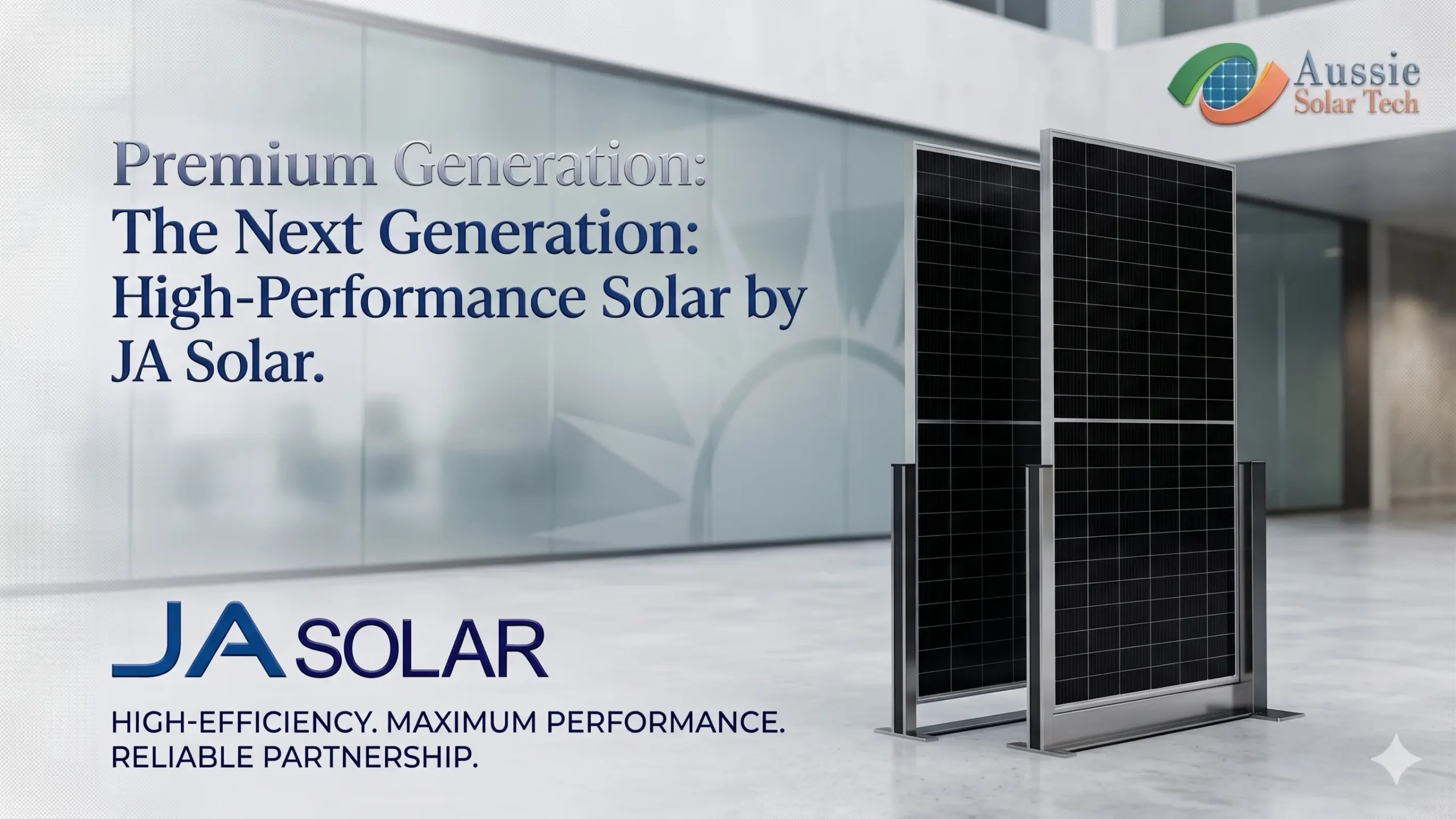
A low budget is the first thing most Australian homeowners consider when choosing a solar panel. Now, although it’s a good strategy, sometimes this might mean making compromises with the quality. For instance, older cell tech, lower efficiency, and durability might keep adding extra costs over the years. As a result, the low-budget strategy might not look so good after all.
JA Solar Panels can help you hit the sweet spot in this case. In a major region like ACT, the total cost (panels+associated solar components+labor) of installing a 6.6 kW system with JA solar comes around 6,500-8000 AUD. This is the well-known budget price of a standard residential solar setup. However, unlike other budget brands, JA solar panels offer so much more at this price. You get 24.8% efficiency compared to the typical 21–22% of budget modules. These panels are also much better at handling shade and low light than other budget brands. Plus, the heat tolerance and yearly degradation rate are at the same tier as premium brands.
At Aussie Solar Tech, we frequently find homeowners asking about these panels since their friends or neighbors achieved excellent results with them. So, here’s an unbiased JA Solar Panels Review from our experience with installing these modules.
Who Makes JA Solar Panels?
JA Solar Technology Co., Ltd is the company behind these panels. It’s originally a Chinese company that started its journey in the PV industry in 1996 from Ningjin, Hebei. They started by making solar rods and silicon wafers. This tells something important about the company- they are not just a business that merely assembles third-party solar materials and markets them as their own panels. Instead, the company has actively contributed to the global development of solar tech. This is the reason they can offer cutting-edge tech at a budget price. In 2005, the company started making solar cells and finally moved to PV module manufacturing in 2010.
Today, the Chinese company is a global one with 16 overseas sales branches catering to 180 countries. They make everything from silicon wafers and cells to modules and storage systems. As of 2026, they have shipped 346 GW worth of solar products to the world and are very likely to stay in the game for many decades to come.
Are JA Solar Panels Good For Australian Homes In 2026?
The average Australian home requires mainly three things when choosing a solar panel. Firstly, it has to generate the most amount of electricity from the least amount of space possible. JA Solar’s Bycium+5 cell tech and superior full-screen design ensure this one. Secondly, the panels should be resilient to the extreme heat and weather conditions in Australia. JA solar panels check that box, too. The company is so confident in their products’ long-lastingness that they offer a 30-year performance warranty. And lastly, they shouldn’t burn a hole in your pocket, which they don’t by being priced at roughly $150-$200/panel. Let’s dive a little deeper.
Bycium+ 5.0: A Win Over The Typical P-type Cells
Most panels in the mentioned price range use P-type cells to convert sunlight into electricity. In contrast, JA solar panels use the far superior Bycium+ 5.0 tech in their newest DeepBlue 5.0. This leads to a higher efficiency of 24.8% and an astonishing output of 670W. For perspective, the mass-produced P-type cells offer around 20% efficiency and 440W output at best.
The Bycium five was developed and perfected by JA Solar itself. It’s essentially a fifth generation of n-type TOPCon cells. Solar cells generate electricity by releasing electrons when sunlight hits them. However, in typical cells, these electrons can face various atomic blockades when escaping and disappear as a result. This leads to loss of power in those cells.
JA Solar solves this problem by doping its cells with phosphorus instead of boron in typical cells. Also, their ultra-pure silicon wafers have extremely low oxygen levels. While boron causes cells to degrade in the sun, phosphorus keeps providing free electrons. As a result, the loss of electrons from atomic causes is effectively neutralized. The Bycium cells also have a microscopic thin strip of silicon oxide inside the cells at the atomic level. This lets the escaped electrons tunnel through the cells and bypass the atomic blockades. The final result is a solar cell that yields a maximum amount of electrons and thus greater electricity production.
More Electricity With Minimalist Aesthetics
In the world of budget panels, aesthetics and increased performance seldom blend. Most of the high-power solar panels also tend to be bulky and don’t sync with your property’s architectural beauty. Which means it will take up too much roof space. Plus, it can hurt your property’s resale value.
JA solar panels address this issue by using the Gapless Flexible Interconnection or GFI in their latest models. This is remarkably different from the traditional budget panels, which leave gaps between the solar cells. Here, the aim is to provide room for the cells when they expand under the scorching sun. Otherwise, the cells would crack when they expand.
In JA’s latest panels, they replace the gaps with a buffer ribbon connection. As a result, they are able to closely pack a greater number of cells in the same panel space and create a seamless full-screen design. The ribbon soaks up the heat, preventing the damage from thermal expansion. Meanwhile, you get a continuous slab of solar cells that has a sleek, glassy aesthetic.
According to the company’s claims, this extends the usable area of the solar matrix by 40 mm, which results in a 1.82% increase in the panel’s power-producing area. This gives you around 15W more raw power, a 0.56% increase in efficiency, and 3.2% greater utilization of roofspace. These are not simple marketing exaggerations since these claims strongly align with our client feedback.
Performs Well In Twilight hours
The standard budget panels wake up late in the morning and go to sleep early. Therefore, they yield much less electricity. These panels with old P-type PERC cells can only work in direct sunlight. They cannot respond to the diffuse light waves during the twilight hours and gloomy days.
In contrast, the Bycium cells in JA solar panels have a much more optimized light absorption feature due to their internal design. They can catch weak sunlight falling on their surface from wide or indirect angles. As a result, they can keep making electricity even during the early and late hours of the day and also when it’s cloudy or foggy. This leads to 10+% more power gain during twilight than a typical panel.
Smart Electrical Rerouting
The average solar panel is quite primitive when it comes to handling the electrical routes. They allot large areas of the panel to a single bypass diode. Even if a single cell in that batch is mildly touched by the shadow of a tree branch or chimney, the diode will shut down the entire area and largely drop power output. As a result, these panels are extremely intolerant to shadowing.
JA solar panels change the game by using a smart circuit architecture. The wiring reroutes the electric current only around the shaded cell and lets the rest of the panel work fine. In other words, they have achieved a granular level of control on the panels’ electrical routing instead of large areas. In comparison to a conventional module, JA panels can deliver 34% more power during such short-edge shading.
Harvests Reflective Light
Both Deepblue five and four from JA Solar are double-glass bifacial modules. The Deepblue 5 has a bifaciality of 85% (+/- 5%). This is possible because, unlike conventional modules, JA panels are not limited on the back side by a solid metal layer. Instead, these panels are essentially a slab of tightly packed cells sandwiched between two layers of glass. So, the rear part is as free to receive light as the front face.
This bifacial feature can significantly boost the panel’s power output depending on how much light the surroundings reflect to the rear part. It also increases the durability of the panel since the cells are protected on both sides from harsh weather factors by strong glass.
JA Solar Panel VS. Popular Low-Cost Panels In Australia 2026
In terms of performance and durability, JA solar panels can give most of the premium panels in Australia a good run for their money. However, it goes without saying that a 400$+ panel is priced like that for a reason. They might have more expensive (but not necessarily better) cell-tech than JA solar panels. Most of them offer far longer product warranties. Then again, those are high-cost premium panels, and it’s unfair to match them up against products that cost half their price.
A better way to evaluate JA panels will be to compare them against the popular option that sits in the same budget range ($150-$200) you initially targeted. Take a look at the table below.
| Feature Category | JA Solar (DeepBlue 5.0) | Jinko Solar (Tiger Neo) | Trina Solar (Vertex S+) | LONGi Solar (Hi-MO X6) | Canadian Solar (TOPHiKu6) | JA Solar vs. Competitors Performance Comment |
| Max Module Efficiency | ~24.8% | ~22.5% | ~22.5% | ~22.5% | ~22.3% | Excels: The Bycium+ 5.0 cells in the DeepBlue 5.0 push front-side module efficiency up to 24.8%, noticeably beating out Jinko, Trina, and Canadian Solar in raw surface-area conversion. |
| Bifaciality Rate | 85% ± 5% | 75% – 80% | 80% | N/A (Front Contact variant) | 70% – 75% | Excels: It dominates in rear-side reflection gains. Its 85% bifaciality outperforms Trina and Jinko, making it vastly superior if used on highly reflective ground mounts or light-coloured commercial roofs. |
| Temperature Coefficient | -0.26%/°C to -0.27%/°C | -0.29%/°C | -0.30%/°C | -0.29%/°C | -0.30%/°C | Excels: JA Solar offers an industry-leading thermal coefficient. It loses less power as it heats up, giving it a clear advantage during intense Australian summer heat waves over Trina and Canadian Solar. |
| Standard Product Warranty | 12 Years | 12 – 25 Years (Model dependent) | 15 – 25 Years (Model dependent) | 15 Years | 15 Years | Falls Short: JA Solar’s baseline 12-year product warranty is restrictive compared to the 15-year base standards of Trina, LONGi, and Canadian Solar. Premium residential lines from Jinko often offer up to 25 years. |
| 25/30-Year Linear Degradation | 87.4% at Year 30 (0.35% annual) | 87.4% at Year 25 (0.4% annual) | 88.4% at Year 25 (0.4% annual) | 88.85% at Year 25 (0.4% annual) | 88.95% at Year 25 (0.4% annual) | Balanced: While JA Solar guarantees performance out to 30 years (thanks to its dual-glass configuration), its cumulative 25-year retention curve tracks slightly behind Canadian Solar and LONGi’s premium N-type offerings. |
Verdict
| Pros | Cons |
| ● Advanced Bycium cell tech
● Excellent efficiency and power output ● Superior Bi-faciality over other panels ● Durable with minimal aesthetics ● Performs well in twilight and overcast days |
● Short product warranty
● Double-glass panels weigh more than glass and plastic panels. |
JA solar panels offer premium perks at less than half the price. The superior cell tech and increased tolerance towards heat, shadows, and low light make it an excellent choice for Australian homeowners who are short on cash and roof space. For more specific info and detailed quotes, contact the Aussie solar tech team.
FAQs
Do JA Solar Panels require a lot of cleaning and maintenance?
No. JA solar panels use a short-edge perforated design that reduces the need for frequent cleaning. Unlike the typical panel, there isn’t a raised panel border to trap dust. Instead, there is a frame with built-in drainage holes that is perfectly levelled or flush with the glass sheet. This allows rainwater to wash away dirt and prevent mud lines that occur on raised edges.
Can JA Solar panels start rooftop fires like most other cheap modules?
No. JA Solar’s panels are the first n-type TOPcon modules to pass the explosion-proof test conducted by TÜV SÜD- one of the strictest safety inspector agencies in the world. This means JA solar systems are extremely unlikely to start a rooftop fire from a spark, even when pushed to the extreme. Explosion-proof also means they are highly resilient against hail storms, acidic bird droppings, or salty sea air.
How can I increase the bifaciality of JA Solar Panels?
To get the most out of JA Solar’s superior bifaciality, you need to ensure more light hits the back of the panel. The easiest way to color the roof is with a bright white coating. This ensures more sunlight is reflected from the roof to the panel’s rear surface. You might also want to make the area beneath or behind the panels clutter-free, like neatly organizing the wiring and such.
Can JA solar panels perform well on extremely hot Australian days?
Yes. JA solar panels have a temp co-eff of -0.26% compared to the -0.30 to-0.40% of products in the same price range. So, on a very hot afternoon, when the panel’s surface temperature is 30-40 degrees above its baseline, JA panels’ performance drop will be negligible compared to typical modules. In other words, it wouldn’t bring your household’s electric activities to a stop, which the standard panels might.

Shah Tarek is a Solar Energy Consultant with 10 years experience in solar system design and solar consultancy field at Australia. He is now a Director, Operation & Consultancy Division at Aussie Solar Tech, a leading Australian solar retailer and installer. Here he is writing informative and engaging solar content that educates the community on the benefits of solar power. His work supports Aussie Solar Tech’s mission to promote sustainable energy solutions and foster a greener future for Australia.





Seraphim Solar Panels Review: Efficiency, Reliability, and Value Unveiled

Talesun Solar Panels: Honest Review Before You Buy

Sungrow Battery VS Tesla Powerwall : Which is Best in Australia?

Leapton Solar Panels Review: Affordable Energy Solution

REC Solar Panels Review: Outstanding Efficiency & Durability

Best Hybrid Inverters for Home Solar Systems in 2025

Best Solar Battery In Australia 2026 — Complete Guide

Sigenergy VS Fox ESS Battery: Which is The Best Choice for 2026

How Much Do Solar Panel Costs in Australia? (2026 Price Guide)

