
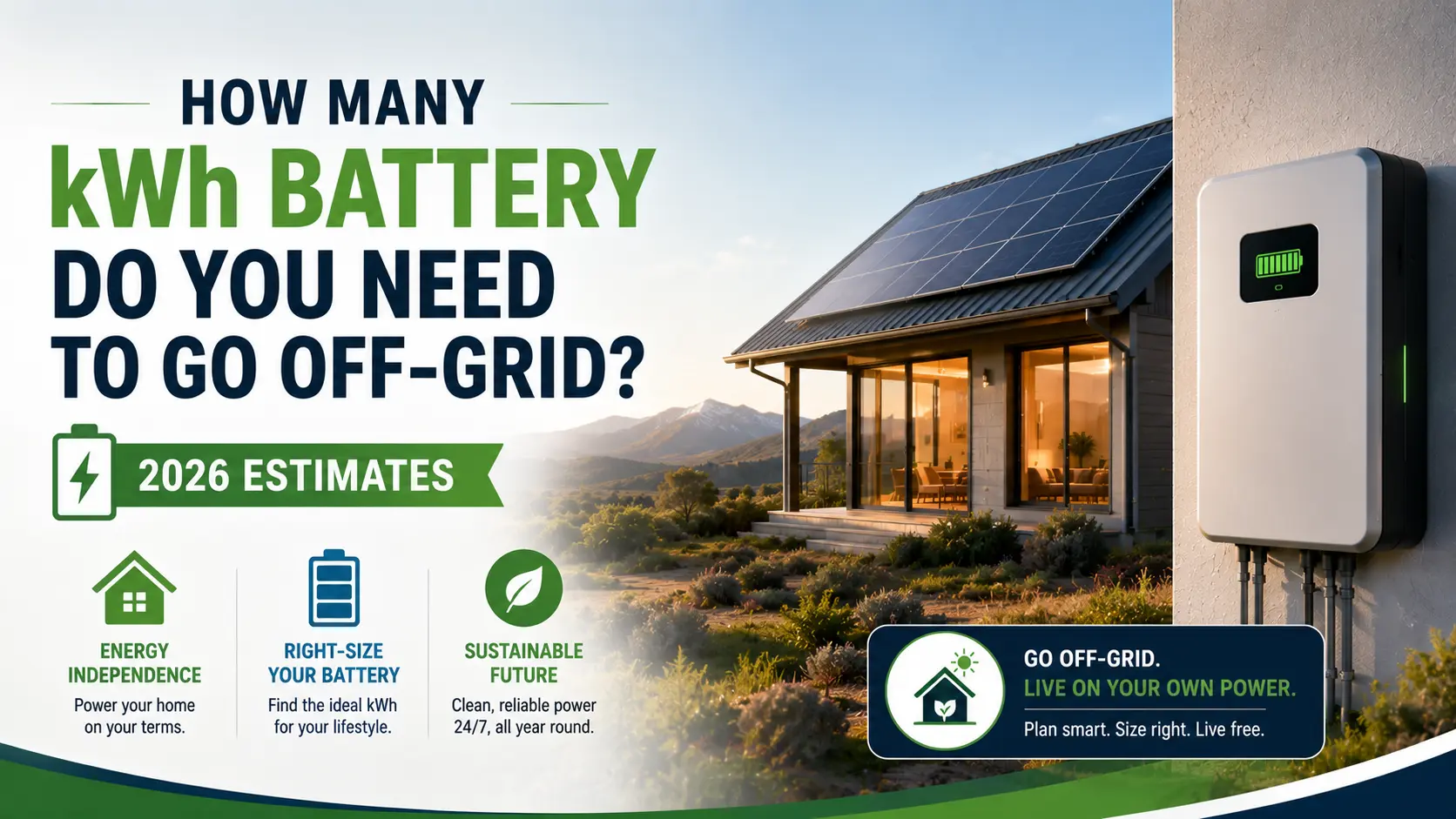
Search “How Many kWh Battery Do You Need to Go Off-Grid ” and you’ll mostly find advice for people staying connected to the grid — sizing a battery to shave the evening peak off their bill. That’s a different, much simpler problem than the one this article answers.
Going genuinely off-grid — disconnecting from mains power entirely — means your battery has to do a job the grid used to do: cover every gap between what your panels produce and what your household uses, including through cloudy stretches, short winter days, and the occasional multi-day system fault. Get the sizing wrong and you’re not just paying a bit more than you needed to — you’re literally out of power.
This guide walks through the real numbers for going off-grid in Australia in 2026: how many kWh of battery storage different household sizes typically need, how much solar array you need to actually refill that battery, why “days of autonomy” matters more than daily usage alone, and where a backup generator still earns its place even in a well-designed system.
Off-Grid vs Grid-Tied With Battery Backup — Know the Difference First
Before sizing anything, it’s worth being clear on what “off-grid” actually means, because the two are sized completely differently:
- Grid-tied with battery backup: You stay connected to mains power. Your battery covers evening peak usage and can back up essential circuits in a blackout, but the grid is always there as a safety net if your battery runs flat. This is what most Australian battery buyers actually install, and it’s what SolarQuotes, Solar Calculator and most mainstream guides are sizing for.
- True off-grid: There is no grid connection at all. Your battery and solar array must cover 100% of your household’s energy needs, 365 days a year, including the depths of winter and multi-day cloudy stretches. This requires meaningfully more storage, more solar capacity, and usually a backup generator for the worst-case scenario.
If you’re planning true off-grid, size for the second scenario — not the first. Most generic “battery size” calculators and guides (including the two we compared this article against) are built around grid-tied assumptions, which will significantly undersize a genuine off-grid system.
The Off-Grid Sizing Framework — Three Numbers That Matter
Properly sizing an off-grid battery isn’t just “daily usage × 1.” It comes down to three factors working together:
- Daily energy usage — how much energy your household actually consumes, in kWh per day
- Days of autonomy — how many consecutive low-sun days your system needs to survive without meaningful solar input
- Usable capacity vs nameplate capacity — most lithium batteries shouldn’t be discharged to 0%, so your usable storage is typically 90–100% of nameplate capacity (varies by brand and chemistry), and you should size with a buffer in mind
The core off-grid sizing formula
Battery size (kWh) = Daily usage (kWh) × Days of autonomy ÷ Usable capacity factorFor example: a household using 18 kWh/day, sized for 2.5 days of autonomy, with a battery that has a 95% usable capacity factor, needs approximately:
18 × 2.5 ÷ 0.95 ≈ 47 kWh of battery storage
That’s a genuinely large number compared to the 10–13.5 kWh batteries most grid-tied guides recommend — and it’s exactly why off-grid systems typically use multiple batteries stacked together, not a single unit.
How Many Days of Autonomy Do You Actually Need?
This is the concept every competing article skips — and it’s the single biggest factor in off-grid battery sizing.
“Days of autonomy” means how many consecutive days your battery needs to power your home with little to no solar input — think a run of winter storms in Gippsland, or a week of heavy cloud cover on the NSW coast.
| Climate/Location Profile | Recommended Days of Autonomy |
|---|---|
| Reliably sunny inland regions (e.g. inland NSW, parts of SA) | 1.5–2 days |
| Coastal VIC/NSW with variable cloud cover | 2–3 days |
| High country, Tasmania, or areas with frequent extended overcast winters | 3–4 days |
Sizing for too few days of autonomy is the most common — and most costly — off-grid design mistake. It’s the difference between a system that quietly rides out a wet week and one that runs your generator overtime or leaves the fridge off.
2026 kWh Battery Estimates by Household Size
The table below gives realistic off-grid battery sizing ranges for 2026, based on typical Australian household consumption and a 2–3 day autonomy buffer (adjust up for high country/Tasmania, down for consistently sunny inland regions).
| Household Profile | Typical Daily Use | Recommended Off-Grid Battery Size | Recommended Solar Array |
|---|---|---|---|
| Small household (1–2 people, no EV) | 8–12 kWh/day | 20–30 kWh | 6–8 kW |
| Medium household (3–4 people) | 15–20 kWh/day | 35–50 kWh | 9–12 kW |
| Large household (4–5+ people, pool) | 25–35 kWh/day | 55–80 kWh | 13–18 kW |
| Large household + EV charging | 35–45+ kWh/day | 80–110+ kWh | 18–24+ kW |
These figures are indicative planning estimates, not a substitute for a proper site-specific off-grid design — actual sizing should always be confirmed with an accredited installer who can assess your roof, shading, location, and appliance loads.
Why the Solar Array Matters as Much as the Battery
A battery this size is only useful if you can actually refill it. Off-grid systems typically need a solar array 1.5–2× larger than an equivalent grid-tied system, for two reasons:
- You have to fully replenish the battery on a good day, not just cover same-day usage, so there’s excess capacity built into the design specifically for battery charging
- Winter solar yield is meaningfully lower than summer — in Victoria and southern NSW, expect winter generation to be roughly 40–60% of summer output per panel, which is why off-grid arrays are sized around worst-case winter generation, not the annual average
This is one of the most commonly underestimated aspects of off-grid planning: a system that comfortably meets your needs in December can fall well short in July if it wasn’t sized with winter in mind from the start.
Where a Backup Generator Still Fits In
Even a well-designed off-grid system, sized generously for days of autonomy, will occasionally hit a stretch of weather that exceeds its design buffer. Most genuine off-grid installations in Australia still include a backup generator as the final layer of protection — not because the battery sizing was wrong, but because it’s more cost-effective than sizing a battery bank for a true worst-case scenario that might occur once every few years.
A well-designed off-grid system typically layers protection like this:
- Solar array sized for worst-case winter generation
- Battery sized for 2–3 days of autonomy
- Generator backup for the rare event that exceeds both
This layered approach is usually far more cost-effective than trying to eliminate generator backup entirely by oversizing the battery bank alone.
Frequently Asked Questions
How many kWh of battery do I need to go fully off-grid in Australia?
Most Australian households need somewhere between 20 kWh (small household) and 80–110+ kWh (large household with EV charging) of off-grid battery storage, depending on daily usage and how many days of autonomy the system is designed for. This is significantly more than the 10–13.5 kWh typically recommended for a grid-tied, bill-reduction-focused battery.
What’s the difference between off-grid battery sizing and grid-tied battery sizing?
Grid-tied battery sizing assumes the grid is always available as a backup, so it only needs to cover evening peak usage — typically 10–14 kWh. Off-grid sizing has no such safety net, so it must account for consecutive low-sun days, seasonal generation drops, and full daily coverage — resulting in a much larger battery bank.
What is “days of autonomy” and why does it matter?
Days of autonomy is the number of consecutive days your system needs to power your home with little to no solar input. It’s the single most important factor in off-grid sizing, and it’s commonly overlooked in generic “battery size” guides that are written with grid-tied households in mind.
Do I need a backup generator if I go off-grid?
Most professionally designed off-grid systems in Australia include a generator as a final backup layer, even with generous battery and solar sizing. It’s typically far more cost-effective than trying to eliminate every possible worst-case scenario through battery capacity alone.
Does winter affect off-grid battery and solar sizing?
Yes, significantly. In Victoria and southern NSW, winter solar generation can drop to 40–60% of summer output per panel. A genuine off-grid system needs to be sized around worst-case winter generation, not annual averages, or it risks falling short exactly when you need it most.
Is it cheaper to stay grid-tied with battery backup instead of going fully off-grid?
In most cases, yes — a grid-tied system with battery backup costs significantly less than a true off-grid setup, because it doesn’t need to be sized for worst-case, multi-day autonomy. Full off-grid makes the most financial sense where grid connection is unavailable or prohibitively expensive to install.
Conclusion
Going off-grid in 2026 is a genuinely different sizing exercise to adding a battery to reduce your power bill — and most of the advice online, including from some of the biggest names in Australian solar, is written for the latter. If you’re planning to disconnect from the grid entirely, the numbers you need are bigger: typically 20 kWh at the small end through to well over 80 kWh for a larger household with an EV, backed by a solar array sized for worst-case winter generation and, in most cases, a generator for the rare event that exceeds it all.
The framework matters more than any single number — daily usage, days of autonomy, and a properly matched solar array will get you to a realistic figure for your specific home and location, which a generic calculator simply can’t do.
Thinking about going off-grid, or want a proper site-specific assessment rather than a rule-of-thumb estimate? Our team can walk your roof, your usage, and your location through a real off-grid design — get in touch for a free, no-obligation assessment.
[Get Your Free Off-Grid Assessment →]

Shah Tarek is a Solar Energy Consultant with 10 years experience in solar system design and solar consultancy field at Australia. He is now a Director, Operation & Consultancy Division at Aussie Solar Tech, a leading Australian solar retailer and installer. Here he is writing informative and engaging solar content that educates the community on the benefits of solar power. His work supports Aussie Solar Tech’s mission to promote sustainable energy solutions and foster a greener future for Australia.









Seraphim Solar Panels Review: Efficiency, Reliability, and Value Unveiled

Talesun Solar Panels: Honest Review Before You Buy

Sungrow Battery VS Tesla Powerwall : Which is Best in Australia?

Leapton Solar Panels Review: Affordable Energy Solution

REC Solar Panels Review: Outstanding Efficiency & Durability

Best Hybrid Inverters for Home Solar Systems in 2025

Best Solar Battery In Australia 2026 — Complete Guide

Sigenergy VS Fox ESS Battery: Which is The Best Choice for 2026

How Much Do Solar Panel Costs in Australia? (2026 Price Guide)

