
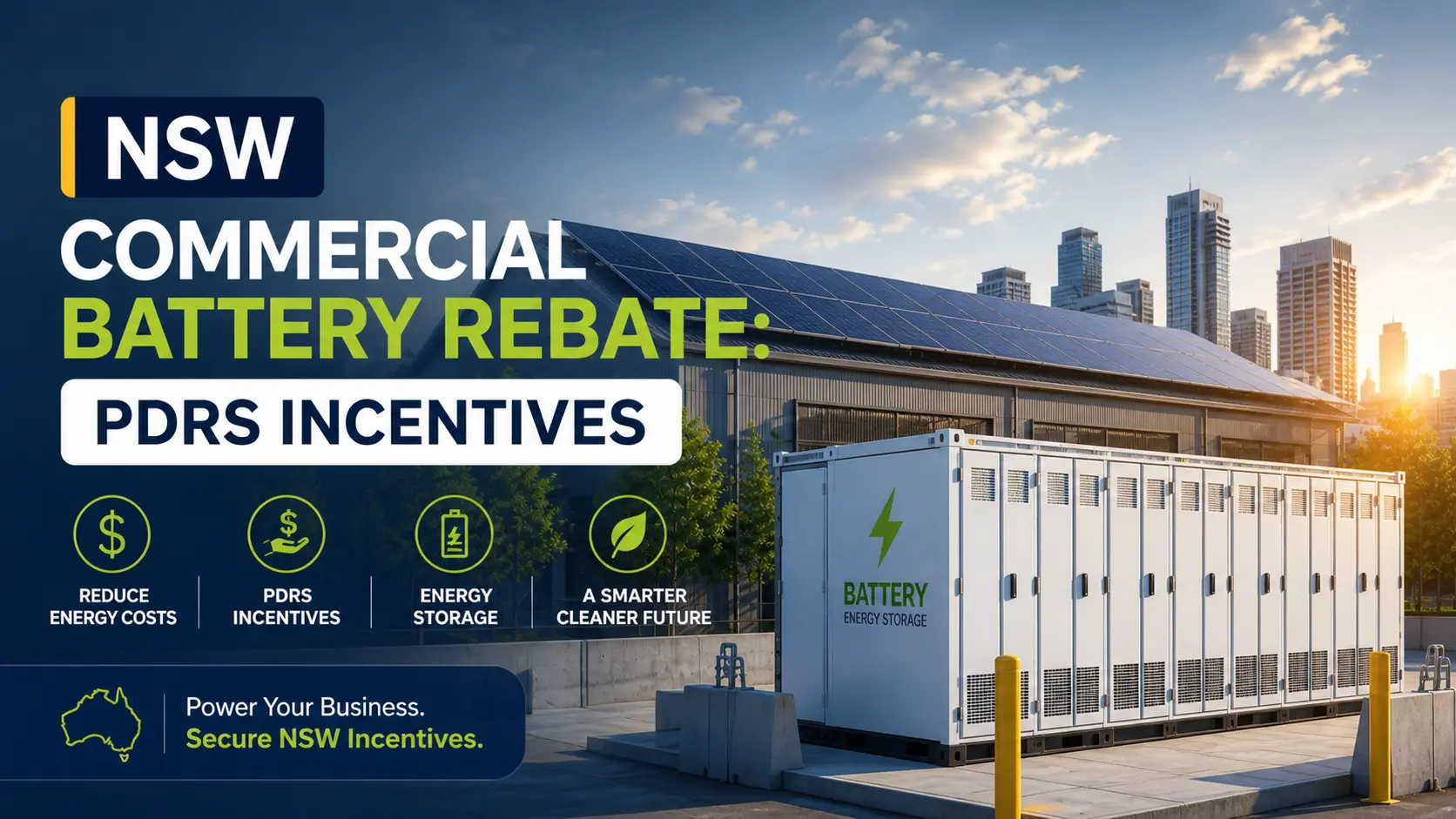
Commercial batteries are not an easy investment decision. They cost six- or seven-figure sums depending on the capacity. Owners with moderate-sized operations might think it takes too long for the business to make the money back. Well, the NSW commercial battery rebate makes you rethink.
The PRC certificates, which equal the rebate payback, easily cover around 20% of the upfront costs. We are currently helping several businesses with such installations, and the math shows some of them might even get close to a 50% discount on their initial expense for the criteria they fulfil. Let’s see how your business too can get a heavily discounted commercial battery with this rebate.
Is this a Solar Rebate?
Business owners who have not yet installed solar might assume the NSW commercial battery rebate is not for them. This is understandable, since the federal rebate program for home batteries makes solar a must-have requirement.
However, this is a misconception. The rebate for commercial batteries does not make solar mandatory. You do get a bigger payback if you install solar within 90 days of the battery, so it favors solar, but it is not exclusively a solar rebate.
As with most of these rebates in Australia, this new one too favours tech that reduces grid electricity use. The PDRS incentives, which make the rebate possible, have an even narrower focus on reducing grid use during peak demand hours.
Commercial batteries, like the ones defined in BESS4 and BESS5, can save the grid without needing a solar panel, and therefore the PDRS do not require one.
An Overview of the New NSW Rebate for Commercial Batteries
A commercial battery is an effective way to cut operating expenses. You charge up during the day when grid electricity sells at the cheapest rate and use it during the peak-rate evening hours. The saved power bills add to your monthly profits.
So the NSW government has included them in the PDRS incentives to support businesses, reduce grid stress, bring down electricity prices, and most importantly, help the environment. The scheme opened on 1 September, with administrative clarifications taking another seven days. The table below gives you the key facts in one place.
| Item | Detail |
| Scheme | The Peak Demand Reduction Scheme (PDRS), administered by IPART. (Peak demand is a 6-hour window, generally 2:30 pm to 8:30 pm.) |
| Start date | Installations on or after 1 September 2026 |
| BESS4 (qualifying path 1) | Small and medium business sites, usable capacity above 20 kWh and up to 200 kWh |
| BESS5 (qualifying path 2) | Commercial, industrial and community batteries, above 200 kWh and up to 30 MWh |
| What you receive | An upfront discount funded by Peak Reduction Certificates (PRCs). It is not a cash payment. |
| Typical discount | About 20% to 50% of installed cost, based on industry modelling range, not a government guarantee. |
| Certificate price | $3.00 as at August 2026. It moves with the market, so it can be $2.50 or $3.50 depending on the time. |
| Solar required? | No. New solar installed within 90 days of the battery earns a higher rate. |
| Federal stacking | BESS4 systems up to 100 kWh may also qualify for the federal Cheaper Home Batteries Program. |
| Minimum customer payment | $5,000 per implementation for BESS4 |
| Claim limit | Once per site |
How Is the NSW Government Paying for Commercial Batteries?
The NSW Government has an understandable motivation for paying 20–50 percent of your commercial battery’s upfront cost. But where are they getting all the money? It is important to understand this for the scheme and its rules to make more sense.
Everyone knows the government does not have money of its own. They just redistribute what they take from the people. Same here. In this case, the people happen to be electricity retailers.
The government has made it mandatory for electricity retailers to take part in peak demand reduction. They do so by surrendering a certain number of Peak Reduction Certificates they bought from us — accredited installers — who create these PRCs when we put in a commercial battery.
So it looks like the retailers are the ones who end up paying for your battery. Next time a ridiculously high monthly bill bothers you, know that you can make the people who sent that bill pay for your commercial battery.
What lets us, or installers working with ACPs, make those certificates is the PDRS. You can think of it as a reward system for technologies that reduce demand during peak hours: air conditioning, refrigerated equipment, pool pumps, virtual power plants, and some commercial heat-pump water heaters, alongside the new addition of commercial batteries.
Installations of these appliances, under proper conditions, are pre-defined “actions” under the PDRS rules (codes like BESS4 and BESS5), and each action creates PRCs. This is the reason you cannot get a rebate with a DIY installation and also have to choose installers working with ACPs.
BESS4 and BESS5 Explained: Your Battery Size Sets Your Payout Tier
BESS stands for Battery Energy Storage System. In the PDRS Rule, each type of battery project is an “activity” with its own code. The codes run from BESS1 for homes to BESS5 for large industrial sites. All of them cover behind-the-meter systems. That means the battery sits on the customer’s side of the electricity meter and supplies your site directly.
BESS4 and BESS5 are the two business lanes. A business qualifies based on the size of its battery, not its industry. Both lanes exclude residential buildings and data centers. BESS5 counts only the first 10,000 kWh when it calculates the incentive. The table shows how the lanes compare.
| Feature | BESS4 | BESS5 |
| Usable capacity | Above 20 kWh and up to 200 kWh | Above 200 kWh and up to 30 MWh |
| Typical site | Small and medium businesses | Commercial, industrial and community sites |
| Equipment | Battery and inverters listed with the Clean Energy Council (CEC) | Battery must pass the UL9540A fire-safety test |
| Installer | Solar Accreditation Australia (SAA) accredited, working to AS/NZS 5139 | SAA accredited, as with all PDRS activities |
| Maximum duration | 6 hours | 6 hours |
| Certificate cap | 4 hours × inverter capacity | 4 hours × inverter capacity, and 10 MWh maximum |
| Minimum customer payment | $5,000 per implementation | Check with your ACP |
| Demand response readiness | Internet-connectable and controllable by an aggregator | Internet-connectable and controllable by an aggregator |
| Federal stacking | Possible up to 100 kWh.The federal program’s ceiling is a nominal capacity of 100 kWh (and STCs only on the first 50 kWh usable). | Do not assume it applies. |
How Much Battery Discount Can I Get With PDRS? Let’s Calculate
The PDRS does not quote a fixed dollar amount for commercial batteries. Your incentive depends on your battery’s specifications, your electricity network, and the market price of Peak Reduction Certificates (PRCs).
The commercial activities are also new, having opened on 1 September 2026. That is too recent for a consensus to form on what businesses typically save, so any headline average would be a guess. The more reliable approach is to calculate your own figure. This section shows how, step by step, with a worked example.
Step 1: Find usable capacity
Multiply the battery’s nameplate (nominal) capacity, as listed on the Clean Energy Council-approved battery list, by 0.9. The scheme applies this fixed 90% rule to every battery. A manufacturer’s 100% depth-of-discharge claim therefore earns no extra certificates. Every later step in the calculation builds on this number.
Step 2: Apply the inverter cap
Compare your usable capacity with four times the inverter’s power rating (in kW) and always use the lower figure. For BESS5 systems, the number is also capped at 10,000 kWh. The “four hours × inverter” rule means the scheme only pays for the amount of energy the battery can realistically discharge during the peak period at the inverter’s full power.
For example, a 50 kW inverter can deliver 200 kWh in four hours (50 kW × 4 h). If your battery is larger than that, the extra capacity earns nothing because the inverter cannot push it out fast enough when the grid needs it most. This is why the inverter is so important: it sets the real limit on how much peak-demand reduction your system can actually provide, and the incentive is based on that practical delivery ability rather than the battery’s total size.
Step 3: Apply the coefficient
Multiply the counted capacity by 0.10 with new solar installed within 90 days, or by 0.067 for a battery alone. (Peak Demand Reduction Scheme Rule of 2022, equations on page 42 define these coefficients). The result is the demand shifting component (DSC), the peak demand the battery is credited with reducing. The higher rate rewards pairing storage with new solar; battery-only systems still qualify.
Step 4: Build the certificate count
Multiply the DSC by 6 hours, 15 years, and the network loss factor, then by 10, rounding down. Six hours is the daily peak window, 2:30 pm to 8:30 pm. Fifteen years is the assumed battery life. The factor covers network losses: 1.04 for Ausgrid, 1.05 for Endeavour or Essential.
Step 5: Find the value
Multiply your certificate count by the current Peak Reduction Certificate (PRC) price ($2.80–$3.50 typically). The result is the upfront discount you can expect on your quote. Because the PRC price moves with the market, test your figure at several prices before you commit to a project.
In short: certificates = DSC × 900 × network loss factor.
Worked example: Rebate payback on a 220 kWh commercial battery in NSW
Assume a 220 kWh nameplate battery, a 50 kW inverter, at least 50 kW of new solar installed within 90 days, and a PRC price of $3.00. A 225 kWh battery would have 202.5 kWh usable and move into BESS5, so this example uses 220 kWh to stay in BESS4.
- Usable capacity: 220 × 0.9 = 198 kWh.
- Inverter cap: 4 × 50 kW = 200 kWh. Usable capacity is lower, so the counted capacity is 198 kWh.
- DSC: 198 × 0.10 = 19.8.
- Certificates: 19.8 × 6 hours × 15 years = 1,782. Then 1,782 × 1.04 = 1,853.28, and × 10 = 18,532.8. Rounded down, that is 18,532 PRCs.
- Value: 18,532 × $3.00 = $55,596.
Now remove the solar. The coefficient drops to 0.067, so the DSC is 13.266. That gives 12,416 PRCs. At $3.00, the value is $37,248. That is $18,348 less, so new solar lifts the value by about 49%.
Certificate price is the biggest swing factor. At $2.00, the with-solar example is worth $37,064 and the battery-only case $24,832. At $4.00, they are worth $74,128 and $49,664. The network matters too. On Endeavour or Essential, the with-solar example earns about 18,711 PRCs, or $56,133. So test your business case at more than one price.
How New Solar Can Lift Your Payout by About 49%
You do not need solar to qualify. Battery-only projects are eligible. But new solar, a firmness factor, raises the coefficient from 0.067 to 0.10, as the example showed. The NSW Government confirms that the size of your discount depends on whether solar and a battery are installed together or the battery is installed alone.
There are two rules for the bonus. The new solar capacity must be at least a quarter of the battery’s usable capacity. That means 0.25 kW of solar for every usable kWh. A 198 kWh battery needs at least 49.5 kW of new solar. A 1,000 kWh battery needs 250 kW. And the solar and battery must be installed within 90 days of each other.
The solar itself earns nothing from the PDRS. It only raises the battery’s rate. The panels have their own federal incentives, which we cover next.
Can You Add Federal Incentives on Top?
The PDRS is a state scheme, but some federal support can sit alongside it. The main one is the Cheaper Home Batteries Program, which is open to businesses as well as households.
It pays through Small-scale Technology Certificates (STCs), and it has strict limits. The battery must be a fixed system with a nominal capacity of 5 kWh to 100 kWh. Electric vehicle batteries do not qualify. The battery and inverter must also be on the Clean Energy Council list. STCs cover only the first 50 kWh of usable capacity, and solar is required, so the battery must be installed with new or existing solar PV.
That size limit shapes how the two schemes stack. BESS4 can be combined with the federal program when both sets of rules are met. In practice, that means batteries of roughly 20 kWh to 90 kWh usable, with solar on site. Larger BESS4 batteries and all BESS5 batteries fall outside the federal limit.
The panels earn their own federal certificates. STCs currently cover solar up to 100 kW, with or without a battery. The government has announced that this will expand to 1 MW from 1 October 2026, subject to regulations. Check the Clean Energy Regulator for the final rules.
Who Benefits From the NSW Commercial Battery Incentive?
A battery pays off when your power use has big spikes, and your bill punishes them. The first thing to check is timing. If your business uses a lot of power in the late afternoon or evening, you are drawing it when grid demand and power prices tend to peak. That is when a battery earns its keep.
Next, look at your bill for a demand charge. This is a fee based on your single highest burst of use in a billing period, not on your total use. One short spike can cost you for the whole month. A battery can trim that spike by supplying power just as it starts.
Finally, consider solar. Without a battery, your midday surplus goes to the grid. With one, you store it and use it later. If two or more of these points apply to you, you are likely a strong candidate. These business types often fit well:
- Cold storage and food businesses: fridges and freezers create heavy, constant loads and sharp spikes that a battery can trim.
- Warehouses and logistics: large roofs suit solar, and EV charging raises your peak, which a battery helps keep in check.
- Farms: dairy sheds, poultry sheds and irrigation pumps run in heavy bursts, so check your network connection early.
- Aged care, health and schools: a battery can keep chosen circuits running in an outage, but backup must be designed in from the start.
- Cafés, restaurants and retail: busy evenings mean high use when power costs more, and a smaller BESS4 battery may be enough.
- Manufacturers: machines starting up create big spikes, and larger sites may land in BESS5.
How to Claim the PDRS Battery Incentive: A Step-by-Step Guide
Claiming the PDRS battery incentive is less a single application and more a sequence of steps. The installer and Accredited Certificate Provider (ACP) handle the certificate side. Your job is to prepare the site, choose the right partners, and get the details right. Lead times can be long for some battery activities, so the sooner you start, the better.
- Start with your numbers by pulling 12 months of interval data and your current tariff. Pick your lane early by deciding between BESS4 and BESS5, and whether new solar is part of the plan.
- Shortlist an installer and an ACP. Confirm the installer is SAA accredited and the ACP is named. Request them to show you the maths, including usable capacity, inverter size, network loss factor, certificate count, and the PRC price assumed instead of a single unexplained discount figure.
- Ask for the fact sheet that ACPs must give you with the quotation. Also check the equipment, since BESS4 batteries need to be CEC-listed and BESS5 batteries need UL9540A testing.
- Get your planning and network approvals sorted, because certificates cannot be created without them.
- Keep good records, since you will need documentation before and after installation, including geo-tagged photos.
- Wait for your ACP to create the Peak Reduction Certificates, and the value will then reach you as agreed.
Final Words
The NSW commercial battery rebate is a great opportunity to cut the upfront cost of a commercial battery and size the system for your business as it will be, not just as it is today.
There is no telling if the certificate prices will fall in the future. Well, it might go up too, but considering the current rate is good enough to get a substantial discount, why not make the wise move and lock in fast.
Also, the provider you choose shapes every step above, so choose carefully. The Aussie Solar Tech Team is currently handling several such projects. Like many NSW businesses, you too can trust us for an installation. Request a quote or contact us directly.
FAQs
- Does the NSW commercial battery rebate pay more for bigger batteries?
Not always. Certificates are capped by the inverter size (four hours × inverter kW) and, for BESS5, by the first 10,000 kWh. A larger battery only earns more if the inverter can support it. Oversizing without matching inverter capacity wastes money and does not increase the incentive.
- Is there a PDRS incentive for commercial batteries in apartments?
Yes. Apartment buildings with four or more dwellings use a separate activity called BESS3. It covers usable capacity from 20 kWh to 200 kWh and requires a $1,000 minimum customer payment. Townhouses and villas are not eligible under BESS3.
- Can I claim the commercial battery incentive more than once at the same site?
No. A site can only receive one BESS4 or BESS5 incentive. Once claimed, you cannot apply again for additional capacity later. Plan the system for future needs (such as EV charging or expansion) before you install.
- Is there a minimum customer payment for BESS5 systems?
No. Unlike BESS4 (which requires a $5,000 minimum payment), BESS5 has no mandatory co-payment under the current rules. You should still confirm the latest position with your Accredited Certificate Provider, as administrative details can change.

Shah Tarek is a Solar Energy Consultant with 10 years experience in solar system design and solar consultancy field at Australia. He is now a Director, Operation & Consultancy Division at Aussie Solar Tech, a leading Australian solar retailer and installer. Here he is writing informative and engaging solar content that educates the community on the benefits of solar power. His work supports Aussie Solar Tech’s mission to promote sustainable energy solutions and foster a greener future for Australia.





Seraphim Solar Panels Review: Efficiency, Reliability, and Value Unveiled

Talesun Solar Panels: Honest Review Before You Buy

Sungrow Battery VS Tesla Powerwall : Which is Best in Australia?

Leapton Solar Panels Review: Affordable Energy Solution

REC Solar Panels Review: Outstanding Efficiency & Durability

Best Hybrid Inverters for Home Solar Systems in 2025

Best Solar Battery In Australia 2026 — Complete Guide

Sigenergy VS Fox ESS Battery: Which is The Best Choice for 2026

How Much Do Solar Panel Costs in Australia? (2026 Price Guide)

