
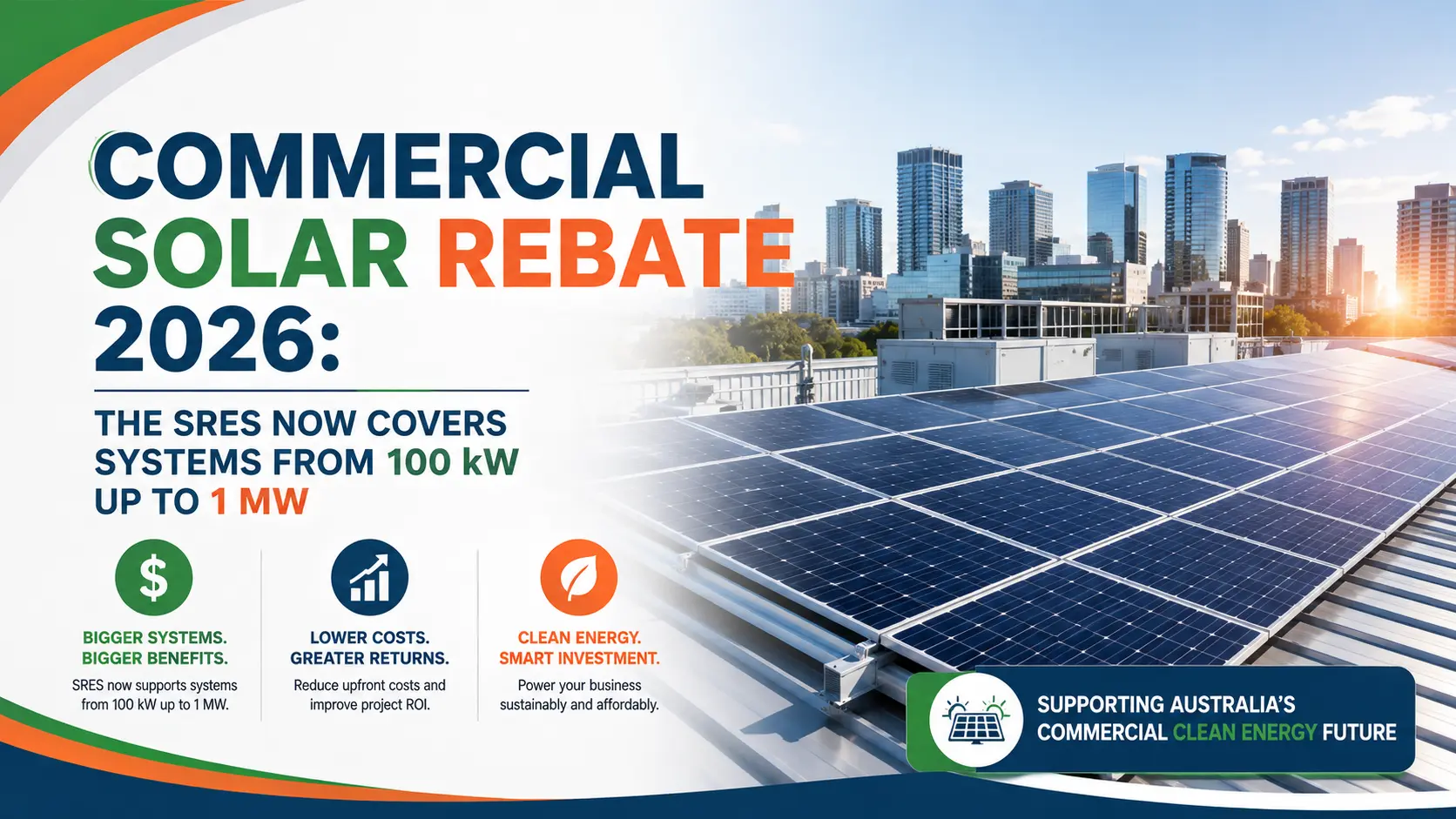
When the Australian government started offering solar rebates, it was mostly for homes and small businesses with small-capacity setups. Mid-sized or large businesses that installed bigger setups kind of felt left out. The commercial solar rebate in 2026, which people are calling the Business Solar Rebate, solves this problem.
From the first of October 2026, commercial solar and mid-scale systems, spanning from 100 kW to 1 MW, are now also part of the Small-scale Renewable Energy Scheme (SRES). This means these bigger commercial systems can, like home solar setups, get an upfront discount (estimated at 20%) on the total installation cost based on the number of STCs they generate. The CER will be accepting applications for these STCs from mid to late November.
This guide covers everything you might want to know about this rebate and also helps you manage expectations. Find out how the certificates work, finance and ownership rules, evidence the regulator wants, and more.
Commercial Solar Rebate at a Glance
| Item | Details |
| Scheme | Small-scale Renewable Energy Scheme (SRES), run by the Clean Energy Regulator (CER) |
| Eligible system size | Solar PV above 100 kW and up to 1 MW (kW rating) |
| Installation date | On or after 1 October 2026 (the testing and commissioning date) |
| What you receive | Small-scale technology certificates (STCs), usually applied as an upfront discount on the installed price |
| How STCs are calculated | System size (kW) × zone rating × deeming years |
| Deeming period | Fixed five years through to 2030 for mid-scale systems |
| Zone ratings | Zone 1: 1.622 | Zone 2: 1.536 | Zone 3: 1.382 | Zone 4: 1.185 |
| Value of one STC | One STC represents 1 MWh of deemed generation or, more accurately, how much fossil fuel use is reduced. The CER Clearing House price is fixed at $40 excluding GST; market prices vary |
| Applications open | Mid to late November 2026 |
| Claim deadline | Within 12 months of installation |
| Products and installer | Components on the Clean Energy Council approved list; installation meeting Solar Accreditation Australia guidelines. Check here for your installer. |
| Approvals and evidence | Planning, building and network approvals, design and compliance records, panel serial numbers, and geotagged installer photos on the final commissioning day |
| Capacity limit | New system plus related solar at the site or adjoining sites must stay within 1 MW |
| Other certificates | No STCs and LGCs for the same capacity; choosing STCs may also rule out REGO certificates during the deeming period |
| Systems over 1 MW | Not covered; they stay under the Large-scale Renewable Energy Target |
Is the Commercial Solar Rebate Live Yet? What Changed on 1 October
The commercial solar rebate is live in the sense that the eligible 100 kW to 1 MW systems must be installed on or after 1 October 2026. So, businesses that hadn’t yet installed a commercial solar system due to high cost can now go forward.
However, the STC applications are still not open, and the CER will start the process in mid or late November. So systems installed on 1 October will get the rebate, but you have to wait about a month to claim the discount.
The Commercial Solar Rebate Timeline
Three dates matter for any business planning a 100 kW to 1 MW system:
- 5 August 2026: The government announced the expansion. So, the rebate actually became a reality roughly two months ago. Well-informed business owners or managers had already started planning in August.
- 1 October 2026: The amended regulations apply to mid-scale solar installed from this date. Those who started planning months before can be some of the first to install. This means they would be some of the first to get the discounts.
- Mid to late November 2026: STC applications open, and assessment begins after that.
The Major Change
Until now, systems above 100 kW could only create large-scale generation certificates (LGCs). LGCs are earned gradually, based on the electricity a system actually generates, so they did little to ease the upfront cost of a big installation.
STCs work differently. They are created once, after installation, based on the electricity the system is deemed to produce over its deeming period, and their value comes off the price you pay upfront.
A system cannot create both STCs and LGCs for the same capacity, and the CER notes that choosing STCs may also rule out REGO certificates for the deeming period. Existing accredited power stations stay under the large-scale scheme and keep earning LGCs.
Who Qualifies for the Commercial Solar Rebate 100 kW up to 1 MW?
If you have experience with the federal solar rebate for home solar set-ups, then you probably know most of the qualification criteria. The Clean Energy Regulator (CER) treats the expansion as an extension of the existing SRES, so familiar rules carry over. A mid-scale system must:
- Be above 100 kW and up to 1 MW, measured by its kW rating. Smaller systems are already covered by the SRES, and anything larger stays under the large-scale scheme.
- Be installed on or after 1 October 2026. A system commissioned on 30 September misses out because the rebate is an upfront discount, not an after-sales cashback.
- Use approved products and accredited installation. Panels, batteries or inverters must be on the Clean Energy Council approved list, and the installation must meet Solar Accreditation Australia guidelines and electrical safety requirements.
- Have every approval in place. That means planning, building and network connection approvals, with evidence you can give the CER.
In practice, the best fit is any site with a large roof and steady daytime electricity use.
Who Owns the STCs for Commercial Solar Rebate 2026?
Trying to sell the STCs you get from the rebate is quite a hassle if you try to do it on your own. So, most commercial buyers will choose finance, lease, or Power Purchase Agreement (PPA) structures instead of paying cash upfront. Under these arrangements, buyers typically assign the Small-scale Technology Certificates (STCs) to the installer, financier, or PPA provider.
There are upfront capital requirements and market risks if you are looking for a direct cash exchange for your STCs. Selling STCs independently means you have to navigate a fluctuating market, deal with complex administrative paperwork, wait for regulatory approvals, and similar stuff, which is a waste of your time.
By assigning the STCs to a third party, businesses trade a delayed, volatile cash payment for an immediate, guaranteed reduction in project costs and offload all regulatory and market risk. How this financial benefit is realized depends entirely on the type of financing entity managing the arrangement:
| Financing Structure | STC Recipient | How the Discount Is Applied | Why Buyers Prefer It |
| Solar Installer | The Installation Company | Applied as an immediate discount on the system’s capital cost. | Drastically reduces the total contract value and initial out-of-pocket setup expenses. |
| Equipment Lease / Finance | The Financial Institution | Factored into the asset value to lower monthly lease or loan repayments. | Preserves operational cash flow with predictable, reduced overhead payments over time. |
| Power Purchase Agreement (PPA) | The Energy / PPA Provider | Retained by the provider to lower the ongoing electricity rate (per kWh) charged to the business. | Secures ultra-low operational energy tariffs with zero upfront capital expenditure ($0 upfront). |
Regardless of the structure, your contract must explicitly state –
- who is entitled to create and sell the STCs
- exactly how the discount is calculated and applied
- who carries the financial risk if market certificate prices crash or application approvals are delayed.
Settle these terms clearly before system commissioning.
Calculate Commercial Solar Rebate STCs 2026: Zones, Deeming Years and Certificate Price
Your system size, which Australian area you installed the system in, and the date you installed it – is what will determine the number of STCs you get. In other words, it follows the standard SRES formula. One STC represents one megawatt-hour of renewable electricity the system is deemed to produce.
STCs = system size (kW) × zone rating × deeming years
Zone Rating
Australia has four postcode zones by postcode. Each one has a fixed rating based on how much sun it receives. So, it should be clear that the zone is not your head office address but where the solar system is physically set up. Also, this rating does not change with system size.
| Zone | Rating | Typical areas | STCs for a 400 kW system |
| Zone 1 | 1.622 | Sunniest regions, including Alice Springs and pockets of outback Queensland, South Australia and Western Australia | 3,244 |
| Zone 2 | 1.536 | Darwin and parts of northern and inland Australia | 3,072 |
| Zone 3 | 1.382 | Sydney, Brisbane, Adelaide, Perth and surrounding regions | 2,764 |
| Zone 4 | 1.185 | Melbourne and most of Victoria, and all of Tasmania | 2,370 |
The area descriptions here are mostly a guide. The CER postcode table is the authority, and boundaries may not always follow what you would expect. A Zone 1 site earns about 37% more certificates than an identical system in Zone 4. So you understand why it’s important to check your exact postcode with the CER mid-scale STC calculator before relying on any estimate.
Deeming Years: Different From Smaller Than 100 kW systems
For small-scale systems up to 100 kW, the deeming period shrinks each year as the scheme heads towards its scheduled end in 2030. Mid-scale systems are different: eligible systems get a fixed five-year deeming period through to 2030, so the count does not step down year by year the way it does for smaller systems.
Certificate Price
STCs are sold on the open market, and the CER Clearing House offers a fixed price of $40 per certificate (excluding GST). Market prices tend to sit close to that figure but move over time, and the expansion itself may affect demand. Ask every installer which certificate price their quote assumes, and to show the certificate value as a separate line.
Will I Really Save 20% With the Commercial Solar Rebate?
Not exactly. The government doesn’t promise or guarantee an exact 20% discount on your upfront cost. However, this is the rough amount you get when you consider how much you can save on the cost of an average commercial solar setup at the current STC price. Your own percentage depends on how much your system costs to install.
Here is a simple way to see it. In Zone 3, every kW of solar earns 6.91 STCs (1.382 × 5 years). At the $40 Clearing House price, that is about $276 off per kW. The discount equals 20% when your system costs about $1.38 per watt to install.
If your quote is cheaper than that, the discount is a bigger share of your bill. If it is more expensive, because the roof needs structural work or the cable runs are long, the share is smaller. The same maths in Zone 1 gives about $1.62 per watt, and in Zone 4 about $1.19 per watt.
So treat 20% as a rough guide, not a promise. Your zone, the certificate price you actually receive, and your installed cost all move the number. The best way to know is to ask your installer for the system price before STCs and the STC value as two separate lines.
How Does the 1 MW Limit Work With Existing Solar and Staged Builds?
Your existing solar setup for your business is not outside the new commercial solar rebate limit. The limit does not look at the new system alone. The CER considers the total solar capacity at your site or adjoining sites, and how those systems are connected and metered. Three situations come up most often.
Adding to an existing system: An extension can qualify if it is part of the same system, is electrically connected, and the combined capacity is above 100 kW and no more than 1 MW. STCs are created only on the added capacity installed from 1 October 2026. In the CER’s example, an existing 80 kW system extended by 40 kW can qualify as a 120 kW system, with STCs on the extra 40 kW only.
Sites with an accredited power station: If existing large-scale solar plus the new installation exceeds 1 MW, the new system is not eligible. In the CER’s illustrations, a new 500 kW system can sit alongside a 100 kW system and a separately metered 400 kW power station, but not alongside a 600 kW one. Separate metering is required where the existing station keeps creating LGCs.
Staged and multi-building projects: Electrical configuration, metering, network connection and whether systems are “related” all count, and a single meter identifier (NMI) does not settle the question. The CER has said it will publish further guidance on related solar devices and power stations, so plan stages upfront and raise this with your installer early.
Can You Claim If You Install Before Applications Open?
Yes. Eligibility depends on the installation date, not the date you lodge. The CER treats a system as installed when it is first capable of producing and delivering electricity, which is the testing and commissioning date on the certificate of electrical compliance (or the state equivalent).
Systems commissioned on or after 1 October 2026 can claim once applications open in mid to late November, and are assessed against the rules that apply from their installation date.
You can design, procure and build before 1 October, as long as commissioning falls on or after that date. Don’t leave lodging open-ended, though: STCs for a mid-scale system must be created within 12 months of installation. Because the discount is not available until certificates are created, your contract should also explain how it appears on your invoice in the meantime.
What Evidence Do You Need to Claim the Commercial Solar Rebate?
Mid-scale claims are document-heavy. You must show the CER that all planning and approval requirements were met, and keep records throughout the project (see the CER transitional guidance):
- System design documentation
- Planning and building approvals, plus structural engineering reports where applicable
- Network connection approvals where applicable
- Metering information
- Electrical compliance certificates and testing and commissioning records
- Photographs and installation evidence
Panel serial numbers must be submitted with the application, and installers and certificate creators must be able to verify them if the CER asks.
The photo rule is stricter than many expect. The accredited installer must take geotagged, time-stamped photos that clearly show their face, the installed system, and the testing and commissioning on the final day of commissioning. Photos taken afterwards to recreate evidence may not be accepted, and applications can be rejected.
Network approval is part of the evidence too. Where one approval covers a staged project, the CER focuses on whether it covers the specific device claiming STCs, so check its scope. Network delays also push back commissioning and your claim, so start early. Ask your installer how they will capture all of this before work starts, not after.
Final Words
The commercial solar rebate has finally caught up with the businesses that needed it. From 1 October 2026, systems between 100 kW and 1 MW can earn upfront STCs, with applications opening in mid to late November. The size of your discount depends mostly on your zone and the certificate price, while the claim itself depends on getting the paperwork right from day one. The tax and GST treatment of the discount depends on your business structure, so confirm it with your accountant before you sign.
Planning a 100 kW to 1 MW system? Aussie Solar Tech can help you size it to your daytime load, check how the rebate applies to your site (including system kW rating and existing solar), and plan the approvals and records the Clean Energy Regulator expects. Request a commercial solar assessment today and get a clear picture before you sign.
FAQs
Is there a government rebate for commercial solar in Australia in 2026?
Yes. Through the SRES, eligible commercial and mid-scale systems from 100 kW up to 1 MW can create upfront STCs when installed from 1 October 2026. Smaller systems already could. Applications for mid-scale systems open in mid to late November.
Can I get the commercial solar rebate on a system over 1 MW?
Not through the expanded SRES, which stops at 1 MW. Larger projects continue under the Large-scale Renewable Energy Target, where certificates are earned as the system generates. If your site already has solar, check how combined capacity is counted before choosing a size.
Can an off-grid commercial solar system qualify for the federal business rebate 2026?
Yes, off-grid systems can generate STCs since they reduce the use of fossil fuels too. The CER says eligible mid-scale systems may be grid-connected or stand-alone, provided they meet all other requirements, including approved products, accredited installation, and planning approvals.
If my business has several buildings, does the 1 MW limit apply to each one?
It depends. The CER looks at the physical and electrical boundaries of the system, metering arrangements, and whether installations are “related”, and a single meter identifier does not decide it. Get your site layout assessed by a professional installer before design.

Shah Tarek is a Solar Energy Consultant with 10 years experience in solar system design and solar consultancy field at Australia. He is now a Director, Operation & Consultancy Division at Aussie Solar Tech, a leading Australian solar retailer and installer. Here he is writing informative and engaging solar content that educates the community on the benefits of solar power. His work supports Aussie Solar Tech’s mission to promote sustainable energy solutions and foster a greener future for Australia.


Seraphim Solar Panels Review: Efficiency, Reliability, and Value Unveiled

Talesun Solar Panels: Honest Review Before You Buy

Sungrow Battery VS Tesla Powerwall : Which is Best in Australia?

Leapton Solar Panels Review: Affordable Energy Solution

REC Solar Panels Review: Outstanding Efficiency & Durability

Best Hybrid Inverters for Home Solar Systems in 2025
Best Solar Battery In Australia 2026 — Complete Guide

Sigenergy VS Fox ESS Battery: Which is The Best Choice for 2026

How Much Do Solar Panel Costs in Australia? (2026 Price Guide)

