
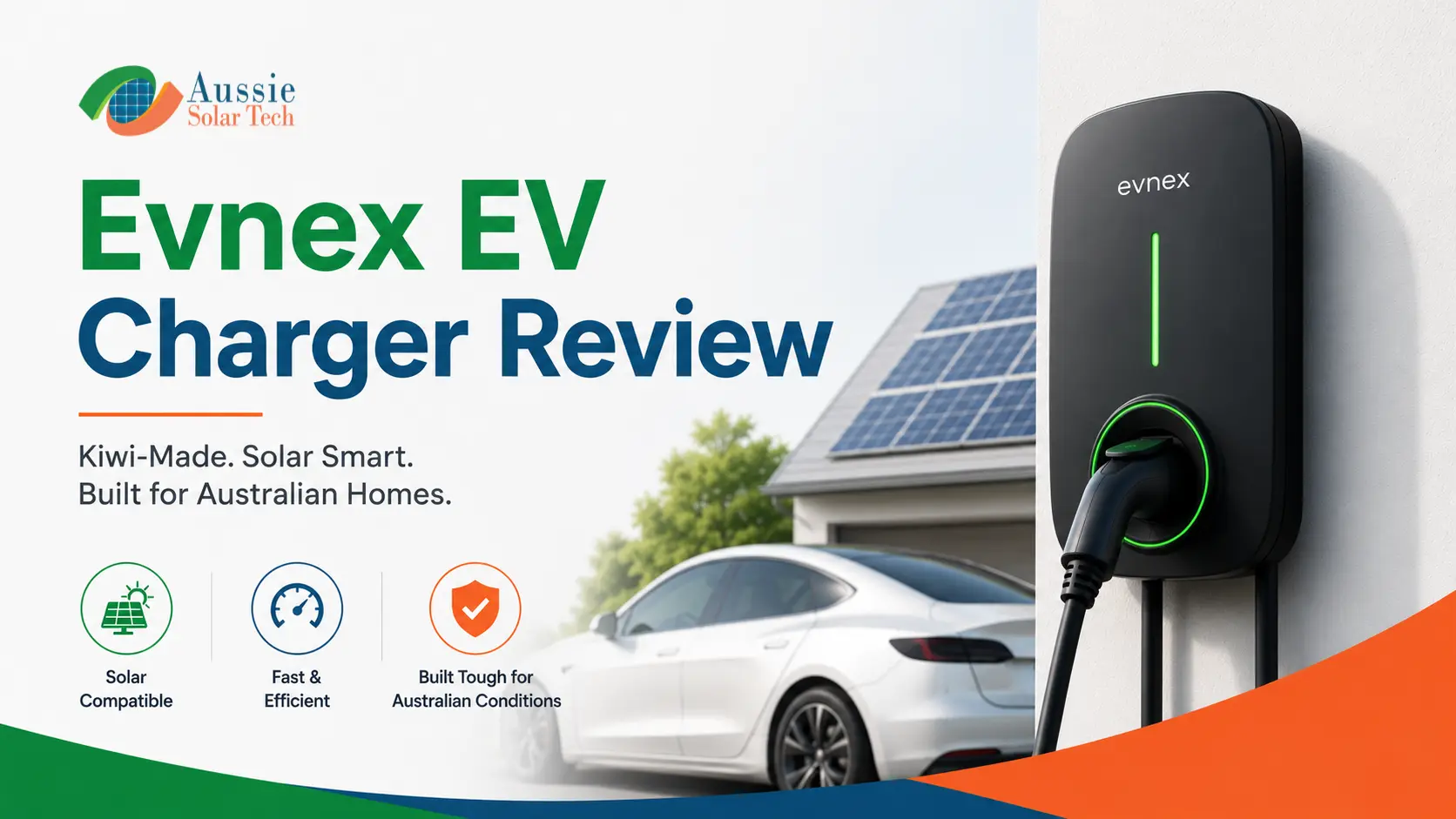
Australia had a historic year in EV sales in 2026. Consequently, EV chargers also became a mainstream home appliance in the country during this time. And among the brands praised for price and performance, the Evnex EV charger holds a top position.
The Evnex EV charger, especially the E2 Plus, is fast and inclusive. It works with almost every EV on Australian roads. Also, this charger can fully pair with any solar setup already on your roof. No ecosystem required.
Our Aussie Solar Tech installers have fitted enough of these units to know exactly where it shines and where it doesn’t. So, this Evnex EV charger review is a must-read before the final purchase.
Evnex at a Glance: A Quick Scan for Busy Buyers
Pros
- Works with virtually every EV sold in Australia
- Fast charging performance
- Hardwired solar diversion; therefore, no ecosystem lock-in
- Four-year residential warranty across the range
- Local Sydney office plus 7-day support
Cons
- Closed OCPP, no third-party automation
- Occasional Wi-Fi dropouts reported by owners
Kiwi Engineering Meets Aussie Roads: Who Actually Makes Evnex?
Evnex started its operations in Christchurch in 2014. The company believes in the build-your-own-hardware approach rather than repackaging third-party hardware. This has earned Evnex New Zealand’s Best Design Award. Meanwhile, New Zealand’s Energy Efficiency and Conservation Authority endorses their commercial X-series chargers.
Local Backing You Can Trust
Evnex expanded into Australia in 2023. They opened an office at the Sydney Greenhouse Climate Tech Hub. Backing that office is a network of certified installers and a 7-day local support line.
Evnex’s local presence means that if something goes wrong with their product, you are not stuck waiting on an overseas call centre. That local footprint also means your installer is trained on Australian wiring standards, state-based demand-response rules, and the rebate schemes that vary depending on where you live.
The 2026 Evnex Lineup: Model Options, Specs, and Pricing
| Model | Price AUD | Power | Connectivity | Best For |
| Evnex E2 Flex | $799 | 7.4kW (single-phase) | Wi-Fi only | Drivers without solar who want basic smart charging |
| Evnex E2 Core | $1,099 | 7.4kW (single-phase) | Wi-Fi only | Suburban homes with solar and strong garage Wi-Fi |
| Evnex E2 Plus | $1,399 | 7.4kW (single-phase) | Wi-Fi + 4G cellular | Detached garages, multi-car driveways, Tesla owners |
| Evnex X22 | $1,699 | 22kW (three-phase) | Wi-Fi + 4G + Ethernet | Fleets, workplaces, homes with three-phase power |
If you have solar, skip the entry-level Flex since it’s grid-only. Instead, consider the E2 Core. It’s the ultimate sweet spot for most suburban homeowners who don’t want to spend more than a $1000. If you run a larger household, a multi-EV driveway, or need three-phase power, look straight to the E2 Plus or the X22.
Hardwired Solar Mastery: How Evnex Beats Cloud-Only Rivals
The core difference comes down to hardware versus the cloud. Brands like Tesla rely on an app talking to your inverter over the internet, a link that can lag or drop out entirely. But Evnex takes a different route on the E2 Core and E2 Plus models:
- A physical CT clamp is fitted directly into your switchboard
- It reads your home’s real electricity flow straight from the wall, not from a server somewhere
- When genuine solar surplus appears, usually around 6A or 1.3kW, the charger switches into Solar Mode automatically
- Output throttles up and down in step with the sun, instead of tripping or stalling the way software-only systems can
One caveat worth knowing: solar diversion is included as standard on the E2 Core and E2 Plus, but the budget E2 Flex is shipped grid-only. The same functionality can be unlocked later with a $349 software upgrade, and no return electrician visit is required.
Competent Charging Performance: From 7.4kW Daily Top-Ups to Heavy-Duty 22kW Power
The Evnex E2 charger is built to genuinely deliver a full 7.4kW on a single-phase circuit.
That works out to roughly 50km of range added per hour. It is designed to truly accelerate charging compared to the granny cable that ships in most EV boots.
Meanwhile, the three-phase X22 pushes that to 120km of range per hour, aimed squarely at fleets and multi-EV households rather than typical suburban driveways.
For most single-phase suburban homes, the E2 range’s speed is a win. It saves both money and time. A fully depleted battery reaches full charge in seven to eight hours when you plug in after dinner and wake up to a full charge. And if it lines up with off-peak or solar generation, you’re not paying anywhere near daytime electricity prices for it.
This matters most for drivers who don’t want to plan their week around charging; set and forget is the goal. A quick top-up before an unplanned trip, or a full overnight recharge after a long weekend drive, is handled without any real thought once the charger is installed and the routine is set.
Built for the Harsh Aussie Sun: Weatherproofing & Thermal Limits
An IP55 weatherproofing rating is common across all the E2 models. This rating tells you the charger is sealed against dust and light water jets. So, it’s safe for permanent outdoor wall mounting.
The charger can comfortably operate from -25°C to +55°C. This is an acceptable temp range for an EV charger. However, if you live in a sunny southern state, daytime temperatures can often reach 65 degrees, especially during the Autumn and Spring. So, arrange for shade over the charger or install it in a cool place to begin with.
- IP55-rated enclosure holds up well against dust and water
- UV-resistant housing means it looks almost new despite years of outdoor exposure
- Wide temp range of -25°C to +55°C is mostly good enough. But install in a protected area if your area is especially sunny.
One exception worth flagging for you: the white “Snow” colourway is recommended for indoor use only in many cases. Evnex warns it can visibly discolour if you mount it outdoors long-term, so raise it with your installer before you pick a colour.
Seamless Integration: Unlocking Tesla Port-Openers and Smart Telemetry
Tesla remains one of Australia’s best-selling EV brands. Which means compatibility matters, even for buyers choosing hardware outside the Tesla ecosystem. Evnex recognizes this demand, and their E2 Plus features native cloud-to-cloud integration between the two brands. However, this is exclusive to the E2 Plus.
It lets you open a Tesla’s charge port using the physical button on the charger handle, mirroring the convenience of a genuine Tesla Wall Connector. It also pulls live State of Charge telemetry straight from the vehicle, so the Evnex app can show exact battery percentages in its reporting.
So for Tesla owners who want non-ecosystem hardware without losing convenience, this is a genuine bridge. The E2 Core and E2 Flex don’t include this integration, leaving them unable to fully access the same features.
Intelligent Home Protection: Preventing Overloads on Single-Phase Grids
Most homes are supplied by a single-phase connection rated around 63 to 80A, and a large share of that headroom is already being eaten by a 32A charger running flat-out before anything else is switched on.
Every Evnex charger smartly solves this. It uses the CT clamp to continuously monitor whole-home power draw and throttle its own output automatically to keep total draw under the switchboard’s safe limit. The feature is standard across the entire range, including the entry-level Flex. So, there’s no premium tier reserved just for basic electrical safety.
Without that kind of protection, an overdrawn charger risks tripping a breaker or, in the worst case, overheating the incoming supply cable; a costly mistake either way. Evnex’s approach means the charger, not the homeowner, is doing the math on what the switchboard can safely handle at any given moment.
It’s a boring feature right up until the day it saves you an expensive electrical service call, which is when its real value becomes clear.
The Safety-Net: Industry-Leading Warranty and Local Aussie Support
Most EV chargers sold in Australia cap out at a two- or three-year warranty. Evnex backs its entire current lineup, Flex, Core, Plus and X22, with a 4-year warranty on residential installs, and three years on commercial ones.
That’s coverage for a piece of equipment that will sit bolted to an exterior wall in the Australian sun for a decade or more in many cases, and it signals no small amount of confidence in the hardware itself.
Moreover, you get their 7-day local support out of the Sydney office; that means a fault gets you a local technician on the phone rather than an overseas call centre. No frustrating hold music from another time zone.
The Fine Print: Potential Drawbacks to Consider Before Buying
There is no charger without a few trade-offs. We cross-checked Australian EV owner forums, Facebook groups, and, most importantly, talked to our own clients. A pattern of complaints emerged from there. These are worth weighing before you buy, rather than discovering them after installation day. It is useful to carefully consider these before committing.
- Occasional Wi-Fi dropouts even on strong home broadband, sometimes needing a manual reconnect
- Installers must complete a short training module and quiz, roughly 30 to 45 minutes, before commissioning a unit. This can be annoying for the homeowner and mess up their schedule.
- OCPP is present but closed to third-party platforms, which mainly frustrates owners running Home Assistant or similar automation setups. This doesn’t affect the charger’s solar and EV compatibility.
- No in-app pause button, so pausing a session means physically unplugging and replugging the cable
Head-to-Head: How Evnex Stacks Up Against Rival Chargers in 2026
| Charger | Approx. Price | Max Power | Solar Integration | OCPP | Warranty | Standout Trait |
| Evnex E2 (Core/Plus) | $1,099-$1,399 | 7.4kW single-phase | Yes, hardwired CT clamp | Closed | 4 years | Best warranty + genuine hardwired solar diversion at mid-range price |
| Tesla Wall Connector Gen 3 | ~$800 | 7.4kW / up to 22kW | No (Powerwall only) | No | 4 years | Cheapest major brand, longest cable, best for Tesla owners |
| Wallbox Pulsar Plus | ~$1,345 | 7.4kW single-phase | No built-in solar mode | Open | 2 years | Most compact design, open OCPP |
| myenergi Zappi V2.1 | ~$1,595 | 7.4kW / 22kW | Yes, three modes | No | 3 years | Most granular solar diversion control |
| Sigenergy Sigen EVAC | ~$1,200 | 7.4kW single-phase | Yes, CT clamp | Open | 3 years | Open OCPP + solar + load management at a competitive price |
| Ocular IQ Home Solar | ~$1,495 | 7.4kW single-phase | Yes, CT clamp | Open (varies) | Varies | Highest weatherproofing rating (IP66) |
- Nothing on this list beats Evnex on warranty length, and no charger at a similar price point matches its combination of hardwired solar reliability and local Australian support
- The Zappi offers more granular solar-mode control for owners who want to fine-tune exactly how much grid top-up they’re willing to allow
- Wallbox and Sigenergy suit buyers who specifically want an open OCPP implementation to connect to third-party home-automation platforms
Verdict: Is the Evnex Charger Right for Your Home?
There is a solid case to choose the Evnex charger if you want a smart, solar-aware system backed by a genuinely local team and the longest warranty in its class. If you’ve got rooftop solar, existing or planned, and want hardwired reliability rather than a cloud link that can fail on a cloudy day, this is a strong fit for your home.
It’s a pass, though, if third-party OCPP integration or deep home-automation tinkering is non-negotiable for you; in which case Wallbox or Sigenergy’s open systems will suit you better. Simple as that. On balance, for the average solar-equipped Australian home, we lean toward recommending it.
FAQs
Can I install an Evnex charger without solar panels?
Yes. The E2 Flex ships as a grid-only charger for exactly this case, which makes it suitable if solar is not yet installed. So if you add solar later, its features unlock with a one-off software upgrade, no electrician callout required.
Does Evnex work with every EV sold in Australia?
Virtually every EV using the Type 2 connector, the Australian and New Zealand standard, is supported to a large degree, including Tesla, BYD, Hyundai, Kia, MG, Volkswagen, Polestar, BMW and Mercedes-Benz. A different cable is needed for Type 1 imports.
Can one Evnex charger manage multiple EVs at one property?
Yes. And Evnex supports a Server-and-Client load-sharing setup, designed to smartly coordinate power across multiple units on one site, useful for two-EV households or small businesses adding charging bays over time.
What happens if my home internet goes down?
The charger keeps working at full charging speed for up to 28 days offline. No internet, no problem, for basic charging at least. You’ll lose scheduling, solar diversion, and remote app control until the connection is restored, but it continues to operate fully for core charging needs.

Shah Tarek is a Solar Energy Consultant with 10 years experience in solar system design and solar consultancy field at Australia. He is now a Director, Operation & Consultancy Division at Aussie Solar Tech, a leading Australian solar retailer and installer. Here he is writing informative and engaging solar content that educates the community on the benefits of solar power. His work supports Aussie Solar Tech’s mission to promote sustainable energy solutions and foster a greener future for Australia.







Seraphim Solar Panels Review: Efficiency, Reliability, and Value Unveiled

Talesun Solar Panels: Honest Review Before You Buy

Sungrow Battery VS Tesla Powerwall : Which is Best in Australia?

Leapton Solar Panels Review: Affordable Energy Solution

REC Solar Panels Review: Outstanding Efficiency & Durability

Best Hybrid Inverters for Home Solar Systems in 2025

Best Solar Battery In Australia 2026 — Complete Guide

Sigenergy VS Fox ESS Battery: Which is The Best Choice for 2026

How Much Do Solar Panel Costs in Australia? (2026 Price Guide)

