
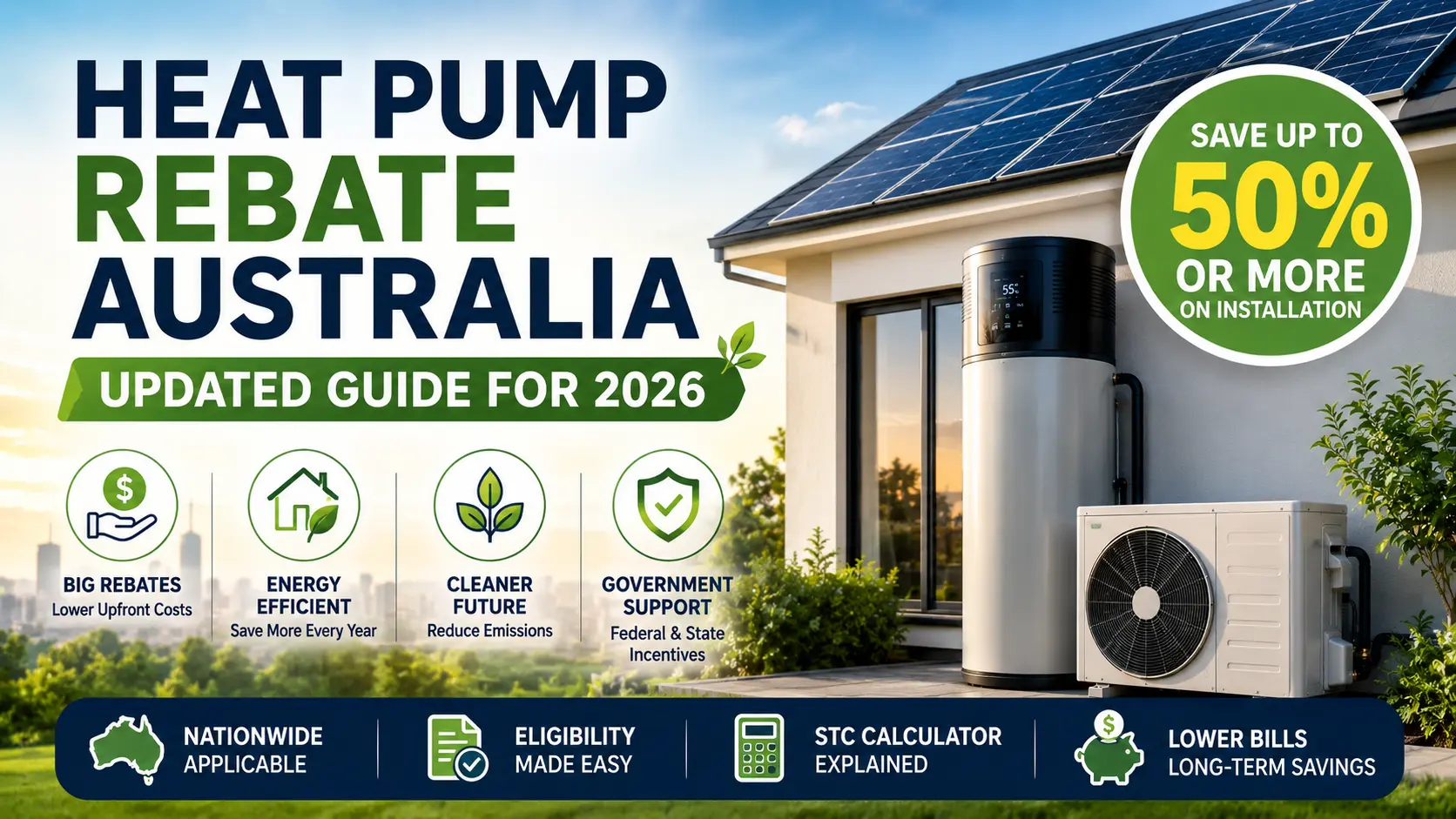
Heat pumps work best in warm regions where the ambient air temperature is high. Therefore, Australian homeowners can get the most out of installing one of these systems. Plus, Australia has one of the world’s highest rooftop solar adoption rates, and adding a heat pump can boost such a home’s energy savings. You will be essentially turning sunlight into hot water to use during peak demand evening hours.
To help homeowners make the transition while achieving their own climate goals, the government offers heat pump rebate across Australia. These are upfront discounts applied to the total installation cost of a heat pump system. There are both federal and state-level rebates, which you may be able to combine to significantly reduce the upfront cost.
The federal discount amount varies widely since a heat pump can generate anywhere from 10 to 20 STCs, depending on the zone and the type of tech installed.Most residential heat pump systems generate roughly 10–20 STCs depending on the model, climate zone, and installation year.
Apart from the federal STCs, which are available to everyone, there are state-specific rebates. Each of those works in its own way, and it can be quite confusing for someone who is trying to figure it out for the first time. The following guide provides a comprehensive overview of heat pump rebates in Australia.
How Does The Federal Heat Pump Rebates Australia Work in 2026?
Unlike what many people assume, the Federal Heat Pump Rebate is not a cash back offer. Instead, it’s a government-backed discount that your installer will include at the point of sale. This significantly reduces the financial burden most homeowners face when paying the big sum of $3000-$5000 for a standard heat pump.
SRES and STCs: The Foundation Of Heat Pump Rebate Australia
The SRES is a government framework that the CER, or Clean Energy Regulator, upholds based on the Renewable Energy Act of 2000. This initiative aims to accelerate the transition of Australian homes from fossil-fuel grid energy to sustainable, non-carbon electricity. In the past few decades, it has been extremely successful in making almost half of Australian homes adopt this change.
Roof-top solar panels are the most well-known items covered by SRES. However, they also include Air-source heat pump hot water systems, Solar water heaters, wind turbines, and hydroelectric systems, since they help reduce dependence on grid electricity.
The rebate you get on a heat pump is entirely dependent on the amount of conventional grid electricity it displaces. It’s very important to understand this since it explains why the same heat pump generates a lesser number of STCs in warm zones.
The amount of grid electricity the heat pump displaces is represented in STCs. Suppose your heat pump is expected to displace 10 MWh of grid electricity up to the last day of 2030. Now, 1 MWh is one STC. So, this heat pump generates 10 STCs. In terms of upfront discount, this will be a maximum 400$ since STCs fluctuate around 38-$40 (the government’s official STC Clearing House caps the price at exactly $40).
When you participate in this rebate system, you will be assigning the rights of these STCs to your installer since you can’t trade them on your own. The installer trades these STCs on the open renewable energy market and subtracts the amount from your final invoice. This is the reason DIY installed heat pumps do not receive the government rebates.
Heat Pump Rebate Eligibility Requirements Australia 2026
Equipment Standards
To qualify for federal STCs, the equipment must satisfy strict criteria:
- Must be an air-source heat pump hot water system using either an integrated (all-in-one) or split-system design.
- Must have a storage tank capacity under 425 litres for residential eligibility.
- Must be officially listed on the Register of Solar Water Heaters maintained by the Clean Energy Regulator.
- Must comply with Australian testing and performance standards, including AS/NZS 4234.
- Note: Do-It-Yourself (DIY) or unlisted systems are strictly ineligible.
Property & Installer Criteria
- Property Type: Available nationwide for owner-occupied homes, rental/investment properties, holiday homes, small businesses, existing dwellings, and new builds. There is no income or means testing under the federal scheme.
- Installation Requirements: The system must be installed by a licensed plumber and/or electrician, like the Aussie Solar Tech Team, who is authorized to process STC assignment documentation. Self-installed systems do not qualify.
Visit best heat pump available now.
Factors Determining Heat Pump Rebate Value in Australia
Three things determine the rebate value or the discount on the heat pump installation. These are the model and configuration, climate zone, and year of installation.
Design and Technology
As mentioned earlier, your heat pump is only as good to the government as much grid electricity it replaces. For instance, split-system heat pumps often generate higher STC. In other words, they get a greater discount compared to integrated systems in the same zone. This is because split systems have their compressor separate from the storage, allowing them to better optimize airflow and reach high efficiency.
However, well-insulated integrated systems can perform just as well. Plus, they don’t lose heat through external piping like many split systems. This is why the exact brand and model of your system is a crucial factor when calculating STCs.
Another consideration here is the refrigerant technology. If your heat pump uses standard synthetic refrigerants or HFCs like R134a or R410a, its efficiency will drop noticeably in cold weather. In comparison, heat pumps using CO2 refrigerants (R744) maintain good efficiency even in low outside temperatures. As a result, they displace more grid electricity and yield higher STCs.
| Heat Pump Type | Efficiency Level | Estimated STCs (2026) | Approximate Upfront Discount (at ~$38–$40/STC) |
| Budget Integrated (Standard HFC) | Lower | 10–14 STCs | ~$380 – $530 |
| Premium Integrated / Mid Split | Medium | 14–18 STCs | ~$530 – $680 (Avg: $600) |
| High-End Split CO2 System | Higher | 18–20+ STCs | ~$680 – $800+ |
Where You Live
The CER divides Australia into five climate zones (attached to postcodes) for the heat pump rebate. Zones 1 and 2 are tropical and subtropical regions of northern and central Australia, such as Darwin and Cairns. Heat pumps in these regions yield the lowest number of federal STCs. Heat pumps generally perform efficiently in warmer climates because they can extract heat from ambient air more easily.
Zone 3 includes the Temperate Coastal regions like Sydney, Perth, Brisbane, and Zone 4 covers the cool temperate areas like Melbourne. Zone 5 encompasses the cold alpine areas like Canberra and Hobart, where the demand for hot water is high. Heat pumps generate higher STCs in these areas since they are replacing old hot water tanks. These tanks put immense and consistent pressure on the grid electricity throughout the day to keep the water from freezing. Replacing them with a heat pump saves a significant amount of grid electricity in these areas since they generate much more heat per kilowatt compared to old tanks.
When You Installed It
The SRES programs will shut down on 31st December, 2030. So, the further your heat pump installation date is from this day, the more clean energy it will generate for Australia.
For instance, a heat pump installed in 2024 will be displacing grid energy for seven years. Meanwhile, if you install a heat pump in 2026, it will be doing the same thing for only five years. Therefore, the heat pump installed in 2024 is eligible for a greater number of STCs and therefore a bigger upfront discount. So, the sooner you install, the more you are going to save.
Example
The best way to find out the amount of STCs your heat pump is eligible for is to use the REC registry solar water heater STC calculator. The calculator will require you to input the three above mentioned information to give you a result.
Suppose you live in Sydney, Zone-3, postcode 2000, and are installing a modern 270L heat pump system. This is a 270-litre, integrated system that uses advanced propane-based refrigerant. The date of installation is 23rd May, 2026.
Put all these in the calculator, and you will find that your system yields 15 STCs.
At 40$ per STC, this brings the upfront discount to around 600 AUD. Now, the cost of an Aether HP270 is roughly $3000. So, after only applying the federal rebates, your total out-of-pocket cost will come to $2,400. This is what you can realistically expect with federal heat pump rebates.
HEUF Green Loans
Let’s say after applying the rebates, your total out-of-pocket cost for the heat pump has come to around $2500. This is fairly lower than the original price. Still, spending this much at once might take a toll on your everyday household expenses. Meanwhile, the years are running out. So, what you do here is take a HEUF-backed green loan to cover the heat pump expenses.
The Household Energy Upgrades Fund is a one-billion-dollar fund that the CEFC maintains. It aims to give loans to homeowners for green or climate-friendly tech like Solar panels and heat pumps.
However, you cannot directly access the fund. Instead, you have to apply to commercial lenders like Westpac, Plenti, ING Australia, etc., which the HEUF backs. They will grant you loans at interest rates lower than standard personal loans. Once you install, the monthly energy savings from the solar panels and heat pump make it very easy to repay the loan.
Residential, rental, and rebuild projects are eligible for the loans. However, they don’t give loans to high-end luxury properties to ensure fair and equitable distribution. Needless to say, your system must be CER-approved and certified, and a licensed professional must install it.
Heat Pump Rebate Australia In Different States 2026
On top of the $400-$600 federal discount, you can add more using the heat pump rebate available specifically for your state. This varies widely according to where you live, with some states not offering any heat pump rebate at all. You should also note that, with 2030 approaching, many programs have shut down, and most are nearing the end. For instance, As of 2026, Queensland, Western Australia, and Tasmania do not operate major statewide residential heat pump rebate programs comparable to VIC or NSW.
Victoria
This is probably the best state for a heat pump rebate. Solar Victoria hot water rebate offers a $1000 discount on installation that you can add to the federal rebates. This can extend upto $1400 if your system is Australian-made. To qualify, you must own and occupy the home where they install the heat pump. The property value should not exceed 3 million, and the household’s income should be less than 210,000 AUD.
A renter or a non-occupier landlord cannot use the Solar Vic Hot water rebate. However, you are still eligible for the Victorian Energy Upgrades program. This works based on a certificate system known as the VEEC, which your commercial installer will use to give a discount.
New South Wales
NSW adopts a certificate-based system driven by the NSW Energy Savings Scheme. The predicted energy saving from your pump is converted into certificates by the ACPs. The installer trades them and gives a discount from the profits they make. According to the ESS rules, you can get discounts up to $640 when you replace a primitive electric resistance system with a heat pump and up to $330 if the prior system was a gas-based one.
South Australia
The heat pump rebate in South Australia is based on the Retailer Energy Productivity Scheme (REPS). All major South Australian electric retailers must hit annual energy-saving targets. This essentially means the retailer must swap a specific number of grid-dependent tech for energy-efficient ones each year. The government sets ‘Priority groups’ for this target. They include low-income households, concession card holders, etc.
Retailers can’t afford to miss these priority groups. So, they aggressively market high-discount heat pump installation offers to them and hire third-party installers for the job. If you are not a priority group, you might still apply, but the discounts will be much lower.
| State | Primary Program / Links | Scheme Type | Who Is Eligible? | Real-World Realities & Out-of-Pocket Cost |
| VIC | Solar Victoria Rebate +VEU Scheme | Direct cash rebate stacked with market certificate discounts. | Rebate: Owner-occupiers earning <$210k on properties <$3M.
VEU: Open to landlords and renters. |
Highest savings in Australia. Up to $1,400 from the state rebate alone if choosing an Aussie-made unit, totaling $1,500–$2,500+ off when fully stacked. |
| NSW | Energy Savings Scheme (ESS) | Market-based energy efficiency certificate system. | Most households are replacing an old, inefficient system. | Minimum $200 inc. GST payment is required by law. Real-world out-of-pocket costs range from $400 to $1,800 (state+federal), depending on your zone and system choice. |
| QLD | QBEST (Business Only) | Isolated sector grants; no broad residential program. | Private homes = No one.
Up to $12.5k for eligible small businesses. |
$0 State Residential Support. Every day, homeowners must rely entirely on federal STCs to lower their invoices. |
| SA | REPS Scheme | Retailer-obligation target system. | Technically, all households, but heavily optimized for Priority Groups. | Amazing for concession holders (often just a $33 administration fee). Standard households receive almost no commercial interest or discount from installers. |
| TAS | None | Fully Closed. | None. | Federal STC discount only. Expect to pay standard market rates minus the baseline federal certificate value. |
| WA | None | No state scheme exists. | None. | Federal STC discount only. Fully market-dependent pricing driven entirely by installer competition. |
Conclusion
If your rooftop already has a solar panel, then wait no more to change the old heater tank for a heat pump. You will get more heat from each kilowatt of electricity using a pump, thus saving money and the climate. STCs are getting fewer every year and will run out at the end of 2030. So, make a decision now. Feel free to contact our team with any queries.
FAQs
Which states don’t offer any heat pump rebates in Australia?
States that don’t offer any heat pump rebate are Queensland, WA, TAS, and NT. The average homeowner can’t get any state-backed cash subsidies or energy certificates for their systems. So, you have to rely entirely on the federal STCs.
Can I get a heat pump rebate in ACT?
The ACT Home Energy Support Program may offer rebates for eligible energy-efficient upgrades, including heat pumps.
Which heat pump rebate state programs shut down recently in 2026?
Queensland’s PeakSmart Air Conditioning incentive (offered up to $400 cash back for efficient heat pump cooling) and the Climate Smart Energy Savers program (up to $1,000 for heat pump hot water units) have both officially closed. Their funding pools ran out in 2026.
What can make someone ineligible for a heat pump rebate?
You become ineligible for Federal STCs if you perform a DIY installation. The same happens if you select a model unapproved by the Clean Energy Regulator. At a state level, this varies depending on where you are. For instance, in VIC, you are disqualified if your income exceeds $210,000.

Shah Tarek is a Solar Energy Consultant with 10 years experience in solar system design and solar consultancy field at Australia. He is now a Director, Operation & Consultancy Division at Aussie Solar Tech, a leading Australian solar retailer and installer. Here he is writing informative and engaging solar content that educates the community on the benefits of solar power. His work supports Aussie Solar Tech’s mission to promote sustainable energy solutions and foster a greener future for Australia.



Seraphim Solar Panels Review: Efficiency, Reliability, and Value Unveiled

Talesun Solar Panels: Honest Review Before You Buy

Trina Vertex Solar Panels Review: Efficiency, Lifespan, and Performance

Sungrow Battery VS Tesla Powerwall : Which is Best in Australia?

Top 17 Solar Panel Brands in Australia 2025

Leapton Solar Panels Review: Affordable Energy Solution

REC Solar Panels Review: Outstanding Efficiency & Durability

Best Hybrid Inverters for Home Solar Systems in 2025

Kings Solar Panels Review: The Ultimate Energy Solution

