
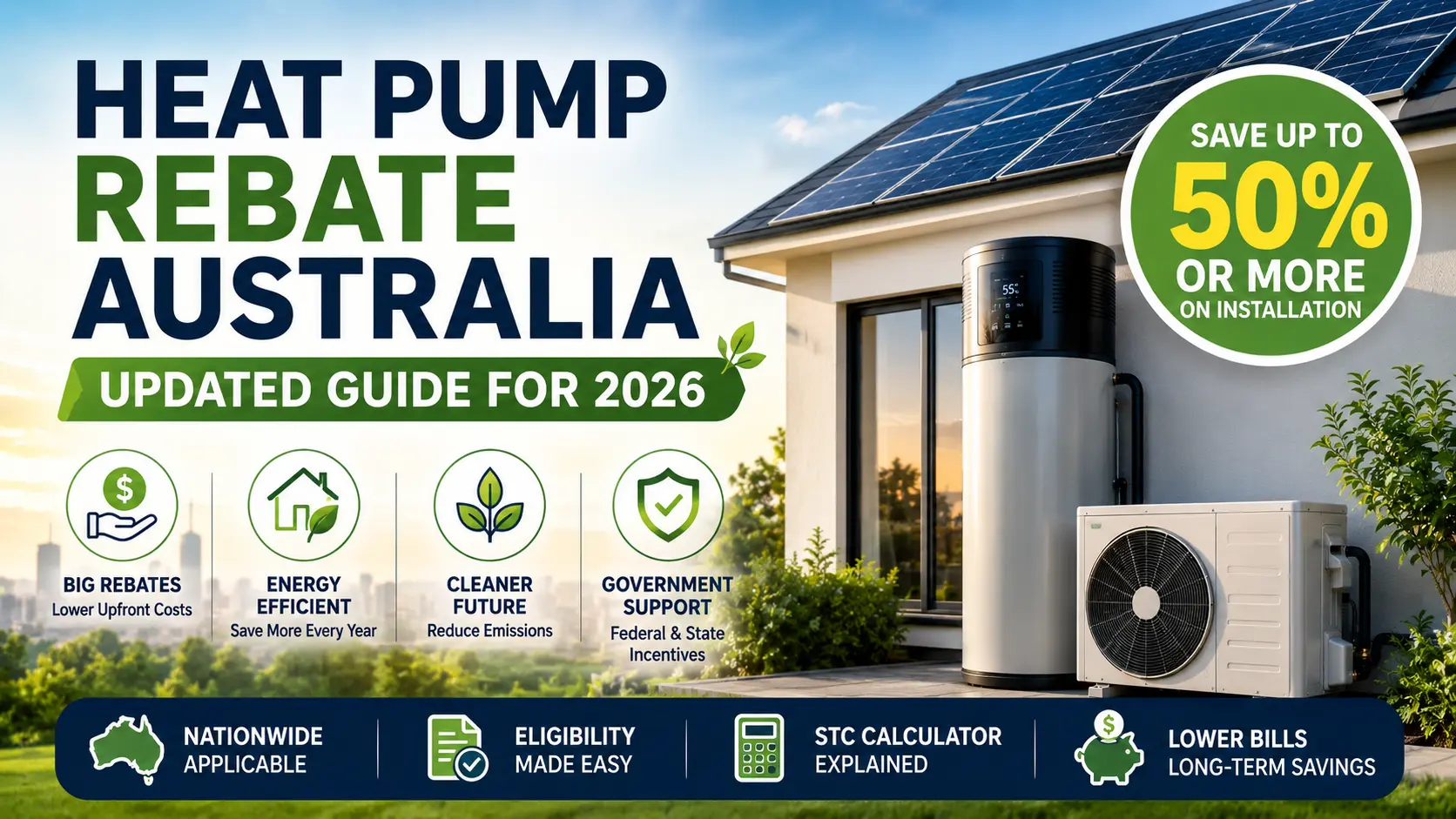
Old gas or electric tanks are costly to run and hard to maintain. Plus, they’re less effective than newer hybrid heat pumps. So, why doesn’t every Australian home have one? Well, a decent heat pump sits in the $3000-$5000 range in total installed cost. When people think back to how much cheaper their gas or electric hot water tank was, they hesitate.
The government has solved the money problem with the heat pump rebate Australia. This SRES-backed system allocates STCs to your heat pump based on how much grid electricity it can save in the near future. So, it’s not a fixed-price rebate. But the general idea is that you can reduce the heat pump’s costs roughly to those of an old electric tank of the same tier. This removes the main reason for the hesitation.
If you live where a heat pump state incentive is available, you can stack that on top of the federal rebate and further cut down expenses. However, this scheme has an expiry date. So, there wouldn’t be a better time than now to get a heat pump for your home.
How Much Money Can You Save With Heat Pump Rebate?
The federal government has never set or announced an official dollar figure or flat rate for the heat pump rebate. There are so many factors at play here that two people from different parts of Australia can install the same heat pump and still see significant differences in their rebate amounts.
That said, we can try to make a rough estimate. Keep in mind this is not an answer to the question, but rather something to help you manage expectations.
For an average 3000-5000 AUD heat pump, you can expect the rebate to slash off around $400-$700 from the total cost. Some state incentives can add a few hundred dollars on top. Which means your out-of-pocket costs can come down to as low as $2000. This estimation is based on the fact that heat pumps usually generate 10-20 STCs.
You usually get more discount when you live in a colder region since that means the installation is saving more grid electricity. The rebate also favors those who install Australian-made units and replace an old electric tank (since electric tanks put more stress on the grid compared to gas variants)
Who Gives the Heat Pump Rebate Discount: Government or Retailer?
Your installer will directly include the discount you get from the federal heat pump rebate in your point-of-sale price. There is no claiming process or waiting period after making the purchase.
Here’s the mechanism behind that discount:
SRES- The Main Framework
The Small-scale Renewable Energy Scheme (SRES) is a federal framework administered by the Clean Energy Regulator (CER) under the Renewable Energy (Electricity) Act 2000. Its goal is to accelerate the shift of Australian households from fossil-fuel grid electricity to renewable, low-carbon energy sources.
Eligible Technologies
Eligible technologies include rooftop solar panels, air-source heat pump hot water systems, solar water heaters, small wind turbines, and small hydro systems, because each one displaces grid electricity.
What Mainly Drives The Rebate Size
The rebate size is driven entirely by how much conventional grid electricity your system is expected to displace, measured in Small-scale Technology Certificates (STCs).
One MWh of displaced electricity, projected out to the scheme’s 2030 end date, equals one STC. A heat pump expected to displace 10 MWh generates 10 STCs.
The STC Trade
STCs currently trade for roughly $38–$40 each, with the government’s STC Clearing House capping the price at exactly $40.
You assign your STC rights to your installer at the time of purchase (households can’t trade STCs directly). The installer sells them on the open renewable energy certificate market and deducts that value from your invoice.
This last point is also why DIY installations are automatically excluded. If there’s no licensed installer in the chain to process the STC assignment, there’s no mechanism to apply the discount.
2026 Eligibility Criteria: Who Qualifies for Federal Heat Pump Grants?
You have to show your eligibility in three things to get the heat pump rebate. Firstly, proper equipment as defined by the CER. Then, a property that is used as a home or small business but not large-scale commerce. And lastly, an installer who can take care of the STC process.
Equipment Standards
- Must be an air-source heat pump hot water system, in either an integrated (all-in-one) or split-system design.
- Storage tank capacity must be under 425 litres for residential eligibility.
- The specific model must be listed on the CER’s Register of Solar Water Heaters.
- The system must meet Australian testing and performance standards, including AS/NZS 4234.
- DIY-installed or unlisted systems are strictly ineligible; no exceptions.
Property & Installer Criteria
- Eligible property types: owner-occupied homes, rental and investment properties, holiday homes, small businesses, existing dwellings, and new builds.
- There is no income or means testing at the federal level; that only comes into play with certain state schemes, covered further down.
- Installation must be carried out by a licensed plumber and/or electrician authorised to process STC assignment documentation, like the Aussie Solar Tech Team. A self-installed system does not qualify, regardless of how well it’s installed.
What Drives Your Discount: Key Factors Shaping Heat Pump Rebate Values
Three variables determine how many STCs, and therefore how large a discount, your specific installation generates. These are the design and technology of the unit, your climate zone, and the year you install it.
Design and Technology
(Note: the pattern below reflects general industry framing on efficiency and STC yield, not a specific rule published by the CER. The actual STC count always comes down to the individual model’s listed rating, not its general category.)
A heat pump is only as valuable to the rebate scheme as the amount of grid electricity it displaces. Split-system heat pumps, which separate the compressor from the storage tank, often generate more STCs than integrated units in the same climate zone because that separation allows better airflow optimisation and higher efficiency.
That said, a well-insulated integrated system can close the gap. It avoids the heat loss that split systems can suffer through external piping. This is why the exact brand and model matter when a rebate figure is calculated, rather than just the general category of unit.
Refrigerant type is the other major lever. Standard synthetic refrigerants like R134a or R410a lose efficiency noticeably in cold weather. CO2 refrigerant (R744) systems hold their efficiency even at low outside temperatures, which means they displace more grid electricity and earn higher STC counts.
Where You Live (Climate Zones)
The CER splits Australia into five climate zones by postcode for rebate purposes:
- Zones 1–2: tropical and subtropical regions (Darwin, Cairns): the lowest federal STC yield, because the ambient heat already does most of the work your heat pump would otherwise need electricity for.
- Zone 3: temperate coastal regions (Sydney, Perth, Brisbane).
- Zone 4: cool temperate regions (Melbourne).
- Zone 5: cold alpine regions (Canberra, Hobart): the highest STC yield, since hot water demand is greatest here and old electric tanks put the most sustained pressure on the grid that a heat pump meaningfully relieves.
When You Installed It
The SRES scheme is legislated to close on 31 December 2030. STCs are calculated based on how many years of grid-electricity displacement remain between your installation date and that sunset date.
So, the earlier you install, the more years of displacement your system is credited for, and the more STCs (and dollars) you receive.
A heat pump installed in 2024 earns credit for roughly seven years of displacement; one installed in 2026 earns credit for about five. That difference translates directly into a smaller upfront discount the longer you wait.
Worked Example: Sydney Installation
The most reliable way to check your own numbers is the REC Registry’s solar water heater STC calculator, which takes your postcode, system model, and installation date as inputs. Here’s how it plays out for a real scenario:
- Location: Sydney, Zone 3, postcode 2000
- System: Aether HP270- a 270-litre integrated unit using a propane-based refrigerant
- Installation date: 23 May 2026
- Result: 15 STCs generated
- At roughly $40/STC, that’s a $600 upfront discount
- Unit cost before rebate: approximately $3,000
- Out-of-pocket cost after the federal rebate: approximately $2,400
That’s a realistic picture of what the federal rebate alone can do — before any state-level scheme is added on top.
| Heat Pump Type | Efficiency Level | Estimated STCs (2026) | Approx. Upfront Discount (~$38–$40/STC) |
| Budget Integrated (Standard HFC) | Lower | 10–14 STCs | ~$380 – $530 |
| Premium Integrated / Mid Split | Medium | 14–18 STCs | ~$530 – $680 (avg. $600) |
| High-End Split CO2 System | Higher | 18–20+ STCs | ~$680 – $800+ |
Bridging the Gap: Using HEUF Green Loans for Upfront Costs
Even after federal STCs bring a system down to roughly $2,000–$2,500, paying that in one lump sum can still strain a household budget, especially with SRES value shrinking each year as 2030 approaches. This is where the Household Energy Upgrades Fund (HEUF) comes in.
HEUF is a $1 billion federal fund managed through the Clean Energy Finance Corporation (CEFC), designed to make low-interest finance available for climate-friendly home upgrades, including heat pumps and solar panels.
- You don’t apply to the government directly. Applications go through accredited commercial co-financiers, including Westpac, Plenti, and ING Australia.
- Loans are offered at interest rates below standard personal loan rates.
- Monthly energy savings from the heat pump (and solar, if installed) typically make the loan repayments manageable.
- Residential, rental, and rebuild projects are all eligible.
- High-end luxury properties are excluded, to keep the fund’s benefit targeted at typical households.
- As with the federal rebate, the system must be CER-approved and installed by a licensed professional.
State-by-State Breakdown: Stacking Local Rebates in 2026
On top of the $400–$700 federal discount, many states run their own heat pump incentives that stack on top of the STC rebate. Coverage is uneven, though, and as 2030 approaches, several state programs have already wound down. Queensland, Western Australia, and Tasmania currently have no dedicated residential heat pump rebate.
Victoria
Victoria remains the strongest state for stacking rebates. The Solar Victoria hot water rebate offers up to $1,000 off an eligible heat pump, rising to $1,400 for an Australian-made unit, on top of the federal STC discount.
Recently changed: from 1 July 2026, the combined household income cap for this rebate dropped from $210,000 to $150,000 per year. Applications submitted before 30 June 2026 were assessed under the old cap; anything submitted now falls under the new $150,000 limit. Property value must also stay under $3 million, and you must be an owner-occupier of the home.
Renters and non-occupier landlords can’t access the Solar Victoria rebate, but they can still use the Victorian Energy Upgrades (VEU) program, which works through a certificate system (VEEC) that a commercial installer applies as a discount at the point of sale.
New South Wales
NSW runs a certificate-based scheme through the Energy Savings Scheme (ESS). Accredited Certificate Providers convert your heat pump’s predicted energy savings into certificates, which the installer trades and passes back to you as a discount. Under current ESS rules, you can receive up to $640 if you’re replacing an old electric resistance system, or up to $330 if you’re replacing a gas system.
South Australia
South Australia’s rebate runs through the Retailer Energy Productivity Scheme (REPS), which sets annual energy-saving targets that every major electricity retailer must hit. The government designates “priority groups” as low-income households, concession card holders, and similar categories. Retailers are incentivised to prioritise them, often with aggressive discount offers and third-party installer partnerships.
If you don’t fall into a priority group, you can still apply, but the available discount will typically be smaller, since retailers face less pressure to court your business specifically.
| State | Primary Program | Scheme Type | Who Is Eligible? | Real-World Realities |
| VIC | Solar Victoria Rebate + VEU Scheme | Direct cash rebate stacked with market certificate discounts | Rebate: owner-occupiers earning under $150,000 (from 1 July 2026) on properties under $3M. VEU: open to landlords and renters. | Highest savings nationally — up to $1,400 from the state rebate alone for an Australian-made unit, totalling $1,500–$2,500+ off when fully stacked. |
| NSW | Energy Savings Scheme (ESS) | Market-based energy efficiency certificate system | Most households replacing an old, inefficient system | A minimum $200 (inc. GST) payment is required by law. Real-world out-of-pocket costs range from $400–$1,800 depending on zone and system. |
| QLD | QBEST (business only) | Isolated sector grants; no broad residential program | Private homes: none. Up to $12,500 for eligible small businesses. | $0 state residential support. Homeowners rely entirely on federal STCs. |
| SA | REPS Scheme | Retailer-obligation target system | Technically all households, heavily weighted toward priority groups | Excellent for concession holders (often just a ~$33 admin fee). Standard households see little installer interest. |
| TAS | None | Fully closed | None | Federal STC discount only; standard market pricing minus the baseline certificate value. |
| WA | None | No state scheme exists | None | Federal STC discount only; pricing driven entirely by installer competition. |
Final Words: Why 2026 is the Critical Year to Upgrade
If your roof already carries solar panels, there’s little reason to keep running an old resistance-heated hot water tank. A heat pump extracts far more usable heat from every kilowatt of electricity it consumes, which lowers your bills and your household’s carbon footprint at the same time.
The federal STC value is shrinking a little further each year on the way to the scheme’s scheduled close at the end of 2030, and several state programs have already shut their doors entirely.
This hard federal deadline and an uneven, narrowing patchwork of state support make the case for acting sooner rather than later. Get a quote, check what your postcode and preferred system qualify for, and see whether a HEUF-backed loan makes sense for the balance. Reach out to our team if you have questions about your specific eligibility.
FAQs
Which states don’t offer any heat pump rebates in Australia?
Queensland, Western Australia, Tasmania, and the Northern Territory do not currently offer dedicated state-backed cash subsidies or energy certificates for residential heat pumps. Homeowners in these regions rely entirely on the federal STC discount.
Can I get a heat pump rebate in the ACT?
The ACT doesn’t have a standalone heat pump rebate program. However, concession card holders can access the ACT Home Energy Support Program. It offers a 50% rebate capped at $2,500 for approved green technology upgrades, including heat pumps. There is a property value limit and a requirement to attend a free government climate workshop.
Which heat pump rebate state programs shut down recently in 2026?
Queensland’s PeakSmart Air Conditioning incentive and the Climate Smart Energy Savers program have both closed after running out of allocated funding.
What can make someone ineligible for a heat pump rebate?
At the federal level, a DIY installation or a model not listed on the Clean Energy Regulator’s register automatically disqualifies you. State-level rules add further conditions; for example, Victoria’s household income cap, which now sits at $150,000 following the 1 July 2026 change.

Shah Tarek is a Solar Energy Consultant with 10 years experience in solar system design and solar consultancy field at Australia. He is now a Director, Operation & Consultancy Division at Aussie Solar Tech, a leading Australian solar retailer and installer. Here he is writing informative and engaging solar content that educates the community on the benefits of solar power. His work supports Aussie Solar Tech’s mission to promote sustainable energy solutions and foster a greener future for Australia.



Seraphim Solar Panels Review: Efficiency, Reliability, and Value Unveiled

Talesun Solar Panels: Honest Review Before You Buy

Sungrow Battery VS Tesla Powerwall : Which is Best in Australia?

Leapton Solar Panels Review: Affordable Energy Solution

REC Solar Panels Review: Outstanding Efficiency & Durability

Best Hybrid Inverters for Home Solar Systems in 2025
Best Solar Battery In Australia 2026 — Complete Guide

Sigenergy VS Fox ESS Battery: Which is The Best Choice for 2026

How Much Do Solar Panel Costs in Australia? (2026 Price Guide)

