
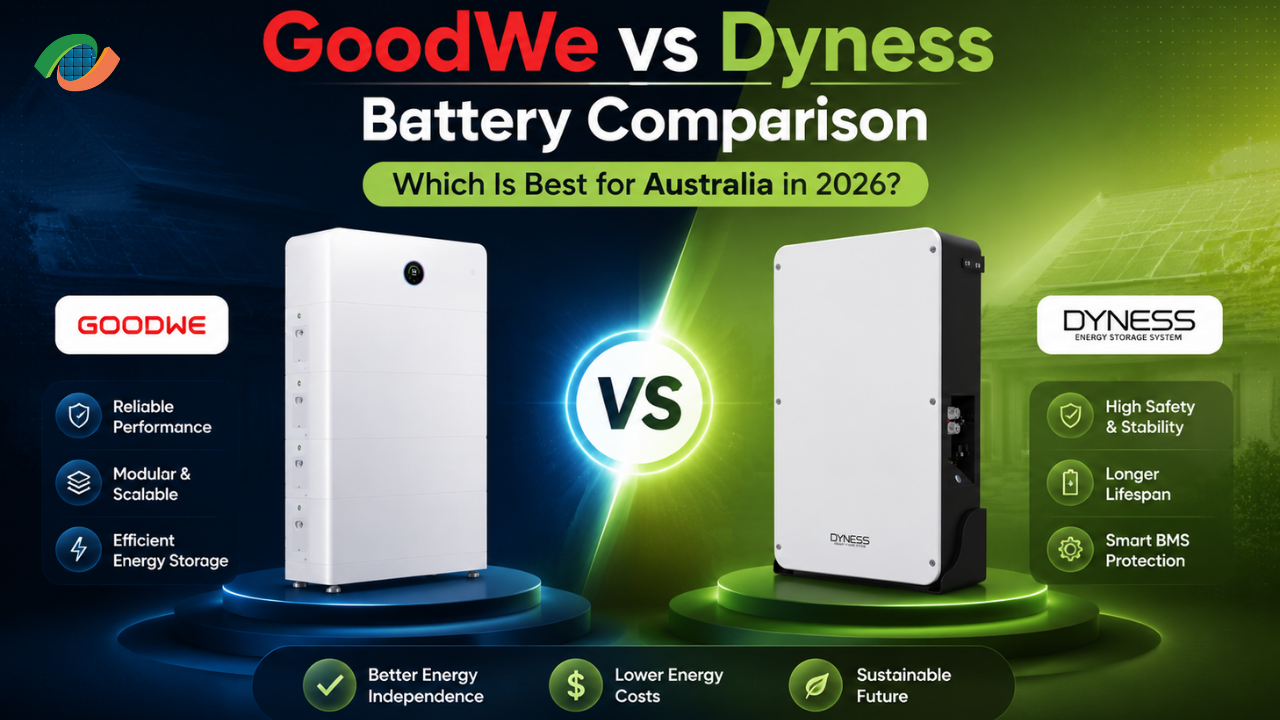
GoodWe and Dyness are two popular solar battery brands in the Australian market, especially for homeowners looking for reliable solar energy storage and backup power. Both brands use LiFePO4 battery technology and offer good performance, but there are noticeable differences in pricing, flexibility, smart features, and overall system design.
GoodWe is generally known for its more premium all-in-one setup and smoother smart energy management, while Dyness is often preferred for its flexible expansion options and budget-friendly battery systems.
In this guide, we compare GoodWe vs Dyness battery systems based on performance, battery capacity, warranty, backup support, smart features, and overall value for Australian homes in 2026..
GoodWe ESA Series vs Dyness Powerbox Pro Comparison Chart
| Feature | GoodWe ESA Series | Dyness Powerbox Pro |
| Type | All-in-one home energy storage system | Lithium battery storage system |
| System Layout | Inverter + battery in one unit | Battery only system |
| Battery Chemistry | LiFePO4 (LFP) | LiFePO4 (LFP) |
| Battery Capacity | 10.8kWh | 10.24kWh |
| Nominal Voltage | 48V class | 51.2V |
| Voltage Range | 40V – 60V | 44.8V – 57.6V |
| Inverter | Built-in hybrid inverter | External inverter required |
| Output Power | 5kW hybrid output | Depends on inverter setup |
| Peak Power | — | 10.24kW |
| Charge Current | 90A | 100A |
| Discharge Current | 100A | 100A |
| Backup Switching | <10ms UPS-level | Depends on inverter |
| Communication | CAN / RS485 | CAN / RS485 / RS232 |
| Monitoring | SEMS app support | Dyness / inverter app |
| Battery Expansion | Extra storage support | Multiple units parallel support |
| Installation | Compact indoor/outdoor unit | Wall or floor mounting |
| Protection Rating | IP65 | IP65 |
| Lifespan | Long-term residential use | 6000+ cycles |
| Best Use | Simple home backup, all-in-one system, easy installation | Flexible solar system, inverter already available, future expansion needed |
Popular GoodWe and Dyness Battery Series
GoodWe Battery Series
Lynx A G3
Lynx A G3 is a low-voltage LiFePO4 battery series mainly designed for small to medium-sized homes. It is commonly used for daily solar energy storage and home backup power.
Lynx D Series
Lynx D Series is a high-voltage modular battery system suitable for larger homes and small businesses with higher energy usage. Users can expand the battery capacity later if needed.
Lynx D G2 Series
Lynx D G2 Series is the upgraded version of Lynx D with improved charging performance and smarter energy management. It is suitable for residential and light commercial solar systems.
ESA Series
ESA Series is GoodWe’s flagship all-in-one battery system launched for modern solar setups in 2026. It combines the inverter, battery, and smart energy management into one integrated unit for easier installation and stable backup performance.
Dyness Battery Series
PowerBox Pro Series
PowerBox Pro is Dyness’ popular home battery series designed for small to medium-sized homes. It uses LiFePO4 battery technology and works with many hybrid inverters for flexible solar backup setups.
PowerBrick Series
PowerBrick Series is designed for larger homes and small businesses that need longer backup time. Its modular design allows users to expand battery capacity later if needed.
Stack Series (Stack100)
Stack100 Series is mainly used in commercial and industrial solar systems. It supports large-scale energy storage and is designed for easy system expansion.
Tower Series
Tower Series is Dyness’ high-voltage modular battery system for modern residential and small business solar setups. It offers flexible expansion and works smoothly with hybrid inverters
GoodWe vs Dyness Capacity & Scalability
GoodWe
GoodWe Battery usually starts at 5 kWh. It can be gradually increased to 28 kWh or more. This system usually works best with its own GoodWe inverter. It is easier to work within the same setup, and the performance is steady.
However, there is a limit here. Everything has to be kept within the same brand. So, adding new things or expanding the system becomes a bit fixed. This can be a good fit for those who want a stable and long-term Solar Battery Storage setup.
Dyness
Dyness Battery is designed to be more flexible. You can start with a small setup. Then the system can be expanded as needed. It is possible to go from 2.4 kWh to much larger capacities. The user can expand gradually if they want. This is its biggest advantage. The system can be upgraded in the future without making a large upfront investment. Dyness is used in many Australian homes because it helps with budget management and works with various inverters.
GoodWe vs Dyness Chemistry & Safety Operating
GoodWe
GoodWe Battery uses LiFePO4 battery chemistry. It is known for its safe and stable performance. It does not generate much heat even in daily use. It has a Battery Management System (BMS). It controls the charge and discharge properly. As a result, the battery does not get overstressed. The system is well-controlled during use. If it is used with a GoodWe inverter. ThenThe stability is better.
Dyness
Dyness Battery also uses LiFePO4 chemistry. It is a good technology for long-term use. Its BMS system is quite flexible. It can work with different types of inverters. So installation is very easy. It gives stable performance in daily use. It works properly even in hot weather. If installed properly. All in all, it is an Energy Storage System that is good for use. And easy to manage.
GoodWe vs Dyness Conditions & Climate Readiness
GoodWe
GoodWe Battery is designed for Australia’s hot climate. It can generally operate from -10°C to 50°C. Performance is stable in this range. When the temperature rises, the internal system automatically adjusts its work. Charging is slightly slower to avoid stressing the battery.
This will keep the battery in good condition for a long time. Many models have IP55 to IP66 protection. So dust, rain, and outdoor environments are not easily a problem.If installed correctly in hot areas, it will provide steady performance for many years.
Dyness
Dyness Battery is also generally designed to work in temperatures ranging from -10°C to 50°C. It can continue to work in hot weather. However, good airflow is essential. Performance is stable if installed properly. Most of its models have IP65 protection. This is sufficient for outdoor use.
The system automatically adjusts the output when the temperature rises. This does not put too much strain on the battery. Due to the modular design, heat does not accumulate in a single location in a large setup. As a result, it is relatively easy to use.
GoodWe vs Dryness Efficiency & Depth of Discharge
GoodWe
GoodWe Battery maintains good efficiency. Most of the charged energy can be used, about 90% to 95%(depending on the model). So energy waste is very low. Its Depth of Discharge (DoD) is about 90% (depending on the model). This means that a large part of the battery can be used without damaging it.
It works steadily according to daily household use. The performance is stable when running the load at night. If a GoodWe inverter is used, the whole system runs more smoothly.
Dyness
Dyness Battery also operates in a similar range. Generally, 90% to 95% efficiency is available. Energy loss is less during use. Its Depth of Discharge (DoD) goes from 90% to 95%( depending on the model). It provides a little more usable power.
It also gives steady performance in real use. It adapts to both small and large houses.
GoodWe vs Dyness Backup & Off‑Grid Support
GoodWe
GoodWe Battery is used by many homeowners in Australia to provide a stable backup. When the power goes out, the battery starts to power up very quickly. So the lights, fridge, and WiFi in the house do not turn off. If you have a GoodWe hybrid inverter in the house, everything runs more smoothly. Switching is fast, and there is no noticeable interruption during use.
GoodWe keeps the power steady in hot weather or when there is a problem with the grid. So it seems reliable in daily home use. It is basically a setup that handles basic backup of the house properly, without any hassle.
Dyness
Dyness Battery is preferred by homeowners who plan to expand their system later. When the power goes out, it provides steady power, keeping the essentials running. Its easiest advantage is flexibility. If you get a small setup today, you can increase the backup time by adding another battery later. Many installers use it because it works with different inverters, making system design easier. Dyness also works well in hot weather if the installation is good.
Rebate and VPP Support GoodWe vs Dyness Battery
GoodWe
GoodWe Battery can be used with some rebate programs in Australia. However, it depends a lot on the installer and system setup. If the setup is properly approved, the initial cost can be reduced somewhat. GoodWe works quite stably in the case of VPP (Virtual Power Plant). When the battery is connected to the grid, the system itself manages when to use or provide power.
The advantage as a homeowner is that once it is set up, everything runs automatically. However, to get all the benefits, you need the right inverter and an approved setup.
Dyness
Dyness Battery is chosen by many Australian homeowners because it is easy to integrate with the Solar Battery Rebate. While there is a possibility of getting a rebate, it depends on the installer and the inverter.Some setups have VPP support when a compatible inverter is used. It depends entirely on the system design. The best part is its flexibility. You can start with a small system and then gradually expand it.
GoodWe vs Dyness Battery Price Comparison
GoodWe Battery Price
GoodWe ESA Series battery systems are available in multiple capacity options, making them suitable for modern Australian homes and businesses looking for reliable solar battery storage.
| Battery Capacity | Approx. Price (AUD) |
|---|---|
| 8.32 kWh | $5,149* |
| 16.64 kWh | $5,549* |
| 24.96 kWh | $6,549* |
| 33.28 kWh | $8,689* |
| 41.60 kWh | $10,889* |
| 49.92 kWh | $12,929* |
GoodWe ESA Series battery systems Price Start From approximately A$5,149 for the 8.32 kWh system, while the 16.64 kWh GoodWe ESA battery price is approximately A$5,549. The 24.96 kWh battery price is approximately A$6,549, while the 33.28 kWh model is approximately A$8,689.
For larger energy storage needs, the 41.60 kWh GoodWe ESA battery price is approximately A$10,889, and the 49.92 kWh battery price is approximately A$12,929.
Dyness Battery Price
Dyness battery systems are flexible and budget-friendly energy storage options for homes and commercial properties. They are suitable for customers who want reliable performance with expandable storage capacity.
| Battery Capacity | Approx. Price (AUD) |
| 15.3 kWh | $5,010* |
| 23.4 kWh | $6,660* |
| 30.7 kWh | $7,630* |
| 34.5 kWh | $9,575* |
| 46 kWh | $12,370* |
Dyness battery systems Price Start From approximately A$5,010 for the 15.3 kWh system, while the 23.4 kWh Dyness battery price is approximately A$6,660. Larger capacities include the 30.7 kWh battery at approximately A$7,630, the 34.5 kWh battery at approximately A$9,575, and the 46 kWh battery at approximately A$12,370.
Overall, GoodWe offers strong high-capacity battery options, while Dyness is a flexible and cost-effective choice for customers looking for expandable solar battery storage.
GoodWe vs Dyness Battery Warranty
GoodWe
GoodWe Battery usually comes with a 10-year warranty. During this period, the battery is said to retain a large part of its capacity, about 70%. If installed correctly and a compatible inverter is used. Then the performance according to this warranty is available.
GoodWe’s warranty structure is a bit clear and fixed. This means that if everything goes according to the manufacturer’s rules, it can be used for up to 10 years without any major problems. However, if the installation is wrong, the coverage will not be available properly.
Dyness
Dyness Battery also typically offers a 10-year warranty. Here, the battery is required to maintain approximately 70% capacity based on specific usage and cycles. Dyness’s warranty is a bit more usage-based. Performance coverage adjusts based on how you use the battery. Many homeowners find this easier because it naturally matches daily solar use.
GoodWe vs Dyness Battery Battery Apps and Smart Features
GoodWe
Using the GoodWe Battery, you can see the entire system from your phone. You can see how much charge the battery has, how much electricity is currently being used in the house. You can also know how much the solar is generating all at once. It feels pretty neat in daily use. You can see the energy situation of the entire house at a glance, without having to keep separate accounts.
In some setups, you can even check the system remotely. If the battery status changes or there is a problem, it can be seen in the app. GoodWe is a little more neat and detail-focused,
Dyness
The Dyness Battery app is relatively simple. Here you can basically see the battery charge, usage, and basic status. Even if you have multiple batteries, they can all be seen together. So there is no problem in understanding. If there is a problem, the app will notify you, so you can understand it quickly.
Dyness provides simpler and easier-to-use monitoring. It is easy to use for the average homeowner.
GoodWe vs Dyness Battery Pros & Cons
GoodWe Battery
Pros
- The inverter and battery work well together, so the system feels pretty steady
- When the power goes out, the power switch is very fast, and the home’s use doesn’t stop much
- The home’s energy use and battery status can be easily seen on the mobile app
- Many installers in Australia know this system, so getting support is relatively easy
Cons
- The price is a bit high; it’s a more premium-side system
- Can’t be used with all inverters
- You have to stay within the same brand ecosystem, so flexibility is low
- Later, expanding or mixing the system is relatively limited
Dyness Battery
Pros
- Can be used with many inverters, so installation is easy
- Can be expanded by adding batteries later if needed
- Low initial setup cost
- Easy to deploy for installers
Cons
- Software experience not as tight as GoodWe
- The monitoring system is relatively simple
- Advanced optimization not always available
- Less premium “fully integrated system” feel
GoodWe vs Dyness Battery Battery Best Choice By User’s
| Feature | GoodWe Battery | Dyness Battery |
| Daily Home Use | Stable backup, works quietly in the background | Easy daily use, simple operation |
| Backup Capacity | Steady power delivery during outages | Easy to increase capacity by adding more units |
| App & Monitoring | More structured view of system data | Simple and straightforward monitoring |
| Budget | Higher cost, premium setup | Lower starting cost, flexible scaling |
Conclusion
Both GoodWe and Dyness are good battery options for Australian homes, but they are different in terms of usage.GoodWe is more suited for those who want to keep everything set up together. Once installed, there is no need to worry about it anymore. Home backup and monitoring are all in the same system, so it is easy to use. Dyness is different in terms of usage. It can be started small. Later, it can be expanded if needed. It is best for those who plan to expand the system in the future.
Ultimately, it is very simple. GoodWe is better if you want a fixed setup without hassle. And Dyness is more practical if you want to expand gradually.
FAQs
Is Dyness a good solar battery?
Dyness Battery is used in many home solar setups. It is easy to install, and it also handles daily electricity usage well. It is more convenient for those who are thinking of expanding the system later.
How long do Dyness batteries last?
In general, a Dyness battery can be used for about 10 years. However, it actually depends on how it is used. How many times a day is it charged and discharged? On whether the installation is correct or not.
Are Dyness batteries lithium?
Dyness battery uses LiFePO4 lithium technology. This type of battery is usually more stable. It is considered safe for home solar systems.
Which is better Dyness battery or Sungrow battery?
Both are good, but the use is different. Sungrow battery usually comes together as a complete system. So everything works together, and the setup is quite fixed. Dyness is more flexible. It can be used with different inverters, and it is also easy to expand the system later.
Is GoodWe a good inverter brand?
GoodWe inverters are quite popular in Australia. It is used in many solar systems. Because it works well with batteries. It gives stable performance in daily use.

Shah Tarek is a Solar Energy Consultant with 10 years experience in solar system design and solar consultancy field at Australia. He is now a Director, Operation & Consultancy Division at Aussie Solar Tech, a leading Australian solar retailer and installer. Here he is writing informative and engaging solar content that educates the community on the benefits of solar power. His work supports Aussie Solar Tech’s mission to promote sustainable energy solutions and foster a greener future for Australia.






Seraphim Solar Panels Review: Efficiency, Reliability, and Value Unveiled

Talesun Solar Panels: Honest Review Before You Buy

Sungrow Battery VS Tesla Powerwall : Which is Best in Australia?

Leapton Solar Panels Review: Affordable Energy Solution

REC Solar Panels Review: Outstanding Efficiency & Durability

Best Hybrid Inverters for Home Solar Systems in 2025
Best Solar Battery In Australia 2026 — Complete Guide

Sigenergy VS Fox ESS Battery: Which is The Best Choice for 2026

How Much Do Solar Panel Costs in Australia? (2026 Price Guide)

