
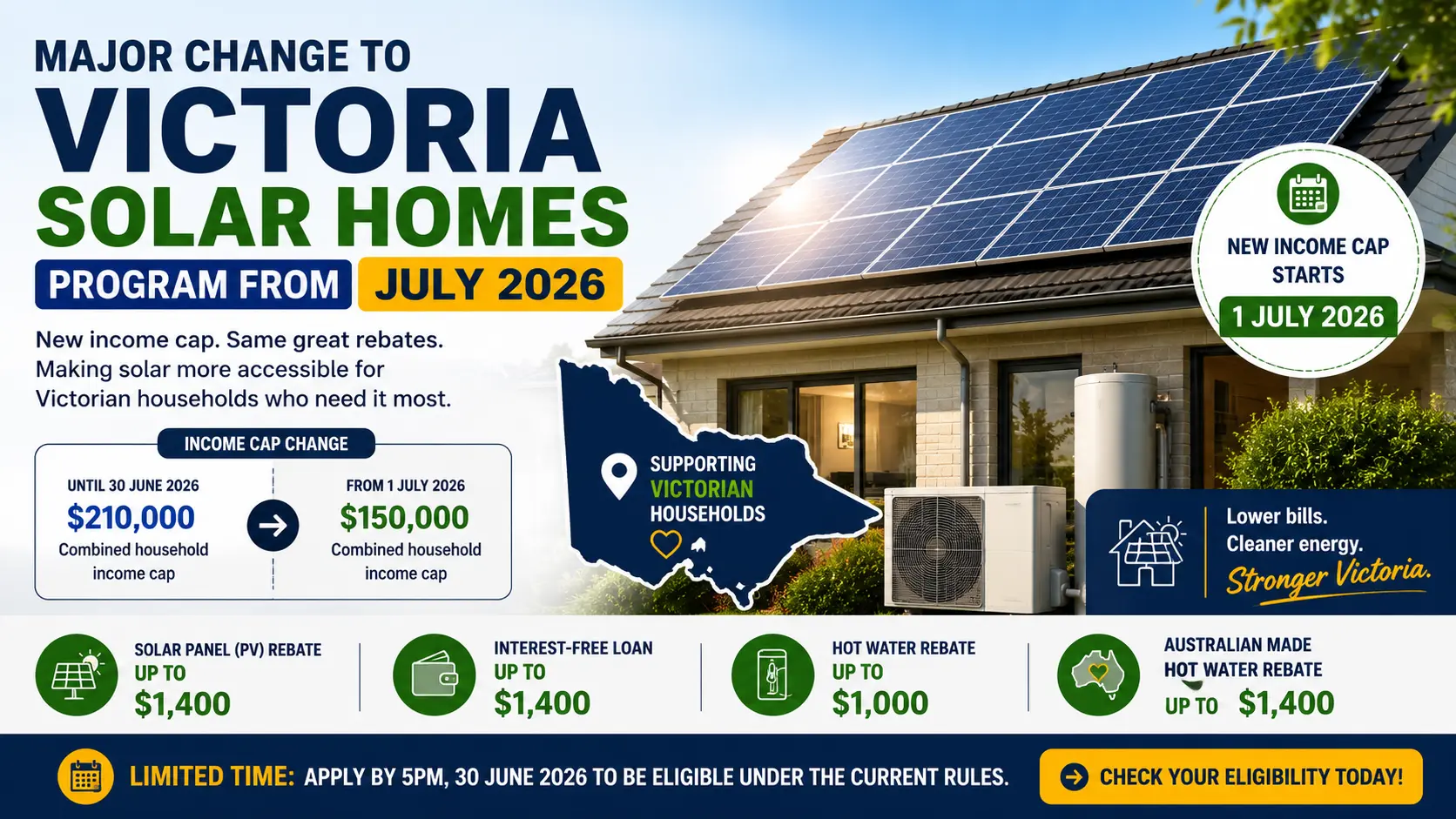
The Victoria Solar Homes program has been immensely successful since it started in 2018. At the beginning of the program, around 14% of the homes in Victoria, Australia, had rooftop solar. As of mid-2026, it has doubled to 30%. However, the government is changing some rules so the program can help Australians who will benefit the most from the rebate amount.
According to the new rules, you are only eligible for Victoria’s solar and hot water rebate if your combined household income is $150,000 per year. Previously, this income cap used to be $210,000. Everything else about the rebate stays more or less the same. The change ensures that the rebate is spent on households with low income. In other words, people who actually need this money.
Are you thinking about signing up for a solar or hot water rebate in Victoria? Depending on your income, you might not have much time left. Find out the changes to Victoria Solar Rebates.
What Is Changing for Solar Rebate Victoria In July 2026
In short, the only thing changing is the income cap. If your household’s combined income exceeds 150,000 AU$, then you are not eligible for the solar and hot water rebate anymore. As for the rebate amount, it’s still $1400 to cover the upfront cost of rooftop solar panel installation. Meanwhile, for heat pump installation, the rebate amount is $1000.
A Brief Overview of the Victoria Solar and Hot Water Rebate
Victoria has been providing financial incentives for solar installation for quite some time now. It started in 2009 when they set up the Premium Feed-in Tariff scheme. Homeowners with a solar system of 5 KW or less could sell back the excess energy from their panel to the grid for 60 cents/kWh. It was an effective and profitable way for a home with solar panels to recoup the cost of installation.
However, as the government met its target number of solar transitions, the program closed to new applicants around 2011.
From 2012 to 2018, Victoria didn’t have any new solar rebates for first-time applicants. Then, in August 2018, the government launched the Victoria Solar Homes program. It had a massive fund of $ 1.3 billion to equip 777,000 households with solar panels and hot water systems.
Victorian households had an incredible response to this program. The first phase of the program sold out by April 2019, which was several months before the original cutoff. To ensure an equal distribution, the government changed the second phase of the program to only give out a set number of rebates per month. To this day, this is how the program still works.
In the meantime, the Victoria Solar Homes program has gone through a few changes. For instance, the rebate value was upto 1,850$ initially. This changed to $1400 or 50% of the upfront cost left after federal STCs. The income cap was $180K, which later increased to 210K. Recently, before the changes in July 2026, the rebate program looked like this-
- You are eligible for the program if your combined household income is $210,000 or less.
- You get 50% off the upfront cost of your solar installation or $1400, whichever is lower. Suppose your standard 6.6 kW system costs $2,500 after applying the federal STCs. In this case, the Victorian government pays $1,250 for the installation. If the system costs $4000, then the government pays only $1400, since it’s lower than 50% of the upfront cost. You are also eligible for an interest-free loan of the same amount that you can pay over 4 years.
- For a heat pump installation, you receive a $1000 rebate for eligible systems and installation. The amount can go up to $1,400 if the heat pump system in Australian made.
What Is Changing in July 2026
The only thing changing in July 2026 is the income cap. Households with a combined annual income of $210,000 will not be eligible anymore. Instead, the cap has dropped down to $150,000. The government decided to do this to target low-income households. This ensures a fair and proper use of the fund.
In other words, the changes are not leaving people out of the rebate. Instead, it’s actually including more people in the program. It’s also worth noting that around 52-55% of the total rebate given out so far went to households with income below $100K. So, the changes aren’t affecting Australians who actually need the money. Instead, it’s giving them a better chance.
The narrow group of people affected by these changes will be those whose combined income falls between $150K to $210K. If you are in this group and had been planning a rooftop solar installation this year, then time is extremely limited. You must submit the Full Application before 5 pm on 30 June 2026.
The “Full Application” term is of special importance here. You must provide or upload all the necessary details and documents to the Service Victoria portal. The final “Submit” button must be clicked before the deadline. Simply starting the process or a saved-but-not-submitted application doesn’t count.
Understanding the July 2026 Changes to the Victoria Solar Homes program: At-a-glance:
| Feature | Until 30 June 2026 | From 1 July 2026 |
| Income cap | $210,000 | $150,000 |
| Solar panel (PV) rebate | Up to $1,400 | Up to $1,400 (unchanged) |
| Interest-free loan | Up to $1,400 | Up to $1,400 (unchanged) |
| Hot water rebate | Up to $1,000 | Up to $1,000 (unchanged) |
| Hot water (locally made) | Up to $1,400 | Up to $1,400 (unchanged) |
| Deadline to act | 5 pm, 30 June 2026 | The new cap applies automatically |
Who Is Eligible For The New Victoria Solar Rebate?
As we already mentioned, all the eligibility criteria stay the same except for the income cap. However, some readers might still be confused about what the eligibility looks like under the new rules. So, here’s a full recap.
Ownership
You must be the owner-occupier of the property. For solar, homes under construction also qualify — you can apply during the build and install once you move in. Hot water is stricter: construction must be fully finished, and you must have moved in. Renters can’t apply directly; landlords apply separately for rental properties.
Income ca
Your combined household taxable income must be $150,000 or less per year from 1 July 2026, for both rebates. “Combined” means every owner on the title or council rates notice added together, not just whoever fills out the form. You’ll need proof of income for each owner, from the same financial year.
Property value
The property must be valued under $3 million, whether it’s an existing home or one still under construction (valued once complete). This applies identically to both the solar and hot water rebates, ensuring the subsidy targets typical households rather than very high-value properties.
Prior rebates
The property address must not have already received a solar panel or hot water rebate under this program — rebates are tied to the address, not the person. A previous owner claiming it generally rules out claiming again at that same address for either rebate.
System age
Solar systems must not have been installed in the last 10 years, though systems over 10 years old may qualify for replacement or expansion. Hot water systems just need to be at least 3 years old — a shorter window reflecting that hot water units naturally wear out faster.
Moving house
If you’ve already received a Solar Homes rebate or loan at a previous address, moving doesn’t disqualify you. You can apply again at your new primary residence, for either solar or hot water, as long as that new address hasn’t received the rebate before.
Approved suppliers
You must use an authorised retailer and only products on Solar Victoria’s approved list — separate lists exist for solar and hot water. For hot water, choosing a product on the “locally made” list unlocks the higher $1,400 rebate instead of the standard $1,000.
How to Apply for the Vic Solar Homes Rebate: A Step-by-Step Guide
This walks through exactly what happens once you decide to go ahead — from your first phone call to a retailer, right through to the day the installer shows up.
Step 1: Get Quotes Before You Touch the Portal
Before you go anywhere near the government’s online system, you need to talk to a retailer first — the process literally cannot start without one.
Find a retailer from Solar Victoria’s authorised retailer list — using anyone outside this list disqualifies you from the rebate entirely, no exceptions. Aussie Solar Tech has been on this list since 19th April, 2024 (ABN 27628715882). So you can get a quote from us to start the process.
Step 2: Your Retailer Uploads the Quote — Not You
This is the part that surprises a lot of first-timers: you don’t start the application yourself. Once you’ve picked a retailer and agreed on a system, they upload your written quote directly into the Solar Victoria Portal on the backend. You don’t see this happen — it’s between them and the government’s system.
Once that’s done, you’ll get an email from Solar Victoria with a link. That email is your actual starting gun — there’s nothing for you to do before it arrives.
Step 3: Click the Link and Verify Your Phone Number
Open the link from the email. The portal will ask for your email address and mobile number, then text you a one-time security code to type in. This is just to confirm it’s really you before showing your quote details.
Step 4: Confirm the Quote Is Yours
The portal will show you the quote your retailer uploaded — the retailer’s name, the quote number, the total price before any rebate is taken off, your property address, and which type of rebate it’s for (solar panel, hot water, or both).
Check this carefully. If anything’s wrong — wrong amount, expired quote, wrong address — don’t try to fix it in the portal. Go back to your retailer; they’re the only ones who can correct or resubmit it.
If you’re applying as a landlord for a rental property rather than your own home, you’ll select that here — it changes a few of the later questions.
Step 5: The Emergency Box (Hot Water Only)
If you’re applying for a hot water rebate because your old system has actually broken down and you’ve already had to install a replacement, there’s a checkbox for emergency installations. Tick it if that’s your situation — it changes how your application is assessed, since normally you’re meant to get approval before installing, not after.
Step 6: You’ve Now Reserved a Spot — But the Clock Starts Ticking
Here’s something worth knowing that isn’t obvious from the rebate pages themselves: the moment you get this far, you’ve reserved your place in that month’s rebate allocation. But that reservation only holds for 14 days.
If you don’t fully submit within that window, you lose your spot and have to start the entire process over from scratch — including potentially missing out if that month’s rebates have run out by the time you restart.
This is exactly the kind of “saved but not submitted” trap mentioned earlier with the 30 June 2026 deadline — except this 14-day rule applies every single time you apply, not just around the income cap change.
Step 7: Prove Who You Are
If you’ve never used the program before, you’ll need to verify your identity here. Have two acceptable ID documents ready before you start this step — fumbling around looking for your passport while the clock is running isn’t a great use of your 14 days.
You’ll be offered the choice to log in with an existing Service Victoria account or continue as a guest if you don’t have one or don’t want to create one.
Step 8: List Every Homeowner — Spelling Has to Match Exactly
This step trips people up more than any other: you need to enter the details of every person who owns the property, not just yourself, and their names have to be spelled exactly as they appear on either their ID or the Council Rates Notice. A middle name included on one document but left off in the portal can cause a mismatch and slow things down.
If you’ve successfully gone through the Solar Homes process before, the portal will already recognise you as a returning customer and skip this step — you’ll just need to re-verify your identity and tick a declaration confirming your income and property value still meet the rules, rather than uploading fresh documents again.
If you’re a landlord rather than an owner-occupier, you’ll be asked for slightly different details here, plus a couple of extra documents specific to rental applications.
Step 9: Prove Your Income
New customers need to upload income proof for every homeowner listed in Step 8, all from the same financial year, and tick a declaration confirming you meet the eligibility rules.
Returning customers get a shortcut: instead of uploading documents again, you simply tick a box declaring your combined household income is under the relevant cap. You’re trusted to self-declare here rather than re-proving it every single time — but bear in mind you’re still legally declaring it’s true.
Step 10: Decide on the Interest-Free Loan
This step only appears if you’re applying for solar panels. You’ll be asked whether you want the matching interest-free loan on top of your rebate.
If yes, you enter your banking details and upload whatever documents are requested for the loan check. If no, you simply select “no” and move straight to finalising.
Worth remembering: as of May 2026, this decision has to be made right now, at this stage of the application — you can’t go back later and add a loan on top of a rebate you already locked in without one.
Step 11: Review Everything Before You Submit
The portal shows you a full summary of everything you’ve entered. This is your last chance to catch a typo in someone’s name, a wrong account number, or a mismatched ID detail before it’s locked in.
Step 12: Tick the Declarations and Hit Submit
You’ll tick a final set of declaration checkboxes (confirming everything you’ve provided is accurate) and then formally submit. This is the actual moment your application counts as “submitted” — not when you reach the portal, not when you reserve your place, but right here.
Step 13: Wait for the Confirmation Email and QR Code
After submitting, you’ll get an email outlining what happens next. Once Solar Victoria has reviewed and approved your eligibility, they’ll send you a unique QR code by email — this is effectively your proof of approval.
Step 14: Hand the QR Code to Your Installer on the Day
Your installer has to scan this code on-site, on the day of installation, before any work begins. This is a safety and fraud-prevention checkpoint — it confirms to Solar Victoria that the installation being done matches an approved, authorised job. If your system gets installed without this scan happening, you risk losing the rebate entirely, even if everything else about your application was correct.
Step 15: Get Installed Within the Time Limit
From the day your QR code is issued, you have a countdown to get the system actually installed: 120 days for an existing home, or 270 days if it’s a home still under construction. This is a separate clock from the 14-day reservation window back in Step 6 — that one was about submitting your application; this one is about finishing the physical job.
Step 16: Pay the Balance, Not the Full Price
Once installation is done, your retailer submits a payment claim to Solar Victoria for your rebate amount. The rebate is paid directly to them — it never touches your bank account. You only ever pay the gap between the full invoice and the rebate (and loan, if you took one).
Step 17: If You Took the Loan, Repayments Start Automatically
If you opted for the interest-free loan, repayments begin 30 days after your installation is approved, debited automatically from the bank account you provided back in Step 10, spread evenly over 4 years.
Final words
Worried you will miss out on the rebate due to the changes in the Victoria Solar Homes Program in July 2026? Our team at Aussie Solar Tech might be able to help. Of course, rules are rules, and the new income cap will apply to everyone. However, we might be able to find a way to work around that or come up with an alternative solution. Contact us today.
FAQs
What do you actually get from the Victoria Solar Homes rebate?
Eligible households can access rebates of up to $1,400 for rooftop solar installations, alongside an equivalent interest-free loan. For hot water, it’s up to $1,400 for locally manufactured products, or up to $1,000 for other approved systems. These amounts haven’t changed — only who qualifies for them has.
What’s the Solstice Energy exemption all about?
Solstice Energy is shutting down its compressed natural gas network across 10 regional Victorian towns by mid-to-late 2026. Affected households get the income cap removed entirely, plus $4,200 in upfront support — no minimum system age required — to help them electrify ahead of the gas shutdown.
I’m in the $150,000–$210,000 bracket, but haven’t applied yet — am I locked out forever?
Not forever. If your income is below $150,000, the deadline doesn’t affect you — you remain eligible after July 1. If you’re above $150,000 and missed the cutoff, you’d need either an income change or a different program (like the federal STC scheme) to access support.
Does the change affect rental properties and apartments, too?
Yes. The revised $150,000 cap applies to owner-occupiers, rental properties, and hot water rebate seekers alike, with no carve-outs by property type. The Solar for Apartments program follows the same rules from 1 July 2026, though it’s a separate scheme with its own application process via the Owners Corporation.

Shah Tarek is a Solar Energy Consultant with 10 years experience in solar system design and solar consultancy field at Australia. He is now a Director, Operation & Consultancy Division at Aussie Solar Tech, a leading Australian solar retailer and installer. Here he is writing informative and engaging solar content that educates the community on the benefits of solar power. His work supports Aussie Solar Tech’s mission to promote sustainable energy solutions and foster a greener future for Australia.





Seraphim Solar Panels Review: Efficiency, Reliability, and Value Unveiled

Talesun Solar Panels: Honest Review Before You Buy

Trina Vertex Solar Panels Review: Efficiency, Lifespan, and Performance

Sungrow Battery VS Tesla Powerwall : Which is Best in Australia?

Top 17 Solar Panel Brands in Australia 2025

Leapton Solar Panels Review: Affordable Energy Solution

REC Solar Panels Review: Outstanding Efficiency & Durability

Best Hybrid Inverters for Home Solar Systems in 2025
Best Solar Battery In Australia 2026 — Complete Guide

