
“Daytime Free Electricity” has been all the hype in Australian news and social media since July 2026. You might have heard the energy minister talking about it. Or you might have seen an ad or got an email from the retailers. The whole thing sounds too good to be true, and you might have been asking what the catch is.
The buzz about free electricity began with the Solar Sharer Offer scheme, which officially launched on the first of July, 2026. First of all, this is not a scheme for everyone. Nor does it turn your electricity bill into zero. Instead, it’s a three-hour window during the day when your electricity usage costs nothing. And yes, properly strategizing your electricity use around this window can result in significant savings on your energy bills.
Most interestingly, despite having the word solar in its name, you don’t necessarily need solar panels to be on this plan. Still, the plan isn’t available for all Australians. Learn more about how the whole thing works and how to make the most of it.
What Is the Solar Sharer Offer?
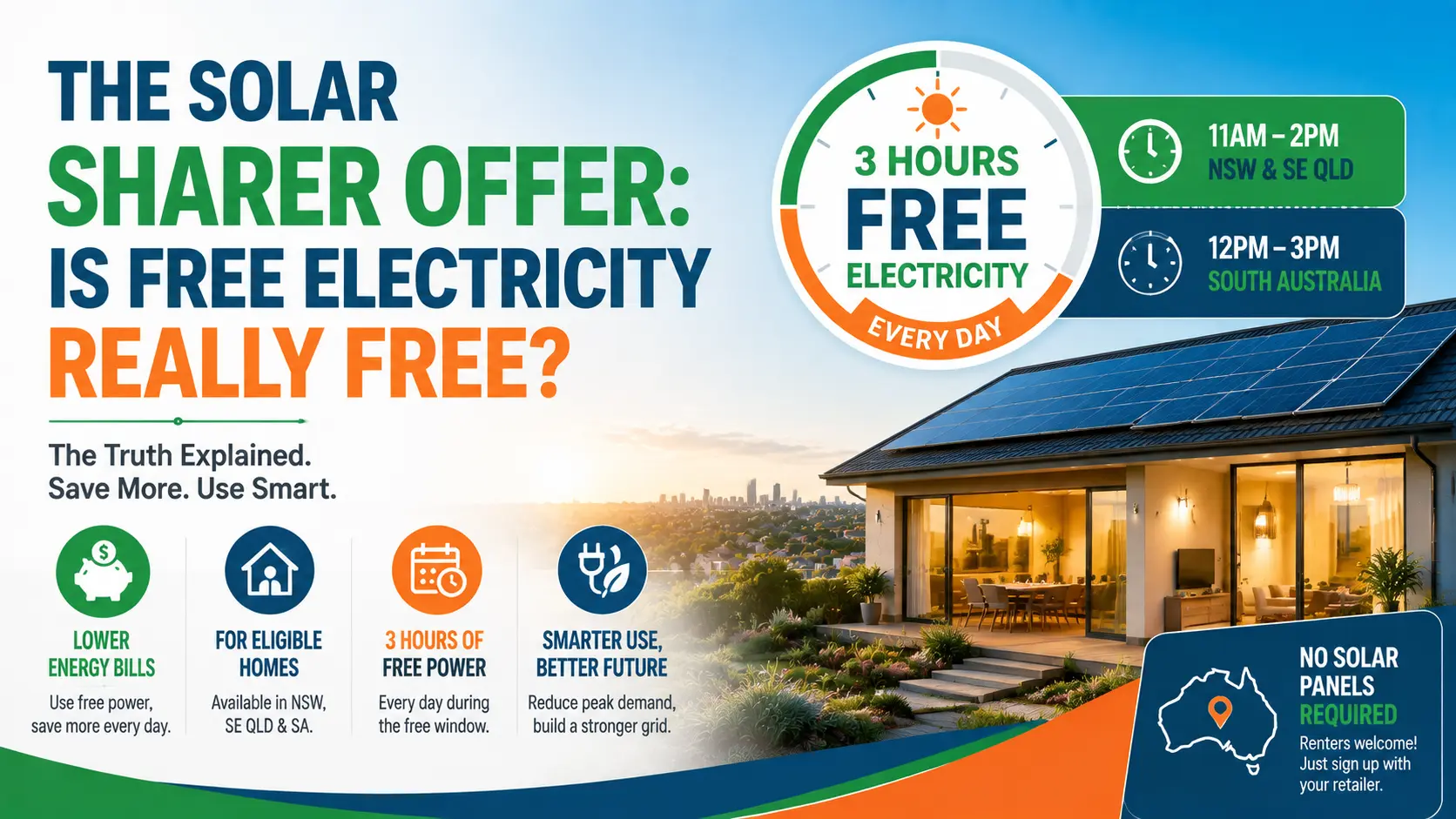
The Solar Sharer Offer gives eligible households in NSW, South East Queensland and South Australia three hours of genuinely free electricity every day. The time frame is usually within 11 am–2 pm for NSW and South East QLD or 12 pm–3 pm in SA.
During this time, you can use up to 24kWh. You don’t need solar panels, and it doesn’t matter if you rent or own. But you must actively sign up for the plan via your retailer. In other words, you can’t expect an automatic free 3-hour window if you live in those areas.
Why is the Australian government giving out free electricity?
The Solar Sharer offer isn’t a rebate like the Federal STCs. It’s a government-mandated electricity plan. Currently, Australia has over 4.3 million rooftop solar installations. These panels generate so much power on sunny days that the grids overflow with more power than they can handle. This essentially turns the wholesale value of midday electricity to zero or negative.
Although more power sounds like a good thing, it means little if all Australians aren’t benefited by it. Before SSO, only solar homes benefited from this low-priced electricity. Everyone else was paying the same price.
So, the government designed the SSO. The free window will give everyone in the eligible areas, regardless of solar ownership, a reason to use more electricity during that specific time of the day. This accomplishes several things.
Firstly, the excess electricity generated during the day is not going to waste anymore. Secondly, getting many of the chores done during that window will reduce demand during the peak evening hours. When more homes get into this new energy consumption habit, it will eventually reduce electricity costs for all Australians.
The DMO Framework
The SSO sits inside the Default Market Offer (DMO) framework. It’s the system that sets a regulated “safety net” price for households who haven’t shopped around for a better deal.
As part of the 2026–27 DMO reforms, the Australian Energy Regulator now requires any retailer with more than 1,000 customers across DMO regions to make a Solar Sharer Offer available in each of those regions.
That means, if you’re with a mid-size or large retailer in NSW, South East Queensland or South Australia, they’re obligated to offer you this plan, whether or not they think it’s a good fit for their business. Very small retailers (1,000 customers or fewer across all DMO regions) are exempt.
Retailers can’t design their own free-usage hours or opt out of the requirement, and can’t choose a shorter free period — the AER sets the free-window rules network-wide.
The published cent-per-kWh rates act as a maximum. Similar to how the standard DMO works, they differ by network area, and individual retailers are free to undercut them. Therefore, it’s worth checking whether your specific retailer’s SSO rates sit below the published cap.
The SSO also gets its own annual “comparison price,” set by the AER the same way the standard DMO does. This is the figure retailers must quote so you can compare their SSO plan against other offers on a like-for-like basis.
It’s worth checking this number specifically rather than judging the plan on the free hours alone. This figure is designed to reflect your likely total annual cost, not just the headline free period.
Solar Sharer Offer at a glance
| Detail | What it means |
| Available in | New South Wales, South East Queensland, South Australia (DMO regions only) |
| Launched | 1 July 2026 (rollout still ongoing — not all retailers live yet) |
| Free usage window (NSW/SE Qld) | 11 am–2 pm local time, year-round (doesn’t shift with daylight saving) |
| Free usage window (SA) | 12 pm–3 pm local time, year-round |
| Solar panels required? | No — available to households with or without rooftop solar |
| Renters eligible? | Yes |
| Smart meter required? | Yes |
| Opt-in or automatic? | Opt-in only — you must actively switch; retailers can’t default you onto it |
| Free usage cap | 24 kWh per day during the free window (roughly the total daily electricity use of an average five-person household, per AER benchmarks) |
| Usage above the cap | Charged at a separate “reasonable usage” rate |
| Charges outside the free window | Daily supply charge, plus normal time-of-use rates (off-peak, shoulder, peak) which vary by network |
| Who must offer it | Retailers with more than 1,000 customers across DMO regions |
| Comparison benchmark | Its own AER-set annual comparison price, separate from the standard DMO |
| Regulatory basis | Competition and Consumer (Industry Code – Electricity Retail) Amendment Regulations 2026 |
Am I Eligible for the Solar Sharer Offer?
Before applying, run through these checks:
Your address is in a covered network area
The SSO currently only exists in NSW (Ausgrid, Endeavour Energy, Essential Energy networks), South East Queensland (Energex) and South Australia (SA Power Networks). If you’re outside these areas, no retailer can offer you an SSO plan yet, no matter how big they are.
Your home has a smart meter.
This is the one piece of hardware that makes the whole scheme work. A smart meter records your usage in intervals throughout the day, which is the only way a retailer can tell how much of your consumption fell inside the free window versus outside it.
Without one, there’s no way to apply the free period accurately. Look at a recent bill, check your retailer’s app, or look at the meter itself (digital display, usually with a retailer or distributor logo). If you’re unsure, ask your retailer directly whether your specific meter is smart-meter enabled.
You’re a renter or a homeowner — both qualify.
You don’t need to own the property or have permission to install anything. If you rent, the electricity account simply needs to be in your name (or you need to be able to authorise the switch with whoever holds the account).
You do not need rooftop solar.
This is the detail that trips people up most. “Solar” is in the name, but the offer has nothing to do with panels on your roof. It’s about the solar already flowing into the grid from everyone else’s system. Whether your roof is bare or fully panelled, eligibility is identical.
How Do I Get Free Electricity With SSO?
Once you’ve confirmed you’re eligible, here’s the sequence to actually get onto the plan:
Step1: Contact your retailer and ask specifically for their Solar Sharer Offer / Solar Sharer standing offer
Not every retailer has this plan live yet. Some rolled it out on 1 July 2026; others are still building theirs. Ask directly: “Do you have a Solar Sharer Offer available, and can I switch to it?”
Step 2: Actively opt in
Nothing happens automatically. Retailers are barred from defaulting anyone onto the SSO. Including when a fixed-term contract ends, and a customer rolls onto a standing offer. You have to request the switch yourself.
Step 3: Ask for the plan’s full comparison price
Do not get carried away by the free-hours pitch. Ask for the full comparison price so you can weigh it against your current plan properly. There is also the government’s Energy Made Easy comparison tool. This lets you compare the SSO against your retailer’s other market offers using your real usage data.
It’s also worth asking your retailer whether they offer a similar daytime-discount plan outside the regulated SSO structure. Some retailers already had their own free or discounted midday offers before the SSO existed, and those may suit heavy solar or battery households better.
Step 4: Once switched, start shifting usage into your free window
Simply being on the plan without changing your habits won’t save you anything, and could even cost slightly more.
Which Retailer Offers the SSO Plan in Australia 2026?
Rollout has been uneven, so it’s worth checking your specific retailer rather than assuming the plan is available:
| Retailer | Status (as of late July 2026) |
| AGL | Live — already had a similar daytime free-power plan before the SSO existed |
| Origin | Live |
| Alinta | Live |
| Red Energy, Engie, Dodo, OVO, Sumo | Live — launched Solar Sharer plans from 1 July 2026 |
| EnergyAustralia | Not yet live — expected by September 2026 |
| GloBird | Offers its own separate four-hour free-power plan, distinct from the regulated SSO |
If your retailer isn’t listed or you’re unsure, ask them directly. Smaller or newer retailers may have their own timeline, and this list will keep shifting as the rollout continues.
How Much Can You Actually Save With SSO?
The honest answer is, it depends entirely on your rate card and how much you shift, and it’s easy to overstate. Rather than stating a generic dollar figure, it’s more useful to understand the mechanism that determines whether you come out ahead.
An SSO plan isn’t just “your old plan plus free hours.” Retailers recover the cost of the free window by raising rates elsewhere. Which means every kWh you use outside the free period on an SSO plan typically costs more than the equivalent kWh on a standard time-of-use plan.
The published Ausgrid SSO rates illustrate the shape of the trade-off. The peak usage outside the free window sits around 64c/kWh, while the free window itself is 0c/kWh up to the 24kWh cap.
So a genuine 3–4kWh shift, like a dishwasher and a load of washing moved from the evening peak into the midday window, is worth roughly $2–2.50 in that peak-rate difference alone on a given day. But that figure only holds if the rest of your day’s usage isn’t now costing more than it did on your previous plan.
In other words, the free window can be worth real money, but only once your shifted usage has first paid off the higher rates the plan charges everywhere else.
A single load of washing a week won’t get you there; a genuine, repeated change in daily habits will. Since that’s why the government has started this scheme- to change Australians’ daily electricity consumption habits.
This is exactly why comparing the SSO’s published comparison price against your current plan matters more than doing the maths on the free hours in isolation.
When Is the Solar Sharer Offer Not Best for You
Being eligible for the SSO and actually benefiting from it are two different things. There are several situations where switching could leave your bill unchanged, or even higher.
Some of the retailers required to offer this plan aren’t fully convinced of it either. A major company has publicly argued the regulation adds complexity on top of daytime deals many retailers already offered voluntarily. Another retailer has gone as far as warning that some households “may even be worse off if they switch to the offer.”
Now those are not reasons to dismiss the SSO. However, it’s reason to check your own numbers rather than assume the free hours are an automatic win.
Good fit vs. not a good fit
| Likely a good fit | Likely not a good fit |
| You or someone home can run appliances, EV charging, or heating/cooling between 11 am–2 pm (or 12 pm–3 pm in SA) | Everyone’s out at work/school all day, and usage is concentrated in the evening |
| You’re on a standard DMO or an uncompetitive market plan | You’re already on a well-priced, discounted market offer |
| You don’t yet have solar panels | You already have solar and self-consume most of your daytime generation |
| You can batch high-draw tasks (laundry, dishwasher, pre-cooling) into the window | Your only daytime load is standby devices (fridge, router) — too small to matter |
| You’re comfortable checking usage against the 24kWh cap | You already have a battery optimised around a different tariff or feed-in plan |
6 Ways to Get the Lowest Bills With an SSO Plan
Getting real value from the Solar Sharer Offer comes down to deliberately moving load into your free window rather than just letting it happen. Here’s how households are approaching it.
- Batch your high-draw appliances into the window
Washing machines, dishwashers, and clothes dryers are the classic targets. Most of these appliances have delay-start timers, so you can load them before you leave for work and set them to run between 11 am and 2 pm (or 12 pm–3 pm in SA) instead of in the evening.
- Pre-cool or pre-heat your home before the evening peak
Run your air conditioner or heater harder during the free window. Then ease off once it ends. This lets your home coast on its own insulation through part of the expensive evening period instead of drawing peak-rate power to do the same job later.
- Schedule EV charging into the free hours where possible
A three-hour window won’t fully charge most EVs from empty, but scheduled or app-controlled charging can top up a meaningful chunk of the battery for free before the evening peak takes over the rest of the charge.
- Let an AI-powered home battery do the timing for you
If you already have a battery, especially one with AI-based load and price forecasting, it can automatically charge from the grid during your free window and then discharge to cover the evening peak. There’s not even any need to manually schedule anything. This turns the “hard to plan around” nature of a fixed three-hour window into a background process.
- Keep an eye on the 24kWh cap
The free period isn’t unlimited. Usage above 24kWh in the window is charged at a separate “reasonable usage” rate. Most retailer apps show real-time or near-real-time usage, so check yours occasionally.
This is especially important if you’re running several appliances plus EV charging in the same window. Otherwise you would be accidentally paying for what you assumed was free.
- Compare your full tariff, not just the free hours.
SSO rates outside the window are often higher than a standard time-of-use plan to offset the free period. So, it’s worth checking your daily supply charge and off-peak/shoulder/peak rates against what you were paying before. The free window only pays off if the rest of your usage doesn’t quietly cost you more than it used to.
Final Words
The Solar Sharer Offer is a genuinely useful idea for the right household. Three hours of truly free electricity, every day, with no solar panels required, is not something the Australian electricity market has offered before.
However, free is never actually free. Offers like these are always built around a trade. In this case, free hours in exchange for slightly higher rates the rest of the day. Which means it rewards households that can actually reorganise when they use power.
If your daily routine can flex around the 11 am–2 pm or 12 pm–3 pm window, it’s likely worth switching. If your usage is locked into the evening, it’s worth running the numbers before you do. Contact the Aussie Solar Tech team for more guidance.
FAQs
Do I need solar panels to get the Solar Sharer Offer?
No. The offer is available to any eligible household with a smart meter, whether or not you have rooftop solar. The “solar” in the name refers to the grid’s solar generation, not panels on your roof.
Can apartment residents on embedded networks access the SSO (Solar Saver Offer)?
Not always. In embedded networks, the building operator buys electricity wholesale and on-sells it, so you can’t switch retailers yourself. SSO access depends on the operator. Check your bill’s biller name — if unfamiliar, ask your body corporate, not a retailer.
Is my whole electricity bill free during the window?
No. Only usage during the free period, up to a 24kWh daily cap, is free. You still pay a daily supply charge, normal rates for usage outside the window, and a “reasonable usage” charge for anything used above the cap during the free hours.
Will I be automatically switched onto the Solar Sharer Offer?
No. It’s strictly opt-in. Retailers cannot move you onto it by default, including when a contract ends — you have to actively request the switch, and you’ll need to be told the offer may not suit your circumstances before you do.
What happens if I use more electricity than the free cap allows?
Usage during the free window above 24kWh is charged at a separate “reasonable usage” rate rather than being free. Usage outside the free window is billed at your plan’s normal off-peak, shoulder, or peak rates depending on the time of day and your network area.

Shah Tarek is a Solar Energy Consultant with 10 years experience in solar system design and solar consultancy field at Australia. He is now a Director, Operation & Consultancy Division at Aussie Solar Tech, a leading Australian solar retailer and installer. Here he is writing informative and engaging solar content that educates the community on the benefits of solar power. His work supports Aussie Solar Tech’s mission to promote sustainable energy solutions and foster a greener future for Australia.





Seraphim Solar Panels Review: Efficiency, Reliability, and Value Unveiled

Talesun Solar Panels: Honest Review Before You Buy

Trina Vertex Solar Panels Review: Efficiency, Lifespan, and Performance

Sungrow Battery VS Tesla Powerwall : Which is Best in Australia?

Top 17 Solar Panel Brands in Australia 2025

Leapton Solar Panels Review: Affordable Energy Solution

REC Solar Panels Review: Outstanding Efficiency & Durability

Best Hybrid Inverters for Home Solar Systems in 2025

Best Solar Battery In Australia 2026 — Complete Guide

