

The cost of electricity in Australia is increasing every day. It is becoming difficult for many to manage household expenses. So now everyone is looking for solutions that will reduce electricity bills and provide energy independence. Solar battery storage is the best solution in 2025. Electricity is generated from sunlight and stored in batteries. That electricity can be used at night or when needed. This reduces electricity bills a lot.
The Australian government is also now offering various rebates and financial assistance for solar batteries. This reduces the initial cost a lot. In this guide, we will know how much it costs, which brand is best, how to get government rebates, installation tips and how to save the most. After reading the whole thing, you will easily understand which solar battery is right for your home and how to save up to thousands of dollars on your electricity bill.
What is Solar Battery Storage and How Does It Work?

A Solar Battery Storage System is a device that stores the electricity generated by your solar panels. The energy generated from sunlight during the day is first used in your home. The excess energy is stored in the battery. At night or when the power goes out, this stored energy can be used. This is very important for Australian families because electricity prices are very high here, and grid dependency is risky in many cases.
Especially in NSW, Victoria, and Queensland, the demand is growing as households face summer load shedding. Therefore, Solar Battery Storage is now the smartest investment for Australian homeowners.
Renewable Energy Storage Process

A solar battery storage system works in a simple three-step process:
- Power Generation from Solar Panels
Sunlight is captured by your solar panels and converted into electricity.
- Energy Storage in Batteries
Any unused electricity is stored in a solar battery, ready for use later.
- Electricity Usage When Needed
Stored power can be used at night, during cloudy days, or when the grid goes down
In Australia by 2025, Solar Battery Storage will not only save electricity, but also be a form of energy independence. Solar energy backup, renewable energy storage, and sustainable living are now part of the new way of life for Australian families.
Australia’s Solar Battery Storage Market Trends in 2025
2025 is being hailed as a turning point for renewable energy in Australia. Rising electricity bills, climate change, and the government’s net-zero goal have all led to a huge shift in solar battery storage across the country. Nearly 40% of Australian households now have solar panel systems installed on their homes, and of these, nearly 28% have solar battery storage installed.

This trend is growing for three main reasons:
1. Electricity Bill Savings
It is possible to generate too much solar energy during the day. A solar battery will store this excess energy instead of sending it back to the grid, and use it at night. This reduces reliance on the grid and makes electricity cheaper for consumers. For many homeowners, the potential to shave off a substantial amount from their energy bills remains the critical motivation behind investing in solar storage.
2. Government Strongly Supports It
Solar batteries are made affordable by the federal and state governments through rebates, low-interest loans, and other financial incentives. These programs urge households to invest in renewable energy while also taking steps toward the net-zero emission target. With these programs in place, solar batteries are now becoming affordable for the average Australian.
3. Improved Technology
Solar batteries are now safer, more efficient, and stronger than ever. They ensure a steady energy supply that keeps blackouts or load-shedding at bay, increasing grid reliability. These advancements are making solar batteries a wiser and more dependable choice for homeowners.
Growth in Solar Battery Installations
According to a report published by the Clean Energy Regulator in 2025, the number of solar battery installations in each state of Australia increased by an average of 25% compared to the previous year.
State-wise Installation Data (2025):
| State | 2024 Installations | 2025 Installation | Growth (%) |
| NSW | 52,300 | 65,000 | +24% |
| VIC | 47,800 | 61,200 | +28% |
| QLD | 39,500 | 50,700 | +28% |
| SA | 21,600 | 27,900 | +29% |
| WA | 19,400 | 23,800 | +23% |
Key market trends for 2025
- 70% of new installations now use Hybrid Solar Systems.
- Lithium-ion solar batteries currently hold 80% of the market share.
- Tesla Powerwall 3 alone holds 35% of the Australian market sales in 2025.
- Government rebates have reduced ROI time to an average of 6 years.
- Sustainable energy storage solutions are now a major investment trend.
Australia’s Solar Battery Storage market grew faster than ever before in 2025. With a combination of hybrid solar systems, lithium-ion batteries and government rebate programs, this sector is now the most profitable energy solution for investors.
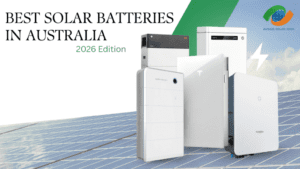
Top Solar Battery Storage Brands in Australia (2025)
The competition in the Australian Solar Battery Storage market is fierce. Different brands are offering new technologies, long-term warranties, and advanced energy management solutions.
However, choosing the right brand is not always easy. Here is a comparison of the top 5 brands in Australia in 2025.
1. Tesla Powerwall 3 (Most Popular)
The Tesla Powerwall 3 in Australia is the best-selling solar battery storage option. It is ideal for those who want high capacity, efficiency, and premium technology.
Key Features:
- Capacity: 13.5 kWh
- Efficiency: 90%
- Price (Without rebate): Around A$11,900
- Price After Rebate: Approx A$8400
- Warranty: 10 years
- Integration: Smart energy management via Tesla App
Who is suitable for: Large families who need high electricity consumption and energy independence.
2. Sungrow SBR096 (Budget-Friendly)
Sungrow is the best option for those looking for good performance at a low price. This brand is rapidly gaining popularity in Australia in 2025.
Key Features:
- Capacity: 9.6 kWh
- Efficiency: 88%
- Price without rebate: Approx A$12,871
- Price after rebate: Approx A$10,271
- Warranty: 10 years
- Features: Affordable price and easy installation
Who is suitable for: Ideal for small and medium families who want solar energy backup on a limited budget.
3. Sigenergy SigenStore (Premium Hybrid Option)
The SigenStore by Sigenergy is made for those gardens that want to go with a high-aspiration battery with a sleek mode of operation. Its all-in-one design makes it a perfect choice for Australian homes in 2025, able to house energy storage, a hybrid inverter, and smart management in one neat box.
Key Features:
- Capacity: 8 kWh (expandable)
- Efficiency: 90%+
- Price without rebate: Approx A$9,786
- Price after rebate: Approx A$7,626
- Warranty: 10 years
- Features: Advanced hybrid technology, modular design, backup support, and smart energy management.
Who is suitable for: Ideal for households wanting a premium, future-ready solution with smart hybrid technology and backup support.
4. SolarEdge Home Battery (Smart Solar Integration)
SolarEdge Home Battery is made to be used with SolarEdge inverters to guarantee the highest efficiency and intelligent management of energy. It is popular with Australian homeowners who want a tightly integrated solar-and-storage system.
Key Features:
- Capacity: 10 kWh
- Efficiency: ~94%
- Price without rebate: Approx A$12,686
- Price after rebate: Approx A$9,666
- Warranty: 10 years
- Features: Seamless inverter integration, high round-trip efficiency, and advanced monitoring through the SolarEdge app.
Who is it suited for: Perfect for homeowners who already own or plan to install a SolarEdge inverter and want maximum efficiency with a fully integrated system.
5. BYD Battery-Box Premium (Long-Lasting Performance)
The BYD Battery-Box Premium is a modular and highly durable solar battery system, known for its long lifespan and flexible design. Trusted worldwide, it has become a popular choice in Australia for those seeking reliable and expandable storage.
Key Features:
- Capacity: 10.2 kWh (expandable)
- Efficiency: ~89–90%
- Price without rebate: Approx A$11,000
- Price after rebate: Approx A$8,205
- Warranty: 10 years
- Features: Modular design, long cycle life, safe lithium iron phosphate (LFP) chemistry, and scalable for larger homes or businesses.
Who is it suited for: Ideal for households or small businesses looking for a durable, expandable battery system that delivers long-lasting performance.
In 2025, Australian Solar Battery Storage brands are increasingly moving towards advanced technology, long warranties, and management features. While the Tesla Powerwall 3 tops the premium segment, Sungrow and BYD offer powerful solutions at affordable prices.
Note: The “Price after rebate” is based on the 2025 Australian Federal Government Solar Battery Rebate, which helps lower upfront costs for households investing in solar energy storage. Actual savings may vary depending on your location, system size, and installer.
Costs and Savings of Solar Battery Storage in Australia (2025)
The cost of solar battery storage systems in Australia in 2025 has increased slightly compared to last year, but the annual savings and ROI are now much more profitable. According to the Clean Energy Regulator, choosing the right battery can save an average household AUD$1,800–$2,400 per year on their electricity bills.
According to the Clean Energy Regulator, choosing the right battery can save an average household AUD$1,800–$2,400 per year on their electricity bill.
Popular Solar Battery Prices in 2025
| Battery Brand | Storage Capacity | Estimated Price (AUD) | Annual Savings | ROI Period |
| Tesla Powerwall 3 | 13.5 kWh | $11,200 – $11,900 | ~$2,200 | ~5.5 years |
| Sungrow SBR096 | 9.6 kWh | $7,500 – $11,000 | ~$1,650 | ~5 years |
| Sigenergy SigenStore | 8.0 kWh | $7,000 – $10,990 | ~$1,700 | ~5.1 years |
|
SolarEdge Home Battery |
10 kWh | $9,200 – $11,500 | ~$1,800 | ~5.3 years |
|
BYD Battery-Box Premium |
10.2 kWh | $8,200 – $11,000 | ~$1,600 | ~5 years |
Solar Battery ROI Calculation (2025)
The average 6.6kW solar system in Australia produces around 9,600 kWh of electricity per year.
If a 13.5 kWh Tesla Powerwall 3 is added to this, then:
- Average electricity bill savings → AUD $2,200 per year
- Initial installation cost → around AUD $11,500
- ROI period → around 5.5 years
- Average battery life → around 15 years
That is, the full investment will be recovered after the first 5.5 years and the next 9.5 years. Around AUD $20,000+ can be saved.
Australian Government Incentives and Rebate Programs (2025)
New South Wales (NSW) – Virtual Power Plant (VPP) Incentives
NSW residents can receive additional payments maximum $1,500 for connecting their battery storage systems to a VPP.The upfront incentive you receive depends on the usable capacity of the battery in kilowatt-hours (kWh). Larger batteries will receive a larger incentive.
From 1 July 2025, the incentive amounts you can receive are:
- up to $550 for a 10 kWh battery
- up to $1,500 for a 27 kWh battery
South Australia (SA) – Home Battery Scheme
City of Adelaide Council Incentive
For properties located within the City of Adelaide council area, owners and renters (with permission) may still access locally funded rebates on top of national incentives:
- Up to 50% of installation cost, capped at $2,000 for battery systems.
Retailer Energy Productivity Scheme (REPS) — VPP Cashback
Through REPS, South Australian households who connect their battery to an accredited Virtual Power Plant (VPP) can receive additional cashback up to $2,050 on top of the federal rebate.
WA Residential Battery Scheme (State Rebate)
Starting 1 July 2025, WA homeowners on Synergy and Horizon Power networks can access state rebates as part of the WA Residential Battery Scheme.
-
-
Synergy customers: Receive $130 per kWh, up to A$1,300 (maximum for first 10 kWh).
-
Horizon Power customers: Receive $380 per kWh, up to A$3,800 (maximum for first 10 kWh)
-
Proper maintenance and long-term use of Solar Battery Storage
A Solar Battery Storage will not work just by installing it. Regular maintenance is essential to ensure its long-term performance and savings. Some specific maintenance tips for home battery systems in Australia in 2025.
Regular testing and monitoring
- It is important to check battery terminals and cabling regularly.
- Track battery performance using the Tesla Powerwall monitoring system or other smart monitoring apps.
- Create monthly checklists: charge-discharge ratio, temperature fluctuation, app alerts.
Proper charging and discharging
- Never overcharge or deep discharge the battery.
- It is important to follow the recommended charge cycles according to daily usage.
- For lithium-ion batteries, maintaining a 50-80% charge range increases lifespan.
Temperature Control
- It is not advisable to store batteries in very hot or cold places.
- Ideal ambient temperature: 20°C – 25°C
- Keep batteries in an insulated enclosure during extreme weather.
Cleaning and Dust Removal
- Clean the battery terminals, connectors, and inverter surface regularly.
- Use a soft cloth or approved cleaning agent.
- Dust & moisture reduce corrosion and efficiency loss.
Software Updates and System Checks
Keep the firmware of the smart battery or inverter up to date. Software updates enhance battery efficiency and safety.
Proper maintenance ensures long-lasting battery performance. Regular monitoring, proper charging, temperature control, cleaning, and software updates can ensure that solar batteries in Australian homes can last 15+ years. This way, ROI is maximized and the battery is safe.
Guide for buying Solar Battery Storage for Australian homes in 2025
Choosing the right Solar Battery Storage is not just about technology, but also about future savings and security. A step-by-step guide for Australian homeowners in 2025.
Step 1 – Determine your energy needs
First, identify your home’s average daily electricity consumption.
According to data from the Australian Energy Regulator (AER), an average family of 4 uses ~900 kWh of electricity per month. Determine your backup capacity (whether you need a battery for 5-8 hours).
Step 2 – Budget planning
The battery price can range from AUD 7,000–12,500. It is possible to reduce the actual cost by using government rebates. Calculate ROI and annual savings to set your budget.
Step 3 – Brand and model selection
Top 5 brands in the market: Tesla, Sungrow, BYD, LG Chem, AlphaESS. Consider performance, warranty, efficiency, and installer support. If modular design or AI integration is required, look at AlphaESS or BYD.
Step 4 – Installer selection
It is mandatory to use a government-approved installer. Check the installer’s experience, reviews, and warranty support. It is important to have the system checked before and after installation.
Step 5 – Regular Monitoring and Maintenance
Track battery efficiency using a smart monitoring system. Follow regular cleaning, proper charging, and seasonal care.
With the right planning and incentives, you can achieve ROI quickly and save on your electricity bill in the long run.
FAQs
- Why is Solar Battery Storage needed in Australia?
Electricity costs in Australia are increasing annually. Using Solar Battery Storage in Australia can store solar energy generated at home and reduce peak-hour electricity costs. - Which battery brand is the most popular in Australia?
Tesla Powerwall 3 is the most popular in Australia in 2025. Sungrow, BYD, LG Chem, and AlphaESS are also widely used. - How much does it cost to install Solar Battery Storage in Australia?
The typical cost of installing a battery in Australia in 2025 is AUD $7,500–$12,500.. - How to get the Australian Government rebate?
Rebates of up to $2,950 in VIC, $2,000 in SA, $1,800 in NSW, and $1,500 in QLD are available. A rebate claim form must be submitted using a government-approved installer. - How long do batteries last in Australia?
Lithium-ion solar batteries typically last 10–15 years. Proper maintenance, proper charge cycles, and temperature control increase the lifespan. - Can Solar Battery Storage power an entire home in Australia?
A 13–14 kWh battery can power a medium or large family for an entire night. A small family or 10 kWh battery provides 5–6 hours of backup.
Conclusion
Solar Battery Storage in Australia will not only save electricity but also ensure energy independence, eco-friendly living, and future savings. Whether Melbourne, Sydney, Brisbane, Adelaide, or Perth – in each city, it is possible to significantly reduce the cost of your home by using batteries.
If you use the right batteries, government rebates, and a certified installer, the ROI is possible in just 4.5–5.5 years. Tesla Powerwall 3, Sungrow, BYD, LG Chem, AlphaESS – all brands offer different benefits. Batteries can last 15+ years with regular maintenance, proper charging, seasonal care, and smart monitoring. For Australian homeowners who are looking for long-term savings and security, solar battery installation is a premium and profitable investment.
Looking to install a solar battery in Australia? Get a free quote today from Aussie Solar Tech and discover how much you could save.

Shah Tarek is a Solar Energy Consultant with 10 years experience in solar system design and solar consultancy field at Australia. He is now a Director, Operation & Consultancy Division at Aussie Solar Tech, a leading Australian solar retailer and installer. Here he is writing informative and engaging solar content that educates the community on the benefits of solar power. His work supports Aussie Solar Tech’s mission to promote sustainable energy solutions and foster a greener future for Australia.





Seraphim Solar Panels Review: Efficiency, Reliability, and Value Unveiled

Talesun Solar Panels: Honest Review Before You Buy

Trina Vertex Solar Panels Review: Efficiency, Lifespan, and Performance

Sungrow Battery VS Tesla Powerwall : Which is Best in Australia?

Top 17 Solar Panel Brands in Australia 2025

Leapton Solar Panels Review: Affordable Energy Solution

REC Solar Panels Review: Outstanding Efficiency & Durability

Best Hybrid Inverters for Home Solar Systems in 2025
Best Solar Battery In Australia 2026 — Complete Guide

