
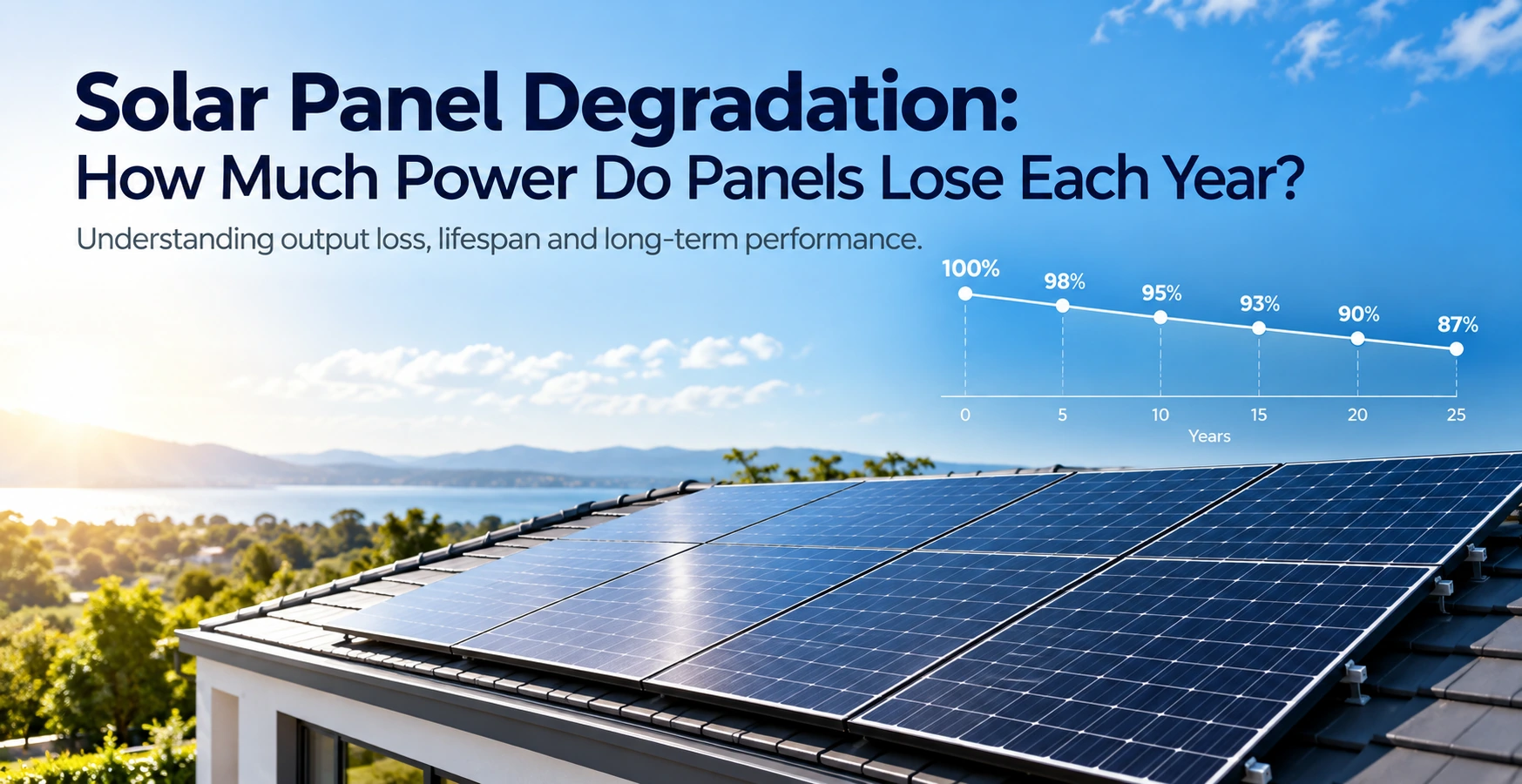
Solar panels do not suddenly stop working after a few years. Instead, their output slowly reduces over time. This process is called solar panel degradation. For most quality modern panels, the change is gradual. In Australia, many current panels carry long performance warranties because manufacturers expect them to keep producing useful power for decades. Solar panels generally last around 20–30 years, while their generating ability slowly declines over time.
What Is Solar Panel Degradation?
Solar panel degradation is the gradual loss of a panel’s ability to produce its original rated power.
A panel rated at 450W when new may not still produce the same maximum output many years later under identical conditions. That does not necessarily mean the panel is faulty. A small decline is normal. The amount allowed over time is usually written into the panel’s performance warranty.
How Much Power Do Solar Panels Lose Each Year?
There is no single number for every panel. Many quality modern panels have an annual degradation rate of around 0.4% or less after the first year, while broader figures are often around 0.3–0.6% per year, depending on the brand, model and technology.
First-Year Degradation
The first year can have a slightly larger drop. Many current performance warranties allow around 1–2% degradation in the first year, followed by a much smaller annual decline.
Annual Degradation After Year One
After the initial period, degradation usually becomes much slower. A quality panel with a strong linear performance warranty may lose only a small fraction of its original rated output each year.
Solar Panel Output Over Time
Here is a simple example based on:
- 1% loss in the first year
- 0.4% loss each following year
| Year | Approx. Warranted Output |
|---|---|
| Year 1 | 99% |
| Year 10 | 95.4% |
| Year 20 | 91.4% |
| Year 25 | 89.4% |
This is only an example. Actual degradation depends on the solar panel model and its performance warranty.
What Causes Solar Panels to Degrade?
Heat and UV Exposure
Solar panels spend years exposed to sunlight and temperature changes. Constant heating and cooling can gradually place stress on the materials and electrical connections inside the panel.
Moisture, Salt and Thermal Cycling
Humidity, coastal salt air, moisture and repeated temperature changes can also contribute to long-term ageing. Modern solar panels are built for outdoor conditions, but like any equipment exposed to the weather for decades, they will slowly age.
Normal Degradation vs a Solar System Problem
This is important because normal solar panel degradation happens slowly. If your solar production suddenly drops by a large amount, normal ageing is probably not the main cause. Other possible reasons include:
- Dirt or debris on the panels
- New shading from trees or nearby buildings
- Inverter faults
- Damaged wiring or isolators
- Panel damage
- Installation problems
If your output suddenly falls and stays low on clear sunny days, it is worth checking your monitoring system and inverter rather than assuming the panels have simply become old.
What Does a Performance Warranty Really Mean?
A product warranty and a performance warranty are different.
A product warranty generally covers defects or manufacturing problems.
A performance warranty describes how much power the manufacturer expects the panel to retain over time.
For example, a panel may have a 25- or 30-year performance warranty with a minimum output level at the end of that period.
It does not mean every panel will lose exactly that amount of power. The warranty simply sets the minimum performance level promised by the manufacturer.
Things You Can Do to Make Your Solar Panels Last Longer
You cannot completely stop normal degradation, but good care can help prevent avoidable performance loss.
- Check your solar monitoring regularly. It makes sudden changes in output easier to notice.
- Keep the panels reasonably clean. Heavy dust leaves and bird droppings can reduce solar generation.
- Watch for new shading. Trees can grow and begin shading panels that were previously clear.
- Fix faults early. Do not ignore recurring inverter errors, damaged isolators or wiring problems.
- Use qualified solar professionals. Avoid DIY electrical work or climbing onto the roof to inspect panels yourself.
- Keep the surrounding area in good condition. Roof drainage and nearby structures should not create ongoing moisture problems around the solar system.
- Keep your warranty documents. Knowing your product and performance warranty terms can make future claims much easier.
Good maintenance will not stop normal solar panel degradation, but it can help prevent unnecessary performance loss and keep the system operating reliably for longer.
When Should You Replace Solar Panels?
Do not replace solar panels simply because they are getting older. If the system is still producing useful electricity and the panels are in good condition, replacement may not be necessary. Replacement becomes more worth considering when:
- Output has fallen significantly
- Panels are physically damaged
- Repairs are no longer economical
- The system regularly develops faults
- Your energy needs have increased significantly
- A newer system would provide a practical benefit
Age alone should not be the only reason for replacing a working solar system.
Final Verdict: Should Solar Panel Degradation Worry You?
Usually, not much. For quality modern solar panels, degradation is generally slow and predictable. A small reduction in output over many years is normal. A sudden drop in production is more likely to point to shading, dirt, inverter problems or another system fault rather than normal degradation.
The best approach is simple: choose quality panels, understand the performance warranty and keep an eye on your system over time.
Frequently Asked Questions
How much do solar panels degrade each year?
Many quality modern panels lose around 0.4% or less per year after the first year, although the exact rate depends on the panel model and technology.
Do solar panels lose more power in the first year?
They can. Many performance warranties allow a larger first-year decline, often around 1–2%, followed by a lower annual degradation rate.
How much power can solar panels lose after 25 years?
It depends on the panel and its warranty. Many modern solar panels are still expected to retain a high percentage of their original rated output after 25 years.
Does hot Australian weather increase solar panel degradation?
Long-term heat and repeated temperature changes can contribute to ageing. However, quality solar panels are designed to operate outdoors in demanding weather conditions.
Is sudden low solar output caused by degradation?
Usually not. Normal degradation happens gradually. A sudden drop should be checked for shading, dirt, inverter faults, wiring issues or panel damage.

Shah Tarek is a Solar Energy Consultant with 10 years experience in solar system design and solar consultancy field at Australia. He is now a Director, Operation & Consultancy Division at Aussie Solar Tech, a leading Australian solar retailer and installer. Here he is writing informative and engaging solar content that educates the community on the benefits of solar power. His work supports Aussie Solar Tech’s mission to promote sustainable energy solutions and foster a greener future for Australia.




Seraphim Solar Panels Review: Efficiency, Reliability, and Value Unveiled

Talesun Solar Panels: Honest Review Before You Buy

Sungrow Battery VS Tesla Powerwall : Which is Best in Australia?

Leapton Solar Panels Review: Affordable Energy Solution

REC Solar Panels Review: Outstanding Efficiency & Durability

Best Hybrid Inverters for Home Solar Systems in 2025
Best Solar Battery In Australia 2026 — Complete Guide

Sigenergy VS Fox ESS Battery: Which is The Best Choice for 2026
How Much Do Solar Panel Costs in Australia? (2026 Price Guide)

