
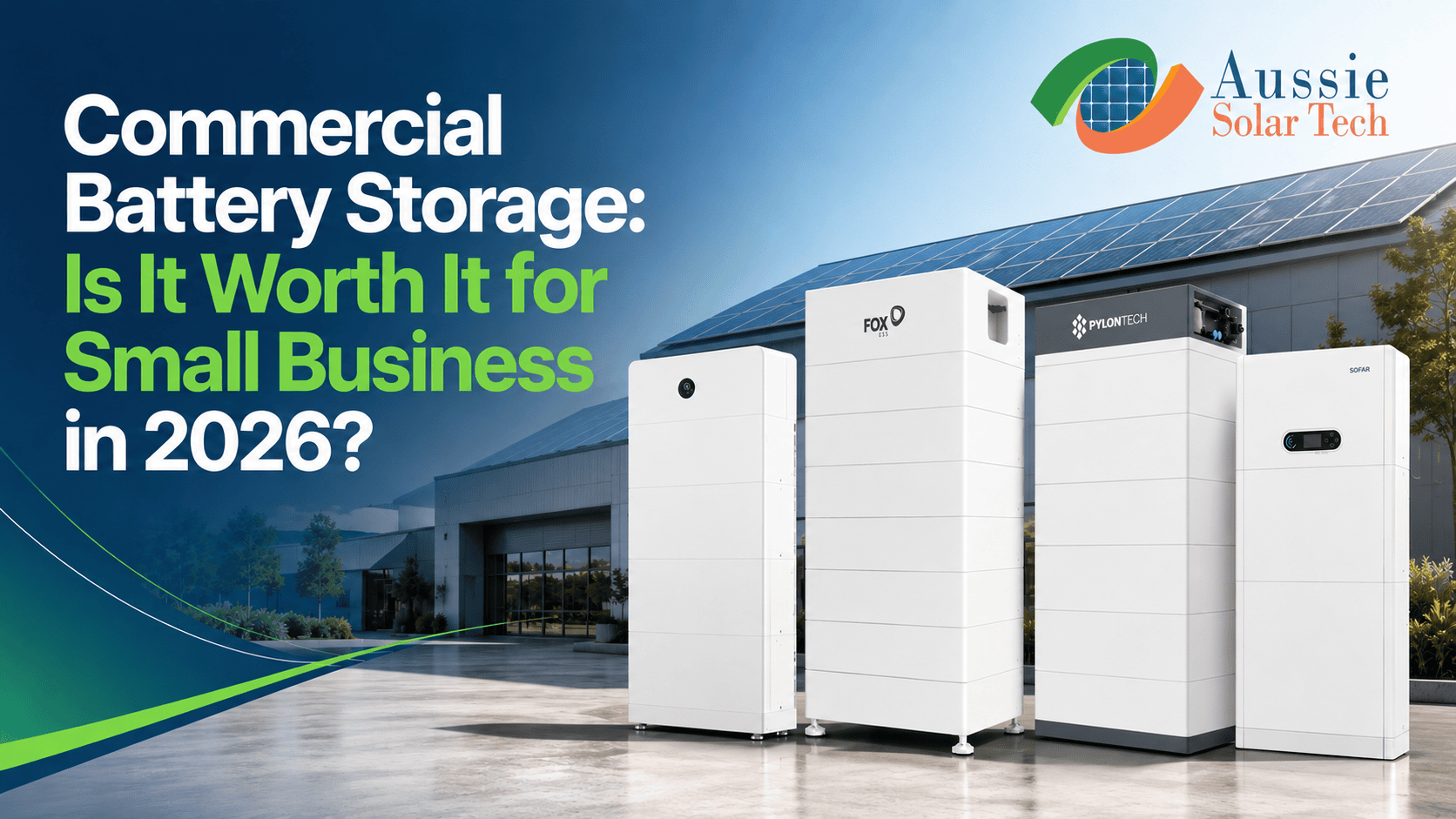
Commercial battery storage can help small businesses reduce electricity costs, use more solar energy and manage peak demand. It can also provide backup power when the system is designed for it.
In 2026, eligible Australian small businesses may also benefit from federal battery incentives. This guide explains costs, savings, sizing, rebates and ROI to help you decide whether commercial battery storage is worth it for your business.
What Is Commercial Battery Storage?
Commercial battery storage is an energy storage system designed to store electricity for later use by a business.
The battery may charge from:
- excess rooftop solar generation
- the electricity grid during lower-cost periods
- a combination of solar and grid energy, depending on the system and tariff
It can then discharge when the business needs electricity, particularly when solar generation falls, grid electricity becomes more expensive or grid demand needs to be reduced.
Battery capacity, measured in kilowatt-hours (kWh), indicates how much energy can be stored. Battery or inverter power, measured in kilowatts (kW), indicates how much power can be supplied at one time.
A 60 kWh battery therefore does not automatically mean it can support a 60 kW business load. The inverter, battery discharge capability and system design also determine how much equipment can operate simultaneously.
How Commercial Battery Storage Works for Small Businesses
A commercial battery system can be programmed around the operating pattern of the business.
A typical solar-and-battery setup may operate like this:
| Time | Typical Energy Strategy |
| Morning | Solar begins supplying business loads |
| Midday | Solar powers the business and charges the battery with surplus generation |
| Afternoon | Battery charging continues when surplus solar is available |
| Peak tariff period | Battery discharges to reduce expensive grid purchases |
| High-demand event | Battery may discharge to reduce the site’s grid demand |
| After sunset | Stored solar supplies part of the evening load |
| Grid outage | A correctly configured backup system can support selected or wider business loads |
Businesses on time-of-use tariffs may also be able to charge a battery using lower-cost grid electricity and discharge it during more expensive periods.
The exact strategy should be based on the site’s meter data rather than using the same battery settings for every business.
Why Small Businesses Are Considering Battery Storage in 2026
One of the biggest changes in 2026 is the availability of federal battery support for eligible small businesses.
Under the Cheaper Home Batteries Program, an eligible battery can receive support through Small-scale Technology Certificates, or STCs. The program applies to households and small businesses that meet the eligibility requirements.
Battery storage can also address several commercial energy problems at once:
- excess daytime solar that would otherwise be exported
- expensive electricity during peak tariff periods
- demand charges
- solar export restrictions or curtailment
- operational disruption during some grid outages
- increasing future electricity demand
This does not mean every business needs a battery. It means businesses with the right load and tariff profile now have more reasons to assess one.
Commercial Battery Storage Benefits for Small Business
The financial value of a battery is normally created by combining several benefits rather than relying on one saving alone.
| Benefit | How It Can Help |
| Higher solar self-consumption | Stores surplus solar instead of immediately exporting it |
| Peak-demand management | Reduces grid draw during high-demand periods |
| Time-of-use savings | Uses stored energy when electricity rates are higher |
| Backup capability | Can support selected loads during outages when correctly configured |
| Reduced grid dependence | Uses more locally generated and stored electricity |
| Reduced curtailment | Stores some solar that could otherwise be restricted by an export limit |
| VPP participation | Eligible systems may access additional value where a suitable program is available |
Australian Government guidance notes that battery storage can increase solar self-consumption, take advantage of time-of-use tariffs, reduce peak demand and potentially participate in a VPP.
The strongest business case usually comes from combining multiple benefits—for example, solar storage plus peak-demand reduction rather than installing a battery only for occasional backup.
Peak Demand Charges and Energy Cost Savings
Demand charges are particularly important for commercial customers.
Unlike a normal usage charge based on total kWh consumed, a demand charge is linked to the highest amount of power drawn from the grid during the relevant billing period. For businesses, demand charges are often calculated using the highest demand during a short interval, commonly a half-hour period, although the exact tariff depends on the electricity contract.
Consider a workshop where several large machines, air conditioners and other loads start operating at the same time.
Even if that peak lasts only briefly, it may influence the demand component of the electricity bill.
A correctly sized battery can discharge during these high-load periods so that part of the required power comes from the battery rather than the grid.
This is known as peak shaving.
The potential saving depends on:
- whether the business actually has a demand tariff
- when its highest demand occurs
- the battery’s kW discharge capability
- how long peak events last
- how frequently those peaks occur
This is why battery sizing based only on daily kWh consumption can produce a poor result. For demand management, power output in kW is just as important as stored energy in kWh.
Commercial Battery With Solar vs Battery Without Solar
A commercial battery can provide value in different ways depending on whether rooftop solar is installed.
Battery With Solar
Solar and battery storage usually provide the clearest energy-flow strategy.
During the day, solar first supplies business loads. Surplus generation can then charge the battery instead of being exported immediately. The stored energy can later be used after solar output falls or during more expensive tariff periods.
Australian Government guidance notes that using solar directly generally provides greater value than exporting it where the retail electricity price is higher than the feed-in tariff. A battery can increase this self-consumption by moving surplus solar to a later time.
Battery Without Solar
A battery can also shift electricity purchased from the grid. For example, a suitable system may charge during a lower-cost off-peak period and discharge during a more expensive peak period.
However, the financial case depends heavily on the difference between those electricity rates, battery efficiency, cycling and the site’s demand tariff.
There is also an important 2026 rebate distinction: to qualify for the federal battery STC support, the battery must be installed with a new or existing solar PV system of no more than 100 kW.
So a standalone battery may still have an operational use case, but it does not automatically meet the federal battery rebate requirements.
Solar Self-Consumption and Reducing Grid Dependence
A business with rooftop solar may generate its highest output around the middle of the day.
If the site cannot use all that electricity immediately, surplus energy may be exported or, where network export restrictions apply, some generation may be curtailed.
A battery creates another destination for that surplus.
Instead of:
Solar → Grid Export
the energy flow can become:
Solar → Business Load → Battery → Later Business Use
Every stored kilowatt-hour later used by the business can reduce the amount of electricity that must be purchased from the retailer.
Australian Government guidance also confirms that a battery can reduce some solar curtailment where export limits prevent all surplus generation from being sent to the grid.
The potential benefit is usually greater for businesses that generate substantial surplus solar but still use electricity after solar production falls.
Backup Power and Business Continuity
For some businesses, avoiding downtime may be just as important as reducing electricity bills.
A blackout can affect:
- refrigeration
- security and access systems
- computers and communications
- point-of-sale equipment
- lighting
- pumps
- selected machinery
- other critical equipment
However, installing a battery does not automatically provide blackout protection.
Australian Government guidance states that a battery must be specifically configured for backup operation. Depending on the system, it may support the whole property, selected essential circuits or only part of a three-phase installation.
An effective commercial backup design therefore needs to consider:
Battery energy capacity (kWh) – how long critical equipment can operate.
Battery/inverter power (kW) – how much equipment can run at the same time.
Starting loads – some motors, pumps, refrigeration and machinery can require much higher power when starting.
Backup switching – the system needs suitable equipment to safely isolate the premises from the grid.
Solar operation during an outage – an islandable system may allow solar to continue operating and recharging the battery during a blackout.
For businesses where an outage has a high financial cost, backup value should be included in the investment decision rather than looking only at electricity-bill savings.
How to Size Commercial Battery Storage for a Small Business
A café, workshop, retail store and warehouse can all consume the same total number of kilowatt-hours per day while having completely different peak-demand patterns.
The most accurate starting point is 12 months of smart-meter or interval data.
Australian Government guidance recommends using interval data because it records when electricity is consumed, usually at 15- or 30-minute intervals. Businesses can request this data from their distribution network service provider.
A proper commercial battery assessment should look at:
| Data | Why It Matters |
| Daily electricity consumption | Helps estimate overall energy requirements |
| 15/30-minute interval data | Shows exactly when electricity is used |
| Maximum site demand | Helps determine required battery/inverter kW |
| Solar generation | Shows when and how much surplus solar is available |
| Solar export | Indicates potential energy available for battery charging |
| Operating hours | Shows whether stored solar can be used later |
| Electricity tariff | Determines peak, off-peak and demand-charge value |
| Critical loads | Determines backup requirements |
| Future equipment | Helps prevent undersizing |
| EV charging | Can significantly change future demand |
For example, a business with 100 kWh of daily consumption does not necessarily need a 100 kWh battery.
If only 35 kWh of surplus solar is available each day and the business needs roughly 30 kWh after sunset, a much smaller battery may be more economical.
The reverse can also happen. A business may need relatively little stored energy but require high battery power to reduce a short 40 kW demand spike.
Good sizing therefore considers kWh + kW + timing, not capacity alone.
Commercial Battery Storage Cost in Australia
Commercial battery cost varies significantly with capacity, brand, inverter requirements, backup equipment, switchboard condition and installation complexity.
Current guide pricing provides the following indication for several higher-capacity battery sizes:
| Battery Capacity | Current Guide Price From |
| 30 kWh | A$7,999* |
| 40 kWh | A$10,799* |
| 50 kWh | A$15,999* |
| 60 kWh | A$18,199* |
| 70 kWh | A$21,399* |
| 100 kWh | A$32,999* |
These are starting guide prices rather than a guarantee of the final installed commercial system cost. Current published pricing confirms the 30, 40 and 50 kWh guide figures, while current 60, 70 and 100 kWh listings provide the larger-system figures shown above.
The final installed cost can increase where the project requires:
- a new hybrid or battery inverter
- additional battery cabinets or modules
- three-phase integration
- backup switching
- essential-load circuits
- switchboard upgrades
- protection equipment
- longer cable runs
- network-related changes
- difficult battery placement
- monitoring or site-control equipment
A 50 kWh battery that fits easily into an existing compatible system may therefore cost less to install than another 50 kWh system requiring significant electrical upgrades.
Final price may varies based on location, installation requirements. Contact us for a personalized quote and expert advice.
2026 Battery Rebates and Government Incentives for Small Businesses
Eligible small businesses can access the Australian Government’s Cheaper Home Batteries Program through the Small-scale Renewable Energy Scheme.
As of August 2026, an eligible battery system must meet several requirements, including:
- be a new battery system
- be installed with new or existing solar PV of no more than 100 kW
- have 5–100 kWh nominal battery capacity
- be installed as a single job
- use a battery configuration on the Clean Energy Council approved battery list
- comply with relevant Australian standards and electrical safety laws
- have VPP capability where required
- be installed by a Solar Accreditation Australia accredited installer with battery endorsement.
How Much Battery Capacity Receives Support?
A system can have up to 100 kWh nominal capacity and remain within the program’s battery-size requirement, but STCs can only be claimed against the first 50 kWh of usable battery capacity.
From May to December 2026, the base STC factor is 6.8 per kWh, with support tapering according to usable capacity:
| Usable Capacity Portion | STC Factor Applied |
| 0–14 kWh | 100% of applicable factor |
| Above 14–28 kWh | 60% |
| Above 28–50 kWh | 15% |
| Above 50 kWh | No additional battery STCs |
This means installing a larger battery does not result in the same level of support for every additional kWh.
The actual dollar discount also depends on the number of STCs created and their market value, so a fixed rebate amount should not be assumed before the exact battery configuration and installation date are known.
Businesses should also check whether additional state, territory, finance or energy-efficiency programs are available at the time of purchase, as these can change.
Payback Period and Return on Investment
Battery payback is the time required for the financial value created by the system to recover its upfront cost.
A simple calculation is:
Simple Payback Period = Net Installed Battery Cost ÷ Annual Battery-Related Savings
For example, if a system costs A$20,000 after applicable incentives and produces A$4,000 per year in combined electricity and demand-charge savings:
A$20,000 ÷ A$4,000 = 5 years
That is only an illustrative calculation, not a typical guaranteed payback period.
A proper commercial battery ROI analysis should include:
- solar self-consumption savings
- peak-demand savings
- time-of-use tariff savings
- available rebates
- potential VPP income where applicable
- backup value to the business
- battery degradation
- financing costs
- maintenance
- warranty conditions
- expected future electricity use
Australian Government guidance cautions that battery payback depends on electricity consumption and timing, electricity prices, solar-system size and battery cost. It also notes that batteries generally have a longer payback period than solar PV alone and may not be financially beneficial in every situation.
This is particularly important for small businesses.
A battery with a low purchase price can still provide poor ROI if it rarely cycles or cannot reduce the business’s actual demand peak. A more expensive system can potentially perform better financially if it is correctly sized around a high-value load profile.
Grid Connection, Export Limits and Installation Requirements
Commercial battery design must also account for the local electricity network.
Distribution Network Service Providers can set limits on:
- inverter connection capacity
- solar export
- export per phase
- other connection requirements
Australian Government guidance confirms that connection and export limits vary by local distribution network. Where the inverter capacity is greater than the permitted export level, export limiting may be required.
Battery storage can sometimes help in an export-limited solar system because some surplus generation can be stored rather than exported or curtailed.
For an eligible battery under the federal program, the system must also use a CEC-approved battery configuration, comply with AS/NZS 5139:2019, meet state or territory electrical-safety requirements and be installed by an appropriately accredited SAA installer with battery endorsement.
The Clean Energy Council also notes that its approved product lists are dynamic, so the exact battery and inverter should be checked at the time the system is selected.
For a commercial property, system design should therefore happen before purchasing battery capacity—not after.
Which Small Businesses Benefit Most from Battery Storage?
Commercial battery storage is most attractive when there is a clear energy problem for the battery to solve.
| Business Profile | Why Battery Storage May Help |
| Retail stores | Evening operation, air conditioning and lighting can use stored daytime solar |
| Cafés and restaurants | Refrigeration and extended operating hours create ongoing electricity demand |
| Workshops | Batteries may help manage short periods of high equipment demand |
| Small manufacturing sites | Peak shaving may reduce grid demand where demand tariffs apply |
| Warehouses | Solar storage can support lighting, refrigeration and after-hours loads |
| Farms and rural businesses | Storage can support pumps and critical loads depending on system design |
| Offices with large solar systems | Surplus daytime generation can be stored for later operation |
| Businesses with EV charging | Battery storage can help manage additional charging demand |
| Sites affected by outages | Backup storage may improve resilience for selected essential equipment |
The best candidates generally have one or more of these characteristics:
- significant solar surplus
- meaningful electricity use after solar production falls
- high peak electricity rates
- demand charges
- valuable critical loads
- regular, predictable energy consumption
- enough time at the premises to recover the investment
A business with low electricity consumption, little surplus solar and a simple low-cost tariff may see a much weaker financial case.
For many small businesses in 2026, commercial battery storage can be worth it when the system is sized around real interval data and used for more than one purpose. The strongest projects typically combine solar self-consumption, tariff optimisation and demand management, while backup capability can add additional business value where downtime is costly.
The key is not simply buying the biggest battery available. It is matching battery capacity, power output, inverter design and control strategy to the way the business actually consumes electricity.
Frequently Asked Questions
What size battery does a small business need?
There is no standard size. Commercial battery sizing should consider 12 months of interval data, solar generation, peak demand, operating hours, critical loads and future electricity needs. Australian Government guidance recommends smart-meter or interval data for more accurate system assessment.
Can a commercial battery work without solar panels?
A battery can use lower-cost grid electricity and discharge during more expensive periods where the tariff and system allow it. However, eligibility for the federal Cheaper Home Batteries Program requires the battery to be installed with a new or existing solar PV system of no more than 100 kW.
Can a commercial battery provide backup during a blackout?
Yes, but only when the battery system is designed and configured for backup. Some systems can support the whole premises, while others supply only selected essential circuits or part of a three-phase site.
Are small businesses eligible for the federal battery rebate in 2026?
Eligible small businesses can receive support through the Cheaper Home Batteries Program. The battery must meet program requirements, including approved equipment, eligible capacity, appropriate solar PV and installation by an SAA-accredited installer with battery endorsement.
How much commercial battery capacity can receive STCs?
Eligible systems can have between 5 and 100 kWh of nominal capacity, but STCs can only be claimed for the first 50 kWh of usable battery capacity. The support also tapers across different capacity bands.

Shah Tarek is a Solar Energy Consultant with 10 years experience in solar system design and solar consultancy field at Australia. He is now a Director, Operation & Consultancy Division at Aussie Solar Tech, a leading Australian solar retailer and installer. Here he is writing informative and engaging solar content that educates the community on the benefits of solar power. His work supports Aussie Solar Tech’s mission to promote sustainable energy solutions and foster a greener future for Australia.






Seraphim Solar Panels Review: Efficiency, Reliability, and Value Unveiled

Talesun Solar Panels: Honest Review Before You Buy

Trina Vertex Solar Panels Review: Efficiency, Lifespan, and Performance

Sungrow Battery VS Tesla Powerwall : Which is Best in Australia?

Top 17 Solar Panel Brands in Australia 2025

Leapton Solar Panels Review: Affordable Energy Solution

REC Solar Panels Review: Outstanding Efficiency & Durability

Best Hybrid Inverters for Home Solar Systems in 2025
Best Solar Battery In Australia 2026 — Complete Guide

