
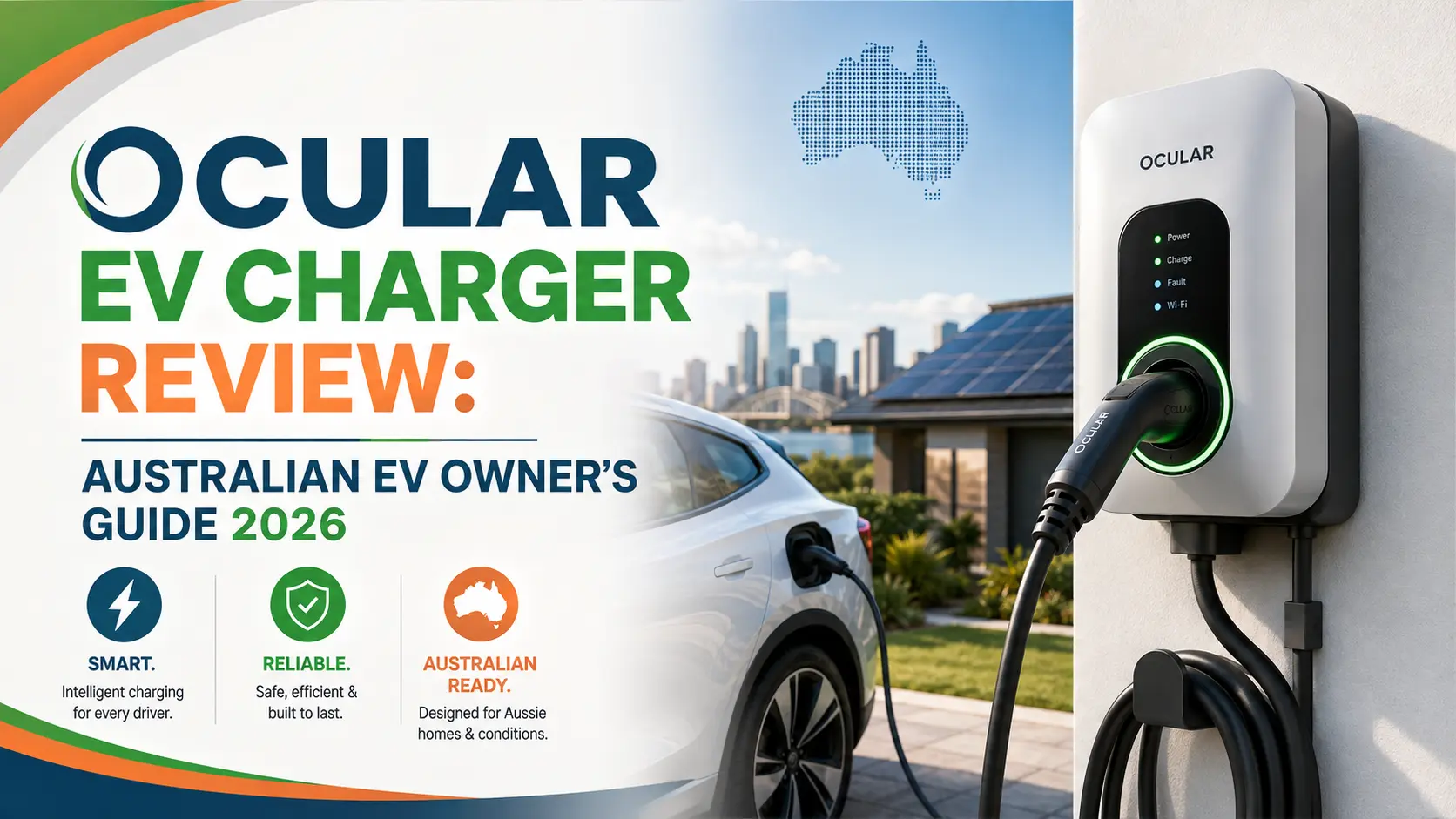
Ocular is one of the most well-known solar EV charger brands in Australia. Users love it for its wide compatibility with other solar hardware and for providing an all-in-one smart home charging solution.
The brand offers chargers for both homes and stations. However, we are exclusively focusing on Australian homes here. So, our pick is the Ocular IQ Home Solar after considering the brand’s other residential models. It’s perfect for those who want EV charging without changing their existing solar setup.
You can expect the retail price for IQ Home Solar to be $1,150-$1,400 (7.2 kW) and $1,350-$1,550 (22 kW) before installation costs. This may seem somewhat expensive since rival brands offer lower prices. Then again, you don’t have to buy any extra hardware or subscriptions. So, the total expenses with Ocular are actually less than its competitors.
Like any charger, it has genuine strengths and weaknesses that only become clear after months of real ownership. This Ocular EV charger review weighs both so you can decide whether it belongs on your shortlist.
Ocular IQ Home Solar Specs at a Glance
| Feature | Specification | User Benefit |
| Model Number | IOCAH30-7TE / -22TE / -7SE / -22SE series | Single- and three-phase, tethered or socket. |
| Power Output | 7.2 kW (1-phase) / 22 kW (3-phase) | Match speed to your electrical supply. |
| Charging Connector | Type-2 Socket or 5 m Type-2 Cable | Fits virtually every EV sold in Australia. |
| Display | LED indication lights | Status visible without opening the app. |
| CT Clamps | Included (1 for 1P, 3 for 3P) | Solar charging works immediately – no extra meter. |
| CT Clamp Spec | 20 m cable (extendable), 16 mm, 100 A max | Suits most Australian switchboards. |
| Input / Output | 230 V ±20% (1P) / 400 V ±20% (3P), 32 A max | Matches standard Australian residential supply. |
| User Interaction | App, physical button, RFID, start on plug | Multiple start/stop options. |
| Operating Temperature | -30°C to +50°C | Suited to Australian conditions, including hot summers. |
| IP / IK Performance | IP55, IK10 | Rated for outdoor rain, dust and impact. |
| Internal RCD | 30 mA AC / 6 mA DC leakage | Built-in safety independent of switchboard RCD. |
| Internet Connection | Ethernet, Wi-Fi, 4G | Ethernet or 4G recommended for stability. |
| Mounting | Wall mount | Fits garages, carports, or external walls. |
| Dimensions (H×W×D) | 398 × 285 × 226 mm | Compact single-box unit (per installation manuals). |
| Net Weight | 4.5-4.7 kg (tethered) / 1.5-1.7 kg (socket) | Confirmed in official installation manuals. |
| Recommended Breaker | 40 A Type A RCBO | Guides the electrician to correct protection. |
| Main Features | OCPP 1.6J & 2.0.1, dynamic load management, Smart Home App | Open to third-party platforms. |
| Warranty | 3 years according to the datasheet, but some retailers advertise 2 years | |
| Certification | CE, IEC/EN 61851-1, IEC 61008-1-A1, IEC 62955-1-A1, IEC/EN 61851-21-2, IEC 62196-2, RCM | Meets international and Australian marks. |
Ocular IQ Home Solar Official Datasheet
Who Makes Ocular EV Chargers?
EVE Australia Pty owns the Ocular Brand. This parent company is an Australian corporate entity that backs up a broader cleantech ecosystem. The Australian roots are kind of a guarantee that the Ocular EV chargers are designed keeping the extreme weather demands of the country in mind.
Apart from their main office in Sydney, the company maintains a strong business and service network that covers the entire region. That means you can rely on the brand for after-sales services. Although it’s an Australian brand, the company does most of its manufacturing in China to cut labor costs.
In addition to the IQ Home Solar, Ocular’s catalogue includes the LTE Plus (simpler smart residential) and the discontinued LTE. They also offer commercial AC units like the IQ Wallbox, IQ Commercial, IQ Dual Tower, and compact IQ Mini, plus a full DC range.
The IQ Home Solar is the only complete residential model that ships with CT clamps and native solar modes as standard, which makes it the ideal choice for solar homes.
Choosing the Right IQ Home Solar: Phase, Size and Australian Conditions
The charger comes in 7.2 kW single-phase (32 A) and 22 kW three-phase (32 A per phase). Most Australian homes are still single-phase, and for them the 7.2 kW version comfortably covers a daily commute and overnight (6-10 hours) full charges.
Three-phase is more common in newer Queensland and NSW homes. Few EVs accept the full 22 kW on AC (most top out around 11 kW), so the purpose of the higher rating is mainly future-proofing.
The Ocular IQ Home Solar’s dimensions are 398 × 285 × 226 mm, and it weighs 4.5-4.7 kg (tethered) or 1.5-1.7 kg (socket). As you can see, this is a compact, lightweight charger, which makes handling, transportation, and installation much easier than some of its bulkier rivals.
The operating range of -30°C to +50°C, plus IP55 and IK10 ratings, gives solid headroom for Australian summers and exposed installs. This temp tolerance is noticeably better than several rivals rated only to 40°C.
Ocular EV Charger Solar Compatibility: Smart Modes & Built-in CT Clamps
The IQ Home Solar charges from surplus rooftop solar while not forcing you into any particular solar, inverter, or battery brand. That inclusiveness is a major advantage for homeowners who already have a full solar setup and only need an EV charger to go with it.
Ocular Solar Charging Modes
The IQ Home Solar has three solar charging modes for the user’s convenience. The Fast mode charges at the maximum rate from the grid when needed. You use this mode when your solar production is low, or your home doesn’t have solar panels yet.
Meanwhile, the Solar Assist blends surplus solar with a small grid top-up so charging continues on cloudy days. This is the most practical mode for everyday use.
Solar Only draws exclusively from surplus and pauses below threshold. Official guidance puts the single-phase Solar Only minimum around 7 A (roughly 1.6-2 kW); three-phase needs higher total excess (around 21 A / ~4.6-5 kW).
Does Ocular EV Charger work with existing solar, inverter, or battery?
Yes, and it’s one of the main reasons why many homeowners choose this Ocular IQ Home Solar.
The Ocular EV charger offers complete hardware freedom by eliminating the need to communicate directly with your specific inverter or battery. Instead, the box comes with CT clamps. Your installer will fit this component on your main switchboard. Thus, enabling the charger to measure your electrical import/export in real time.
When there is surplus solar, the charger can divert it to the car. This works with any standard system that exports to the grid – Fronius, SMA, Sungrow, Growatt, Tesla, or others. There is no proprietary lock-in.
Just make sure you use an experienced and accredited installer like Aussie Solar Tech to take care of the installation. Improper installation might hinder the solar charging performance.
When you have a solar home battery, it usually absorbs the solar surplus, and less of it reaches the CT clamps. In that case, Solar Only mode will not work, and Solar Assist mode is the more realistic setting.
Single-phase Ocular EV chargers come with one CT clamp, and three-phase boxes contain three. The 20 m cable covers most homes and can be extended. Correct orientation (arrow toward the main board) is essential.
User Complaints Regarding Ocular Solar Charging
Some owners notice that the Ocular charger isn’t as good at working with small amounts of solar power as older, more established systems like the myenergi Zappi could. This can cause some of your free, leftover solar energy to go to waste. This happens for the following reasons –
It requires a bigger “push” to start.
All electric cars need a minimum amount of electricity to start charging. While rival chargers can turn on using just a tiny bit of solar power, Ocular’s software is much more cautious. It waits until your solar panels are producing a large, steady stream of extra power before it turns on. If your solar generation goes up and down slightly, the Ocular won’t capture it.
Three-Phase systems need even more power.
If your home has a heavy-duty three-phase power setup, the charger has to split its power across three separate lines. Therefore, it requires a very large solar panel setup to generate enough power just to trigger “Solar Only” mode.
Slower adjustments
When a cloud passes over, or you turn on a kitchen appliance, the household solar surplus changes instantly. Older, highly specialized chargers adapt to these changes smoothly like a dimmer switch. The Ocular adjusts more like a rigid staircase, meaning it doesn’t always keep up with fast changes in your home’s power use.
Dynamic Load Management: Keeping the Lights On
So, you are charging your EV in the evening for tomorrow’s commute. The AC and oven are running too. Everything is going well, and you are happy about the major bill savings during these peak rate hours. Suddenly, the main switch trips and plunges you into darkness. Homeowners who are new to solar EV charging often have this experience. This happens when your EV charger cannot adjust itself to the demand of the running appliances.
Ocular EV charger prevents this by using the same CT clamps; the charger reads the home’s incoming feed and automatically reduces EV output when other appliances raise demand. It will then ramp back up when the demand falls.
This helps avoid tripping the main breaker – especially useful in older Australian homes where the main fuse is often only 63 A or 80 A.
| Scenario | Appliances Running | Power Left for EV | Total Load | Result (80 A limit) |
| Evening peak | 55 A (oven, AC, dryer) | 25 A | 80 A | EV throttled to protect breaker |
| Moderate load | 40 A (AC + general) | 32 A (max) | 72 A | EV charges at full available speed |
| Overnight | 15 A (low load) | 32 A (max) | 47 A | EV charges at full speed |
App, OCPP and Day-to-Day Usability
The Ocular IQ Home stands out from fully locked-down competitor brands by supporting Open Charge Point Protocol (OCPP 1.6J and 2.0.1). Think of OCPP as a universal translator for EV chargers. Instead of forcing you to use only Ocular’s built-in tools, it allows the charger to seamlessly communicate with independent, third-party energy software.
The biggest real-world advantage of this open design is its compatibility with smart electricity providers. The charger being able to talk to third-party platforms gives you more control over how it charges the EV. For instance, you can automate your vehicle to only charge when wholesale electricity prices plummet or when the grid is flooded with cheap, excess renewable energy.
This open architecture offers far greater long-term flexibility than traditional, closed-ecosystem chargers.
What the Ocular Smart Home App Can Do
The charger connects to the free Ocular Smart Home App using Wi-Fi, Ethernet, or a 4G SIM card. For the most reliable connection, installers recommend a hardwired Ethernet cable or 4G. Weak home Wi-Fi signals can cause drops.
Once connected, the app allows you to manage the following features directly from your phone-
Live Status Monitoring: Check your current charging speed, power draw, and real-time solar tracking.
Custom Charge Scheduling: Program the charger to automatically turn on during cheap, off-peak electricity hours (Note: user reviews indicate scheduling can occasionally fail if the network drops).
Remote Management: Instantly start or stop a charging session from anywhere outside the home.
Usage History & Analytics: Track your weekly or monthly energy consumption data to see how much power your car is drinking.
Cost Estimations: Input your specific electricity tariff rates to calculate exactly how much money each charge costs.
Over-the-Air Updates: Receive automatic wireless firmware upgrades to improve system performance and fix software bugs over time.
The physical charger uses simple, color-coded LED indicator lights on the front cover rather than a built-in LCD screen. So, the mobile app is your primary dashboard for viewing specific charging metrics.
Ocular IQ Home Solar vs Top Australian EV Chargers
You can’t really decide on an EV charger before you compare it with other options in the market. Here’s how the IQ Home Solar compares with the chargers Australian buyers most often choose:
| Feature | Ocular IQ Home Solar | Wallbox Pulsar Plus | Tesla Wall Connector | myenergi Zappi |
| Price (approx.) | $1,150-$1,550 | From $1,349 | From $800 | $1,350-$1,595 |
| Max power | 7.2 / 22 kW | 7.4 / 22 kW | 7.4 / 22 kW | 7.4 / 22 kW |
| Native solar | Yes – CTs included | Needs separate meter | No (unless Powerwall) | Yes – CT clamps included |
| OCPP | 1.6J + 2.0.1 | 1.6 | Limited/local API | Limited |
| Load management | Yes (dynamic) | Yes (needs meter) | Yes | Yes |
| Weather/temp | IP55, IK10 / 50°C | IP54 / 40°C | IP55 / not specified | IP65 / 40°C |
| Warranty | 2 yr mfr / often 3 yr retail | 3 years | 4 years | 3 years |
| Best for | Built-in solar + broad OCPP | Compact + OCPP | Lowest price, long cable | Most mature solar software |
A glance at this table probably makes Tesla look like the winner, mostly due to price, cable length, and also brand recognition. However, Tesla’s low price tag will seem more like a marketing trick once you consider how closed and non-inclusive the system is. This means your true costs are much higher. From that angle, Ocular is the best since it bundles native solar (CTs included) with comparatively broad OCPP support at a mid-range price.
Final Verdict: Who Should Buy the Ocular IQ Home Solar?
| Pros | Cons |
| CT clamps for solar and load balancing included | App scheduling can be inconsistent |
| Wide temperature range and IP55/IK10 rating | OCPP can be quirky; some owners use Home Assistant |
| Broad OCPP support (1.6J and 2.0.1) | Install quality varies; trained electrician preferred |
| Genuine dynamic load management | Three-phase needs high surplus for effective solar-only |
| Local Australian support network via EVSE | Warranty advertised inconsistently (2 yr mfr vs 3 yr retail) |
The IQ Home Solar’s core advantage remains genuine. You get solar-aware charging and dynamic load balancing right out of the box. No hassle of installing a separate meter. Broad OCPP support also leaves the door open for third-party platforms later.
Buy it if you already have (or plan) rooftop solar, want the CT clamps included, value protocol openness, and are comfortable with the app or a third-party integration such as Home Assistant. It is especially practical for single-phase homes and warmer or more exposed installs.
This isn’t for you if you are a Tesla owner or if your top priority is the most mature solar-diversion software (myenergi still leads). Buyers who need rock-solid native app scheduling with minimal troubleshooting may also prefer alternatives.
For most other Australian homeowners who simply want built-in solar without extra hardware, the Ocular IQ Home Solar remains a credible shortlist option.
FAQs
What is the actual warranty on the Ocular IQ Home Solar?
The datasheet states 3 years, with extensions available. However, some Australian retailers currently advertise 2 years on the same model. Confirm the precise term and any extension cost (often a one-time fee around $135-$180) at purchase. Australian Consumer Law guarantees apply regardless. Don’t settle for less than 2 years and don’t expect more than 3 years.
Is Ocular IQ Home Solar EV Charger still worth buying if I don’t have solar yet?
Yes. Even if you don’t have solar panels now, chances are high you will be installing them soon since solar conversion has become a national trend in Australia. For now, run it in Fast mode. When you later add solar, switch to Solar Assist or Solar Only in the app. No extra hardware is required.
Does the Ocular EV charger work properly with a home battery?
Yes, the Ocular EV charger is universally compatible with all solar battery brands. However, you might face issues if you try to charge with solar only. That is because home batteries absorb surplus solar first, so less reaches the CT clamps. Solar Assist is usually the more practical mode in that situation.
How hard is the installation and what should I budget?
A licensed electrician is required. Ocular-trained installers (often via EVSE) are preferred for correct CT orientation and solar setup. Standard single-phase installs commonly cost $1,200-$1,470 before any switchboard upgrades. You can also choose an experienced installer like Aussie Solar Tech to reduce installation costs.

Shah Tarek is a Solar Energy Consultant with 10 years experience in solar system design and solar consultancy field at Australia. He is now a Director, Operation & Consultancy Division at Aussie Solar Tech, a leading Australian solar retailer and installer. Here he is writing informative and engaging solar content that educates the community on the benefits of solar power. His work supports Aussie Solar Tech’s mission to promote sustainable energy solutions and foster a greener future for Australia.








Seraphim Solar Panels Review: Efficiency, Reliability, and Value Unveiled

Talesun Solar Panels: Honest Review Before You Buy

Sungrow Battery VS Tesla Powerwall : Which is Best in Australia?

Leapton Solar Panels Review: Affordable Energy Solution

REC Solar Panels Review: Outstanding Efficiency & Durability

Best Hybrid Inverters for Home Solar Systems in 2025

Best Solar Battery In Australia 2026 — Complete Guide

Sigenergy VS Fox ESS Battery: Which is The Best Choice for 2026

How Much Do Solar Panel Costs in Australia? (2026 Price Guide)

