
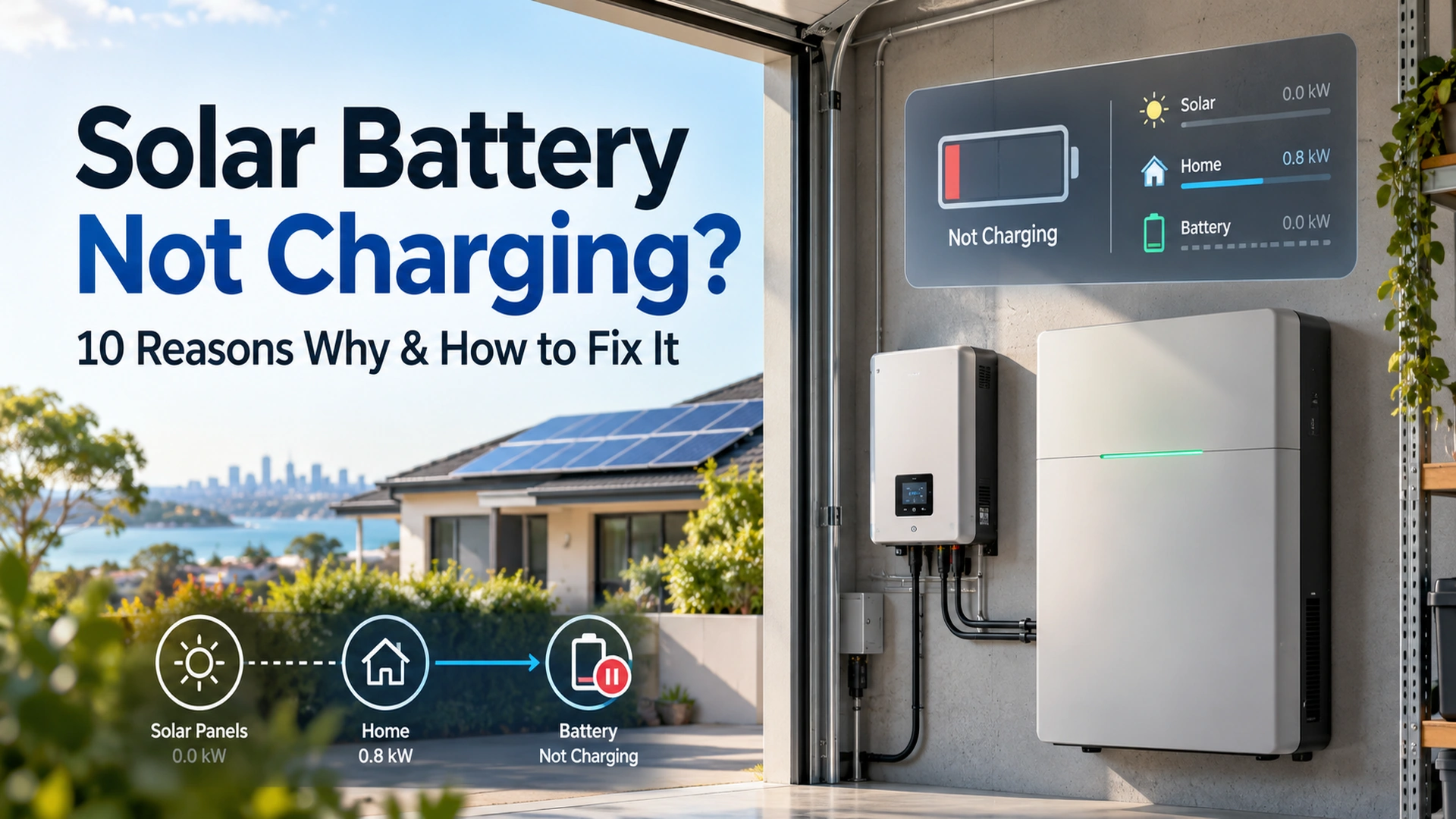
A solar battery that suddenly stops charging can be frustrating, especially when your solar panels appear to be working normally. If you are dealing with a solar battery not charging, it does not always mean something is broken. Sometimes there is simply not enough excess solar energy available. In other cases, a setting, temperature limit, communication error or hardware issue may be involved.
If your solar battery is not charging, here are 10 common reasons Australian homeowners should check before assuming the battery has failed.
Quick Solar Battery Troubleshooting Guide
| What You Notice | Possible Cause | What to Check First |
|---|---|---|
| Battery percentage stays unchanged | Little or no excess solar | Solar generation and home usage |
| Battery stops below 100% | SOC limit, temperature or BMS protection | Battery settings and app status |
| Solar is producing but battery will not charge | Meter, CT or operating mode issue | Power-flow screen and settings |
| Battery charges very slowly | High household consumption | Home load versus solar output |
| Warning or fault appears | Inverter, battery or communication fault | Error code in the monitoring app |
Is Your Solar Battery Actually Faulty?
Before troubleshooting the hardware, check whether the system is behaving normally. Your battery may not charge if it is already full, has reached a configured charge limit, there is no excess solar power available, or the system is following a charging schedule. Backup reserve settings can also keep part of the battery capacity unavailable for normal daily use.
Checking your monitoring app first can often explain what is happening.
1. Not Enough Solar Generation
Solar batteries rely on available energy from the solar system. Cloudy weather, heavy shading, short winter days, dirty panels or reduced panel output can leave too little energy for battery charging. Australian conditions can vary significantly throughout the year, so lower winter production does not necessarily indicate a battery problem.
Check your app to see how much solar your system is actually producing.
2. The Battery Is Already Full or Has Reached Its Charge Limit
A battery does not always charge to the percentage you expect. Some systems have maximum state-of-charge settings, battery protection limits or reserve levels configured by the installer or manufacturer. If the battery regularly stops at the same percentage without displaying a fault, check the battery’s SOC settings before assuming there is a problem.
3. High Household Energy Use Is Using the Solar First
Solar generation and solar surplus are not the same thing. For example, if your panels are producing 5 kW while your home is consuming 4.5 kW, only around 0.5 kW remains available for the battery. Air conditioners, pool pumps, electric hot-water systems, ovens and EV charging can significantly reduce the amount of excess solar available during the day.
4. Incorrect Battery Mode or Charging Schedule
Modern battery systems can operate in different modes, including self-consumption, backup, time-of-use and scheduled charging. If a mode or schedule has been changed, the battery may wait until a certain time or condition before charging. Check your battery app for operating mode, charging windows and any time-of-use settings. VPP or energy-management controls may also influence charging behaviour on compatible systems.
5. Backup Reserve or SOC Settings Are Limiting Charging
Many solar batteries allow homeowners to reserve part of the stored energy for blackouts. For example, a backup reserve setting may change how much capacity is available for everyday charging and discharging. Review the minimum and maximum SOC settings in your monitoring platform. Avoid changing installer-level settings unless you understand the manufacturer’s requirements.
6. Battery Temperature Is Too High or Too Low
Lithium batteries use built-in protection systems to control charging outside their preferred temperature range. range. Extreme heat can be particularly relevant in Australian garages, sheds and outdoor installations. During very hot or cold conditions, charging may slow down or temporarily stop to protect the battery.
If charging resumes when temperatures return to normal, this may be normal battery protection rather than a fault.
7. Inverter or Charge Controller Fault
The inverter plays an important role in managing energy between your solar panels, battery, home and electricity grid. If the inverter has shut down, entered fault mode or lost communication with the battery, charging may stop. Check the inverter display or monitoring app for warning messages or error codes. Do not open the inverter or attempt internal electrical repairs yourself.
8. BMS Protection, Battery Fault or Degradation
The Battery Management System, or BMS, protects battery cells from unsafe voltage, temperature and charging conditions. If the BMS detects a problem, it may restrict or stop charging. Older batteries can also lose usable capacity over time. If your battery reaches “full” much faster than it once did, provides noticeably less energy, or shows a sudden capacity change, professional testing may be required.
9. CT Clamp, Smart Meter or Communication Problem
Sometimes the battery itself is working correctly, but the system is receiving incorrect information about energy flow. A CT clamp or smart meter tells the inverter whether your home is importing or exporting electricity. If this information is incorrect, the system may think there is no excess solar available and therefore avoid charging the battery.
Communication faults between the inverter, meter and battery can cause similar behaviour.
10. Wiring, Breaker, Isolator or Hardware Fault
A tripped protection device, damaged cable, loose connection or faulty component can prevent battery charging. These issues require professional attention. Solar and battery systems can remain electrically dangerous even when parts of the system appear to be switched off. Do not remove covers, touch internal wiring or attempt electrical repairs yourself.
Why Does My Solar Battery Stop Charging Before 100%?
A solar battery not charging fully is not necessarily faulty. Common causes include:
- Maximum SOC settings
- Backup reserve settings
- Battery temperature protection
- BMS limits
- Battery ageing
- Insufficient solar surplus
If the battery consistently stops at an unusual percentage or its behaviour has recently changed, check the monitoring data and contact your installer if necessary.
What to Check in Your Solar Battery App
Before arranging a service call, look at:
- Battery state of charge
- Solar generation
- Household consumption
- Grid import and export
- Battery charging power
- Operating mode
- Charging schedule
- Warning messages or error codes
- Whether monitoring data is current
These readings can often reveal whether the issue is related to energy availability, settings or a genuine system fault.
When Should You Call a Solar Battery Technician?
Contact a qualified solar installer or licensed electrician if the battery repeatedly fails to charge despite strong solar production, shows persistent fault codes, shuts down unexpectedly, has visible damage, or develops unusual heat, smell or noise.
You should also arrange professional inspection if there are suspected wiring, inverter, meter, BMS or communication problems.
Final Thoughts
When a solar battery is not charging, the battery itself is not always the cause. Low solar surplus, household demand, charging settings, temperature protection and monitoring issues are all common explanations. Start with the monitoring app and basic system status. If the problem involves electrical equipment, wiring or recurring fault codes, leave the diagnosis and repair to a qualified professional.
A careful check can help determine whether your battery is simply following its settings or whether your solar storage system genuinely needs attention.
FAQs
Why is my solar battery not charging?
Common reasons include low solar generation, high household energy use, incorrect battery settings, temperature limits, inverter faults or communication problems.
Why does my solar battery stop charging before 100%?
It may be due to SOC limits, backup reserve settings, BMS protection, battery temperature or normal battery ageing.
What should I check first if my solar battery is not charging?
Check your monitoring app for battery percentage, solar generation, household usage, charging mode and any warning or error messages.

Shah Tarek is a Solar Energy Consultant with 10 years experience in solar system design and solar consultancy field at Australia. He is now a Director, Operation & Consultancy Division at Aussie Solar Tech, a leading Australian solar retailer and installer. Here he is writing informative and engaging solar content that educates the community on the benefits of solar power. His work supports Aussie Solar Tech’s mission to promote sustainable energy solutions and foster a greener future for Australia.






Seraphim Solar Panels Review: Efficiency, Reliability, and Value Unveiled

Talesun Solar Panels: Honest Review Before You Buy

Sungrow Battery VS Tesla Powerwall : Which is Best in Australia?

Leapton Solar Panels Review: Affordable Energy Solution

REC Solar Panels Review: Outstanding Efficiency & Durability

Best Hybrid Inverters for Home Solar Systems in 2025

Best Solar Battery In Australia 2026 — Complete Guide

Sigenergy VS Fox ESS Battery: Which is The Best Choice for 2026

How Much Do Solar Panel Costs in Australia? (2026 Price Guide)

