
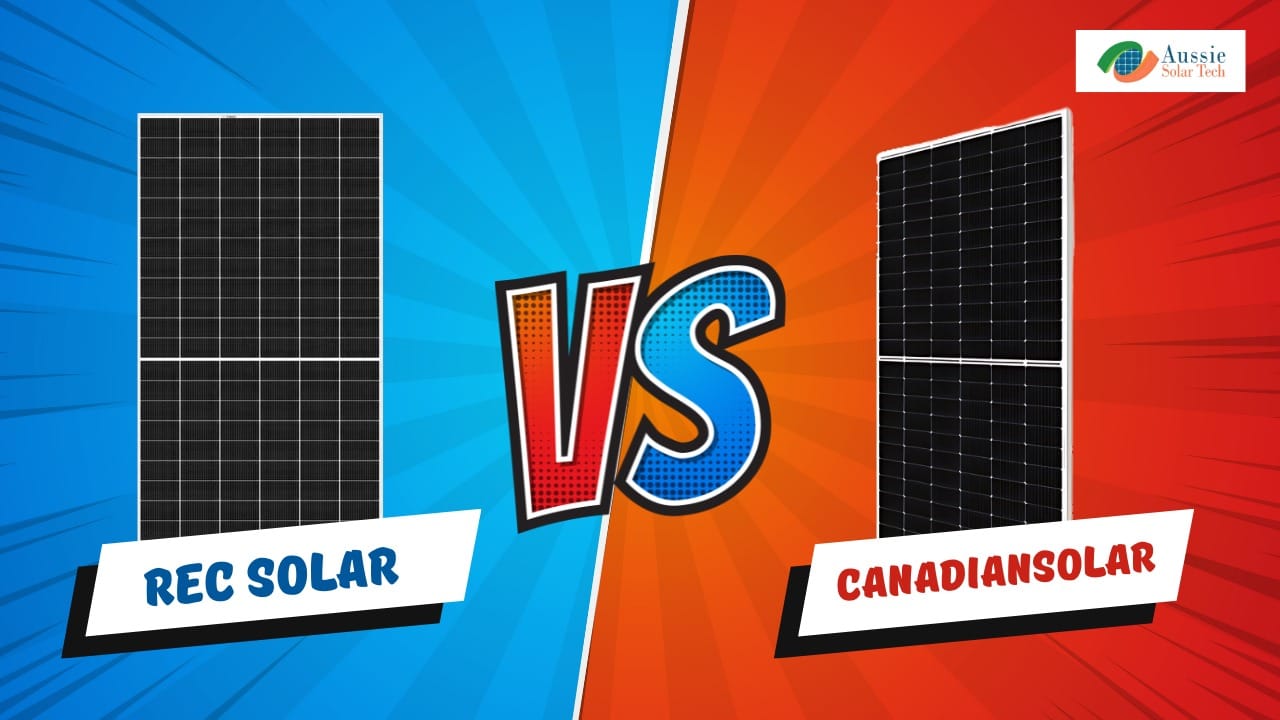
Choosing between Canadian Solar and REC Solar panels is one of the most important decisions Australian homeowners face when going solar. With over 4.22 million solar installations across Australia and the market growing at 14.47% annually, selecting the right panels can mean the difference between thousands of dollars in savings and disappointment.
This comprehensive guide compares Canadian Solar and REC Solar panels specifically for Australian conditions, including performance in Melbourne’s variable weather, Sydney’s coastal climate, Brisbane’s humidity, Perth’s intense heat, and Adelaide’s temperature extremes.
Quick Verdict for Australian Homeowners
Choose Canadian Solar if: You want excellent value for money, proven reliability, and competitive pricing ($4,000-$6,000 for a 6.6kW system). Perfect for budget-conscious families with adequate roof space.
Choose REC Solar if: You prioritize maximum efficiency, have limited roof space, face shading challenges, or want industry-leading warranties. Ideal for hot climates and premium quality seekers ($5,500-$8,500 for a 6.6kW system).
Australian Solar Panel Pricing Comparison (Canadian Solar vs REC Panels)
System Costs Across Australia (Including STCs)
| System Size | Canadian Solar | REC Solar | Price Difference |
|---|---|---|---|
| 6.6kW System | $4,000 – $6,000 | $5,500 – $8,500 | +$1,500 – $2,500 |
| 10kW System | $7,500 – $9,500 | $10,000 – $13,000 | +$2,500 – $3,500 |
| 13.2kW System | $9,000 – $11,500 | $12,500 – $16,000 | +$3,500 – $4,500 |
| Per Watt Cost | $0.85 – $0.95/W | $1.10 – $1.30/W | +$0.25 – $0.35/W |
Important Note: All prices listed are approximate and subject to change. Please request a quote for the most accurate and up-to-date pricing.
Individual Panel Pricing
| Panel Model | Wattage | Retail Price | After STC Rebate |
|---|---|---|---|
| Canadian Solar HiKu6 | 440W | $152 | ~$15-17/panel |
| Canadian Solar TOPHiKu6 | 440W | $154 | ~$17/panel |
| REC Alpha Pure | 430W | $280-300 | ~$140-160/panel |
| REC Alpha Pure-RX | 450W | $300-320 | ~$160-180/panel |
Calculate Your Potential Savings
A typical 6.6kW system in Australia saves homeowners $1,000-$2,000+ per year on electricity bills
Payback Period: Canadian Solar: 4-6 years | REC Solar: 5-7 years
25-Year Savings: Canadian Solar: $25,000-$50,000 | REC Solar: $28,000-$55,000
Technical Specifications: Head-to-Head Comparison
Current Models Available in Australia
| Specification | Canadian Solar | REC Solar |
|---|---|---|
| Popular Models | HiKu6, TOPHiKu6, TOPBiHiKu7 | Alpha Pure, Alpha Pure-R, Alpha Pure-RX |
| Power Output Range | 395W – 725W | 400W – 470W (residential) |
| Maximum Efficiency | 22.5% (TOPHiKu6) | 22.6% (Alpha Pure-RX) |
| Cell Technology | N-Type TOPCon, PERC | Heterojunction (HJT) |
| Temperature Coefficient | -0.29%/°C (TOPCon) | -0.24 to -0.26%/°C |
| Annual Degradation | ~0.5-0.55% | 0.25% |
| Output After 25 Years | 84-87% | 92% (guaranteed) |
| Load Rating | 5,400 Pa wind / 2,400 Pa snow | 7,000 Pa (wind & snow) |
| Manufacturing | China, Indonesia, Vietnam | Singapore (REC Alpha series) |
| CEC Approved | Yes ✓ | Yes ✓ |
What These Specifications Mean for Australian Homeowners
Temperature Coefficient Matters in Australia
REC’s superior temperature coefficient (-0.24%/°C vs -0.29%/°C) means better performance during hot Australian summers. In Perth, where roof temperatures can exceed 65°C, this translates to 10-15% more power generation compared to standard panels during peak summer.
Load Ratings for Extreme Weather
Both brands exceed Australian building standards, but REC’s 7,000 Pa rating provides extra peace of mind in cyclone-prone areas (Queensland, Northern Territory) and regions experiencing severe hailstorms.
Australian Climate Performance Analysis
Performance in Different Australian Conditions
| Climate Condition | Canadian Solar | REC Solar | Winner |
|---|---|---|---|
| Extreme Heat (Perth, Alice Springs) | Good performance | Excellent – 15% better | ✓ REC |
| Coastal Salt Mist (Sydney, Gold Coast) | Good – salt mist tested | Excellent – superior sealing | ✓ REC |
| High Humidity (Brisbane, Darwin) | Good durability | Excellent – HJT technology | ✓ REC |
| Partial Shade (Tree coverage) | Good – half-cut cells | Excellent – 4-section design | ✓ REC (Pure-R) |
| Low-Light (Melbourne, Tasmania) | Good | Excellent – 90%+ efficiency | ✓ REC |
| Dust/Outback Conditions | Excellent | Excellent | Tie |
| Price-to-Performance Ratio | Excellent value | Premium quality | ✓ Canadian Solar |
Real-World Performance Data from Australian Installations
Perth (Extreme Heat Testing)
Summer Performance:
- Canadian Solar TOPHiKu6: 95% of rated capacity at 45°C
- REC Alpha Pure-RX: 98.5% of rated capacity at 45°C
On a typical 40°C Perth summer day, a 6.6kW REC system generates approximately 0.8-1.2 kWh more than Canadian Solar.
Melbourne (Variable Conditions)
Cloudy Day Performance:
- Canadian Solar: 65-70% of peak capacity
- REC Solar: 75-85% of peak capacity
REC’s superior low-light performance means better year-round energy production in Victoria’s variable climate.
Brisbane/Gold Coast (Humidity + Heat)
Both panels perform well, but REC’s heterojunction technology resists humidity-related degradation better over 25 years. Field data shows REC panels maintain 94-95% of original output after 10 years vs 90-92% for Canadian Solar in coastal Queensland.
Warranty Comparison: Australian Coverage
| Warranty Type | Canadian Solar | REC Solar |
|---|---|---|
| Product Warranty | 12-15 years (model dependent) | 20-25 years (with certified installer) |
| Performance Warranty | 25-30 years | 25 years |
| Labor Warranty | Not included | 25 years (ProTrust Warranty) |
| Year 25 Output Guarantee | 84.8-87.4% | 92% |
| First Year Degradation | Up to 2-3% | 0% (no LID) |
| Australian Support | Local presence, good | Excellent – certified network |
| Warranty Claim Process | Standard industry | Simplified with certified installers |
REC ProTrust Warranty Advantage
When installed by a REC Certified Solar Professional (available throughout Australia), you receive:
- 25-year product warranty (vs standard 20 years)
- 25-year labor warranty – covers removal, repair, and reinstallation costs
- 25-year performance guarantee at 92% output
- Simplified claims process through certified installer network
Estimated Value: Labor warranty alone can save $2,000-$5,000 over 25 years if panel service is needed.
Canadian Solar Warranty Value
While Canadian Solar’s warranties are shorter than REC’s premium offering, they still exceed industry standards and are backed by strong local Australian support. The company’s 20+ year track record and presence across 160+ countries provides confidence in long-term support.
Canadian Solar: Detailed Analysis for Australia
Advantages for Australian Homeowners
- Excellent value for money – 20-30% cheaper than REC
- Wide availability across all Australian states
- Proven track record with 125 GW installed globally
- Good efficiency (up to 22.5%) at competitive price
- Strong Australian presence and local support
- CEC approved and eligible for all Australian rebates
- Wide range of models for different needs/budgets
- TOPCon models offer premium performance at mid-range price
- 30-year warranty available on TOPCon models
- Excellent for large installations (commercial, farms)
Considerations
- Higher degradation rate than REC (0.5-0.55% vs 0.25% annually)
- Slightly lower performance in extreme heat
- No labor warranty included
- Made in China (some buyers prefer alternative manufacturing)
- Shorter product warranty (12-15 years vs REC’s 25)
- Standard models have higher temperature coefficient
Best Canadian Solar Models for Australian Conditions
1. Canadian Solar TOPHiKu6 (440-455W) – RECOMMENDED
Price: $4,500-$6,500 for 6.6kW system
Best for: Homeowners wanting premium N-Type performance at mid-range pricing
- 22.5% efficiency
- -0.29%/°C temperature coefficient
- 15-year product warranty
- 30-year performance warranty
- Excellent performance in hot climates
2. Canadian Solar HiKu6 (395-440W)
Price: $4,000-$5,500 for 6.6kW system
Best for: Budget-conscious buyers with adequate roof space
- 19.4-21.3% efficiency
- PERC technology
- 12-year product warranty
- 25-year performance warranty
- Proven reliability
REC Solar: Detailed Analysis for Australia
Advantages for Australian Homeowners
- Industry-leading 25-year comprehensive warranty (ProTrust)
- Exceptional hot climate performance (critical for Australia)
- Lowest degradation rate (0.25% annually)
- 92% output guaranteed after 25 years (vs 84-87% industry average)
- Superior shade tolerance with 4-section design (Pure-R)
- Excellent low-light performance (Melbourne, Tasmania)
- Lead-free construction (environmentally conscious)
- Zero Light-Induced Degradation (LID)
- Maximum efficiency (22.6%) – ideal for limited roof space
- Strong coastal performance (salt mist resistant)
- Premium build quality with 7,000 Pa load rating
Considerations
- Higher upfront cost (20-40% more than Canadian Solar)
- Requires certified installer for full ProTrust warranty
- Limited to residential/small commercial applications
- Premium pricing may not suit all budgets
- Availability may vary by region (check local installers)
Best REC Solar Models for Australian Conditions
1. REC Alpha Pure-RX (450-470W) – BEST PREMIUM CHOICE
Price: $6,500-$8,500 for 6.6kW system
Best for: Limited roof space, hot climates, maximum performance
- 22.6% efficiency (highest available)
- -0.24%/°C temperature coefficient
- 25-year product + labor warranty (ProTrust)
- 92% output at year 25
- Ideal for Perth, Darwin, Alice Springs
2. REC Alpha Pure-R (400-430W) – BEST FOR SHADE
Price: $6,000-$8,000 for 6.6kW system
Best for: Properties with partial shade, tree coverage
- 22.3% efficiency
- 4-section design for superior shade tolerance
- 25-year ProTrust warranty
- 15-25% better performance in shaded conditions
State-by-State Installation Guide & Recommendations
Queensland (Brisbane, Gold Coast, Cairns)
- Climate: Hot, humid, high UV
- Best Choice: REC Alpha Pure-RX
- Why: Superior heat tolerance, humidity resistance, excellent for coastal salt mist
- Average Daily Generation (6.6kW): 28-32 kWh
- Annual Savings: $1,400-$2,000
- Local Rebates: Interest-free loans available, battery incentives
New South Wales (Sydney, Newcastle, Wollongong)
- Climate: Temperate coastal, variable
- Best Choice: Either brand works well – budget determines choice
- Why: Balanced climate suits both; REC better for coastal areas
- Average Daily Generation (6.6kW): 24-28 kWh
- Annual Savings: $1,200-$1,800
- Local Rebates: Peak Demand Reduction Scheme, Empowering Homes program, battery rebates up to $2,400
Victoria (Melbourne, Geelong, Ballarat)
- Climate: Variable, cooler winters, moderate summers
- Best Choice: REC Alpha Pure (low-light performance)
- Why: Excellent cloudy-day generation, consistent output year-round
- Average Daily Generation (6.6kW): 22-26 kWh
- Annual Savings: $1,100-$1,600
- Local Rebates: Solar Victoria rebate up to $1,888, interest-free loans, battery rebates
Western Australia (Perth, Mandurah, Bunbury)
- Climate: Extreme heat, intense sunlight
- Best Choice: REC Alpha Pure-RX (heat performance)
- Why: Best temperature coefficient, maintains output in 40°C+ conditions
- Average Daily Generation (6.6kW): 30-35 kWh (highest in Australia)
- Annual Savings: $1,500-$2,200
- Local Rebates: Renewable Household Energy Scheme (interest-free loans up to $9,500)
South Australia (Adelaide, Port Augusta)
- Climate: Hot, dry summers, mild winters
- Best Choice: Canadian Solar TOPHiKu6 (great value)
- Why: Good heat performance at better price point
- Average Daily Generation (6.6kW): 26-30 kWh
- Annual Savings: $1,300-$1,900
- Local Rebates: Battery subsidy up to $6,000, low-interest green loans
Tasmania (Hobart, Launceston)
- Climate: Cool, variable, lower sunlight
- Best Choice: REC Alpha Pure (low-light efficiency)
- Why: Maximizes production during cloudy/overcast days
- Average Daily Generation (6.6kW): 18-22 kWh
- Annual Savings: $900-$1,400
- Local Rebates: Low-income loans, battery schemes
Northern Territory (Darwin, Alice Springs)
- Climate: Extreme heat, high humidity (Darwin), dry heat (Alice Springs)
- Best Choice: REC Alpha Pure-RX
- Why: Best heat/humidity performance, essential for NT conditions
- Average Daily Generation (6.6kW): 32-36 kWh
- Annual Savings: $1,600-$2,400
- Local Rebates: Territory-specific incentives, check current programs
Australian Capital Territory (Canberra)
- Climate: Cold winters, hot summers, variable
- Best Choice: Either brand – budget dependent
- Why: Moderate climate suits both options
- Average Daily Generation (6.6kW): 24-28 kWh
- Annual Savings: $1,200-$1,800
- Local Rebates: Sustainable Household Scheme (interest-free loans up to $15,000)
Australian Government Incentives & Rebates 2025
Federal Rebates (Australia-wide)
Small-scale Technology Certificates (STCs)
- Reduces upfront cost by approximately $2,500-$4,000 for typical 6.6kW system
- Calculated based on system size and location (solar zones)
- Applied at point of sale by CEC-approved installers
- Available for both Canadian Solar and REC Solar installations
- Important: STC value decreases annually, reducing by 2030
State-Specific Solar Rebates
| State/Territory | Rebate Program | Maximum Benefit | Eligibility |
|---|---|---|---|
| Victoria | Solar Victoria | Up to $1,888 rebate + interest-free loan | Combined household income under $210,000 |
| NSW | Empowering Homes | Interest-free loans up to $14,000 | Homeowners in eligible areas |
| Queensland | Battery Booster | Up to $3,000 for batteries | Existing solar system owners |
| WA | Renewable Energy Scheme | Interest-free loans up to $9,500 | WA residents |
| SA | Battery Subsidy | Up to $6,000 | Combined income under $100,000 |
| ACT | Sustainable Household Scheme | Interest-free loans up to $15,000 | ACT residents |
Important Notes on Rebates
- Rebate programs change frequently – always verify current eligibility
- Many rebates require installation by CEC-approved installers
- Some rebates have limited funding and operate on first-come, first-served basis
- Income limits and property value caps may apply
- REC ProTrust warranty may require certified installer (check compatibility with rebate programs)
Total Savings Calculation Example (6.6kW System in Melbourne)
Canadian Solar TOPHiKu6 System:
- Retail Price: $6,500
- Less STCs: -$2,800
- Less VIC Rebate: -$1,888
- Final Cost: $1,812
- Annual Savings: $1,400
- Payback: 1.3 years!
Installation Considerations for Australian Homes
Roof Space Requirements
| System Size | Panels Needed (440W) | Approx. Roof Space | Best Panel Choice |
|---|---|---|---|
| 6.6kW | 15-16 panels | 28-32 m² | Either brand suitable |
| 10kW | 22-24 panels | 42-46 m² | Canadian Solar (better value for large systems) |
| 13.2kW | 30 panels | 55-60 m² | Canadian Solar (cost-effective) |
| Limited space (<25 m²) | 12-14 high-efficiency panels | 22-26 m² | REC Alpha Pure-RX (maximum efficiency) |
Optimal Roof Orientation for Australian Locations
- Northern States (QLD, NT, Northern WA): North-facing roofs ideal, East-West also excellent due to high sun angle year-round
- Southern States (VIC, TAS, SA): North-facing critical for winter production, 15-30° tilt optimal
- Shaded Roofs: REC Alpha Pure-R recommended for best partial shade performance
Compatibility with Australian Inverters
Both Canadian Solar and REC panels are compatible with all major inverter brands available in Australia:
Final Verdict: Which Should You Choose?
Choose Canadian Solar TOPHiKu6 If You:
✓ Want excellent value for money (20-30% less than REC)
✓ Have adequate roof space (30m² or more for 6.6kW)
✓ Live in moderate climate zones (Sydney, Adelaide, Canberra)
✓ Are budget-conscious but still want quality tier-1 panels
✓ Need a large system (10kW+) for commercial/farm applications
✓ Want proven reliability from established manufacturer (125 GW installed)
✓ Are satisfied with 12-15 year product warranty
✓ Prefer competitive payback period (4-6 years)
Best Value Model: Canadian Solar TOPHiKu6 440W ($4,500-$6,500 for 6.6kW)
Choose REC Alpha Pure Series If You:
✓ Have limited roof space (need maximum efficiency)
✓ Live in extreme heat zones (Perth, Darwin, Alice Springs, Northern QLD)
✓ Face partial shading from trees or buildings
✓ Want industry-leading warranties (25 years product + labor)
✓ Prioritize long-term performance (92% output at year 25)
✓ Value environmental consciousness (lead-free panels)
✓ Are in coastal areas with salt mist exposure
✓ Can work with REC Certified installer for ProTrust warranty
✓ Want the absolute best performance regardless of price
✓ Appreciate superior low-light performance (Melbourne, Tasmania)
Best Premium Model: REC Alpha Pure-RX 450W ($6,500-$8,500 for 6.6kW)
The Hybrid Approach
Some savvy Australian homeowners optimize their investment by:
- Using REC panels on north-facing roof sections (maximum performance)
- Using Canadian Solar on east/west sections (good value for lower-priority areas)
- This hybrid approach balances cost with performance
Note: Consult with your installer about mixing panel brands – some inverter setups handle this better than others.
Quick Decision Matrix
If your priority is:
- Lowest upfront cost → Canadian Solar HiKu6
- Best value for money → Canadian Solar TOPHiKu6
- Maximum performance → REC Alpha Pure-RX
- Shade tolerance → REC Alpha Pure-R
- Extreme heat areas → REC Alpha Pure-RX
- Limited roof space → REC Alpha Pure-RX
- Large commercial system → Canadian Solar TOPBiHiKu7
- Best warranty → REC Alpha Pure series (ProTrust)
Frequently Asked Questions (FAQs)
Q: Which is better for Australian conditions – Canadian Solar or REC Solar?
Both brands are excellent and CEC-approved for Australian conditions. REC Solar performs better in extreme heat, partial shade, and limited roof space situations, making it ideal for Perth, Darwin, and areas with shading. Canadian Solar offers better value for money and is perfect for budget-conscious homeowners with adequate roof space. In moderate climates like Melbourne and Sydney, either brand works well – your choice depends on budget vs. premium features preference.
Q: How much do Canadian Solar and REC Solar panels cost in Australia in 2025?
For a typical 6.6kW system (after STC rebates): Canadian Solar costs $4,000-$6,000, while REC Solar costs $5,500-$8,500. Individual panel prices: Canadian Solar 440W panels cost approximately $15-17/panel after rebates, while REC Alpha Pure panels cost $140-180/panel after rebates. Prices vary by location, installer, and current promotions.
Q: Are Canadian Solar panels any good for hot Australian climates?
Yes, Canadian Solar panels (especially TOPCon models) perform well in hot climates with a temperature coefficient of -0.29%/°C. However, REC Solar panels perform even better with -0.24%/°C, meaning they lose less efficiency in extreme heat. In cities like Perth, Darwin, and Alice Springs where roof temperatures can exceed 65°C, this translates to approximately 10-15% more power generation with REC panels during peak summer.
Q: What’s the difference in warranties between Canadian Solar and REC Solar?
Canadian Solar offers 12-15 year product warranties and 25-30 year performance warranties. REC Solar offers superior coverage: 20-25 year product warranty, 25-year performance warranty, and a unique 25-year labor warranty (ProTrust) when installed by certified professionals. REC also guarantees 92% output after 25 years vs Canadian Solar’s 84-87%.
Q: Which solar panels are made in Australia?
Neither Canadian Solar nor REC Solar panels are manufactured in Australia. Canadian Solar panels are manufactured in China, Indonesia, and Vietnam. REC Alpha series panels are manufactured in Singapore. The only Australian-made panels currently available are from Tindo Solar (Adelaide), with 160MW annual capacity. However, both Canadian Solar and REC maintain strong Australian presence with local support and are fully CEC-approved.
Q: Do I need more or fewer panels with REC vs Canadian Solar?
Due to REC’s higher efficiency (up to 22.6% vs 22.5%), you may need 1-2 fewer panels to achieve the same system capacity. For example, a 6.6kW system might require 15 REC Alpha Pure-RX panels (440W each) vs 16 Canadian Solar panels. This makes REC ideal for limited roof space situations.
Q: Can I get government rebates for both Canadian Solar and REC Solar?
Yes! Both brands are CEC-approved and eligible for all Australian federal and state rebates, including STCs (Small-scale Technology Certificates), state-specific rebates (Victoria’s $1,888 rebate, NSW programs, etc.), and interest-free loans. The panel brand doesn’t affect rebate eligibility – what matters is CEC approval and using a certified installer.
Q: How long do Canadian Solar and REC Solar panels last in Australia?
Both brands are designed to last 30+ years. Canadian Solar guarantees 84-87% output after 25 years, while REC guarantees 92% output after 25 years. In Australian conditions (high UV, heat, humidity), both brands have proven durability. REC’s lower degradation rate (0.25% vs 0.5-0.55% annually) means better long-term performance, especially valuable given Australia’s harsh sun exposure.
Q: Which panels work better with battery storage systems?
Both Canadian Solar and REC Solar panels work excellently with all major battery systems available in Australia (Tesla Powerwall, LG Chem, BYD, Enphase, Sungrow, etc.). The choice of panels doesn’t affect battery compatibility – what matters is proper system design by your installer. Both brands are compatible with hybrid inverters needed for battery integration.
Q: Are REC Solar panels worth the extra cost?
REC panels are worth the premium if you: have limited roof space (higher efficiency), face extreme heat (better temperature coefficient), have partial shading (superior shade tolerance), want maximum long-term performance (92% at year 25), or value comprehensive warranty coverage (25-year labor warranty). For larger roofs in moderate climates with budget constraints, Canadian Solar offers excellent value.
Q: Which brand has better customer service in Australia?
Both brands maintain strong Australian presence. Canadian Solar has operated in Australia for 20+ years with local support teams. REC Solar operates through a certified installer network (REC Certified Solar Professionals) providing direct support channels. Both handle warranty claims through local distributors. Customer experiences are generally positive for both brands, though REC’s certified installer program may provide more streamlined service.
Q: Can these panels withstand Australian hailstorms and cyclones?
Yes, both brands exceed Australian standards. Canadian Solar panels are rated to 5,400 Pa wind load and 2,400 Pa snow/hail load. REC Solar panels have even higher ratings at 7,000 Pa for both wind and hail. Both have been tested to withstand 25mm hailstones at 23 m/s (82.8 km/h). For cyclone-prone areas (Queensland, NT), REC’s higher load rating provides additional peace of mind, though both meet building codes.

Shah Tarek is a Solar Energy Consultant with 10 years experience in solar system design and solar consultancy field at Australia. He is now a Director, Operation & Consultancy Division at Aussie Solar Tech, a leading Australian solar retailer and installer. Here he is writing informative and engaging solar content that educates the community on the benefits of solar power. His work supports Aussie Solar Tech’s mission to promote sustainable energy solutions and foster a greener future for Australia.





Seraphim Solar Panels Review: Efficiency, Reliability, and Value Unveiled

Talesun Solar Panels: Honest Review Before You Buy

Sungrow Battery VS Tesla Powerwall : Which is Best in Australia?

Leapton Solar Panels Review: Affordable Energy Solution

REC Solar Panels Review: Outstanding Efficiency & Durability

Best Hybrid Inverters for Home Solar Systems in 2025
Best Solar Battery In Australia 2026 — Complete Guide

Sigenergy VS Fox ESS Battery: Which is The Best Choice for 2026

How Much Do Solar Panel Costs in Australia? (2026 Price Guide)

