
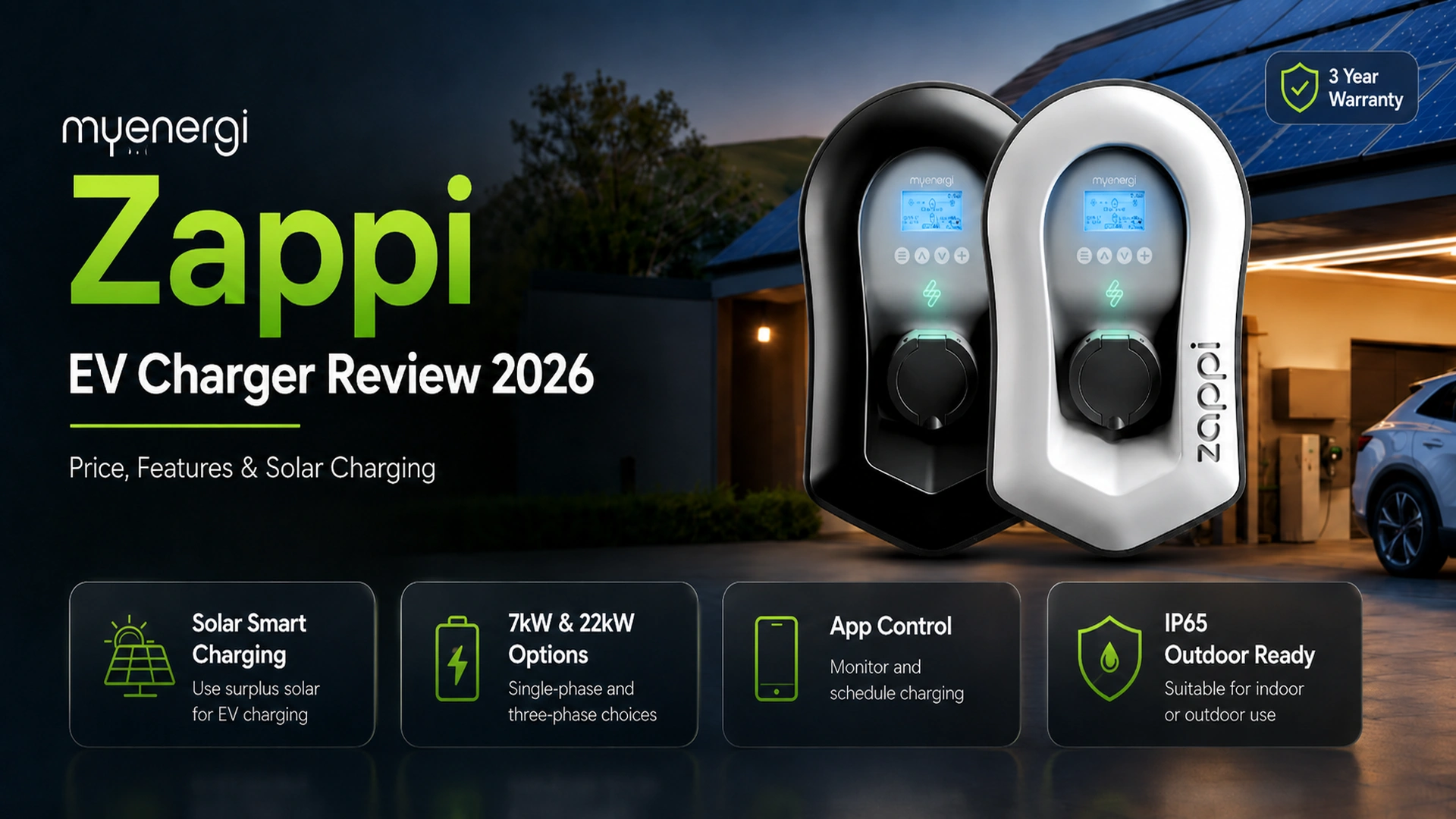
Choosing the right home EV charger is not only about how quickly it can charge your car. Australian homeowners also need to think about solar compatibility, the type of electrical supply at the property, app control, cable options, installation requirements and the overall cost.
This myenergi Zappi EV Charger review looks at the Zappi GLO and Zappi multiphase models, including their solar charging features, everyday performance, Australian pricing, charging times, warranty and installation needs. For anyone planning a myenergi Zappi EV charger Australia installation, one of Zappi’s biggest advantages is its ability to use surplus rooftop solar without requiring a matching solar inverter brand.
Myenergi Zappi EV Charger: Quick Verdict
The Zappi EV charger is a smart AC wall charger for homes with or without rooftop solar. It can charge from the grid like a standard wallbox, while its CT-based monitoring can also direct available surplus solar to the vehicle.
| Category | What buyers should know |
| Current options | Zappi GLO and Zappi multiphase |
| Charging output | Up to 7 kW single-phase or 22 kW three-phase |
| Solar charging | Yes, using CT-based energy monitoring |
| Connector | Type 2 tethered or untethered |
| Tethered cable | 6.5 metres |
| App control | Yes |
| Protection rating | IP65 |
| Operating temperature | -25°C to +40°C |
| Product warranty | 3 years |
| Zappi GLO starting price | A$1,245 |
| Zappi multiphase starting price | A$1,545 |
| Standard installation guide | A$700–A$1,500 |
| Best suited to | Solar homes wanting flexible energy control |
| Main limitations | Premium price, 3-year warranty and +40°C operating limit |
Zappi offers the greatest value when an EV is regularly parked at home during daylight hours. It also works without solar and can be scheduled for lower-cost grid charging.
Zappi GLO vs Zappi Multiphase
The current range includes the compact Zappi GLO and the more flexible Zappi multiphase. The right choice depends on the property’s electrical supply, the EV’s onboard AC charging limit and whether the buyer prefers app-based control or an on-unit display.
| Feature | Zappi GLO | Zappi multiphase |
| Maximum charging output | Up to 7 kW single-phase | Up to 7 kW single-phase or 22 kW three-phase |
| Rated current | Up to 32 A | Up to 32 A |
| User interface | Screen-free; managed mainly through the app | Built-in display and buttons, plus app control |
| Charging operation | Smart Charging and Charge Now | ECO, ECO+ and FAST |
| Connector options | Type 2 tethered or untethered | Type 2 tethered or untethered |
| Tethered cable length | 6.5 metres | 6.5 metres |
| Dimensions | 350 × 170 × 160 mm | 438 × 282 × 122 mm |
| Network connection | Wi-Fi, Bluetooth and local radio communication | Wi-Fi and Ethernet |
| Access control | RFID Access Key | PIN-based control |
| Protection rating | IP65 | IP65 |
| Operating temperature | -25°C to +40°C | -25°C to +40°C |
| Standard warranty | 3 years | 3 years |
| Aussie Solar Tech starting price | From A$1,245 | From A$1,545 |
Zappi GLO is the simpler option for most standard single-phase homes. The multiphase model is better suited to three-phase properties, buyers who want physical controls and sites that can genuinely benefit from faster AC charging.
How Zappi Solar Charging Works
A Zappi solar EV charger uses CT clamps to track how electricity moves between your home and the grid. When your solar system produces more power than the house is using, Zappi can send that extra energy to the EV instead of exporting it.
Because the charger measures power at the switchboard, it can work with different solar inverter brands.
The multiphase model includes three charging modes:
- FAST: Charges at the highest available rate using solar power, grid electricity or both.
- ECO: Uses available solar and adds a small amount of grid power when needed to keep charging.
- ECO+: Gives priority to surplus solar and may pause charging when generation drops too low.
Single-phase charging usually needs around 1.4 kW to stay active. For three-phase charging, the minimum may be closer to 4.2 kW across all three phases.
Zappi GLO works a little differently. Instead of ECO, ECO+ and FAST, it uses Smart Charging. This allows the charger to respond to solar availability, charging schedules and compatible electricity tariffs. When faster charging is needed, Charge Now starts an immediate full-power session.
Key Features That Matter
7 kW and 22 kW Charging
The Zappi 7kW vs 22kW decision comes down to your home’s electrical supply and the charging capability of your EV. For most households, a 7 kW charger is more than enough to recharge the car overnight.
The 22 kW option is mainly suited to properties with three-phase power. Your EV must also support three-phase AC charging to use the full output. Even with a 22 kW charger installed, many vehicles will still charge at only 7 kW or 11 kW because of their onboard charger limit. Checking the vehicle specification first can help avoid paying for charging capacity you cannot use.
App Control and Smart Scheduling
The myenergi app gives owners a simple way to monitor charging, view household energy flow, adjust settings and create charging schedules.
This makes it easier to charge when rooftop solar is producing more electricity or when grid rates are lower. The app is particularly important for Zappi GLO because the charger does not have a built-in screen. The multiphase model offers both app control and physical controls on the unit.
Wi-Fi, Connectivity and OCPP
Zappi GLO supports Wi-Fi, Bluetooth and local radio communication. The multiphase model includes built-in Wi-Fi and Ethernet, so a separate Hub is not usually needed for standard online features.
OCPP support also allows the charger to connect with compatible third-party management platforms. This can be useful for monitoring usage, controlling access or handling selected billing functions in shared homes, workplaces and light-commercial locations.
Tethered and Untethered Options
Tethered Zappi models come with a 6.5-metre Type 2 charging cable. This is the more convenient option for everyday use because the cable is always attached and ready to plug into the vehicle.
Untethered models have a Type 2 socket instead. They offer a cleaner appearance and allow owners to choose their own cable, although the cable must be purchased separately and stored when it is not being used.
Dynamic Load Management
Zappi can monitor the amount of electricity being used throughout the home and reduce EV charging power when demand becomes too high. This can help prevent the property from exceeding its available electrical capacity while appliances such as air conditioners, ovens or electric hot-water systems are running.
Correct CT clamp positioning and system setup are important for this feature to work properly. Some properties may also require additional CT clamps or a harvi wireless monitoring device, especially when the charger is installed a long distance from the switchboard.
Indoor and Outdoor Installation
Both Zappi GLO and Zappi multiphase have an IP65 enclosure, making them suitable for indoor or outdoor installation.
Their listed operating temperature reaches a maximum of +40°C. In warmer parts of Australia, it is better to install the charger in a shaded and well-ventilated area rather than leaving it exposed to strong afternoon sunlight.
Warranty and Product Support
Zappi GLO and Zappi multiphase come with a standard 3-year product warranty. The installer may also provide a separate workmanship warranty covering the installation itself.
Before moving ahead, buyers should confirm whether product registration is needed, what labour costs are covered and who will handle a warranty claim if a problem occurs. Choosing a reliable installer with local after-sales support can be just as important as comparing the original purchase price.
Myenergi Zappi EV Charger Price in Australia
The myenergi Zappi EV charger price depends on the selected model, electrical phase and tethered or untethered configuration.
Aussie Solar Tech currently provides the following guide prices:
| Product or service | Current guide price |
| Zappi GLO charger | From A$1,245 |
| Zappi multiphase charger | From A$1,545 |
| Standard installation | Approximately A$700–A$1,500 |
The listed myenergi Zappi EV charger price is a starting guide, not a fixed installed-package cost. Your final quote may be higher if the installation requires a longer cable run, switchboard upgrades, trenching, extra CT monitoring, a custom mounting setup or three-phase electrical work.
Final price may vary based on location, installation requirements. Contact us for a personalized quote and expert advice.
Zappi EV Charger Charging Times
Charging time depends on the charger output, property supply, battery capacity and the EV’s onboard AC charger. The following empty-to-full estimates include a small allowance for typical AC charging losses.
| EV battery capacity | At 7 kW | At 11 kW | At 22 kW |
| 40 kWh | About 6.5 hours | About 4 hours | About 2 hours |
| 50 kWh | About 8 hours | About 5 hours | About 2.5 hours |
| 60 kWh | About 9.5 hours | About 6 hours | About 3 hours |
| 75 kWh | About 12 hours | About 7.5 hours | About 4 hours |
Actual charging may be slower if the EV cannot accept the charger’s maximum output. Solar-only charging can also take longer because the available power changes with sunlight and household consumption.
Most daily top-ups are shorter because drivers rarely arrive home with a completely empty battery.
Zappi EV Charger Installation Cost and Requirements
The Zappi EV charger installation cost is usually around A$700–A$1,500 for a standard installation through Aussie Solar Tech. The exact price depends on the property, the distance from the switchboard and the amount of electrical work required.
A standard installation may include:
- Checking whether the home has single-phase or three-phase power
- Reviewing the property’s available electrical capacity
- Installing a dedicated charging circuit and safety protection
- Mounting and wiring the charger
- Placing the CT sensors in the correct position
- Connecting the charger to the myenergi app
- Testing both solar and grid charging
- Providing the required electrical compliance documents
The final Zappi EV charger installation cost may be higher if the job involves a switchboard upgrade, a long cable run, trenching or extra monitoring equipment.
Professional installation is important for safety, accurate solar tracking and reliable day-to-day charging. Please request a quote for the most accurate and up-to-date pricing.
Pros and Cons
| Pros | Cons |
| Strong surplus-solar charging capability | Costs more than a basic grid-only charger |
| Works with different solar inverter brands | Standard product warranty is 3 years |
| Choice of GLO and multiphase models | Listed maximum operating temperature is +40°C |
| 7 kW and 22 kW options | 22 kW requires three-phase supply and compatible EV support |
| Tethered and untethered versions | Solar monitoring depends on correct CT configuration |
| App control and charging schedules | Some sites may require extra monitoring hardware |
| Dynamic load management | GLO has no built-in screen |
| OCPP support | Not an operational bidirectional V2H or V2G charger |
| IP65 indoor and outdoor protection | Premium features may be unnecessary for non-solar homes |
The main strengths are solar control, model flexibility and smart energy management. The main limitations are the premium price, average warranty length, careful commissioning requirements and heat-related installation considerations.
Who Is the Zappi EV Charger Best For?
A myenergi Zappi EV charger Australia installation is a good fit for households that want more control over how and when their EV is charged.
It is particularly suitable for:
- Homes with rooftop solar
- Drivers who can leave their EV plugged in during the day
- Households using time-of-use electricity plans
- Buyers who want the flexibility to charge from solar, the grid or both
- Three-phase homes that can make use of faster AC charging
- Users who want app monitoring and dynamic load management
- Shared homes, workplaces or small commercial sites that need controlled access
Zappi GLO is generally the better choice for a standard single-phase home, especially for buyers who prefer a compact design and app-based control. The multiphase model is more suitable for properties with three-phase power or for drivers who can genuinely benefit from charging above 7 kW.
For homes without solar, or for drivers who only charge overnight using grid electricity, a simpler and more affordable EV charger may offer better value.
Myenergi Zappi EV Charger Review: Final Verdict
This myenergi Zappi EV Charger review shows that Zappi is still a strong premium choice for Australian homes with rooftop solar. Its real value comes from combining everyday EV charging with surplus-solar use, smart scheduling, dynamic load management and a choice of 7 kW or 22 kW charging.
Zappi GLO is the simpler option for most single-phase homes, especially for buyers who prefer app-based control and a screen-free design. The multiphase model offers more flexibility and a higher possible charging output for suitable three-phase properties.
The Zappi solar EV charger makes the most sense when the vehicle is often parked at home during the day and the owner plans to use its solar and smart-energy features regularly.
The 3-year warranty, +40°C operating limit and possibility of extra installation work are worth considering. However, for households that want to use more of their rooftop solar and rely less on grid electricity, Zappi can still be a worthwhile long-term investment.
Aussie Solar Tech can assess your EV, solar system, electrical supply and preferred charging location before recommending the most suitable Zappi model and installation setup.
Contact Aussie Solar Tech today for a personalized quote and professional EV charger installation.
Frequently Asked Questions
What is the myenergi Zappi EV charger price?
Prices start from A$1,245 for Zappi GLO and A$1,545 for Zappi multiphase. Standard installation is approximately A$700–A$1,500, depending on the property and required electrical work.
Is 7 kW or 22 kW better?
A 7 kW charger is sufficient for most overnight residential charging. A 22 kW model is useful only when the property has suitable three-phase power and the EV can accept higher-rate three-phase AC charging.
Is Zappi EV charger compatible with Tesla, BYD and other EVs?
Zappi uses a Type 2 connection, which suits most modern electric vehicles sold in Australia. The actual charging speed depends on the vehicle’s onboard AC charger.
Can Zappi charge an EV using solar only?
Yes. The multiphase model’s ECO+ mode can prioritise surplus solar and pause charging when insufficient renewable energy is available. GLO uses Smart Charging to respond to solar availability, schedules and tariff settings.
Does the latest Zappi need a separate Hub?
Current connected models include built-in internet connectivity, so a separate Hub is not normally required for their main app-connected functions. A Hub may still be relevant when integrating some older myenergi devices.

Shah Tarek is a Solar Energy Consultant with 10 years experience in solar system design and solar consultancy field at Australia. He is now a Director, Operation & Consultancy Division at Aussie Solar Tech, a leading Australian solar retailer and installer. Here he is writing informative and engaging solar content that educates the community on the benefits of solar power. His work supports Aussie Solar Tech’s mission to promote sustainable energy solutions and foster a greener future for Australia.







Seraphim Solar Panels Review: Efficiency, Reliability, and Value Unveiled

Talesun Solar Panels: Honest Review Before You Buy

Sungrow Battery VS Tesla Powerwall : Which is Best in Australia?

Leapton Solar Panels Review: Affordable Energy Solution

REC Solar Panels Review: Outstanding Efficiency & Durability

Best Hybrid Inverters for Home Solar Systems in 2025

Best Solar Battery In Australia 2026 — Complete Guide

Sigenergy VS Fox ESS Battery: Which is The Best Choice for 2026

How Much Do Solar Panel Costs in Australia? (2026 Price Guide)

