
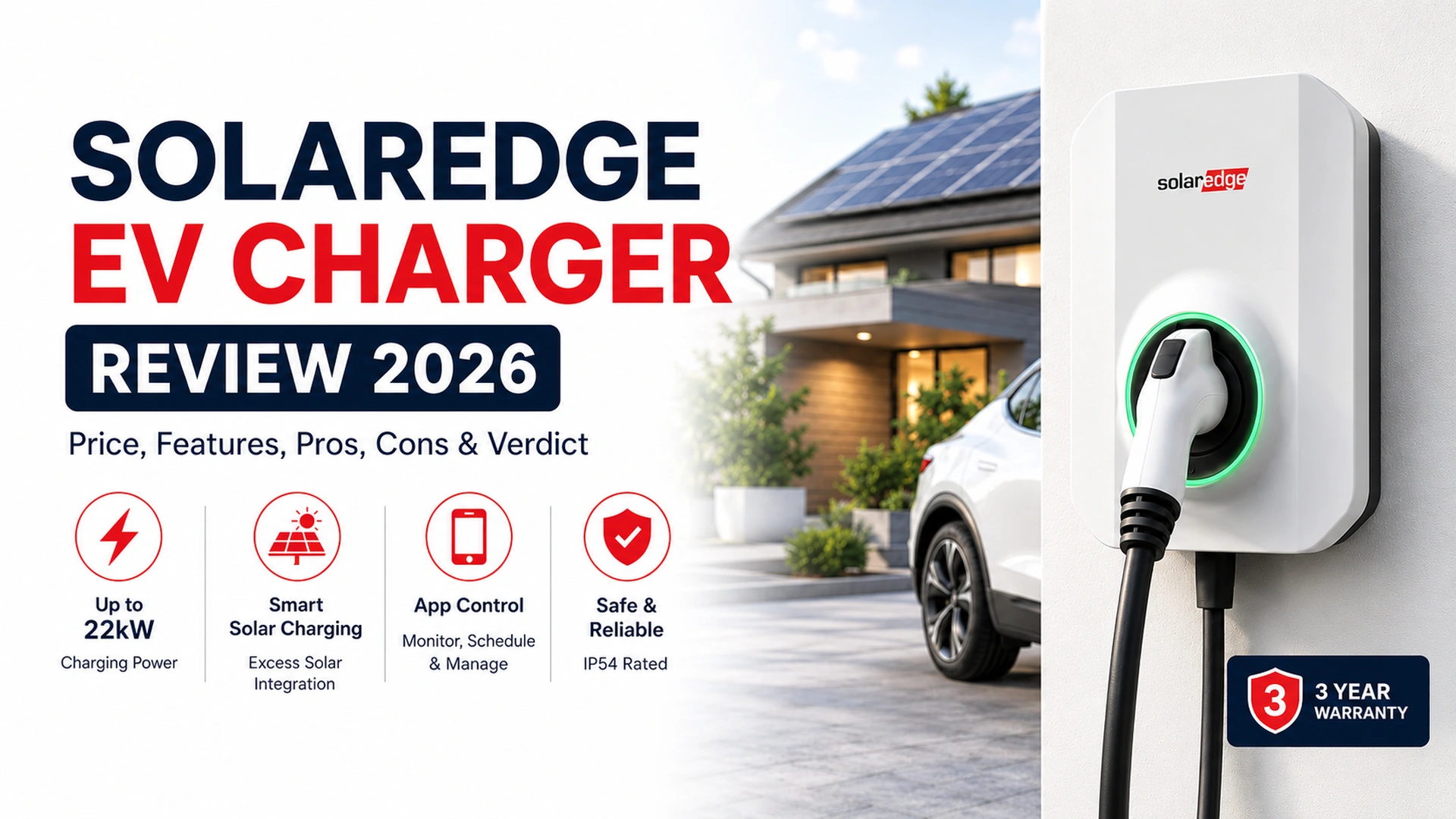
Choosing the right home EV charger involves more than simply looking at charging speed. Australian solar homeowners also need to think about surplus-solar charging, app control, electrical capacity, installation requirements and how well the charger works with their existing energy system.
This SolarEdge EV Charger review covers the available charging options, Australian pricing, key specifications, estimated charging times and overall suitability for different households. Its biggest advantage is the ability to connect with compatible SolarEdge inverters, meters, batteries and smart-energy equipment, allowing solar generation, household electricity use and EV charging to be managed within one connected system. For buyers comparing SolarEdge EV charger Australia options, the key considerations are charging output, solar compatibility, installation requirements and total installed cost.
SolarEdge EV Charger: Quick Verdict
| Category | Our assessment |
| Best suited to | Existing or future SolarEdge solar households |
| Older model output | Up to 7.4kW, single-phase |
| Newer model output | Up to 22kW, single- or three-phase |
| Solar charging | Yes, with compatible SolarEdge equipment |
| App control | Yes |
| Installation | Indoor or outdoor |
| Connector | Type 2 |
| Guide hardware price | AUD $1,300–$1,800 |
| Standard installation | AUD $800–$1,500 |
| Typical installed price | AUD $2,000–$3,000 |
| Official product warranty | 3 years |
| Main advantage | Strong solar and energy-system integration |
| Main limitation | Best value is generally achieved within a SolarEdge ecosystem |
| Overall verdict | A strong premium option for compatible SolarEdge homes |
The original model is rated at 7.4kW and 32A. The newer model supports single- and three-phase installations with output up to 22kW. The price figures above are current guide prices published for the 7.4kW residential charger and a standard installation.
SolarEdge EV Charger Overview
The SolarEdge EV Charger is a smart AC home charger designed to work with compatible SolarEdge solar and home-energy equipment. When the correct inverter, meter and communication setup are in place, it can help homeowners manage EV charging alongside their overall household energy use.
The system can:
- Use available excess solar for EV charging
- Set charging schedules
- Track charging history
- Start or stop charging remotely
- Adjust charging around household electricity demand
- Show EV charging data together with solar-production information
The original SolarEdge Home model can still provide normal EV charging without a SolarEdge solar system. However, controlled excess-solar charging requires a compatible SolarEdge inverter, an import/export meter and communication between the connected devices.
SolarEdge Home EV Charger vs SolarEdge ONE EV Charger
The older model is a 7.4kW single-phase charger. The newer generation supports single- and three-phase installations, automatic phase switching and maximum output up to 22kW.
| Feature | Older Home model | Newer ONE model |
| Model number | EVSA-32A-01 | EVN22B |
| Phase connection | Single-phase | Single- or three-phase |
| Maximum rated output | 7.4kW | Up to 22kW |
| Rated current | Up to 32A | 6–32A per phase |
| Connector | Type 2 cable | Type 2 socket |
| Tethered option | 7.6m cable kit | Available through cable-lock configuration |
| Excess-solar charging | Yes, with compatible inverter and meter | Yes |
| Automatic phase switching | No | Yes |
| App monitoring | mySolarEdge | SolarEdge apps |
| Wi-Fi | Yes | Yes |
| Ethernet | Yes | Yes |
| Bluetooth | Not listed | Yes |
| RFID authentication | No | Yes |
| OCPP 1.6J | No | Yes |
| Protection rating | IP54 | IP54 |
| Operating temperature | -30°C to +50°C | -30°C to +50°C |
| Product warranty | 3 years | 3 years |
The newer SolarEdge ONE EV Charger is the more flexible option for three-phase homes, multi-user sites and buyers who require OCPP or RFID. The original unit remains suitable for straightforward single-phase overnight charging.
Key Features of the SolarEdge EV Charger
SolarEdge Integration and Excess-Solar Charging
The charger works with compatible SolarEdge inverters, batteries and meters, allowing users to manage solar generation, household energy use and EV charging in one system. With the correct meter setup, extra rooftop solar can be used to charge the car instead of being exported to the grid.
7.4kW and 22kW Charging Options
The original model delivers up to 7.4kW on a 32A single-phase connection, making it suitable for overnight charging. The newer SolarEdge ONE EV Charger supports single- and three-phase power with output up to 22kW. Actual speed depends on the home’s power supply and the vehicle’s AC charging limit.
App Control and Smart Energy Management
The mySolarEdge app lets users monitor charging, set schedules and start or stop charging remotely. The newer model also includes load balancing and automatic phase switching.
Cable Length and Connector Options
The original charger is available with a 7.6-metre Type 2 cable. The newer model uses a Type 2 socket and can also be configured as a tethered charger. Buyers should confirm whether the cable is included in the quote.
Indoor and Outdoor Installation
Both models have an IP54 rating and can be installed indoors or outdoors. However, the charger should be placed away from flood-prone areas and excessive weather exposure.
Warranty and Support
Both charger generations include a three-year product warranty. Installation workmanship may have a separate installer warranty, so both should be confirmed before purchase.
SolarEdge EV Charger Price in Australia
The following guide prices apply to the 7.4kW residential model:
| Cost item | Guide price |
| Charger hardware | AUD $1,300–$1,800 |
| Standard installation | AUD $800–$1,500 |
| Typical installed cost | AUD $2,000–$3,000 |
The final cost may increase if the installation requires a switchboard upgrade, long cable run, trenching, three-phase work or additional metering.
Pricing for the newer 22kW model should be confirmed through a site-specific quote.
Price note: Final price may vary based on location and installation requirements.
SolarEdge EV Charger Charging Times
Charging time depends on the charger output, property supply, battery capacity and the vehicle’s onboard AC charging limit. Installing a 22kW wall charger does not guarantee that every vehicle will charge at 22kW. A vehicle limited to 7kW or 11kW AC charging will remain limited to that rate.
| EV battery capacity | At 7.4kW | At 11kW | At 22kW |
| 40kWh | About 6 hours | About 4 hours | About 2 hours |
| 50kWh | About 7.5 hours | About 5 hours | About 2.5 hours |
| 60kWh | About 9 hours | About 6 hours | About 3 hours |
| 75kWh | About 11.5 hours | About 7.5 hours | About 4 hours |
These are approximate empty-to-full times with an allowance for common AC charging losses. Daily top-ups are usually much shorter because most drivers do not arrive home with a completely empty battery.
The original charger provides up to 7.4kW, while the newer charger can provide up to 22kW on a suitable three-phase connection.
SolarEdge EV Charger Installation Cost
The SolarEdge EV charger installation cost varies depending on the condition of the switchboard, the distance between the charger and the electrical panel, the cable route and the amount of electrical work needed.
A typical installation may include:
- A site inspection and load assessment
- A dedicated circuit with the required protection
- Wall mounting and electrical wiring
- Meter or CT installation, where needed
- App and network setup
- System testing and commissioning
- Electrical compliance documentation
For a standard single-phase setup, installation generally costs around AUD $800–$1,500. The final price may be higher if the job requires a switchboard upgrade, trenching, a long cable run or three-phase electrical work.
The charger should always be installed and tested by a suitably licensed electrician.
Pros and Cons
| Pros | Cons |
| Strong integration with compatible SolarEdge equipment | Best value is mainly for existing SolarEdge owners |
| Supports surplus-solar charging | Additional metering may be required |
| App control, scheduling and monitoring | Installation can be more complex than a basic charger |
| 7.4kW model suits overnight home charging | Original model supports single-phase only |
| Newer model supports charging up to 22kW | Not every EV can accept 22kW AC charging |
| Automatic phase switching | Advanced features depend on system configuration |
| Dynamic load balancing | Official product warranty is three years |
| RFID and OCPP support on the newer model | Exact cable configuration must be confirmed |
Who Should Buy It?
A SolarEdge charger is most suitable for:
- Existing SolarEdge inverter owners
- Homes planning a SolarEdge solar and battery system
- Drivers who can charge during sunny daytime periods
- Households using time-of-use electricity tariffs
- Buyers who want integrated solar and EV monitoring
- Three-phase homes with a compatible EV
- Multi-EV households
- Selected commercial sites requiring RFID or OCPP
For a compatible SolarEdge household, integrated solar charging, app control and energy management can justify the premium price.
Homes using another inverter brand may not receive the full value of its ecosystem features. Those buyers should compare total installed cost, warranty, solar-diversion capability and compatibility with other home-charging options.
SolarEdge EV Charger Review: Final Verdict
The SolarEdge EV Charger is a high-quality smart charging solution for Australian homes. It offers surplus-solar charging, app-based monitoring, Type 2 compatibility and strong integration with compatible SolarEdge inverters, batteries and home-energy equipment.
Its biggest strengths are solar optimization, smart scheduling and connected energy management. The original 7.4kW model is well suited to standard single-phase overnight charging, while the newer model supports three-phase charging up to 22kW, automatic phase switching, dynamic load balancing, OCPP and RFID.
The main downsides are the three-year product warranty and the potential for a higher or more complex installation cost. The advanced features also provide the most value for homeowners who already use, or plan to install, compatible SolarEdge equipment. However, for households that value smart solar charging and seamless SolarEdge ecosystem integration, it can be a worthwhile investment.
At Aussie Solar Tech, we can help you choose the right SolarEdge EV Charger for your vehicle, solar system and budget.
Contact us today for a free quote and expert advice.
Frequently Asked Questions
What is the typical cost of a SolarEdge EV Charger in Australia?
The 7.4kW charger typically costs around AUD $1,300–$1,800 for the hardware. A standard single-phase installation may cost AUD $800–$1,500, bringing the usual installed price to approximately AUD $2,000–$3,000. The final quote may be higher if switchboard upgrades, long cable runs, trenching or extra metering are required.
Can the charger work without a SolarEdge inverter?
The older charger can provide normal EV charging without a SolarEdge PV system. However, controlled excess-solar charging requires compatible metering and communication with a suitable SolarEdge inverter.
Is the SolarEdge EV Charger suitable for different EV brands?
Yes. It uses a Type 2 AC connection, which is compatible with most electric vehicles available in Australia. However, charging speed can vary between vehicles, so it is worth checking your EV’s charging port and maximum AC charging capacity before installation.
Can it be installed outdoors?
Yes. The official documents list an IP54 enclosure rating and suitability for indoor or outdoor installation. The selected location should still avoid flood risk, standing water and unnecessary severe exposure.
Is 7.4kW enough for home charging?
For many drivers, 7.4kW is sufficient for overnight charging and regular daily top-ups. A 22kW unit is most beneficial when the property has a suitable three-phase supply, and the vehicle can accept a higher three-phase AC rate.
Where can I find the SolarEdge EV Charger installation manual?
The official SolarEdge EV Charger installation manual is available through the SolarEdge Knowledge Center. It covers mounting, electrical connections, communication setup, commissioning and safety requirements. Installation should be completed by a suitably licensed electrical professional.

Shah Tarek is a Solar Energy Consultant with 10 years experience in solar system design and solar consultancy field at Australia. He is now a Director, Operation & Consultancy Division at Aussie Solar Tech, a leading Australian solar retailer and installer. Here he is writing informative and engaging solar content that educates the community on the benefits of solar power. His work supports Aussie Solar Tech’s mission to promote sustainable energy solutions and foster a greener future for Australia.





Seraphim Solar Panels Review: Efficiency, Reliability, and Value Unveiled

Talesun Solar Panels: Honest Review Before You Buy

Sungrow Battery VS Tesla Powerwall : Which is Best in Australia?

Leapton Solar Panels Review: Affordable Energy Solution

REC Solar Panels Review: Outstanding Efficiency & Durability

Best Hybrid Inverters for Home Solar Systems in 2025
Best Solar Battery In Australia 2026 — Complete Guide

Sigenergy VS Fox ESS Battery: Which is The Best Choice for 2026

How Much Do Solar Panel Costs in Australia? (2026 Price Guide)

