
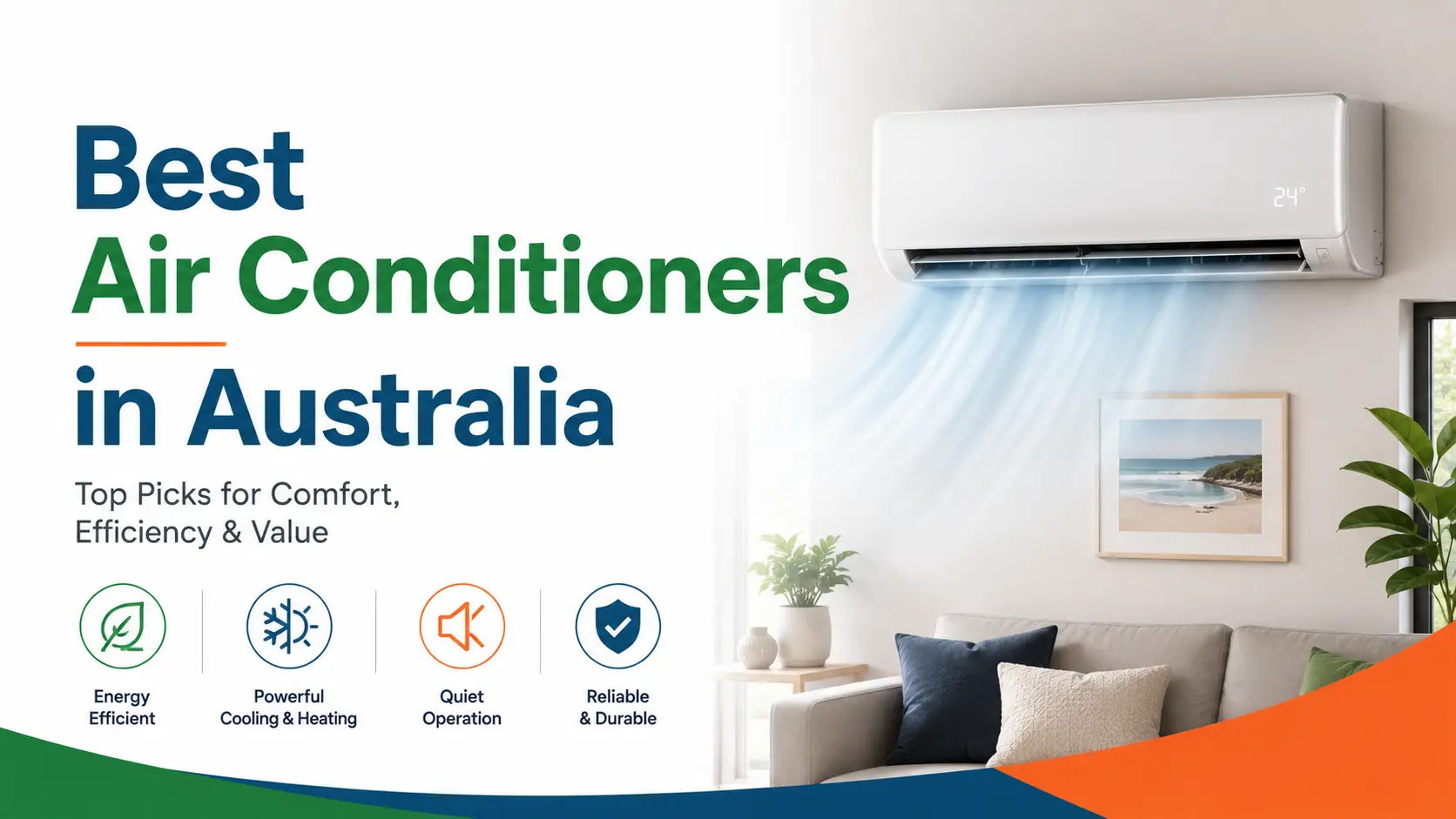
We live in an era of aggressive advertising, and that has made buying electronic appliances like ACs more challenging than ever. The retailers you talk to are not necessarily looking for your best interest. Instead, they are mostly trying to sell off what’s in their stock. Therefore, if the common buyer doesn’t do their own research, chances are high that they will end up paying for something that isn’t a fit for his needs.
To help our readers, we have compiled a list of the best air conditioners in Australia. For a disclaimer, yes, we do sell some of these brands. However, you will also notice many of the models we talk about in this list are not even in our stock. So, this is by no way a sales post. Instead, we have tried our best here to provide a totally unbiased review about brands and models our team had firsthand experience with. Find out more in the following discussion.
Top 6 Air Conditioners in Australia 2026
There are actually two lists here. The first three- Mitsubishi Electric, Fujitsu General, and Daikin- are brands almost everyone knows. Ask a few installers for quotes, and these names will surely come up again and again. They also frequently appear across the lists of best air conditioners in Australia. Each of these brands have their unique focus or specialty. We have tried to address that in detail so the reader can decide which one is best for their specific needs.
The other three – Toshiba, Hitachi, and Haier- are good air conditioners. We put them here because they have excellent features, robust warranties, and provide value-for-money. However, there is not that much hype surrounding them like the first three. And that can work to your advantage since you are more likely to negotiate a lower price on them compared to the high-demand brands.
You should also keep in mind that the prices we mention here are what is most commonly found listed for these models across online stores in 2026. It’s best to consider them as approximate prices, not exact numbers. You might hear a different figure depending on the retailer you are talking to. Still, they shouldn’t be wildly different from what we stated here.
Mitsubishi Electric
Mitsubishi has been serving Australian homes for 50 years. The brand focuses on noise reduction and energy efficiency when designing their ACs. They offer excellent after-sales service and spare-parts support. Take note that Mitsubishi Electric is a separate manufacturer from Mitsubishi Heavy Industries.
Current popular models in Australia
Single-room / budget: MSZ-AP25VGD (2.5kW)
This is Mitsubishi Electric’s most popular AP-series entry model. The Air Conditioner is typically priced around $1,050–$1,250 before installation. There are two variants on the market: the base VGD model and the VGKD model.
The variation becomes important if you are buying from old stock, which is sometimes the case if you are using an online retailer. Many VGD models before 2026 don’t have a built-in Wifi adapter, unlike the VGKD. So you might want to clear this up with your retailer before making a purchase.
Single-room / high-end: MSZ-LN Series
This is the true premium tier within the wall-split range. It has features like plasma filtration, a more refined cabinet design, and more advanced sensors. The model is in the $2,000–$3,000+ bracket depending on capacity.
For many buyers, the LN’s design premium isn’t a priority. Function is good enough for them. In that case, the large-capacity end of the standard MSZ-AP series (6–7.8kW models, for bigger rooms and open-plan areas) is a more affordable way to get high output from the same reliable line, typically sitting in the $1,300–$2,400 range.
Whole-of-house
Mitsubishi Electric also offers ducted reverse-cycle systems installed through roof cavities for whole-home zoned climate control. These are distinct from the single-room wall-mounted split systems above. The pricing for ducted setups typically starts well into five figures once installation is included, and depends heavily on the number of zones.
What makes it special?- Excellent Noise Reduction
The reason Mitsubishi is on top of this list is that they make the quietest Air Conditioners in the market, as far as we know. No matter how flashy an AC is, noisiness can hamper sleep quality and your overall comfort. So, that’s the feature we prioritized.
According to Mitsubishi Electric, the MSZ-AP series’ standout feature is its Quiet Mode. It drops indoor noise to as low as 18 dB(A) in heating mode on the smaller models. As per the brand’s marketing copy, the AC is so quiet that “you’ll check to see if it’s on.”
This is paired with Dual Barrier Coating, which reduces dust and grease build-up on internal surfaces, keeping the unit cleaner for longer with less manual maintenance.
Apart from noise, Mitsubishi’s air conditioners are also focused on reducing your electric bills. These AC’s feature a Full DC inverter compressor. This continuously adjusts speed rather than cycling on/off. As a result, it can hold a steadier room temperature while cutting running costs.
There is also an i-save Mode, which is a one-button preset that recalls your preferred energy-saving temperature settings. Meanwhile, Night Mode dims the indicator light, mutes beeps, and limits outdoor unit noise for undisturbed sleep.
Lastly, you can control your AC via wifi using the Mitsubishi Electric Wi-Fi Control app.
Pros
- Exceptionally quiet operation, especially in bedrooms
- Strong, well-established local parts and service network
- Consistent, positive long-term reliability feedback from owners
- Wide capacity range covering single rooms through to full ducted systems
Cons
- Premium features (like MSZ-LN’s plasma filters) come at a noticeable price step-up.
- Some installers report longer wait times for parts on older or niche models.
Fujitsu General
Fujitsu General Australia is one of the most widely stocked brands in Australia. The brand insists on being a dedicated air conditioning specialist rather than a broad consumer electronics company. Its current residential range covers the Lifestyle series, Lifestyle Next, and the more basic Comfort range, plus ducted options for whole-home control.
The common consensus regarding Fujitsu is that it is not flashy, but a dependable brand that offers competitively priced products and is trusted by installers who recommend what they know will hold up.
Current popular models in Australia
Single-room / budget: Comfort range, ASTH09KNCA (2.5kW)
The model typically retails around $850–$1,100 (supply only), Fujitsu’s accessible entry point for smaller bedrooms and studies.
Single-room / high-end: Lifestyle Next series
This is Fujitsu’s smartest, most feature-rich wall-split tier with built-in Wi-Fi as standard on most models. A 5.0kW Lifestyle unit commonly lists around $1,500–$1,800 (supply only), with larger units climbing toward $3,000–4,000.
Whole-of-house
Fujitsu’s ducted systems support zone control across typically two to eight zones. This lets you condition only the rooms in use, which is a meaningfully different (and pricier) investment than a single wall-split unit.
What makes it special?- Energy Saving
We put Fujitsu’s ACs in number two for their focus on energy saving. Fujitsu’s marketing proudly highlights their Human Sensor Control. This system detects when a room has been vacated and automatically throttles the unit’s output to save power.
It’s a genuinely useful feature for households with children where they might forget to turn the AC off. Fujitsu pairs this feature with a dedicated Economy Mode that caps power draw while still holding a comfortable set temperature.
Fujitsu’s ACs also have a Weekly timer. You can use it to schedule different settings for different days. The units have Corrosion-resistant outdoor coatings. It makes them fit for coastal Australian conditions where salt air degrades unprotected units faster. A 5-year parts and labour warranty is standard across most of the range.
Their Compact indoor unit design is useful in smaller rooms where a bulky head unit is a dealbreaker. You can use the WiFi app for remote scheduling and monitoring via smartphone.
Pros
- Strong value relative to premium Japanese competitors
- Human Sensor and Economy Mode genuinely reduce running costs.
- Broad range spanning budget to premium within one brand
- Well regarded for coastal corrosion resistance.
Cons
- Wi-Fi is not standard on the base Comfort or Lifestyle ranges (Lifestyle Next only)
- Owner reviews are mixed on long-term coil reliability in some regions.
Daikin
Daikin is commonly the number one on most top AC lists in Australia. It’s been voted the country’s most trusted air conditioner brand for four consecutive years (2023–2026) in the Reader’s Digest Australia Trusted Brands Awards. This was based on feedback from over 4,300 Australians.
The brand was also named top-performing split system air conditioner at the 2025 Finder Retail Awards. The company has been “heating and cooling Australian homes for over 50 years.”
Current popular models in Australia
Single-room / budget: Lite series
Daikin’s most affordable range, priced roughly $795–$1,700 depending on capacity (2–7.1kW). This model offers the brand’s quality and R32 refrigerant tech without the premium-tier extras.
Single-room / high-end: Alira X
This one is Daikin’s current premium wall-split flagship. It replaces the older Ururu Sarara (US7) line, which has been phased out of the active Australian dealer network. Alira X pairs Streamer air-purification technology with built-in Wi-Fi and a mould-proof operation mode. Typical pricing is $1,150–$1,300 for a 2.5kW unit, which climbs to around $2,025 for a 7.1kW model. It’s a genuinely premium unit, but without the older US7’s humidify/dehumidify functions.
Whole-of-house
Daikin also offers a wide ducted lineup (Inverter Ducted, Premium Inverter, FBA Slimline) for whole-home zoned control. This lineup is separate from its wall-split single-room range like Cora and Zena.
What makes it special?- Air Purification
If air purification is what matters to you, then this is the one to go for. Daikin carries the only split system that has a Sensitive Choice approval from the National Asthma Council Australia (blue butterfly symbol).
According to Daikin, Alira X’s standout is its Streamer Technology. This is a high-power plasma discharge that generates high-speed electrons to break down odours, bacteria, and pollutants like formaldehyde delivered through three layers of filtration.
These ACs also have Flash Streamer technology, which breaks down odours, allergens, and airborne chemicals as part of purification. Alira X’s Mould-proof operation activates for an hour after cooling or drying to prevent mould and odour build-up in the unit itself.
Daikin focuses on energy saving with its 2-Area Intelligent Eye human-presence sensor. The system detects when you’ve left the room and automatically shifts to energy-saving mode. This sensor can also direct airflow either towards or away from you depending on what’s more comfortable.
The models also feature Coanda Airflow, which are discharge louvres designed to send air along the ceiling for a longer, more even throw across the room.
Pros
- Strongest brand-trust track record in the Australian market
- Alira X offers genuinely strong air-purification tech most competitors don’t match.
- Wide dealer network with dedicated after-sales technical support line
- Asthma Council Sensitive Choice accreditation
Cons
- Focus on specialist distribution can limit direct retail price competition on premium models.
- Alira X carries a price premium over Daikin’s Cora/Zena tiers for the added air-quality features.
- Some owner reviews cite inconsistent servicing experiences depending on the installer.
Toshiba
Toshiba was the first company in the world to incorporate inverter technology into an air conditioner. It launched its first inverter unit back in 1981. That single innovation is now the foundation of virtually every energy-efficient air conditioner sold globally, including those from the competing brands above.
The brand’s Australian footprint is noticeably smaller than the other brands on this list, and there isn’t a dedicated local Toshiba arm. So, you can find a Toshiba AC if you want to, since a decent number of wholesalers around the country stock it. However, it’s genuinely uncommon for an installer to suggest it as their go-to option the way they would Daikin or Fujitsu.
Current popular models in Australia
Single-room / budget: Seiya Plus, RAS-B10E2KVG-A (2.5kW)
This is Toshiba’s current-generation entry-level split system. Its predecessor was the older Seiya Classic. Price ranges from $800 to $3,500 AUD depending on the capacity.
Single-room / high-end: Shorai Edge
Toshiba’s premium mid-range tier. The model features Ultra-Pure PM2.5 filtration and 3D Airflow across six directional patterns; pricing climbs into the low- to mid-$2,000s for larger capacities. The design-focused Haori (with interchangeable fabric covers in six colours) sits at a similar premium level for buyers prioritising aesthetics.
Whole-of-house
Toshiba’s inverter ducted systems support T-Zone Air control across up to 14 zones – a notably granular level of zoning compared to some competitors.
What makes it special?- Long Lastingness
We put this on the list for the brand’s expected long-lastingness. For instance, Toshiba’s standout claim is its 7-year parts and labour warranty on all residential air conditioners. It’s significantly longer than the 5-year coverage most competing brands offer, and a genuine vote of confidence from the manufacturer in its own build quality.
The AC’s engineering also backs this up. For instance, Toshiba’s popular models feature a Magic Coil, which is an acrylic resin-coated evaporator coil. It reduces dust, water, and mould accumulation over time, extending the practical lifespan of the unit.
Toshiba also has excellent energy-saving and purification features. For example, the Twin-Rotary Compressor reduces energy loss and noise through more accurate, stable rotation. Meanwhile it’s Ultra-Pure filter (Shorai Edge) captures up to 94% of PM2.5 fine particulate matter.
The Seiya model has an Outdoor noise reduction function that specifically targets a quieter outdoor unit alongside its indoor Quiet function. A distinctly Australian-conditions design choice in these ACs is the Perforated PCB housing on outdoor units, which keeps insects and small animals out of the electronics.
Pros
- Longest standard warranty (7 years) among mainstream competitors on this list
- Genuine engineering pedigree as the inventor of inverter AC technology
- Magic Coil meaningfully reduces mould/dust build-up over time.
- Competitive pricing relative to warranty length and feature set
Cons
- Lower brand recognition means fewer installers stock it as their default option.
- Fewer independent user feedback available compared to the big three
- Smart/Wi-Fi features are less mature than Daikin or Mitsubishi Electric’s apps.
Hitachi
Hitachi Cooling & Heating is a global joint venture with Johnson Controls. In Australia, the products are exclusively distributed, supported, and warranted by Temperzone Australia. Hitachi has a real, established presence in the country, clearly wider than Toshiba’s, and you’ll find it stocked at a fair number of wholesalers and installers around the country. It’s still noticeably smaller than Daikin, Fujitsu, or Mitsubishi Electric.
Current popular models in Australia
Single-room / budget: airHome 400, RAK-DJ25PHAT (2.5kW)
It is commonly listed around $795–$999 (supply only), undercutting most competitors’ entry-tier units at the same capacity.
Single-room / high-end:airHome 600
The prmium tier, adding built-in Wi-Fi, deeper multi-stage purification (AQtiv-Ion, ViroSense Z1), SleepSense automation, and Smart Eco motion sensing; pricing runs meaningfully above the 400 series, generally into the low-to-mid $2,000s for larger capacities.
Whole-of-house: Hitachi’s airCore 700
Hitachi’s ducted range delivers high-static reverse-cycle whole-home systems, priced from roughly $3,600 up to $6,000 depending on capacity (7.2kW–16kW) — a distinct category from the single-room wall-split airHome range.
What makes it special?- Self-cleaning
Hitachi’s headline technology is FrostWash. It’s a self-cleaning process that freezes the heat exchanger coil, lifts trapped dust, mould, and bacteria as the frost forms. Afterward, it melts and flushes it away hygienically through the drain pan.
According to Hitachi’s own lab testing, units without FrostWash experienced an 18% drop in airflow performance over a simulated two years of use, compared to just a 6% drop in units with FrostWash — a meaningful, measurable maintenance advantage.
Hitachi also has excellent air purification features. Its ViroSense Z1 filter (airHome 600) is tested to reduce virus and bacteria particles on the heat exchanger.
Pros
- FrostWash is a genuinely lab-verified self-cleaning advantage over most competitors.
- Strong 6-year warranty, ahead of the 5-year industry standard
- Competitive entry-level pricing on the airHome 400 series
- Backed by Temperzone’s dedicated Australian warranty, spare parts, and technical support network
Cons
- Wi-Fi requires an optional airCloud adapter on the entry-level airHome 400 models (built-in on 600 series)
- Smaller Australian installer network than the big three, so shopping around takes more effort.
- Fewer long-term independent owner reviews to gauge reliability at scale.
Haier
Haier has built its Australian residential air conditioning presence around efficiency and value. The brand shows up in independent comparison data more often than Toshiba, Samsung, or LG, and it’s stocked by most air conditioning wholesalers around the country. It’s still seen as more of a value/budget pick than a first-choice premium recommendation, but it’s a genuinely mainstream option, not a fringe one.
Current popular models in Australia
Single-room / budget: Tempo M, AS25TBMHRA-SET (2.5kW)
Haier’s accessible entry point into reverse-cycle cooling and heating. It comes with built-in Wi-Fi and voice control included as standard rather than an optional extra. The Tempo M 2.5kW commonly retails around $798–$899 (supply only), undercutting most of the other budget-tier units on this list.
Single-room / high-end: Quartz Plus series
Haier’s step-up tier, adding more advanced efficiency and control features over the base Quartz range. The pricing sits above Tempo but generally below the premium tiers of Daikin or Mitsubishi Electric, reflecting Haier’s overall value positioning.
Whole-of-house
Haier’s multi-split and ducted options extend the same efficiency-first philosophy to whole-home setups, supported by Fisher & Paykel’s local footprint.
What makes it special?- Budget
Firstly, it’s a budget brand. Independent reviewers often highlight Haier’s strong energy efficiency relative to price as a clear differentiator.
Apart from that, this one is also big on Self-Cleaning. The Tempo M uses Self-Clean with Cold Expansion technology. The unit freezes moisture in the evaporator to trap dust, then melts the frost to flush it away, a similar principle to Hitachi’s FrostWash.
The self-cleaning is paired with a Blue Fin anti-corrosion coating on the heat exchanger. According to Haier, Blue Fin improves heat-exchange efficiency by around 40% compared to non-Blue Fin models while adding durability against corrosion.
Other features include Built-in Wi-Fi and voice control (Tempo M), which works with Google Home and Amazon Alexa and is standard rather than a premium-only extra. You also get a 5-year parts and labour warranty. This is confirmed directly on Haier’s Australian product pages, with local backing through Fisher & Paykel.
Pros
- Strong value-for-money positioning against premium competitors
- Genuine owner praise for quiet, quick heating performance
- Straightforward 5-year warranty backed by Fisher & Paykel locally
- Wi-Fi and voice control included as standard on the Tempo M, not a paid upgrade.
- Self-Clean (Cold Expansion) and Blue Fin anti-corrosion coating are genuine hygiene/durability features, not just marketing labels.
- Openly listed pricing across most wholesalers — no trade login or quote request needed to compare costs.
Cons
- SmartHQ companion app has recurring stability complaints in independent reviews.
- Some models have modest heating output — worth checking specs if winter performance matters to you.
- Shorter Australian air-conditioning track record than the long-established Japanese brands
- Smaller installer and service network than Daikin, Fujitsu, or Mitsubishi Electric
How the Six Compare
| Brand | Best Known For | Budget Model (approx. price*) | High-End Model (approx. price*) | Standard Warranty | Ducted Option? |
| Mitsubishi Electric | Whisper-quiet operation | MSZ-AP25VGD — $1,050–$1,250 | MSZ-LN Series — $2,000–$3,000+ (or large-capacity AP — $1,300–$2,400) | 5 years | Yes |
| Fujitsu General | Human Sensor energy saving | Comfort ASTH09KNCA — $850–$1,100 | Lifestyle Next — $1,500–$4,000 | 5 years (industry standard) | Yes |
| Daikin | Brand trust & Alira X’s air-purification tech | Lite series — $795–$1,700 | Alira X — $1,150–$1,300 (2.5kW), up to ~$2,025 (7.1kW) | 5 years | Yes |
| Toshiba | Longest warranty (7 yrs), inverter pedigree | Seiya Plus — Price from $800 to $3,500 AUD |
Shorai Edge — low–mid $2,000s | 7 years | Yes (T-Zone, 14 zones) |
| Hitachi | FrostWash self-cleaning coil | airHome 400 — $795–$999 | airHome 600 — low–mid $2,000s | 6 years | Yes (airCore 700) |
| Haier | Value-for-money efficiency, Self-Clean tech, transparent pricing | Tempo M — $798–$899 | Quartz Plus — mid-range pricing | 5 years (industry standard) | Yes |
The Verdict
- If quiet bedroom comfort is your top priority, Mitsubishi Electric is hard to beat.
- If you want a trusted, widely-installed all-rounder with a genuinely strong air-purification option, Daikin’s range (and especially the Alira X) stands out.
- If value and a straightforward budget purchase matter most, Fujitsu, Hitachi, and Haier all offer strong entry-level units under $1,100. Haier’s Tempo M is currently the cheapest of the bunch with fully open pricing, while Hitachi’s FrostWash and Toshiba’s 7-year warranty each give a specific, tangible reason to look past the bigger names.
There’s no single “best” brand here — the right choice depends on whether you’re prioritising silence, air quality, warranty length, or upfront cost. However, if you are still having a hard time deciding between these or have some other brand in mind, feel free to contact us with your queries. Aussie Solar also features a wide selection of Air Conditioners from which you might find what you are looking for.
Tips to Find the Best Air Conditioner for Your Home
Don’t trust this list and want to do your own research before buying an AC? Well, we encourage you to do so. Here’s a list of tips that can help you to narrow down your search-
- Size it to the room, not the brand.
- Check the Zoned Energy Rating Label (ZERL), not just the star rating.
- Factor in installation, not just unit price
- Match warranty length to how long you plan to stay
- Prioritise noise ratings if the unit is going in a bedroom
- Consider coastal corrosion protection if you live near the sea.
- Decide between split system and ducted early — it changes your shortlist.
- Always use a licensed installer, and ask about warranty registration.
- Cross-check pricing across a few installers
FAQs
Does the Mitsubishi MSZ-AP series include built-in Wi-Fi control?
Older stock requires purchasing a separate $150 Wi-Fi adapter, but the specific VGKD model variant has the module factory-installed. This allows you to connect natively to the Mitsubishi Electronic app right out of the box to set schedules and control your temperature remotely without any unexpected, hidden hardware upgrade fees. The base VGD variant requires an optional adapter, although WiFi is standard built-in in all newest models (2025-2026 lineup).
Does Fujitsu’s Human Sensor feature include an automatic shut-off?
The sensor does not turn the unit completely off if you are still. Instead, it enters an energy-saving eco mode if it detects zero macro-movement for 20 consecutive minutes. It adjusts the target temperature by a single degree to reduce power consumption, then immediately and seamlessly ramps back to your original comfort setting the moment you move or re-enter the room.
Will Hitachi’s FrostWash self-cleaning cycle include a dedicated water line?
This feature operates entirely without any external water hookups or specialized plumbing, relying solely on recycling the ambient humidity inside your room. The system actively freezes the indoor coil to lock in accumulated dust and mold, then melts that frost layer to create a natural flush that safely carries the trapped debris away down your standard, pre-existing air conditioner condensate drain pipe.
Where can I buy the premium Daikin US7 model?
The specialized US7 has been completely phased out and discontinued across the Australian market, making it nearly impossible to purchase outside of rare, leftover warehouse stock. If your goal was acquiring its premium air purification and fresh-air ventilation capabilities, you will need to look to Daikin’s newer Alira X series, which includes their updated Streamer technology to clean indoor air.

Shah Tarek is a Solar Energy Consultant with 10 years experience in solar system design and solar consultancy field at Australia. He is now a Director, Operation & Consultancy Division at Aussie Solar Tech, a leading Australian solar retailer and installer. Here he is writing informative and engaging solar content that educates the community on the benefits of solar power. His work supports Aussie Solar Tech’s mission to promote sustainable energy solutions and foster a greener future for Australia.





Seraphim Solar Panels Review: Efficiency, Reliability, and Value Unveiled

Talesun Solar Panels: Honest Review Before You Buy

Sungrow Battery VS Tesla Powerwall : Which is Best in Australia?

Leapton Solar Panels Review: Affordable Energy Solution

REC Solar Panels Review: Outstanding Efficiency & Durability

Best Hybrid Inverters for Home Solar Systems in 2025
Best Solar Battery In Australia 2026 — Complete Guide

Sigenergy VS Fox ESS Battery: Which is The Best Choice for 2026

How Much Do Solar Panel Costs in Australia? (2026 Price Guide)

