
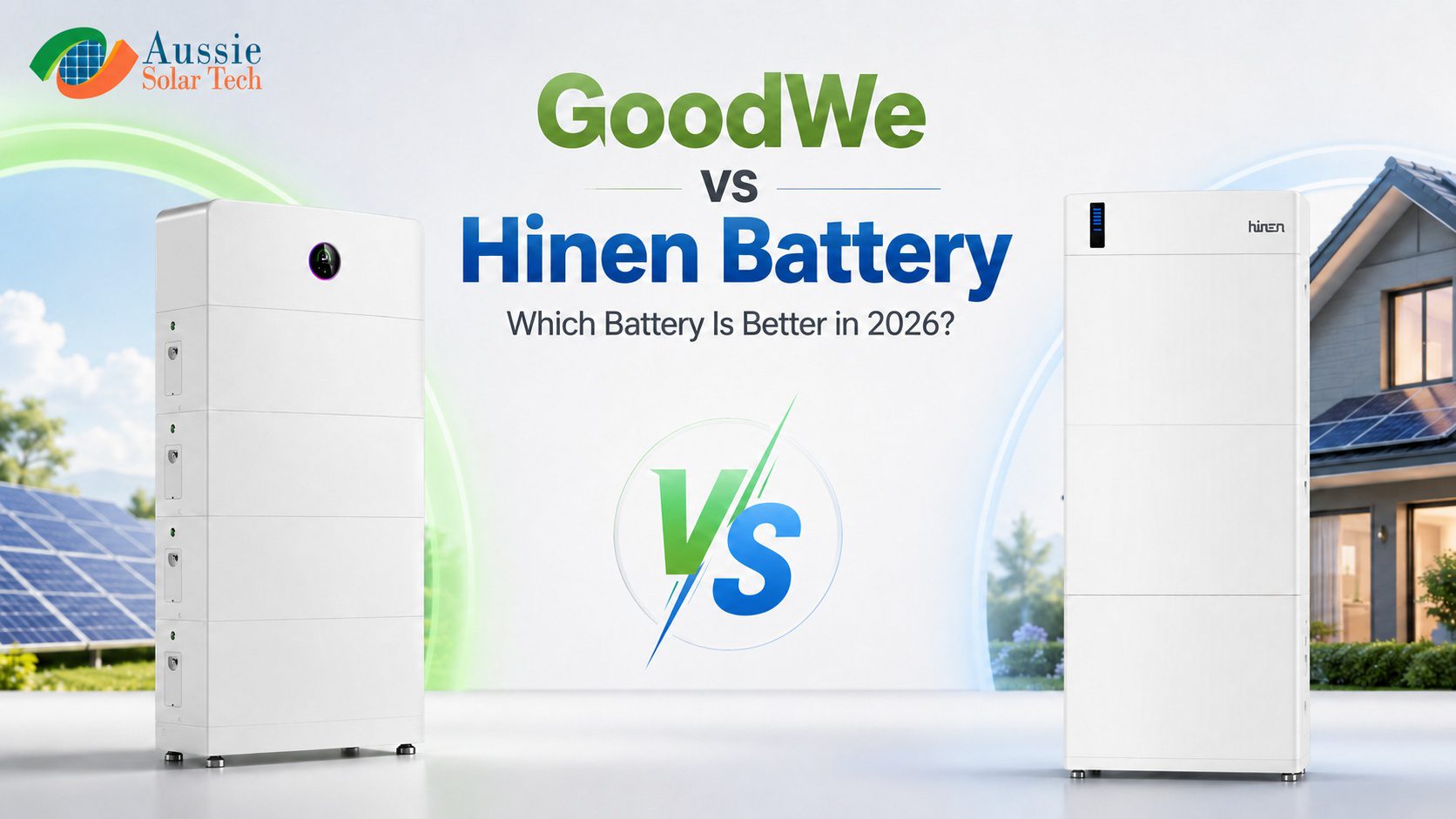
Choosing between GoodWe vs Hinen Battery systems depends mainly on system design, scalability, backup needs and how closely you want the battery to integrate with your solar setup.
GoodWe offers a broad residential energy ecosystem with hybrid inverters, modular batteries and all-in-one storage systems. Hinen focuses on modular and all-in-one residential energy storage, with both low-voltage and high-voltage options.
This comparison looks at the practical differences between the two brands, including capacity, scalability, backup support, monitoring, safety, installation and system compatibility for Australian homes.
GoodWe and Hinen Battery Options Available in Australia
GoodWe offers residential battery and home storage options in Australia, including ESA Series, Lynx Home U Series, Lynx F G2 Series, Lynx U G3 Series and Lynx Home F Series. These options include all-in-one home storage systems, low-voltage batteries and high-voltage battery solutions for different residential solar setups.
Hinen offers residential battery options such as A Series All-in-one RESS, B5000/B5000-W and B8900M-HA. The A Series is an all-in-one residential energy storage system, while B5000/B5000-W is a 5 kWh low-voltage home battery and B8900M-HA is an 8.9 kWh high-voltage battery module for residential energy storage.
GoodWe vs Hinen Battery: Side-by-Side Comparison
| Feature | GoodWe ESA Series | Hinen A Series |
|---|---|---|
| System Type | All-in-one solar and battery storage system | All-in-one residential energy storage system |
| Phase Options | Single-phase and three-phase | Single-phase and three-phase |
| Battery Chemistry | LFP / LiFePO₄ | LFP / LiFePO₄ |
| Battery Capacity | Up to 54 kWh per single-phase stack; up to 108 kWh on three-phase ESA | 8.9–26.7 kWh |
| Power Range | 3–10 kW single-phase / 5–30 kW three-phase | 3.6–25 kW |
| Backup Support | Whole-home backup capability depending on ESA model | Backup capability depends on selected A Series model and system design |
| Protection Rating | IP66 | IP65 |
| Monitoring | GoodWe monitoring ecosystem | Hinen App |
| Installation Design | Pre-wired modular design | Stackable plug-in design |
| Warranty | Depends on exact battery/inverter configuration | Up to 10 years on major residential battery models |
Source: [View ESA Series Datasheet] [Hinen A Series Datasheet]
Both GoodWe and Hinen offer residential battery options for different home energy needs. GoodWe battery provides stronger scalability for larger storage requirements, while Hinen focuses on practical all-in-one residential energy storage with flexible capacity options.
Design and Scalability
GoodWe has a strong advantage in system variety. It offers all-in-one systems, hybrid inverter solutions, retrofit options and separate battery products. This gives homeowners more flexibility when choosing a system based on their current solar setup, phase type and future expansion needs.
The ESA Series is one of GoodWe’s key all-in-one solutions. It uses a pre-wired modular design that combines inverter and battery, helping make installation cleaner and more organised. The single-phase ESA supports 5 kWh and 8 kWh battery modules, and the three-phase ESA supports 5, 6, 8 and 9 kWh module options, depending on system design.
Hinen also offers a clean residential energy storage design. Its A Series integrates inverter, battery modules, control box and battery management system. The plug-in battery stack design is built to reduce installation time, and the slim 180 mm profile makes it suitable for indoor and outdoor installation.
For homeowners who want a wider product ecosystem, GoodWe has the stronger range. For homeowners who want a compact all-in-one residential battery setup, Hinen is also a good option.
Battery Capacity and Expandability
GoodWe offers strong battery capacity flexibility. The ESA Series supports up to 5–108 kWh, depending on whether it is the single-phase or three-phase setup and how the system is designed. This makes GoodWe suitable for small homes, larger homes and even higher energy-use properties.
Hinen also offers flexible capacity options. The A Series includes single-phase options with 8.9–17.8 kWh capacity and a three-phase option with 8.9–26.7 kWh capacity. Hinen’s home battery range also supports broader storage needs, with low-voltage and high-voltage battery options available for different setups.
For maximum capacity expansion, GoodWe is stronger. For normal residential energy storage needs, Hinen still provides practical capacity options.
Backup Power and Energy Storage Performance
GoodWe performs strongly in backup support. The single-phase ESA provides UPS-level full-house backup with 63A output and no gateway needed. GoodWe’s three-phase ESA also includes whole-home backup design features and fast switching support.
Hinen A Series is designed to support household loads depending on the selected model and installation setup. Its 3.6–25 kW power range gives homeowners options for different load requirements, from smaller single-phase homes to larger three-phase setups.
For homeowners who care strongly about backup performance, GoodWe has the stronger official backup positioning. Hinen can still be suitable, but the final backup performance will depend on the selected system, load design and installer configuration.
Smart Features and App Monitoring
GoodWe provides smart energy monitoring through its monitoring ecosystem, allowing homeowners to track solar production, battery performance and energy usage. Its three-phase ESA also includes intelligent energy management features for more advanced system control.
Hinen also supports smart monitoring. Its B5000/B5000-W page mentions visible energy tracking and remote upgrade through the Hinen App. This helps homeowners monitor system performance and manage battery operation more easily.
Both brands offer smart monitoring, but GoodWe may feel more familiar to many Australian solar customers because of its stronger presence in the inverter and energy storage market.
Safety and Battery Technology
GoodWe includes strong safety features in its ESA Series. The single-phase ESA page highlights 6-level battery protection and AI-driven AFCI 3.0, while the system also carries an IP66 protection rating.
Hinen home batteries use LFP battery chemistry and include 5-layer battery protection. The B5000/B5000-W page lists protection features such as temperature detection, BMS control, over-temperature protection, over-current protection, over-voltage protection, built-in physical short-circuit protection, aerosol fire extinguisher and decompression valve. It also lists IP65 protection.
Both brands use safety-focused battery designs. GoodWe has the stronger IP66 rating on ESA, while Hinen has a clear 5-layer safety protection design for its home battery range.
Solar Inverter Compatibility
GoodWe has a clear advantage in inverter compatibility because it offers a wide range of solar inverters, hybrid inverters, retrofit inverters and battery products under the same brand. This can make system design easier when the installer wants to keep the inverter and battery ecosystem under GoodWe.
Hinen’s A Series is also designed as an integrated all-in-one system, so homeowners do not need to think about separate inverter and battery matching in the same way. Hinen also offers home battery products that can suit different installation types depending on the system design.
If you already have a GoodWe-compatible solar setup, GoodWe may be easier to integrate. If you are installing a new all-in-one system, Hinen can also be considered.
System Architecture: GoodWe ESA vs Hinen A Series
GoodWe ESA uses a pre-wired modular architecture that integrates the inverter, battery and energy management system into one platform. Hinen A Series also follows an all-in-one design, but uses a stackable plug-in structure built around inverter, battery modules, control box and BMS.
The practical difference is in system layout: GoodWe emphasises pre-wired integration and larger storage expansion, while Hinen focuses on a compact plug-in residential architecture.
Which Battery Should You Choose?
Choose GoodWe if you want:
- A broader inverter and battery ecosystem
- Larger storage expansion options
- Single-phase and three-phase ESA systems
- Whole-home backup capability
- IP66 enclosure protection
- Pre-wired modular installation
Choose Hinen if you want:
- A compact all-in-one residential storage system
- Low-voltage and high-voltage battery options
- Modular capacity expansion
- LFP battery chemistry
- Five-layer battery protection
- Plug-in stackable installation
The right choice depends on your existing solar system, phase type, required storage capacity, backup loads and installation space.
Final Verdict
The GoodWe vs Hinen Battery comparison mainly comes down to system scale, architecture and integration.
GoodWe ESA offers a broader storage ecosystem, larger expansion options and strong whole-home backup support. Hinen provides practical all-in-one and modular residential storage options with flexible low-voltage and high-voltage configurations.
Before choosing either system, compare the exact battery capacity, phase type, backup requirements, inverter compatibility and installation design.
At Aussie Solar Tech, we can help you compare GoodWe and Hinen battery systems based on your solar setup, energy usage, backup needs and budget.
Request a free quote today to find the right solar battery for your home.
FAQs About GoodWe vs Hinen Battery
Which battery offers better backup support?
GoodWe ESA supports strong whole-home backup capability, including up to 63A passthrough on selected single-phase models. Hinen can also support household backup loads, but the available output depends on the selected model and system design.
Which battery is more scalable, GoodWe or Hinen?
GoodWe ESA supports larger expansion, including up to 54 kWh per single-phase stack and up to 108 kWh on the three-phase range. Hinen also offers modular expansion through systems such as the B5000 and B8900M-HA.
Do GoodWe and Hinen use LFP batteries?
Yes. Both brands use lithium iron phosphate battery chemistry across key residential storage products.
Which system has better outdoor protection?
GoodWe ESA carries an IP66 protection rating, while Hinen’s key residential battery systems such as the A Series and B5000 use IP65 protection.
Can Hinen batteries work with existing solar systems?
Some Hinen systems can be integrated with existing solar installations, but compatibility depends on the exact battery, inverter and system configuration.
Is GoodWe ESA an all-in-one battery system?
Yes. GoodWe ESA combines inverter, battery and energy management within a pre-wired modular storage platform.
What is the main difference between GoodWe ESA and Hinen A Series?
GoodWe ESA focuses on broader ecosystem integration, larger storage expansion and whole-home backup capability. Hinen A Series focuses on compact all-in-one residential storage with a stackable plug-in design.

Shah Tarek is a Solar Energy Consultant with 10 years experience in solar system design and solar consultancy field at Australia. He is now a Director, Operation & Consultancy Division at Aussie Solar Tech, a leading Australian solar retailer and installer. Here he is writing informative and engaging solar content that educates the community on the benefits of solar power. His work supports Aussie Solar Tech’s mission to promote sustainable energy solutions and foster a greener future for Australia.




Seraphim Solar Panels Review: Efficiency, Reliability, and Value Unveiled

Talesun Solar Panels: Honest Review Before You Buy

Sungrow Battery VS Tesla Powerwall : Which is Best in Australia?

Leapton Solar Panels Review: Affordable Energy Solution

REC Solar Panels Review: Outstanding Efficiency & Durability

Best Hybrid Inverters for Home Solar Systems in 2025
Best Solar Battery In Australia 2026 — Complete Guide

Sigenergy VS Fox ESS Battery: Which is The Best Choice for 2026

How Much Do Solar Panel Costs in Australia? (2026 Price Guide)

