
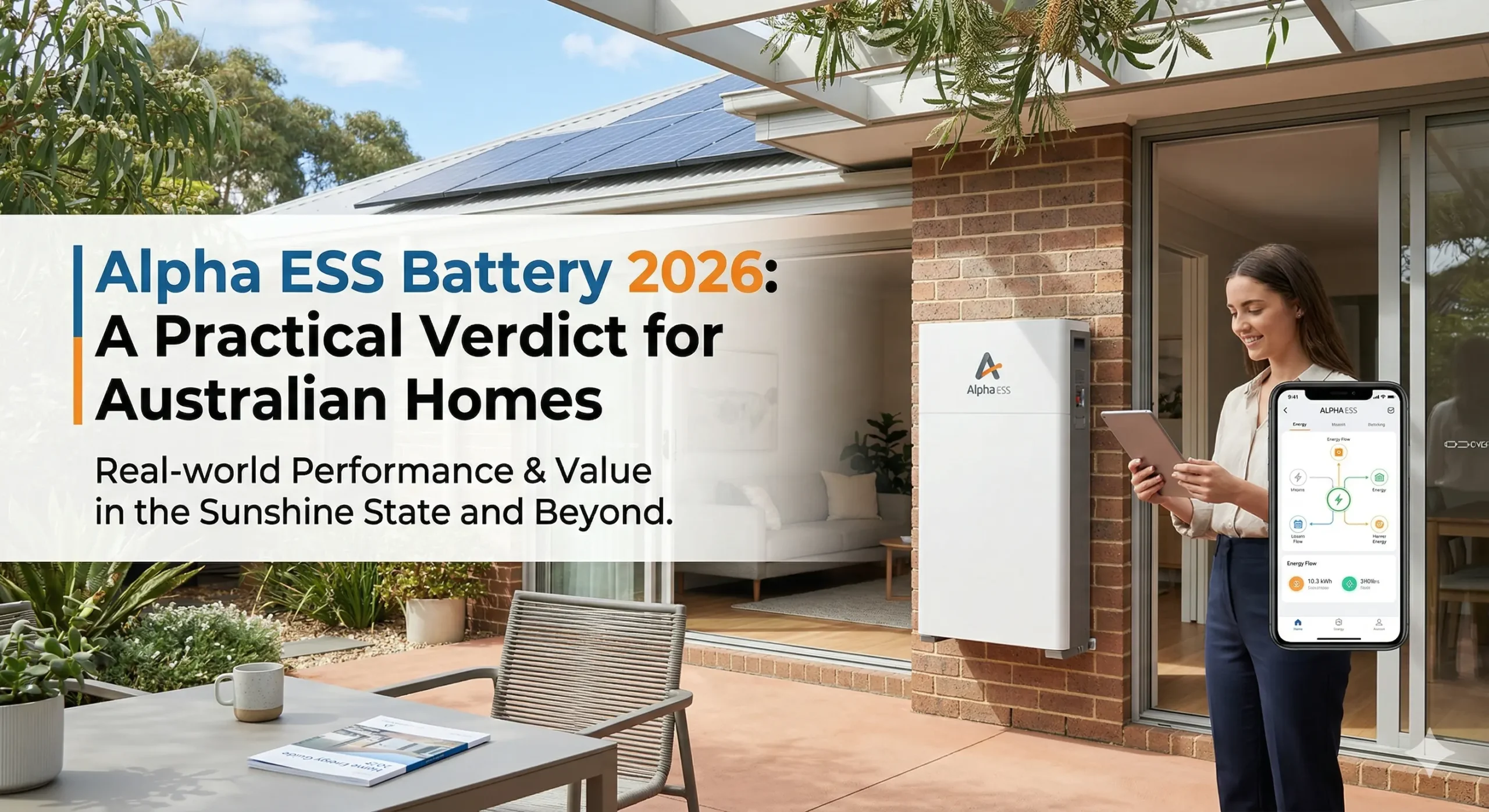
AlphaESS batteries are among the most trusted home energy storage solutions in Australia, offering a reliable, all-in-one system designed for long-term performance. Known for their strong local presence, advanced monitoring, and integrated inverter design, AlphaESS is a popular choice for homeowners who want a hassle-free solar battery setup.
In 2026, AlphaESS continues to be a go-to option for Australian households looking for dependable battery storage with smart energy management. At Aussie Solar Tech, we recommend AlphaESS systems for customers who prioritise reliability, local support, and a complete solar + battery solution.
AlphaESS Battery Review: Key Insights
AlphaESS provides seven main battery storage models for Australia, including the established SMILE-M5-S, SMILE-G3-S5, SMILE-T10-HV, and SMILE-G3-B5, alongside upcoming releases like SMILE-G3-T5~20, SMILE-M5-B, and StaX-M30/M50-AU. These LiFePO4 systems deliver high efficiency (up to 95%), 6000+ cycle life, and flexible scalability from 5 kWh residential to 50 kWh commercial setups, with IP65 ratings for Australia’s tough conditions. Designed for seamless solar integration and backup power, they emphasize modularity, smart monitoring, and grid independence, positioning AlphaESS as a versatile player in the expanding Aussie energy storage market.
AlphaESS Battery Company Overview
AlphaESS was founded in 2012 and has grown into a globally recognised energy storage provider with a strong footprint in Australia. Unlike many newer brands, AlphaESS has established local offices, technical support teams, and a wide installer network across major cities like Sydney, Melbourne, Brisbane, and Perth.
The company specialises in integrated energy storage systems, combining batteries, hybrid inverters, and intelligent energy management software into a single solution. This approach simplifies installation and ensures optimal system performance.AlphaESS has built its reputation in Australia by delivering consistent performance, strong warranty support, and reliable after-sales service—key factors for homeowners investing in long-term energy solutions
AlphaESS Battery Size Options, Specifications and Performance
AlphaESS offers a range of battery systems designed to suit different household energy needs, from small homes to large properties with higher energy consumption.
Key Specifications Overview of AlphaESS Battery
| Feature | SMILE-M5-S | SMILE-G3-S5 | SMILE-G3-B5 | SMILE-T10-HV | SMILE-G3-T10 | StaX-M30 / M50-AU |
|---|---|---|---|---|---|---|
| System Compatibility | Single-Phase | Single-Phase | Single-Phase | Three-Phase | Three-Phase | Three-Phase |
| Status | Standard AU | Standard AU | Standard AU | Standard AU | Standard AU | New / C&I Range |
| System Positioning | Compact entry system (simple & reliable) | Advanced hybrid system (balanced performance) | Flexible battery module system | High-power 3-phase system | Next-gen smart 3-phase system | Commercial-grade energy storage |
| Total Capacity | 5.0 kWh / module | 10.1 kWh / module | 10.1 kWh / module | 8.2 kWh / module | 3.8 / 8.2 / 9.3 kWh | 12.05 kWh / module |
| Usable Capacity | 5.0 kWh (100% DoD) | 9.6 kWh / module | 9.6 kWh / module | 7.8 kWh / module | 3.6 / 7.8 / 9.3 kWh | 11.45 kWh (95% DoD) |
| Battery Chemistry | LiFePO₄ (LFP) | LiFePO₄ (LFP) | LiFePO₄ (LFP) | LiFePO₄ (LFP) | LiFePO₄ (LFP) | LiFePO₄ (LFP) |
| Max Charge / Discharge | 5.0 kW | 5.0 kW (60A) | 5.0 kW (60A) | 10.0 kW (40A) | 10.0 kW (40A) | 30 / 50 kW |
| Peak Power / Backup | < 10ms UPS | 150% (30s) / UPS | < 10ms UPS | < 10ms UPS | < 10ms UPS | < 10ms UPS |
| Cycle Life | 10,000 cycles | 10,000 cycles | 10,000 cycles | 10,000 cycles | 10,000 cycles | 8,000 cycles |
| Inverter Weight | 19.5 kg | 19.5 kg | 19.5 kg | 30 kg | 26.7 kg | 73 kg |
| Dimensions (W×D×H) | 620 × 240 × 412 mm | 610 × 212 × 366 mm | 610 × 212 × 366 mm | 580 × 230 × 606 mm | 610 × 212 × 416 mm | 530 × 880 × 290 mm |
The Complete AlphaESS Battery Lineup: Which Series Fits Your Home?
While the newer generation systems dominate most installations, the AlphaESS ecosystem is far from one-size-fits-all. Each model is engineered for a specific type of household, grid setup, and energy usage pattern. Based on real-world performance and system design, here’s where each model truly shines—and where it doesn’t.
SMILE-M5-S: The Entry-Level ROI Champion
The SMILE-M5-S is built for homeowners who care about one thing above all—maximum return on investment.
How it works:
This is a streamlined hybrid system designed to handle daily solar charging and evening discharge without unnecessary complexity. With a compact footprint and simplified architecture, it reduces both upfront cost and installation time.
The Verdict:
With a 5.0 kWh usable capacity (100% DoD) and 10,000 cycle life, it’s ideal for smaller households or first-time battery buyers. If your goal is to reduce electricity bills quickly—especially under rebate schemes—this is one of the smartest entry points into battery storage.
SMILE-G3-S5: The Balanced All-Rounder
The SMILE-G3-S5 sits right in the sweet spot between performance, flexibility, and price.
How it works:
It’s a modern hybrid system with improved efficiency and smarter energy management compared to older designs. The system integrates seamlessly with solar and provides stable backup with enhanced power delivery.
The Verdict:
With ~9.6 kWh usable capacity per module and strong output, it suits the average Australian household perfectly. If you want a “set and forget” system that handles daily loads, peak shaving, and blackout protection without fuss—this is the go-to choice.
SMILE-G3-B5: The Flexible Expansion Expert
The SMILE-G3-B5 is designed for households that don’t want to commit to full capacity upfront.
How it works:
Unlike fixed systems, the B5 operates as a modular battery unit, allowing you to expand storage over time. You can start small and scale as your energy usage grows.
The Verdict:
With ~10.1 kWh total capacity per module and flexible expansion, it’s perfect for users planning future upgrades—like EV charging or increased appliance usage. If your energy needs are evolving, this system grows with you.
SMILE-T10-HV: The 3-Phase Powerhouse
Most residential batteries struggle with large, energy-hungry homes—but the T10-HV is built for exactly that.
How it works:
This is a high-voltage (HV), three-phase system, meaning it distributes power evenly across your home’s electrical phases. This reduces stress on the system and improves efficiency under heavy loads.
The Verdict:
With 10 kW output and strong load-handling capability, it’s ideal for large homes running ducted AC, pool systems, and multiple appliances. If you have a 3-phase connection, this isn’t optional—it’s essential.
SMILE-G3-T10: The Next-Gen Smart 3-Phase System
The SMILE-G3-T10 takes everything good about the T10-HV and refines it with smarter control and flexibility.
How it works:
It combines high-voltage architecture with next-generation system intelligence, allowing better energy optimisation, smoother load balancing, and improved performance across varying usage patterns.
The Verdict:
Supporting multiple battery sizes (3.8 / 8.2 / 9.3 kWh) and delivering 10 kW output, it’s ideal for modern smart homes. If you want future-proof energy management with high performance, this is the premium pick.
StaX-M30 / M50-AU: The Commercial-Grade Giant
When residential systems hit their limits, the StaX series steps in.
How it works:
Designed for commercial and industrial (C&I) applications, this system delivers massive power output and storage capacity. It supports large-scale energy management, peak shaving, and backup for businesses.
The Verdict:
With 30–50 kW output and 12.05 kWh per module, this is not for typical homes. It’s built for businesses, large properties, and high-demand environments. If your energy needs go beyond residential—this is your solution.
Series Comparison Matrix
| Model Series | Ideal Household | Key Advantage | System Limitation |
|---|---|---|---|
| SMILE-M5-S | Budget-conscious homes / small households | Lowest upfront cost; 100% usable capacity (5 kWh) | Lower power output; basic backup features |
| SMILE-G3-S5 | Standard suburban homes (single-phase) | Balanced performance; strong daily cycling with high efficiency | Passive cooling requires shaded installation |
| SMILE-G3-B5 | Growing households / future upgrades | Modular flexibility; expand storage as energy needs grow | Requires space planning for additional modules |
| SMILE-T10-HV | Large homes with 3-phase power | High output (10 kW); handles heavy multi-phase loads efficiently | Higher installation cost; more complex setup |
| SMILE-G3-T10 | Premium smart homes (3-phase) | Flexible capacity options + next-gen system control | More complex configuration vs entry systems |
| StaX-M30 / M50-AU | Commercial / industrial users | Very high output (30–50 kW); scalable for large energy demand | Not suitable for residential use; high cost |
The “Thermal Penalty”: Real-World Heat Performance
This is where generic reviews fail you. The AlphaESS uses passive cooling, meaning it relies on large heat sinks rather than internal fans or liquid cooling.
In our experience installing systems across Queensland and Western Australia, we’ve found that the AlphaESS handles the 40°C+ threshold by proactively throttling the discharge rate. During a 42°C day, the internal BMS (Battery Management System) protects the cells by dropping power output from 5kW down to roughly 3.2kW. At Aussie Solar Tech, we mitigate this by mandating garage or south-facing shaded installations. If you install this on a north-facing wall in full sun, you will see a significant hit to your summer performance.
AlphaESS Battery Approx. Price 2026
AlphaESS SMILE M5 5 kWh Price
| Battery Capacity | Approx. Price (AUD) |
|---|---|
| 15 kWh | $6,499* |
| 20 kWh | $7,100* |
| 25 kWh | $8,499* |
| 30 kWh | $9,699* |
| 40 kWh | $11,400* |
AlphaESS SMILE M5 5 kWh battery modules are available in multiple capacity options for both residential and commercial energy storage. AlphaESS SMILE M5 battery systems Price Start From approximately A$6,499 for the 15 kWh system, while the 20 kWh AlphaESS SMILE M5 battery price is approximately A$7,100. The 25 kWh battery price is approximately A$8,499, while the 30 kWh battery price is approximately A$9,699. For larger energy storage needs, the 40 kWh AlphaESS SMILE M5 battery price is approximately A$11,400.
AlphaESS SMILE5 13.9 kWh Price
| Battery Capacity | Approx. Price (AUD) |
| 13.9 kWh | $5,099* |
| 27.8 kWh | $6,799* |
| 41.7 kWh | $10,999* |
The AlphaESS SMILE5 13.9 kWh module is a reliable, high-capacity home battery system designed for Australian households seeking stronger solar storage. AlphaESS SMILE5 battery systems Price Start From approximately A$5,099 for the 13.9 kWh system, while the 27.8 kWh AlphaESS SMILE5 battery price is approximately A$6,799. For higher energy storage needs, the 41.7 kWh AlphaESS SMILE5 battery price is approximately A$10,999.
* Final price may varies based on location, installation requirements.
Note: All prices listed are approximate and subject to change. Please request a quote for the most accurate and up-to-date pricing.
AlphaESS Battery Advantages and Disadvantages
AlphaESS batteries are designed for homeowners who want reliability and simplicity in one package.
The biggest advantage is the all-in-one system design, which combines battery storage, inverter, and energy management into a single unit. This reduces compatibility issues and simplifies installation. The brand’s strong presence in Australia also adds confidence, especially for long-term support and servicing.
However, this convenience comes at a higher upfront cost compared to modular or budget battery brands. While the system is expandable, it may not offer the same flexibility as fully modular systems like Fox ESS or Sungrow. Some users may also prefer premium brands with more advanced software ecosystems.
Market Comparison: AlphaESS SMILE5 vs GoodWe, BYD and Tesla Powerwall 3
| Feature | AlphaESS Smile-5 | GoodWe Lynx Home U (Mid-Range) | BYD Battery-Box HVS (Mid-Range) | Tesla Powerwall 3 (Premium) |
| Price (Installed approx.) | $8,499 | $8,689 | $14,280 | $15,200 |
| Cooling | Passive | Passive | Passive | Liquid Cooled |
| Max Discharge | 5.0 kW | 5.0 kW (per module) | 5.0 kW – 7.0 kW | 11.5 kW |
| Backup Power | UPS (Essential) | UPS (Essential) | UPS (High Load Ready) | Full Home Backup |
| Inverter Compatibility | Built-in / Hybrid | Universal (AC Coupled) | Best with Fronius/SMA | Built-in Inverter |
Not Sure If AlphaESS Is Right for You?
With so many battery options available, choosing the right one can be overwhelming. Aussie Solar Tech helps you compare AlphaESS with leading brands to find the best solution for your home.
We assess:
- Your energy usage patterns
- Solar system size
- Budget and future needs
Speak with our experts today for personalised recommendations.
Conclusion
AlphaESS batteries are a reliable and well-established choice for Australian homeowners seeking a complete energy storage solution. With strong performance, advanced monitoring, and local support, they offer peace of mind for long-term investment.
They are best suited for:
- Homeowners wanting an all-in-one system
- Families prioritising reliability and support
- Medium to large households with consistent energy use
While the upfront cost is higher, the integrated design and dependable performance make AlphaESS a worthwhile investment.
FAQs
Is AlphaESS battery good for Australian homes?
Yes, AlphaESS is one of the most reliable and widely used battery brands in Australia, with strong local support.
How long does an AlphaESS battery last?
Typically 10–15 years with over 6000 charge cycles, depending on usage.
Is AlphaESS better than Tesla Powerwall?
AlphaESS offers better integration and local support, while Tesla provides more advanced software features.
Can I expand my AlphaESS battery system?
Yes, some models allow expansion, depending on the system configuration.
Does AlphaESS include an inverter?
Yes, most AlphaESS systems are all-in-one and include a built-in hybrid inverter.

Shah Tarek is a Solar Energy Consultant with 10 years experience in solar system design and solar consultancy field at Australia. He is now a Director, Operation & Consultancy Division at Aussie Solar Tech, a leading Australian solar retailer and installer. Here he is writing informative and engaging solar content that educates the community on the benefits of solar power. His work supports Aussie Solar Tech’s mission to promote sustainable energy solutions and foster a greener future for Australia.


Seraphim Solar Panels Review: Efficiency, Reliability, and Value Unveiled

Talesun Solar Panels: Honest Review Before You Buy

Trina Vertex Solar Panels Review: Efficiency, Lifespan, and Performance

Sungrow Battery VS Tesla Powerwall : Which is Best in Australia?

Top 17 Solar Panel Brands in Australia 2025

Leapton Solar Panels Review: Affordable Energy Solution

REC Solar Panels Review: Outstanding Efficiency & Durability

Best Hybrid Inverters for Home Solar Systems in 2025
Best Solar Battery In Australia 2026 — Complete Guide

