
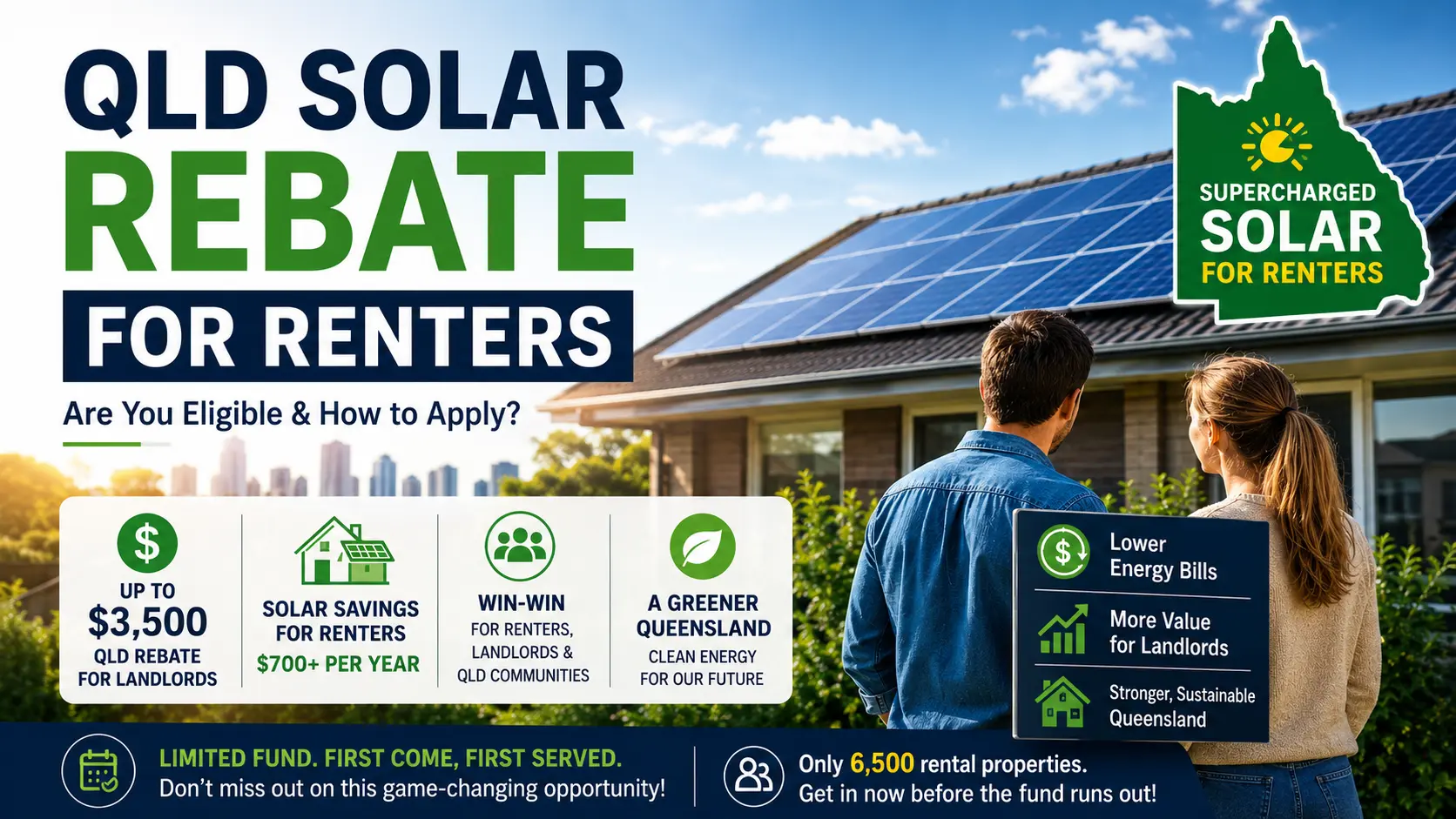
Around 40 percent of the homes in Queensland, Australia, have solar panels on their roofs (source). Federal rebates and lower annual energy bills motivated this surge in conversion to green energy, among other things. However, renters used to miss out on the energy savings benefits. Since landlords didn’t live on those properties, they had no incentive to install solar panels on those roofs.
To solve this, the Queensland Government introduced the QLD solar rebate for renters in December, 2025. Official name: Supercharged Solar of Renters. The rebate slashes up to $3,500 off the upfront cost of solar installation on rental properties for landlords.
Now, after applying the federal STCs, a low-budget but standard 6.6 kW system costs around $5000-$6000 in Australia. Landlords can stack the renter’s rebate over it and bring down their overall costs to as low as $2,500-$3,500.
This creates a win-win situation for all parties. The landlords get to install solar at a low price, which increases the value of their properties. The renters get to enjoy the solar benefits of low energy bills. Meanwhile, the government achieves its goal of converting more homes to solar.
As a landlord of a rental property in Queensland, you must take this opportunity to solar power your property before the fund for the QLD Solar Rebate for Renters runs out. Here is a detailed guide.
What Is the QLD Solar Rebate for Renters?
Let’s clear one thing first. Many Queenslanders get confused by the name ‘Supercharged Solar for Renters’. Yes, of course, the rebate is for renters. The QLD government aims to reduce renters’ annual energy bills with this initiative. According to their estimations, it’s should be a minimum of $700 reduction per year.
However, the renter doesn’t apply for the rebate. As a result, they are not in a position to make the choice to install solar. The landlord is the one who has to make it and take care of the whole process. All the tenant has to do is sign a consent form. The theory is that landlords will choose to do so since they can increase their property value at such a low cost.
The Queensland Government has also warned on its website that many third parties are taking advantage of the confusion. They are setting up scam sites that promise a solar rebate to Queensland renters. Unsuspecting web users might click a link on these websites and fall victim to cybercrimes.
Remember, there are only two places on the web where you might start your process for this rebate. One, the Queensland Government’s official page for the program. Second, by requesting a quote from an approved Solar installer like Aussie Solar Tech. The second method will reduce your time and effort since you have to get a quote to start the process anyway.
As for how much the rebate can benefit the landlord and tenant in terms of money, the following table should answer that fully. The tenant savings are estimated for households that don’t pay more than 1000$/week in rent.
| Solar PV System Capacity | Maximum QLD Rebate for Renters Amount | Estimated Cost After Federal Rebate (Standard/Budget) | Total Cost After QLD State Rebate | Estimated Annual Tenant Savings (Electricity Bills) |
| At least 3 kW but less than 4 kW | $2,500 | $3,500 – $4,000 | $1,000 – $1,500 | $600 – $850 |
| At least 4 kW but less than 5 kW | $3,000 | $4,200 – $4,800 | $1,200 – $1,800 | $800 – $1,100 |
| 5 kW or more | $3,500 | $4,900 – $5,400 | $1,400 – $1,900 | $1,100 – $1,400 |
You must understand the QLD rebate is capped at $3,500. So, a 10 kW system gets the same discount as a 5 kW system. This is different from the Federal Solar Rebate, where bigger systems generate more STCs and thus a greater discount.
Also, if your total installation costs less than the state rebate after applying federal STCs, you would only be compensated for the solar payment. Suppose a 3 kW system costs you $2000 after applying federal STCs. This might happen if you choose a low-budget panel with old solar tech during a clear-out sale. In this case, although your system is entitled to $2,500, you will only get $2,000. There is no chance of a $500 cash payout.
It’s a first-in, first-served type of deal. The fund for this rebate is limited to $26.3 million. The program also has a specific target of equipping 6,500 rental properties.And right now, Queenslanders are aggressively converting to solar. Either the fund will run out quickly, or the government will reach its target number of rental homes soon enough, whichever comes first. So, landlords should move fast if they want to reap the benefits.
Who Is Eligible For The Supercharged Solar Rebate For Renters: The 4 Main Requirements
There are broadly four eligibility requirements for the QLD solar rebate for renters. Firstly, you must be an Australian resident who owns the property. Number two, the solar system must be at least 3 kW in size and have proper approvals.
Third, the rent can’t exceed $1,000/week, and the tenant must have at least 8 months left on the lease. Lastly, it should be a single dwelling (not an apartment) which the landlord doesn’t occupy in any way. Let’s have a more detailed look at these.
1. Australian Rental Property Owner
As mentioned earlier, landlords or the property owners are the ones who apply and go through the process. Apart from owning the property, you must also be a legal resident of Australia.
Your property cannot have any kind of existing solar PV installed anywhere. The lease agreement needs to show that your tenant pays or significantly contributes to the electricity bills. This is to ensure that the rebate benefits the tenant, not just the landlord.
After receiving the conditional approval, the landlord must install an eligible solar PV system within 150 days. That means you have to install the system before you get final approval for the rebate.
However, installing a system within 150 days of conditional approval strongly speaks of the landlord’s commitment to green energy and his tenant’s well-being. So, it’s highly unlikely your rebate application will be rejected for final approval.
2. 3 kW Solar PV system with CEC, SAA. NET approval
The PV system you install should have a minimal capacity of 3 kW. Anything below this won’t make much of a difference and therefore isn’t eligible for the rebate.
The system must have a Generation Signalling Device or GSD. This is mandatory since it acts as an emergency backstop during peak solar generation hours and prevents overloading the grid. Your solar panels and inverter need to be Clean Energy Council-approved. In other words, you should be able to find them on CEC’s list of inverters and panels. Also, you must buy them from a retailer who is listed on the New Energy Tech Approved Sellers directory, for instance, Aussie Solar Tech.
In addition, the panel needs to be designed and installed only by a person accredited by Solar Accreditation Australia (doesn’t have to be the same person).The installer should also hold a current Queensland Open Electrical Worker Licence. Or they might work for an installer with a current Queensland Electrical Contractor Licence, like us.Be sure to inform the Queensland Government (QRIDA) of any modifications to the system made after conditional approval to avoid complications in the final stage.
3. Minimum 8-month lease with rent no more than 1000$
This requirement just shows how the program puts a major focus on the well-being of the middle-class tenant. The lease you submit during the conditional approval must confirm two things to the QLD government.
Firstly, the rent doesn’t exceed $1000/week. If rent costs more than that, then the property is considered a luxurious one and the tenant living there isn’t middle-class. Second, the lease must show that the tenant pays or shares a significant portion of the electrical bills. This helps the government to ensure that the tenants reap the benefits of low energy bills, not the landlord.
At the final approval, your lease must state that the tenant has at least 8 months of staying left from the date of submission. It should also show that you haven’t increased the weekly rent since the conditional approval (unless there was a defined and specified condition). This accomplishes two things.
First, the landlord cannot evict the renter as soon as he gets the upfront discount on his solar installation. Second, it prevents landlords from extorting the solar installation cost from the tenant in the following months by raising the rent.
4. Single Dwelling Not Occupied by Landlord
The Queensland rental property in question should be a Class 1a building to qualify for the rebate. According to the Australian Building Code, such a property might be a detached house, duplex, or townhouse. It can also be a secondary dwelling present on the lot of a Class 1a building. An apartment in a flat is not eligible. Plus, the owner can’t be occupying or living there by any means.
Your tenant must be using the place for dwelling and not for other activities (like business). There should be a dedicated meter that only tracks the electrical supply of that specific property. Your application won’t be approved if you are part of an embedded network.
How To Apply For The QLD Supercharger Solar Rebate: A Step-by-Step Guide
The program is split into two overarching phases: Stage 1 (Steps 1–4) is your planning phase, where you secure conditional approval from the Queensland Rural and Industry Development Authority (QRIDA) to ensure you are eligible before spending any money. Stage 2 (Steps 5–7) is the action phase, where you lock in the tenancy details, get the system onto the roof, pay for it, and claim your cash back.
Step 1: Request a Quote
First up, you need to gather quotes from retailers who are New Energy Tech Approved Sellers. Make sure the quotes are dated after 12 December 2025 and list the designer’s current Solar Accreditation Australia number. To qualify, the quote must explicitly detail Clean Energy Council-approved modules and inverters, showing a system capacity of at least 3 kW alongside the total cost.
Step 2: Talk to your tenant
Since this directly impacts where your tenants live, they need to be fully on board. You must have them complete and sign the official tenant acknowledgement and consent form. It is a great chance to chat with them about how they will save on electricity bills while using clean, sustainable solar energy, all while you cover the installation and ongoing maintenance costs.
Step 3: Conditional Approval
Now you log into the QRIDA application portal using your Australian Government Digital ID, myID. You will submit your eligible quote, proof of property ownership, the signed tenant consent form, a fixed-term lease (like a Form 18a), and proof that the tenant holds the electricity account. If you are part of a body corporate scheme, you will also need to upload their written approval.
Step 4:Get the initial approval
QRIDA will assess your application, which can take a few weeks. Once approved, you will get a conditional approval letter, locking in a 150-day window to complete the remaining steps. Just be careful not to change your solar retailer, panels, or inverter model after this point without telling QRIDA, or you might risk losing the rebate at the final hurdle.
Step 5: Tenancy Agreement
Before filing your final claim, you must update or re-sign a fixed-term lease so it has at least 8 months remaining. The weekly rent cannot be higher than what you listed in Step 3. You must include special terms or a specific annexure clearly stating that a solar system is installed, outlining who handles maintenance, and defining how the solar energy benefits are shared.
Step 6: Solar PV Installation
Coordinate the installation with your chosen New Energy Tech Approved Seller, who will handle the grid connection with Energex or Ergon. Once the work is done, pay the invoice in full (or finalize your finance agreement). Ensure the final invoice itemizes the approved Clean Energy Council components and system capacity separately from ineligible items like solar batteries.
Step 7: Final Application
With the system safely on the roof, head back to the QRIDA portal for the final step. Upload your newly signed lease and the fully paid tax invoice. QRIDA will review everything against your initial conditional approval, and as long as all the technical details match up perfectly, they will process your rebate payment.
Safety Inspections
When you submit that final application, you will be asked to agree to a free safety inspection. The Queensland Government’s appointed energy programs inspectorate selects installations at random to ensure everything is put together safely and correctly. If your property is picked, they will coordinate with you and your tenants to find a convenient time to check out the system.
Final words
All that said, your best option is to start by requesting a quote from an approved retailer and installer, such as Aussie Solar Tech. This would save you a lot of time you might otherwise waste on complex technical guidelines and on putting them all together to make sense. Better hurry up, the funding is running out as you read this.
FAQs
Am I eligible for QLD Solar Rebate for Renters if I have multiple tenants in the same property?
Yes, you can still be eligible if you rent to multiple tenants. For multiple-occupancy properties under the Scheme, you must secure a distinct eligible lease for every occupied room by the time you submit your final approval application. Every co-tenant must be completely accounted for in the paperwork.
Can I apply for this QLD Solar rebate if a previous owner already claimed it for the same property?
No, the rebate is restricted to a single lifetime use per residence. If any individual has previously received financial assistance under this specific Scheme for your rental property, the residence becomes entirely ineligible. You cannot claim a second rebate for a property that has already been funded.
Is there a limit to how many rental properties I can claim a solar rebate for?
Yes, the Queensland Government places a strict cap on portfolio size to keep the distribution fair. You can only receive approval for a maximum of three separate rental properties. If you have already received conditional or final approval for three other residences, any further applications will be refused.
Are there legal consequences if I accidentally or intentionally provide wrong information on my application?
Yes, providing incorrect data carries serious legal weight. Under the Rural and Regional Adjustment Act 1994, strict financial and legal penalties apply if you submit false or misleading information. Beyond losing your eligibility and facing penalties, QRIDA is legally empowered to call up and reclaim any financial assistance already paid out.

Shah Tarek is a Solar Energy Consultant with 10 years experience in solar system design and solar consultancy field at Australia. He is now a Director, Operation & Consultancy Division at Aussie Solar Tech, a leading Australian solar retailer and installer. Here he is writing informative and engaging solar content that educates the community on the benefits of solar power. His work supports Aussie Solar Tech’s mission to promote sustainable energy solutions and foster a greener future for Australia.

Seraphim Solar Panels Review: Efficiency, Reliability, and Value Unveiled

Talesun Solar Panels: Honest Review Before You Buy

Sungrow Battery VS Tesla Powerwall : Which is Best in Australia?

Leapton Solar Panels Review: Affordable Energy Solution

REC Solar Panels Review: Outstanding Efficiency & Durability

Best Hybrid Inverters for Home Solar Systems in 2025
Best Solar Battery In Australia 2026 — Complete Guide

Sigenergy VS Fox ESS Battery: Which is The Best Choice for 2026

How Much Do Solar Panel Costs in Australia? (2026 Price Guide)

