
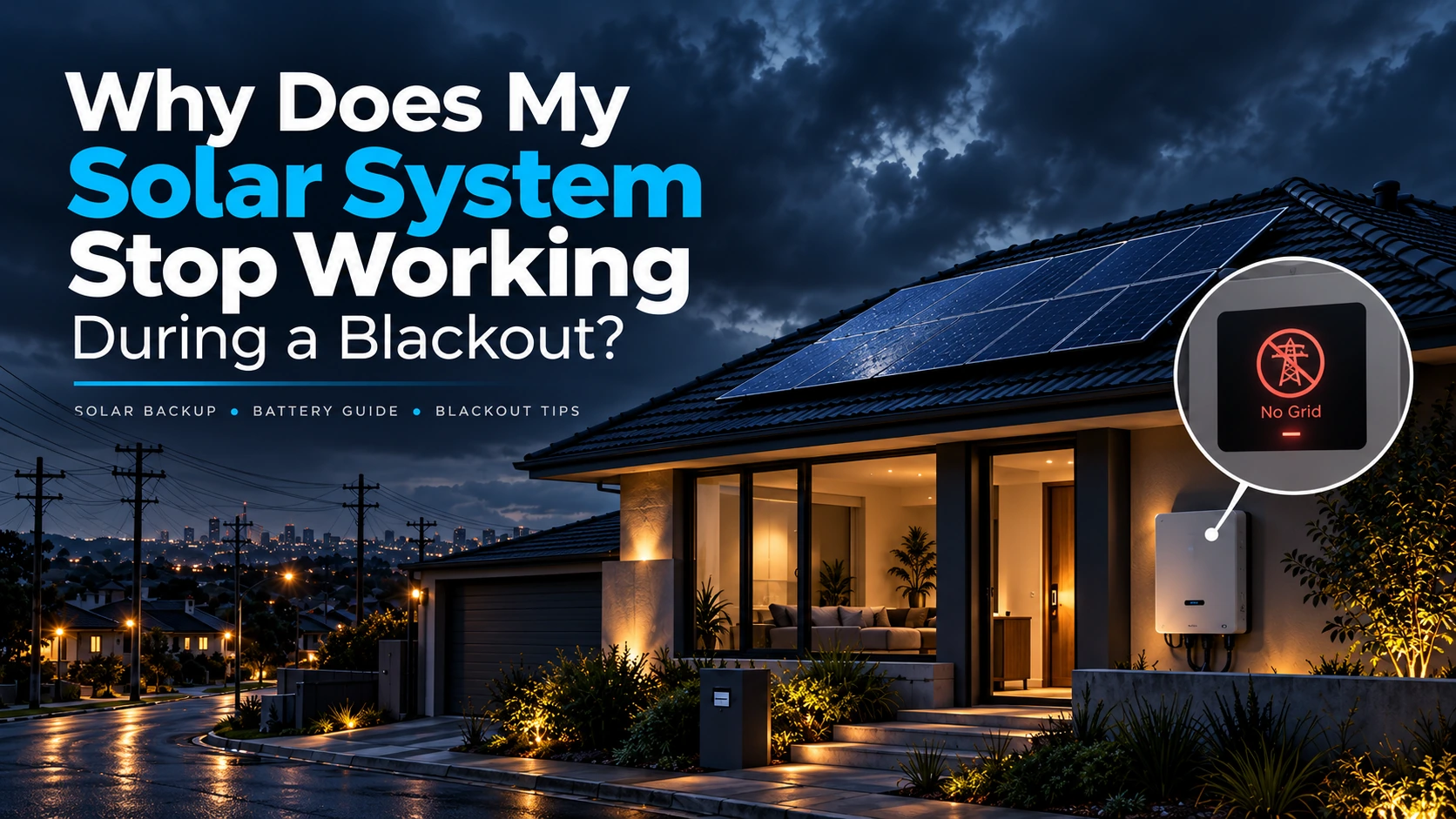
A blackout can be confusing when you already have solar panels on the roof. The sun may be shining, but your home still loses power. Many homeowners think this means the solar system has a fault. In most cases, it does not.
If your solar system stop working during a blackout, it does not always mean there is a fault. A standard grid-connected solar system is designed to shut down during a blackout for safety. The main reason is to stop electricity from flowing back into the grid while technicians may be repairing power lines. Australian Government guidance explains that normal grid-connected solar systems generally switch off when the grid fails unless the system has been designed for backup operation.
Why Does a Solar System Shut Down During a Blackout?
Your solar panels produce DC electricity. The inverter then converts that electricity into AC power that your home can use. When the electricity grid goes down, the inverter detects the problem and automatically disconnects the solar system. This safety process is called anti-islanding. Without anti-islanding, solar panels could continue sending electricity into damaged or isolated power lines. That could be dangerous for electricity workers repairing the network.
So, if your solar system stops working during a blackout, it is usually doing exactly what it was designed to do.
Will a Solar Battery Keep the Power On?
Sometimes, but not always. A battery stores extra solar energy, but having a battery does not automatically mean your home will have power during a blackout. For backup power, your system usually needs:
- a backup-capable inverter
- suitable switching equipment or a backup gateway
- selected circuits connected to the backup system
- enough battery charges available
Government guidance also notes that backup capability depends on the way the battery system is designed and installed.
Essential Loads vs Whole-Home Backup
Not every battery system is designed to power the whole house. Many systems only support essential loads during a blackout.
| Backup Type | Common Loads |
|---|---|
| Essential Load Backup | Lights, fridge, Wi-Fi, selected power points |
| Larger Backup Setup | More appliances, depending on inverter output |
| Whole-Home Backup | Requires suitable battery capacity, inverter power and system design |
Large appliances such as ducted air conditioning, electric hot water systems, pool pumps and EV chargers can use a lot of energy. They may not be included in a standard backup setup. This is why battery size alone does not tell you how useful the system will be during a blackout.
Can Solar Panels Still Work During a Blackout with a Battery?
This depends on the system design. In a basic setup, the battery may provide power to selected circuits, but the solar system may still remain off. A properly designed backup or islandable system can disconnect from the grid and continue working independently. During daylight hours, solar panels may keep supplying the home and charging the battery.
This can be especially useful during a long outage because the battery may be able to recharge while the sun is available.
What About Three-Phase Homes?
Three-phase homes need more careful planning.
A battery connected to only one phase may not provide backup to appliances connected to the other phases. If you want wider backup coverage, the system needs to be designed for that purpose.
Australian Government guidance recommends discussing three-phase backup requirements with the installer before choosing the system.
Why Is My Battery Not Working During a Blackout?
If you already have a solar battery but still lose power completely, possible reasons include:
- backup mode was not enabled
- the battery had very little charge left
- no backup gateway was installed
- only selected circuits are connected to backup
- the inverter reached its backup power limit
- the system was not designed for off-grid operation
This does not always mean the battery is faulty.
How Can You Prepare for a Blackout?
Before buying or upgrading a solar battery, ask the installer a few simple questions:
- Will this system provide backup during a blackout?
- Which appliances will stay on?
- Will solar continue charging the battery during an outage?
- Is the system suitable for a three-phase home?
- How much backup power can the inverter supply?
- How long could the battery last with essential loads?
These questions can prevent surprises later.
Final Verdict on Why a Solar System Stop Working During a Blackout
If your solar system stops working during a blackout, it is usually because of an important safety feature, not a fault. Standard grid-connected solar systems shut down to protect the electricity network and the people working on it. If you want power during an outage, you need a battery and inverter setup that is specifically designed for backup operation.
For many homes, essential-load backup is enough. For others, a larger or whole-home solution may be more suitable. The best setup depends on your household loads, battery size, inverter capacity and the way the system is installed.
Frequently Asked Questions
Do solar panels work during a blackout?
Usually no. A standard grid-connected solar system shuts down automatically during a blackout for safety unless it has a suitable battery and backup setup.
Can a solar battery power my home during a blackout?
Yes, but only if the battery system is designed for backup operation. The inverter, backup gateway and system configuration all need to support blackout backup.
Why does my solar battery not work during a power outage?
The battery may have low charge, backup mode may not be enabled, or the system may not have the required switching equipment or backup circuits.
Can solar panels charge a battery during a blackout?
Yes, some properly designed backup systems can continue using solar energy to power the home and recharge the battery while the grid is down.
Do I need whole-home backup?
Not always. Many homes only need essential loads such as lights, a fridge, Wi-Fi and selected power points during a blackout. Whole-home backup needs a larger system.

Shah Tarek is a Solar Energy Consultant with 10 years experience in solar system design and solar consultancy field at Australia. He is now a Director, Operation & Consultancy Division at Aussie Solar Tech, a leading Australian solar retailer and installer. Here he is writing informative and engaging solar content that educates the community on the benefits of solar power. His work supports Aussie Solar Tech’s mission to promote sustainable energy solutions and foster a greener future for Australia.




Seraphim Solar Panels Review: Efficiency, Reliability, and Value Unveiled

Talesun Solar Panels: Honest Review Before You Buy

Sungrow Battery VS Tesla Powerwall : Which is Best in Australia?

Leapton Solar Panels Review: Affordable Energy Solution

REC Solar Panels Review: Outstanding Efficiency & Durability

Best Hybrid Inverters for Home Solar Systems in 2025
Best Solar Battery In Australia 2026 — Complete Guide

Sigenergy VS Fox ESS Battery: Which is The Best Choice for 2026

How Much Do Solar Panel Costs in Australia? (2026 Price Guide)

