
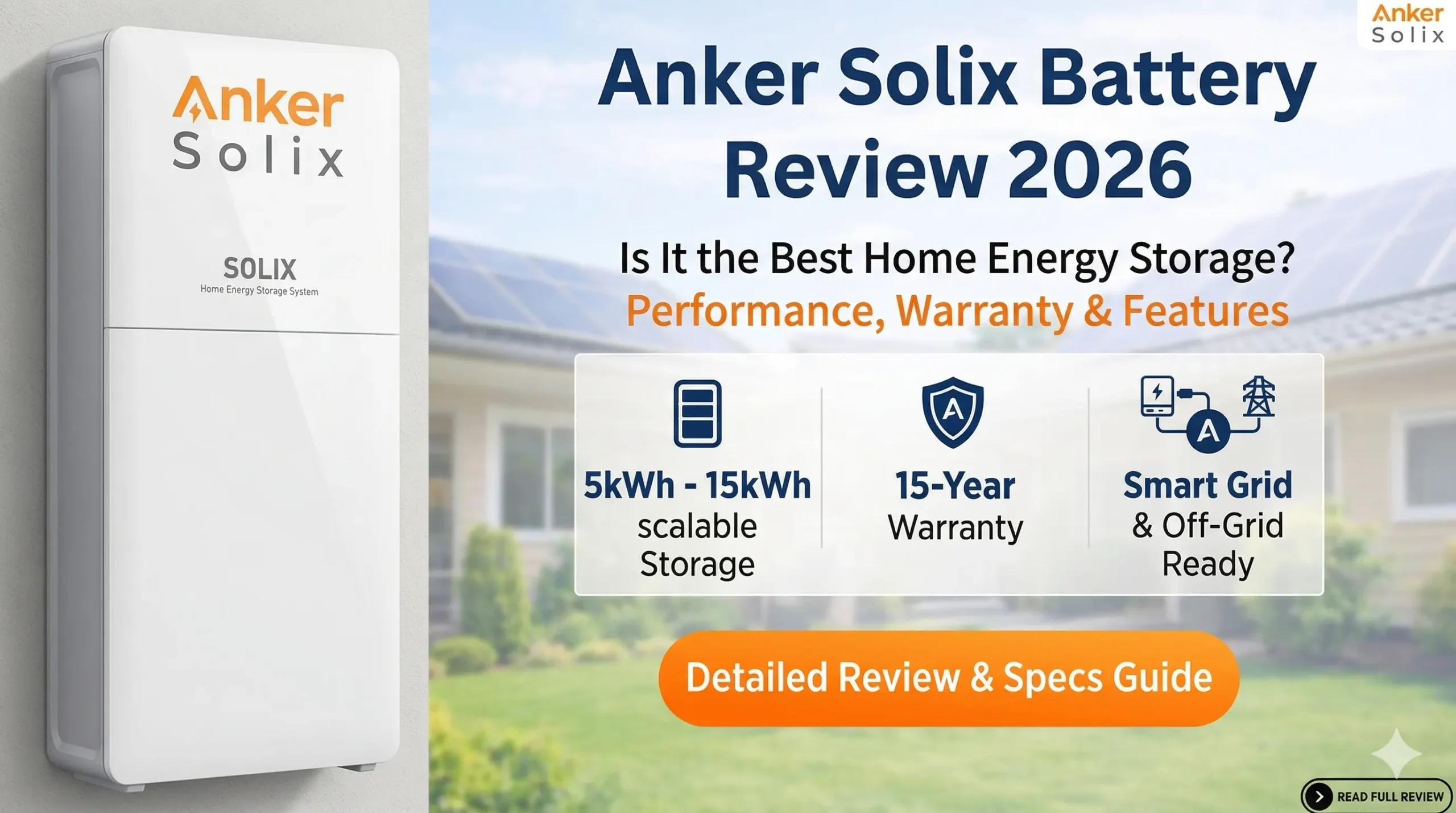
Anker SOLIX batteries are a relatively new but fast-growing option in the Australian energy storage market, offering portable and modular battery solutions designed for flexibility and smart energy use. Known globally for its consumer electronics, Anker has expanded into home energy storage with the SOLIX range, targeting homeowners who want simplicity, portability, and modern design.
In 2026, Anker SOLIX is gaining attention in Australia for its plug-and-play approach and expandable systems. At Aussie Solar Tech, we see growing interest from customers looking for alternative battery solutions that are easy to install and suitable for both backup power and solar integration.
Anker Solix Battery Review: Key Insights
Anker SOLIX X1 is designed as a modular whole-home energy storage system using 5 kWh X1-B5-H LFP battery modules. In Australia, the main available configurations are 15 kWh, 20 kWh, 25 kWh and 30 kWh.
The system works with Power Dock Pro, which helps manage solar generation, battery storage, backup power, home loads and compatible EV charging through one integrated setup. Key features include 0 ms load-side backup switching, third-party solar charging support during outages, smart monitoring through the Anker app, stable LFP battery technology and up to a 10-year warranty.
Anker Solix Battery company overview
Anker is a well-established global brand, widely recognised for its electronics and battery technology. With the launch of its SOLIX energy storage division, the company has entered the renewable energy space with a focus on innovation and user-friendly systems.
Unlike traditional solar battery brands, Anker SOLIX focuses on flexibility and ease of use. Its systems are often designed to work as portable or semi-permanent solutions, making them appealing for renters, small households, or backup power needs. While still new to the Australian solar battery market, Anker benefits from strong global brand trust and high-quality manufacturing standards.
Anker SOLIX Battery Size Options, Specifications and Performance
Anker SOLIX X1 is designed as a modular whole-home battery system for solar storage, backup power and smart energy management. It uses 5 kWh X1-B5-H LFP battery modules and works with Power Dock Pro to manage solar generation, battery storage, backup power, home loads and compatible EV charging.
In Australia, the current main Anker SOLIX X1 battery capacity options are 15 kWh, 20 kWh, 25 kWh and 30 kWh.
Anker SOLIX Battery Technical Specifications
| Feature | Anker SOLIX X1 with Power Dock Pro |
|---|---|
| System Type | Whole-home solar battery system |
| Battery Module | X1-B5-H LFP battery module |
| Module Size | 5 kWh per battery module |
| Current Australia Capacity Options | 15 kWh, 20 kWh, 25 kWh and 30 kWh |
| Battery Chemistry | Lithium Iron Phosphate (LFP) |
| Backup Switching | 0 ms load-side backup switching |
| Solar Support | Supports third-party off-grid solar charging during outages |
| Smart Monitoring | Real-time monitoring through the Anker app |
| Energy Management | Solar, battery, backup power, home loads and compatible EV charging through Power Dock Pro |
| Protection | Component-dependent IP66/IP55 outdoor protection |
| Corrosion Protection | C5-M anti-corrosion protection |
| Installation Options | Wall mounting and front-to-back battery stacking |
| Safety Features | Shock-Free 0 V Shutdown and auto-isolating batteries |
| Warranty | Up to 10 years |
Anker SOLIX X1 with Power Dock Pro: Best Fit for Australian Homes
The current Anker SOLIX home battery range in Australia focuses on the Anker SOLIX X1 with Power Dock Pro. This system is designed for whole-home energy storage, backup power and smart energy management.
The Anker SOLIX X1 uses 5 kWh X1-B5-H LFP battery modules and is commonly available in 15 kWh, 20 kWh, 25 kWh and 30 kWh configurations.
Power Dock Pro works as the central energy management and connection hub. It helps manage solar generation, battery storage, backup power, home loads and compatible EV charging through one integrated system.
Best For
- Homes needing 15 kWh to 30 kWh battery storage
- Customers wanting smart app-based energy monitoring
- Homes that need backup power support during outages
- Homeowners planning solar storage and future EV charging compatibility
- Properties needing a clean, modern whole-home energy storage system
Anker Solix Battery Price in Australia
| Battery Capacity | Approx. Price (AUD) |
|---|---|
| 15 kWh | A$8,312* |
| 20 kWh | A$9,284* |
| 25 kWh | A$11,215* |
| 30 kWh | A$13,226* |
Anker SOLIX battery systems Price Start From approximately A$8,312 for the 15 kWh system, while the 20 kWh Anker SOLIX battery price is approximately A$9,284. For larger energy storage needs, the 25 kWh Anker SOLIX battery price is approximately A$11,215, and the 30 kWh Anker SOLIX battery price is approximately A$13,226.
* Final price may varies based on location, installation requirements. Contact us for a personalized quote and expert advice.
Understanding the Anker Solix Warranty in Australia
Warranties are only as reliable as the local consumer laws that back them. The Anker Solix comes with a rock-solid 10-year cycle life warranty. The manufacturer legally guarantees the battery will retain at least 70 percent of its original storage capacity after a full decade of daily charging and discharging.
They also specify a massive energy throughput allowance. This technical metric means you can cycle the battery aggressively twice a day without voiding the warranty terms. The hardware is fully compliant with stringent AS/NZS 5139:2019 safety standards. This local certification ensures your installation meets all Australian regulations for switchgear clearances, fire safety, and safe residential operation.
Advantage & Disadvantage of Anker Solix Battery
Every piece of solar hardware has engineering trade-offs. We break down the brutal realities of the Anker Solix system below to help you make an informed decision.
| Advantages | Disadvantages |
| Seamless hybrid inverter integration with existing panels | High initial capital outlay for the larger 20kWh models |
| Exceptional blackout protection QLD homes desperately need | The smart energy app interface can be complex for older users |
| Individual module optimisation for future expansion | Heavy physical footprint requires solid brick or stud wall mounting |
| Active Thermal Management System for extreme heat | Stock availability can fluctuate in remote regional areas |
The sub-20-millisecond switchover time is a massive technical advantage. If the main street grid drops out during a severe storm, your household lights and fridge stay on without a single noticeable flicker.
Comparison with Similar Batteries in Australia
To see how Anker truly performs in the mid-tier market, we compared it directly against popular, budget-friendly modular options frequently installed across the country. We evaluated the raw specifications against the Growatt APX and the Fox ESS ECS series to see who offers the most reliable value per kilowatt-hour.
| Feature | Anker Solix X1 (10kWh) | Growatt APX (10kWh) | Fox ESS ECS (12kWh) |
| Battery Chemistry | LiFePO4 (LFP) | LFP | LFP |
| Capacity Expansion | Excellent (Isolated individual modules) | Excellent (Module-level optimisation) | Good (Stacked modules, but no optimisers) |
| Off-Grid Capable | Yes (microgrid setup ready) | Yes | Yes |
| Continuous Power | 6.0 kW | 5.0 kW | 5.0 kW |
| Cooling Method | Active heating and cooling | Passive natural cooling | Passive natural cooling |
While mid-range battery options like Growatt and Fox ESS offer highly competitive upfront pricing, Anker SOLIX X1 focuses more on whole-home backup, smart energy orchestration and premium system integration. Growatt APX is also strong in modular flexibility, with module-level energy optimisation and support for mixing new and old battery packs in one system.
For Australian homeowners, heat performance and installation environment are important factors to consider. Anker SOLIX X1 is marketed as being built for coastal conditions and hot climates, with C5-M anti-corrosion protection, component-dependent IP66/IP55 outdoor protection, stable LFP battery technology and auto-isolating battery safety features.
Fox ESS batteries such as the EQ and EP series use natural convection cooling, while Growatt APX offers a wide operating temperature range and module-level energy optimisation. Overall, Anker’s advantage is not just cooling, but its complete smart home energy ecosystem, including Power Dock Pro, backup power support, app monitoring and compatible EV charging integration.
Our Final Verdict: Is the Anker Solix Right for Your Home?
Anker SOLIX X1 is a strong option for Australian homeowners who want a modern whole-home battery system with smart energy control, backup power support and flexible storage capacity. Its 15 kWh to 30 kWh configurations make it suitable for medium to larger households with higher evening energy use or backup requirements.
The system’s biggest strengths are its sleek design, 0 ms load-side backup switching, app-based monitoring, LFP battery technology and Power Dock Pro integration. It is especially suitable for homeowners who want a future-ready energy system that can manage solar, storage, backup power and compatible EV charging.
However, Anker SOLIX is still newer in the Australian residential battery market compared with brands such as Tesla, Sungrow, BYD and AlphaESS. Customers should compare warranty terms, installer support, system compatibility and final installed cost before making a decision.
Overall, Anker SOLIX X1 is worth considering if you want a premium, smart and scalable battery system for solar self-consumption, backup power and long-term energy independence.
If you want a system that scales with your growing family and survives the brutal humidity in places like Darwin or the dry heat of Adelaide, this hardware delivers. The engineering crew at Aussie Solar Tech highly recommends the Solix X1 for its robust build quality and highly future-proof modular design. Call us on 02 6182 2877 or send your enquiry to info@aussiesolartech.com.au for a free quote and rebate eligibility check.
FAQs
Is Anker SOLIX battery suitable for home solar systems?
It can work for small systems and backup use, but it is not ideal for full-home energy storage.
What is the lifespan of Anker SOLIX batteries?
Depending on the model, they can last up to 10 years with proper use.
Can I expand Anker SOLIX batteries?
Yes, many models support expansion with additional battery modules.
Is Anker SOLIX better than traditional solar batteries?
It depends on your needs. SOLIX is better for portability, while traditional batteries are better for full-home energy storage.
Does Anker SOLIX require professional installation?
Most models are plug-and-play, but solar integration may still require professional setup.

Shah Tarek is a Solar Energy Consultant with 10 years experience in solar system design and solar consultancy field at Australia. He is now a Director, Operation & Consultancy Division at Aussie Solar Tech, a leading Australian solar retailer and installer. Here he is writing informative and engaging solar content that educates the community on the benefits of solar power. His work supports Aussie Solar Tech’s mission to promote sustainable energy solutions and foster a greener future for Australia.





Seraphim Solar Panels Review: Efficiency, Reliability, and Value Unveiled

Talesun Solar Panels: Honest Review Before You Buy

Trina Vertex Solar Panels Review: Efficiency, Lifespan, and Performance

Sungrow Battery VS Tesla Powerwall : Which is Best in Australia?

Top 17 Solar Panel Brands in Australia 2025

Leapton Solar Panels Review: Affordable Energy Solution

REC Solar Panels Review: Outstanding Efficiency & Durability

Best Hybrid Inverters for Home Solar Systems in 2025

Best Solar Battery In Australia 2026 — Complete Guide

