
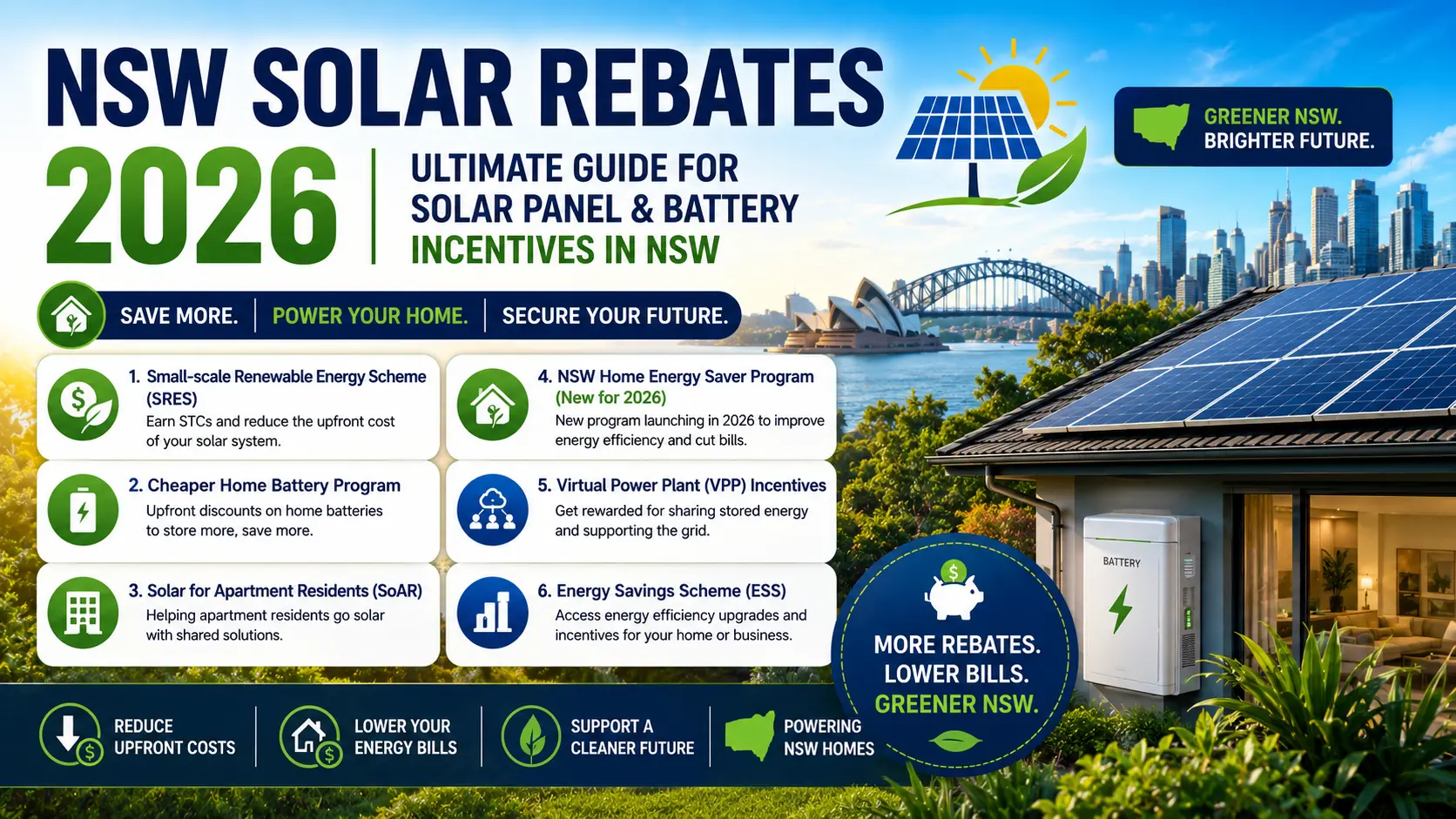
New South Wales (NSW) is leading the charge in the renewable energy transition with a range of government subsidies aimed at making solar energy and battery storage more accessible. As electricity prices climb and the commitment to reducing carbon emissions intensifies, NSW residents and businesses have a unique chance to lower costs while supporting a greener, more sustainable future. This guide explores the various NSW solar rebates, battery rebates, and related schemes such as the Federal Government’s Small-scale Renewable Energy Scheme (SRES) and Cheaper Home Battery Program; NSW Government’s SoAR, NSW Home Energy Saver Program, Energy Savings Scheme, and Virtual Power Plant incentives.
NSW Solar Rebates At a glance
- Small-scale Renewable Energy Scheme (SRES)
- Cheaper Home Battery Program
- Solar for Apartment Residents (SoAR)
- NSW Home Energy Saver Program (New for 2026)
- Virtual Power Plant (VPP) Incentives
- Energy Savings Scheme (ESS)
NSW Solar Panel Rebates
Small-scale Renewable Energy Scheme (SRES) & STCs
The federal SRES program underpins much of the solar subsidy available in NSW. When you install a new solar system, you generate Small-scale Technology Certificates (STCs), which reflect the estimated amount of renewable energy your system will produce until 2030. These certificates can be sold, and their value is applied as an upfront discount on the installation cost. For example, a typical 6.6 kW system can save NSW homeowners approximately $3,000–$3,500 through STC discounts.
Eligibility for SRES:
- Individual Homeowners: Homeowners who install eligible renewable energy systems, such as solar panels, air-source heat pumps, or small wind turbines.
- Small Businesses: Small businesses installing eligible renewable energy systems that meet the criteria established by the government.
- Approved Installers: Systems must be installed by accredited installers and meet technical requirements for certification.
- Location and System Size: The amount of STCs awarded depends on the location (solar exposure, for instance) and the capacity of the system.
Benefits of SRES:
- Financial Support: The key benefit of the SRES is the ability to generate STCs, which can be sold to reduce the upfront cost of installing renewable energy systems.
- Environmental Impact: By encouraging the installation of renewable energy systems, SRES helps reduce carbon emissions and contributes to Australia’s renewable energy goals.
- Energy Savings: Installing renewable energy systems like solar panels can significantly lower electricity bills by reducing dependence on the grid.
- Grid Independence: With solar panels or other systems, homeowners and businesses can reduce their reliance on traditional energy sources, enhancing energy security.
For more information, visit the detailed SRES guide.
Solar for Apartment Residents (SoAR)
For those living in apartment complexes and multi-unit dwellings, the Solar for Apartment Residents (SoAR) grant is a dedicated program that helps overcome the challenges of installing rooftop solar on apartments. This initiative provides grant funding to cover up to 50% of the installation cost (up to $150,000 with a per-project cap), making renewable energy accessible to a wider range of residents. Funding is available for the installation of shared rooftop solar PV systems on multi-unit dwellings with 3 to 55 residential lots.
The building must be a completed development, not have had a solar system installed in the past 10 years, and have an active strata insurance policy covering the solar installation. Grant funds can be used for purchasing and installing solar panels, inverters, mounting systems, solar sharing technology, and related safety equipment. Enabling works like essential roof waterproofing are also eligible, provided they do not exceed 10% of the total project cost.
Key information
- Status: Open
- Grant amount: Up to $150,000 per project
- Application opened: 28 February 2025
- Application closes: 4 December 2026, 5:00 pm
Eligibility Criteria of SoAR:
- Applicant Eligibility: Applications must be submitted by the residential owners corporation managing the strata scheme or an authorized strata managing agent. Individual property owners or tenants are not eligible to apply directly.
- Building Eligibility: The building must be located in NSW, be registered under the Strata Schemes Management Act 2015, and have an active strata insurance policy that covers the solar installation.
- Previous Solar Installations: Buildings that have received funding for a solar PV system under this program in the past are not eligible to apply again.
For more information, visit the detailed SoAR guide.
Solar Battery Rebates NSW:
Cheaper Home Battery Program
Cheaper Home Batteries Program is an Australian Government initiative that provides an upfront discount on eligible home battery systems through the Small-scale Renewable Energy Scheme (SRES). The rebate amount varies depending on the battery’s usable capacity, installation date, and prevailing STC values. The program is available to households, small businesses, and community organisations with new or existing rooftop solar systems.
Key Facts: Cheaper Home Batteries Program
- Start: Launching across the country on July 1, 2025
- End: Operates through 2030, with rebates decreasing progressively
- Money saved: A typical household could save around $2,300 annually on energy costs with a new solar and battery setup
- Scope: Covers both new and existing rooftop solar installations; eligible for small businesses and community facilities
- Eligibility: Eligible for small businesses and community facilities, with subsidies for batteries up to 50 kWh and total systems up to 100 kWh
- Income Restriction: No income restrictions—accessible to all qualifying households and businesses
-
From 1 May 2026, a new tiered rebate structure applies:(0–14 kWh: 100% STC factor, 14–28 kWh: 60% STC factor, 28–50 kWh: 15% STC factor)
For a 20 kWh usable capacity battery installed (STC factor 6.8, $40/STC)
- First 14 kWh: 14 × 6.8 × 100% = 95.2 STCs × $40 = $3,808
- Next 6 kWh (14-20 kWh): 6 × 6.8 × 60% = 24.48 STCs × $40 = $979
- (No capacity over 28 kWh, so third tier unused)
So, the total rebate will be ($3,808 + $979) = $4787
For more detailed information on eligibility criteria and application processes, visit the detailed guide.
NSW Home Energy Saver Program (New for 2026)
On 17 June 2026, the NSW Government launched the $557 million Home Energy Saver Program to help eligible households reduce energy bills by making energy-efficient home upgrades more affordable. Eligible households will now be able to access zero-interest loans of up to $15,000 to install energy-saving and cost-cutting upgrades.
What Upgrades Are Covered?
Eligible households can use the program to install:
- Rooftop solar systems
- Home battery storage
- Ceiling insulation
- Reverse-cycle air conditioning
- Switchboard upgrades
- Ceiling fans
- Draught-proofing solutions
These upgrades can help households lower electricity bills, improve energy efficiency, and make homes cooler in summer and warmer in winter.
Zero-Interest Loans
From 17 June 2026, eligible households can access:
- Up to $15,000 interest-free loan
- Repayment period of up to 10 years
- Available to households with a combined taxable income of up to $210,000
- Expected to benefit more than 32,000 NSW households
- Part of a $480 million NSW Government investment
Instead of paying the full installation cost upfront, households can spread repayments over a decade.
Example
If your household earns $200,000 annually and you install a $10,000 solar and battery system, you can apply for a zero-interest loan and repay the amount over 10 years.
Targeted Discounts (Available Later in 2026)
The NSW Government will also introduce:
- Discounts of up to $4,000
- Available to households with a combined annual income of up to $80,000
- Available to eligible concession card holders
- Supported by a $77 million investment
Households can combine a discount with a loan for the same upgrade.
Important: If you’re applying for both, apply for the discount first, then use the zero-interest loan to cover any remaining balance.
Support for Renters
Eligible renters can also access these incentives, provided they obtain their landlord’s permission before undertaking energy-saving upgrades.
Eligibility Summary
| Criteria | Requirement |
|---|---|
| Loan amount | Up to $15,000 |
| Loan interest | 0% |
| Loan repayment term | Up to 10 years |
| Maximum household income (loan) | $210,000 |
| Maximum household income (discount) | $80,000 |
| Discount amount | Up to $4,000 |
| Concession card holders | Eligible |
| Renters | Eligible with landlord approval |
How to Apply
For information and to apply, visit www.energy.nsw.gov.au/home-energy-saver.
Energy Savings Scheme (ESS)
The Energy Savings Scheme (ESS) is a New South Wales (NSW) Government initiative designed to reduce energy consumption and greenhouse gas emissions by offering financial incentives to businesses and households that implement energy-efficient measures. Participants can receive financial rewards for activities such as upgrading to energy-efficient lighting, HVAC systems, motors, and refrigeration units. Through the scheme, businesses and households earn Energy Savings Certificates (ESCs) for eligible activities, which can be traded or sold to energy retailers obligated to meet specific energy savings targets.
Scope of Benefits:
- Connect your battery to a Virtual Power Plant (VPP)
- Upgrade air conditioner
- Upgrade hot water system
Eligibility Criteria of ESS:
- Location: The ESS is available to businesses and households located in NSW.
- Participation: To participate, businesses must be customers of an electricity retailer that is part of the ESS.
- Types of Eligible Activities: Eligible activities include installing energy-efficient equipment such as LED lighting, upgrading HVAC systems, and improving refrigeration efficiency.
Common Benefits of Participating in ESS:
- Cost Savings: By implementing energy-efficient upgrades, participants can lower their electricity bills through reduced energy consumption.
- Financial Rewards: The sale of ESCs provides additional financial incentives, offsetting the initial costs of energy-efficient investments.
- Environmental Impact: Reducing energy consumption contributes to lowering greenhouse gas emissions, supporting NSW’s sustainability goals.
- Enhanced Property Value: Energy-efficient properties may attract higher valuations due to reduced operational costs and improved environmental performance.
For more detailed information on the ESS, including how to participate and the latest updates, visit the NSW Government’s Energy Savings Scheme.
Under the ESS, eligible energy-saving activities earn Energy Savings Certificates (ESCs), which can then be traded or surrendered, further reducing costs for participants. This scheme complements the solar and battery incentives by promoting a holistic approach to energy management.
Virtual Power Plant (VPP) Incentives
A Virtual Power Plant (VPP) is a network of interconnected battery storage systems that collectively contribute to grid stability by supplying stored energy during peak demand periods. In New South Wales (NSW), under the Energy Saving Scheme (ESS), residents participating in a VPP offer both financial incentives and environmental benefits. NSW residents can receive additional payments maximum $1,500 for connecting their battery storage systems to a VPP.
The upfront incentive you receive depends on the usable capacity of the battery in kilowatt-hours (kWh). Larger batteries will receive a larger incentive.
From 1 July 2025, the incentive amounts you can receive are:
- up to $550 for a 10 kWh battery
- up to $1,500 for a 27 kWh battery
This incentive encourages households to contribute excess energy to the grid during peak times, enhancing grid reliability, and can be claimed twice, with at least a three-year interval between claims. By enrolling in a VPP, your battery is managed to discharge stored energy back to the grid during peak demand periods, providing a revenue stream while supporting the grid by reducing reliance on fossil fuels during high-demand times.
Eligibility Criteria for VPP Participation:
- Battery Specifications: To participate, your battery must have a usable capacity between 2 kWh and 28 kWh and meet specific performance and warranty requirements, including a minimum of six years remaining on the warranty.
- Installation by Accredited Suppliers: The battery must be installed by an Accredited Certificate Provider (ACP) recognized under the Peak Demand Reduction Scheme (PDRS). It’s essential to choose an installer who is accredited to ensure compliance with program standards.
Benefits of VPP Participation:
- Additional Income: Selling excess stored energy back to the grid through a VPP provides an extra income stream, effectively offsetting energy costs.
- Grid Support: By participating, you contribute to grid stability, especially during peak demand periods, reducing the likelihood of outages and supporting the transition to renewable energy sources.
- Environmental Impact: Utilizing stored energy during peak times decreases reliance on fossil fuels, aligning with NSW’s goal to reduce emissions by 70% by 2035 and achieve net-zero emissions by 2050.
For more detailed information on VPPs and to find accredited suppliers in NSW, visit the NSW Government’s Energy Savings Scheme
By participating in a VPP, battery owners not only earn cash incentives but also contribute to grid stability, which is crucial during peak demand periods.
Air Conditioner Upgrading Incentives
The government will provide you with an incentive if you install a new air conditioner or replace an old one in NSW. This is paid as an upfront discount on the quote you are given.
If you are eligible, the discount can range from:
- $340 to $560 if you install a new 6kWh air conditioning system
- $440 to $730 if you replace an old air conditioner with a 6kW split system.
The actual discount amount and final cost of your installation to receive the incentive for a new or upgraded air conditioner in NSW will vary depending on the following factors:
- The installer you choose.
- The location of your installation and the services provided, which may include things like travel and transportation costs.
- The model you choose to install.
- The design of your home or business may influence the complexity of the installation and the need for any additional building work.
To get the installation discount, you need to get the correct paperwork from a trusted installer. We can offer you the best installation discounts and deals in NSW. We will do our best to help you get the cost of your new air conditioner and installation incentives. So that you can get this discount. Get a free quote now.
Hot Water System Upgrading Incentives
You can get a rebate from the NSW Government to help reduce the cost of switching to a new energy-efficient solar or heat pump hot water system in NSW. Switching to a new energy-efficient hot water system in your home or business can help you. Save money on your electricity bill in the long term by using less energy. Reduce maintenance costs with a more efficient and reliable new system. Also reduce your emissions and be an active part of helping NSW reach net zero by 2050.
In NSW, the government will offer you an incentive if you install a new hot water system. This will be paid as an upfront discount on your quote.
If you are eligible to receive a new hot water system installation incentive, the discounts can be:
- $400 to $670 if you replace your electric water heater with an air source heat pump water heater.
- $190 to $310 if you replace your gas water heater with an air source heat pump water heater.
The actual rebate amount and final cost of your installation will vary depending on the following factors:
- The installer you choose.
- The location of your installation and the services provided may include travel and transportation costs.
- The model you choose for your installation.
- The design of your home or workplace building, which can affect the complexity of the installation and any additional construction work required.
Aussie Solar Tech is ready to help you find the best installation incentives and get the best deal. To get your new hot water system and installation rebate, you need the right paperwork, which can only be done by a trusted installer. We are also ready to provide you with all the services you need, from what hot water system you need, how to use the new system and how to dispose of the old hot water system.
Conclusion
NSW’s robust suite of solar and battery incentives in 2026 provides an unprecedented opportunity for homeowners and businesses to invest in renewable energy. By combining the benefits of solar rebates through STCs and the SoAR program, battery rebates under the cheaper home battery program and the PRDS, comprehensive energy savings through the ESS, and additional savings via Virtual Power Plant connections, NSW residents can significantly reduce their energy costs while contributing to a sustainable future.

Shah Tarek is a Solar Energy Consultant with 10 years experience in solar system design and solar consultancy field at Australia. He is now a Director, Operation & Consultancy Division at Aussie Solar Tech, a leading Australian solar retailer and installer. Here he is writing informative and engaging solar content that educates the community on the benefits of solar power. His work supports Aussie Solar Tech’s mission to promote sustainable energy solutions and foster a greener future for Australia.

Seraphim Solar Panels Review: Efficiency, Reliability, and Value Unveiled

Talesun Solar Panels: Honest Review Before You Buy

Sungrow Battery VS Tesla Powerwall : Which is Best in Australia?

Leapton Solar Panels Review: Affordable Energy Solution

REC Solar Panels Review: Outstanding Efficiency & Durability

Best Hybrid Inverters for Home Solar Systems in 2025
Best Solar Battery In Australia 2026 — Complete Guide

Sigenergy VS Fox ESS Battery: Which is The Best Choice for 2026

How Much Do Solar Panel Costs in Australia? (2026 Price Guide)

