
LONGi’s Hi-MO 7 series uses N-type TOPCon cell technology to reach up to 23.3% efficiency, with a sleek black finish that suits modern home designs. LONGi has invested heavily in lead-free, lower-carbon manufacturing, which appeals to environmentally conscious buyers without compromising on output.
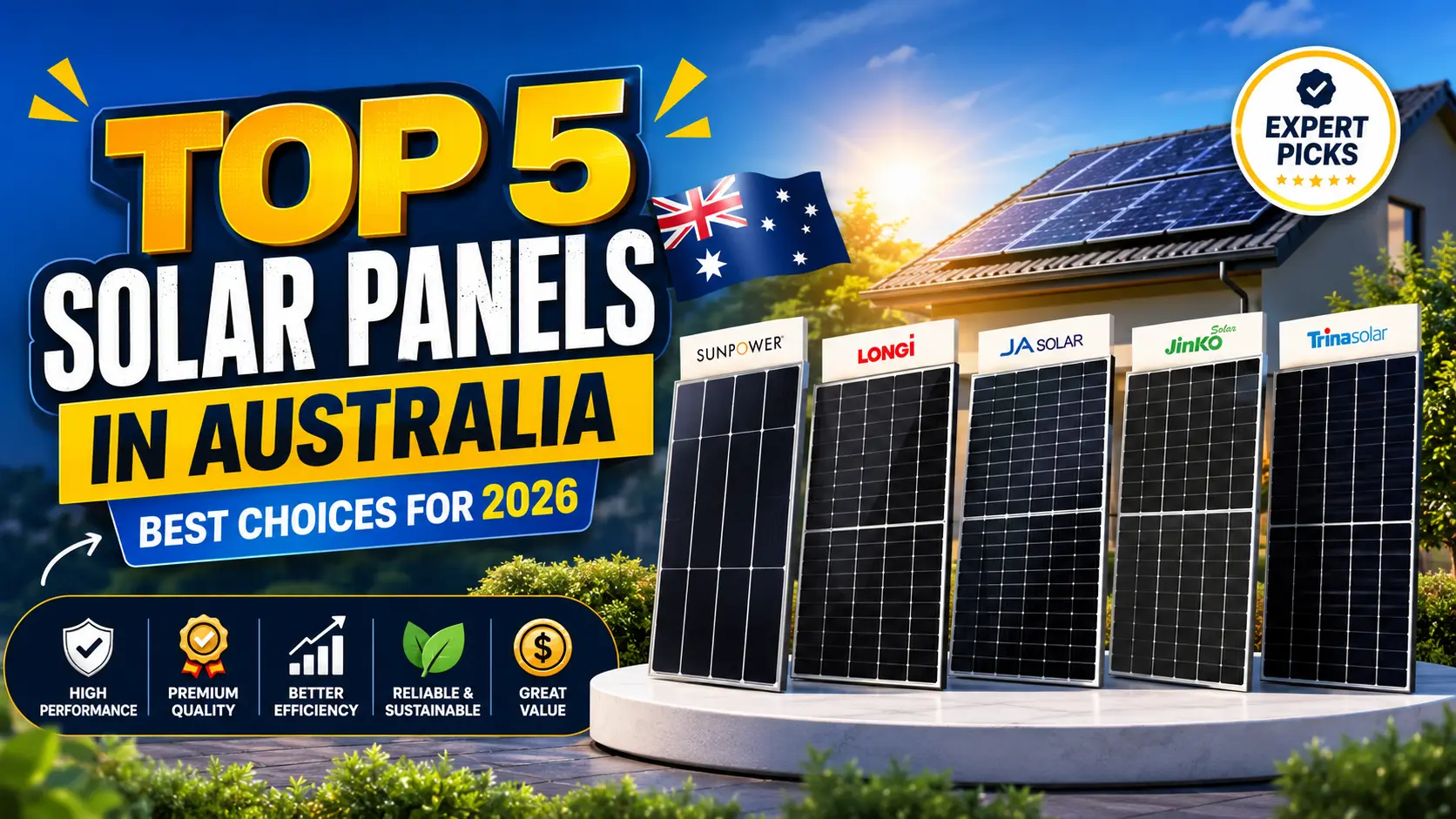
Choosing the best solar panel in 2026 isn’t just about chasing the highest efficiency number on a spec sheet. It’s about matching panel technology, warranty strength, and real-world performance to your roof, your climate, and your budget. With electricity prices climbing across every state and over 8,500 CEC-approved panels on the market, the gap between a good investment and a wasted one comes down to a handful of factors most buying guides gloss over.
In this guide, Aussie Solar Tech breaks down the top 5 solar panels available in Australia for 2026 — AIKO, LONGi, SunPower, REC, and Jinko — based on efficiency, degradation rate, warranty terms, and suitability for Australian conditions. We’ll also show you how to read a datasheet like an installer does, what actually drives long-term value, and how government rebates can cut your upfront cost. Ready to compare? Get a free, no-obligation quote at the end of this guide.
Why Your Solar Panel Choice Matters in 2026
Australia remains one of the best places in the world for solar generation, but harsher summers, more frequent heatwaves, and rising STC rebate step-downs mean panel quality matters more than ever. A panel that degrades faster or underperforms in 40°C heat will cost you real money over a 25-year system life — not just in lost generation, but in slower payback.
However, selecting the right solar panel system is crucial for maximizing your investment. Aussie Solar Tech helps you navigate through the different options available in the market. Here, we will highlight the top 5 solar panels in Australia for 2026, based on their efficiency, longevity, and overall performance
How We Ranked These Panels
We assessed each panel against four measurable criteria:
- Efficiency — how much electricity the panel generates per square metre of roof space
- Degradation rate / performance ratio — how much output the panel retains after 25 years
- Warranty strength — product warranty (covers defects) and performance warranty (guarantees minimum output)
- Suitability for Australian conditions — heat tolerance, shading performance, and (where relevant) coastal durability
Top 5 Solar Panels Ranked by Aussie Solar Tech Experts
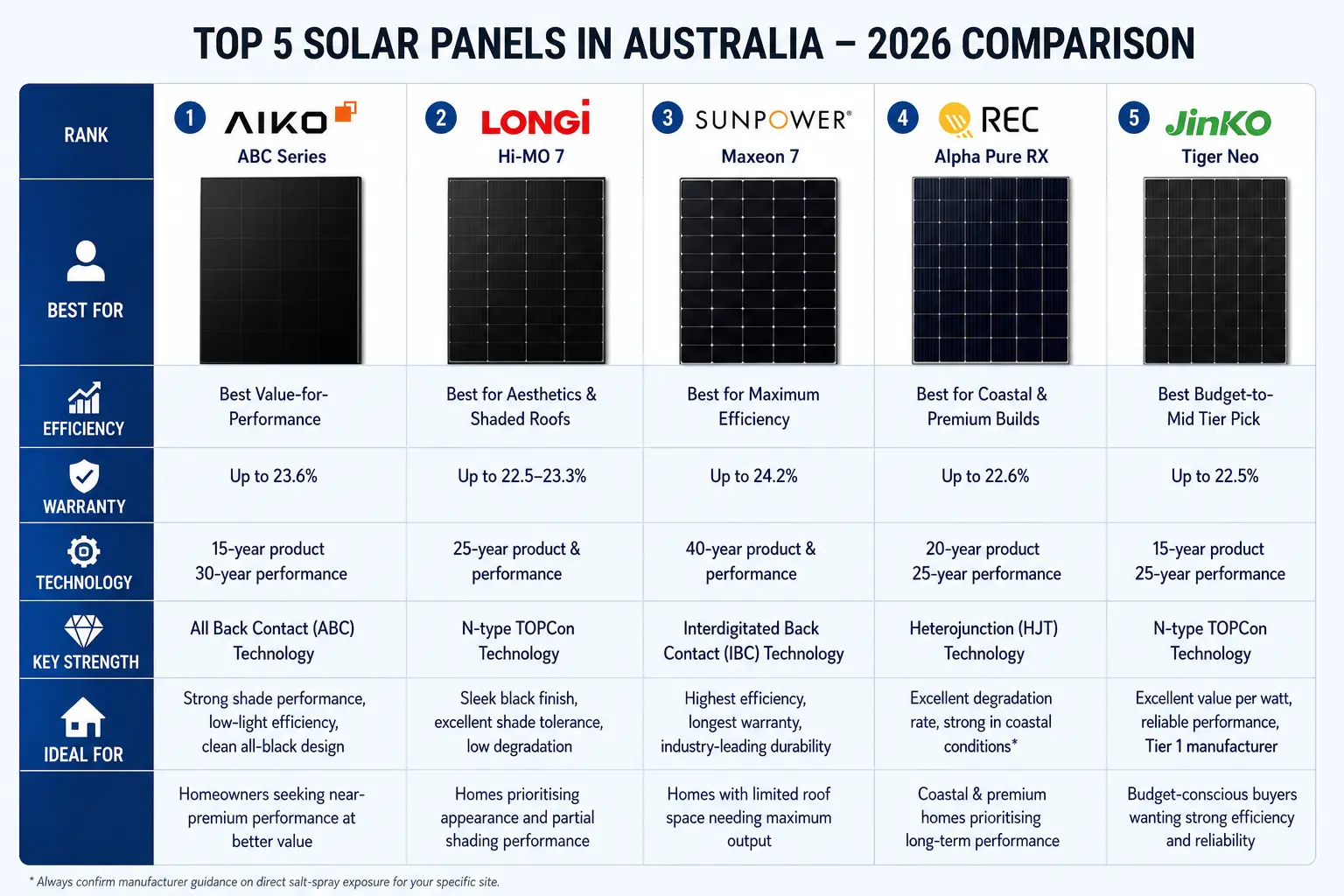
1. AIKO ABC Series — Best Value-for-Performance
Best For: Homeowners who want near-premium performance without the premium price tag.
AIKO‘s All Back Contact (ABC) panels have rapidly become one of the most installed premium panels in Australia, combining up to 23.6% efficiency with strong shade performance and a 25-year product warranty. Their back-contact cell design hides all wiring behind the cell, giving a cleaner all-black aesthetic while reducing shading losses — a genuine advantage for Aussie roofs with partial tree cover.
Key Features:
- Efficiency: Up to 23.6%
- Warranty: 15-year product warranty, 30-year performance warranty
- Performance: Outstanding in low-light and shaded conditions
- Design: Sleek all-black aesthetics for modern homes
2. LONGi Hi-MO 7 — Best for Aesthetics & Shaded Roofs
Best For: Homes prioritising appearance alongside solid mid-to-high efficiency.
Key Features:
- Efficiency: Up to 22.5-23.3%
- Warranty: 25-year product and performance warranty
- Design: Sleek black finish, ideal for modern homes
- Ideal For: Homes with aesthetic concerns and partial shading issues
3. SunPower Maxeon 7 — Best for Maximum Efficiency
Best For: Homes with limited roof space that need maximum output per panel.
SunPower’s Maxeon range remains the efficiency benchmark in the Australian market, reaching up to 24.2% thanks to its Interdigitated Back Contact (IBC) cell technology. Maxeon panels also carry the longest warranty available on any panel sold in Australia — up to 40 years on both product and performance — reflecting genuine confidence in long-term durability.
Key Features:
- Efficiency: Up to 24.2.8%
- Warranty: 25-year product and performance warranty
- Durability: Resistant to corrosion and UV degradation
- Ideal For: Residential and commercial installations
With its long-lasting performance and high efficiency, SunPower solar panels are perfect for homeowners and businesses looking for reliable solar energy solutions.
Explore SunPower Solar Panels →
4. REC Alpha Pure RX — Best for Coastal & Premium Builds
Best For: Premium builds, coastal homes, and buyers prioritising long-term degradation performance over upfront cost.
REC’s Alpha Pure RX uses Heterojunction (HJT) cell technology, delivering up to 22.6% efficiency and one of the best performance ratios in the industry — retaining roughly 92% of nominal output after 25 years. REC panels are widely regarded by installers as a strong choice for coastal properties, though always confirm manufacturer guidance on direct salt-spray exposure for your specific site.
Key Features:
- Efficiency: Up to 22.6%
- Warranty: 20-year product warranty, 25-year performance warranty
- Technology: N-type monocrystalline cells for enhanced performance
- Sustainability: Made from eco-friendly materials
For those seeking innovative technology and high-efficiency solar panels, the REC Alpha Pure Series is an excellent choice for Australian homes and businesses.
5. Jinko Tiger Neo — Best Budget-to-Mid Tier Pick
Best For: Efficiency & Reliability
As the world’s largest solar panel manufacturer by volume, Jinko‘s Tiger Neo range uses N-type TOPCon cells to reach up to 22.5% efficiency at one of the most competitive prices per watt in the Tier 1 segment, backed by a 25-year product and performance warranty.
Key Features:
- Efficiency: Up to 22.5
- Warranty: 15-year product warranty, 25-year performance warranty
- Performance: Great for residential and commercial applications
- Technology: Advanced PERC and multi-busbar cell design
The Jinko Solar Tiger Series is a top choice for those seeking high value with excellent performance in both residential and commercial setups.
Choosing Your Ideal Panels
For 2026 Australian market (CEC-approved, high-efficiency Tier 1 brands):
| Brand / Model | Efficiency | Cell Type | Product Warranty | Performance Warranty | Best For |
|---|---|---|---|---|---|
| AIKO ABC | Up to 23.6% | N-type ABC | 25 years | 30 years | Value + shade performance |
| LONGi Hi-MO 7 | Up to 23.3% | N-type TOPCon | 25 years | 25 years | Aesthetics, partial shade |
| SunPower Maxeon 7 | Up to 24.2% | N-type IBC | Up to 40 years | Up to 40 years | Maximum efficiency |
| REC Alpha Pure RX | Up to 22.6% | N-type HJT | 25 years | 25 years | Coastal, low degradation |
| Jinko Tiger Neo | Up to 22.5% | N-type TOPCon | 25 years | 25 years | Budget Tier 1 |
Explore our Current Offer for a sustainable future powered by the sun.
Understanding Solar Panel Technology (So You Buy With Confidence)
Monocrystalline vs Polycrystalline: What’s the Difference?
Almost every panel on this list is monocrystalline — made from a single, pure silicon crystal, giving higher efficiency (typically 20–24%) and better low-light performance than older polycrystalline panels (typically 17–19%, identifiable by their blueish, speckled look). Polycrystalline panels are now rare in new Australian installations.
N-Type vs P-Type Cells: TOPCon, HJT, IBC and ABC Explained
Most premium panels in 2026 use N-type cells rather than the older P-type (PERC) design, because N-type cells degrade more slowly and perform better in heat — a meaningful advantage in the Australian climate. The main N-type variants you’ll see on datasheets:
- TOPCon (Tunnel Oxide Passivated Contact) — used by LONGi, Jinko; strong all-rounder
- HJT (Heterojunction) — used by REC; typically the best temperature coefficient
- IBC (Interdigitated Back Contact) — used by SunPower; highest efficiency, wiring hidden behind the cell
- ABC (All Back Contact) — AIKO’s proprietary back-contact design; strong shade tolerance
What Is a Performance Ratio (and Why It Matters More Than Efficiency Alone)
Efficiency tells you how much power a panel produces on day one. The performance ratio tells you how much of that output it will still produce after 25 years. A panel with a 92% performance ratio (REC) will be generating meaningfully more power in year 20 than one with an 87% ratio — even if the second panel had a slightly higher headline efficiency at installation. Always check both numbers, not just the efficiency percentage on the box.
How to Choose the Right Solar Panel for Your Home
Matching Panels to Your Climate
- Hot inland regions (WA, NT, inland QLD): prioritise a low temperature coefficient — HJT (REC) and IBC (SunPower) typically perform best.
- Shaded roofs (trees, neighbouring buildings): AIKO’s ABC technology and LONGi’s shade-tolerant Hi-MO design are strong choices.
- Coastal properties: REC is commonly recommended by installers for coastal resilience, but always check the manufacturer’s specific guidance on salt-spray exposure for your exact site.
CEC Approval and Why It’s Non-Negotiable
Every panel you consider must appear on the Clean Energy Council’s approved modules list. Beyond eligibility for STC rebates, CEC approval confirms a panel has passed mandatory safety and quality testing — all five panels in this guide are CEC-approved.
Tier 1 Panels Aren’t Always “The Best”
“Tier 1” is a financial classification (from BloombergNEF) based on a manufacturer’s bankability and project volume over the past two years — it says nothing about a panel’s actual efficiency or degradation rate. Plenty of excellent panels are Tier 1; the label is a useful starting filter, not a substitute for checking the actual datasheet.
What Will It Cost? Solar Panel Pricing in Australia (2026)
Panel pricing in 2026 typically ranges from roughly $0.27–$0.35 per watt for budget-to-mid Tier 1 brands (Jinko, Trina) up to $0.50+ per watt for premium options (SunPower, REC). For a standard 10kW residential system, this generally translates to a panel cost of $2,700–$5,000+ before installation, inverter, and labour.
How STC Rebates Reduce Your Upfront Cost
The federal Small-scale Technology Certificate (STC) scheme reduces your upfront solar cost automatically at point of sale — your installer applies the discount before you pay. Combined with state-based incentives, this can cut thousands off your total system price. If you’re in NSW or QLD, see our dedicated guides: NSW Solar Rebates 2026 and QLD Solar Rebate for Renters.
Pairing Your Panels With a Solar Battery
The best solar panel is only half the equation if you want to maximise self-consumption and protect against rising feed-in tariff cuts. Pairing any of the panels above with a battery — such as a 10kWh or 13kWh system — lets you store excess daytime generation and use it at night, rather than exporting it at low rates. See our full Best Solar Battery in Australia 2026 guide for a side-by-side comparison.
Final Thoughts: Which Solar Panel Is Right for You?
There’s no single “best” solar panel for every Australian home — only the best panel for your roof, climate, and budget. If you want maximum efficiency on a small roof, SunPower Maxeon 7 is hard to beat. If your roof gets partial shade through the day, AIKO or LONGi will outperform a higher-efficiency panel that struggles in those conditions. And if you’re near the coast, REC’s track record on durability is worth the premium.
Whichever panel suits you best, the biggest factor in long-term performance is still installation quality. Get a free, no-obligation quote from Aussie Solar Tech — our CEC-accredited team will recommend the right panel and system size for your specific home, and walk you through eligible 2026 rebates. Or call us directly on 02 6182 2877.
Explore our details solar panels buying guide →
Frequently Asked Questions
1. What are the best solar panels in Australia for 2026?
The top-performing panels for 2026 are AIKO ABC, LONGi Hi-MO 7, SunPower Maxeon 7, REC Alpha Pure RX, and Jinko Tiger Neo — chosen for their efficiency, warranty length, and performance in Australian conditions.
2. Which solar panels last the longest?
SunPower Maxeon 7 offers the longest warranty available in Australia (up to 40 years), while REC Alpha Pure panels have one of the best performance ratios, retaining around 92% of output after 25 years.
3. What’s the difference between monocrystalline and polycrystalline solar panels?
Monocrystalline panels are more efficient (typically 20–24%) and perform better in low light, while polycrystalline panels are less efficient (17–19%) but generally cheaper. Almost all panels installed in Australia in 2026 are monocrystalline.
4. Are expensive solar panels worth it?
For most homes, yes — premium panels typically offer higher efficiency, longer warranties, and slower degradation, which translates to greater savings over a 25-year system life. For smaller budgets or larger roofs where space isn’t constrained, a quality mid-tier panel (like Jinko Tiger Neo) can still deliver strong value.
5. Do I need a Tier 1 solar panel?
Not necessarily. Tier 1 is a financial bankability rating, not a performance score. It’s a useful starting filter, but always check the actual efficiency, warranty, and performance ratio rather than relying on the Tier 1 label alone.
6. How much do solar panels cost in Australia in 2026?
Panel costs range from roughly $0.27–$0.35/watt for budget-to-mid Tier 1 brands up to $0.50+/watt for premium brands, before STC rebates are applied.

Shah Tarek is a Solar Energy Consultant with 10 years experience in solar system design and solar consultancy field at Australia. He is now a Director, Operation & Consultancy Division at Aussie Solar Tech, a leading Australian solar retailer and installer. Here he is writing informative and engaging solar content that educates the community on the benefits of solar power. His work supports Aussie Solar Tech’s mission to promote sustainable energy solutions and foster a greener future for Australia.
Recent Posts


Seraphim Solar Panels Review: Efficiency, Reliability, and Value Unveiled

Talesun Solar Panels: Honest Review Before You Buy

Sungrow Battery VS Tesla Powerwall : Which is Best in Australia?

Leapton Solar Panels Review: Affordable Energy Solution

REC Solar Panels Review: Outstanding Efficiency & Durability

Best Hybrid Inverters for Home Solar Systems in 2025
Best Solar Battery In Australia 2026 — Complete Guide

Sigenergy VS Fox ESS Battery: Which is The Best Choice for 2026

How Much Do Solar Panel Costs in Australia? (2026 Price Guide)

