
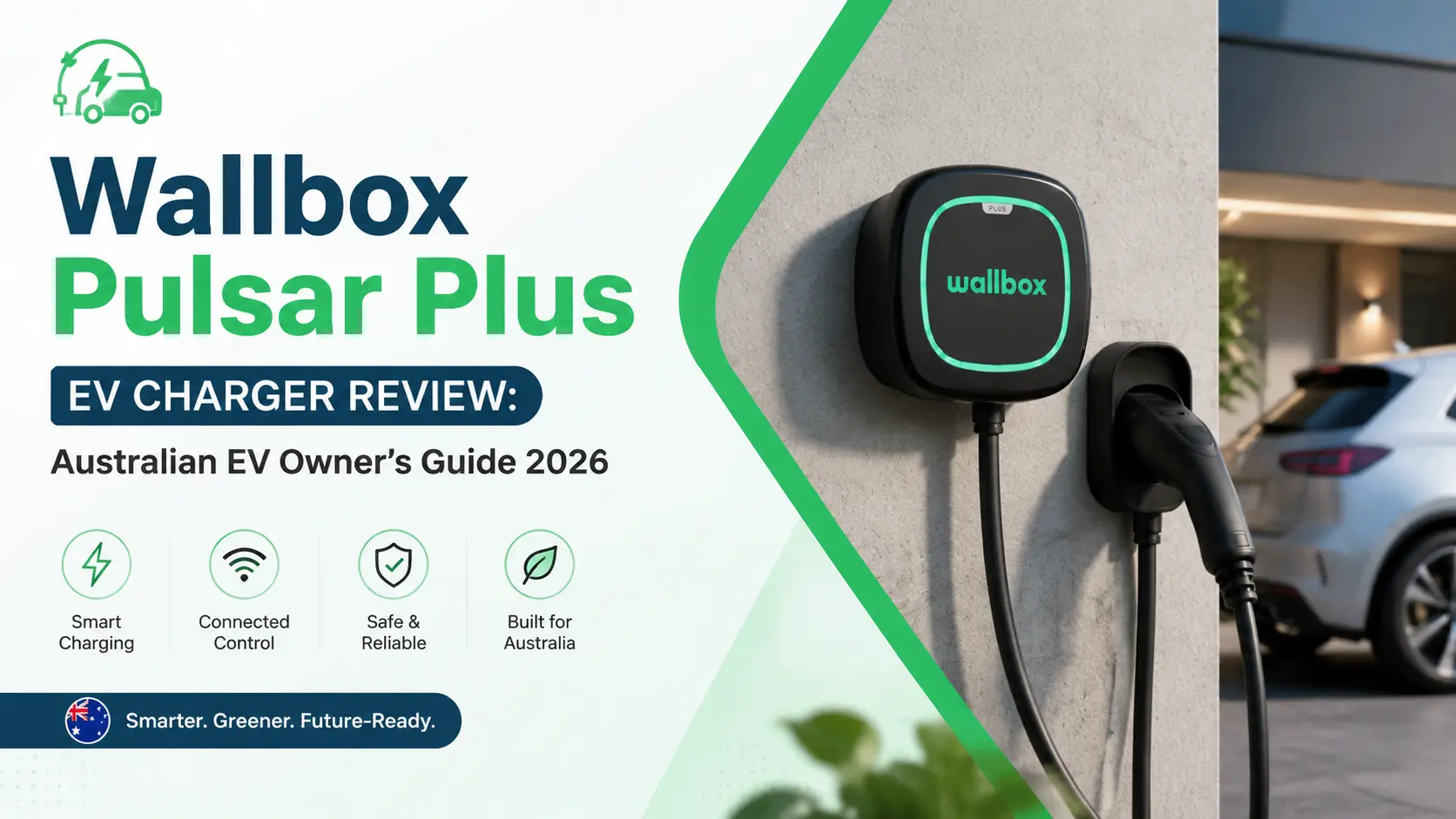
The Wallbox Pulsar Plus has a global track record of reliable performance at a mid-range price. A huge number of Australian EV owners prefer this charger for its multiple-phase configuration, compact size, and universal compatibility. This Wallbox Pulsar Plus review comes from our own experience with the product as installers and direct user feedback.
At most Australian retailers, the Wallbox sells for approximately $1,349 before installation. This figure might vary a little depending on who you are buying from. It comes in all three 7.4 kW, 11 kW, and 22 kW variations with a 5 m- 7 m Type-2 tethered cable. Features like Power Sharing, Power Boosting, and Eco-Smart charging have gained it the recognition of a smart EV charger.
Like any product, the Wallbox Pulsar Plus has its flaws alongside its awesome benefits. As a buyer, you need to carefully measure them to decide if this is the right EV charger for your needs. The following discussion will help you with that process.
Wallbox Pulsar Plus EV Charger Review: Technical Specifications & User Benefits
| Feature | Specification | User Benefit |
| Model | Pulsar Plus | Reliable and compact residential charging unit. |
| Colour | White or Black | Choose an aesthetic matching your home style. |
| Charging Mode (IEC 61851-1) | Mode 3 | Standard, safe charging for your vehicle. |
| Dimensions | 166 × 163 × 82 mm | Discreet, space-saving design for any wall. |
| Weight | 1 kg | Easy, lightweight installation on any surface. |
| Operating Temperature | -25 °C to 40 °C | Operates reliably across diverse weather conditions. Issues regarding this are discussed later. |
| Storage Temperature | -40 °C to 70 °C | Maintains hardware integrity during extreme storage. |
| Connectivity | Wi-Fi, Bluetooth | Control your charger from anywhere with ease. |
| User Identification | myWallbox App & Portal | Securely manage and restrict charger access. |
| User Interface | myWallbox App & Portal | Simple, intuitive control from your phone. |
| Charger Status Information | Halo RGB LED, App | Real-time charging status at a glance. |
| Included Features | Power Sharing, Power Boost | Prevents costly electrical upgrades and breaker trips. |
| Optional Features | Dynamic Power Sharing | Efficiently distributes power across multiple EVs. |
| Charging Power | 7.4 kW, 11 kW, 22 kW | Choose a charging speed that suits your electrical supply. |
| Rated Voltage (AC ±10%) | 230 V, 400 V | Compatible with standard residential electrical systems. |
| Rated Current | 16 A (3P), 32 A (1P/3P) | Flexible current options for different installations. |
| Connector Type | Type 1 / Type 2 | Compatible with virtually all modern EVs. |
| Cable Width | Up to 3 × 10 mm² / 5 × 10 mm² | Supports safe and reliable power delivery. |
| Configurable Current | 6 A to rated current | Adjust charging to match your home’s available capacity. |
| Rated Frequency | 50 Hz / 60 Hz | Compatible with global electrical standards. |
| Protection Rating | IP54 / IK08 | Weatherproof and impact-resistant for outdoor installation. |
| Surge Category | CAT III | Protects the charger from electrical surges. |
| Residual Current Detection | AC 30 mA / DC 6 mA | Advanced electrical safety for added peace of mind. |
Who Makes the Wallbox Pulsar Plus EV Charger
Wallbox N.V. (NYSE: WBX), a Barcelona-based EV charging and energy management company, manufactures the Wallbox Pulsar Plus EV charger. Enric Asunción and Eduard Castañeda founded the company in 2015.
The company designs, manufactures, and distributes its own hardware. In other words, they are not one of those brands that white-labels someone else’s charger instead of engineering the product in-house. The company’s first product was a compact home charger. That early focus on making home charging simple has stayed close to Wallbox’s identity ever since.
Over the past decade, Wallbox has sold more than 1 million chargers worldwide, sold across over 100 countries, and its customers have collectively driven more than 12 billion electric kilometres.
Wallbox Australian Support Network
Wallbox does not run its own retail storefront or corporate office in Australia. Instead, it operates through a network of Australian distribution and installation partners.
The largest and most established of these partners is JET Charge. It’s a Melbourne-headquartered EV charging specialist that has been operating locally for more than a decade. JET Charge stocks Wallbox hardware, provides trade pricing to installers through its partner store, and has worked directly with Wallbox on Australian-specific projects.
Wallbox hardware is also available through EVSE Australia, various solar and EV installers such as Aussie Solar Tech, and select car dealerships (like Volvo) that bundle a Wallbox charger with new EV purchases.
For most Australian buyers, “local support” for a Wallbox charger means one of two things: the installer who fitted it, or the distributor they bought it from. Warranty claims and hardware faults are generally handled through these channels rather than a Wallbox call centre based in Australia.
Wallbox Product Overview
The Pulsar Plus sits within a much larger Wallbox product family that spans home, workplace, and public charging. Here’s how the current lineup compares:
| Model | Segment | Max Power | Key Distinguishing Features | Comment |
| Pulsar Plus | Residential | 7.4 kW (1-phase) / 11–22 kW (3-phase) | Wi-Fi + Bluetooth, myWallbox app, OCPP 1.6, IP54, 3-year warranty | The subject of this review — the best all-round value option in the range, but the least weather-hardened |
| Pulsar Max | Residential | 7.4 kW (1-phase) / 11–22 kW (3-phase) | Same core smart features as Pulsar Plus, but IP55/IK10-rated and operating up to 50°C. 3-5-year warranty, depending on the seller. | The one to choose for harsh Australian outdoor conditions |
| Pulsar Pro | Commercial / shared | Up to 22 kW | RFID + app access control, Ethernet + 4G connectivity, IK10/IP55, built for apartment blocks and fleets | Designed for shared or semi-public charging where you need to control who can charge, not a home unit |
| Copper SB | Semi-public / workplace | Up to 22 kW | Facial-recognition style “Sense” technology, RFID, payment integration | Aimed at businesses wanting to monetise or manage charger access, not a residential product |
| Commander 2 / 2S | Commercial | Up to 22 kW per outlet, multi-connector | Twin-connector, advanced fleet and payment management | Built for depots and multi-vehicle sites, well beyond home-charging needs |
| Quasar / Quasar 2 | Residential (V2G) | Up to 7.4 kW (bidirectional) | Vehicle-to-grid and vehicle-to-home capability, CCS2 support on Quasar 2 | Wallbox’s flagship technology showcase; V2G approval in Australia is still limited to specific trials and states |
Flexible EV Charger For Single And Three Phase Homes
Many top Australian EV chargers are locked into a single power tier. The Wallbox Pulsar Plus breaks free by offering both single and three-phase charging.
You can buy the same core unit in a 7.4 kW single-phase configuration (32 A) and 11 kW or 22 kW three-phase configurations (16 A or 32 A per phase). That means you can specify it correctly for almost any Australian home’s electrical setup. No need to force an unnecessary upgrade.
Roughly 70–80% of Australian houses are still on single-phase power. For them, the 7.4 kW version will comfortably replenish a typical daily commute (30–50 km) in well under two hours. To fully charge a mid-size EV battery, the 7.4 kW Wallbox Pulsar Plus will need around 8 hours, roughly.
Three-phase power is increasingly common in newer Australian homes. Especially in Queensland and parts of NSW. The 22 kW version can be an excellent fit there.
However, in practice, very few electric cars sold in Australia can actually accept 22 kW on AC charging since most three-phase-capable EVs top out at 11 kW onboard. So, the real-world benefit of the 22 kW version is mostly future-proofing rather than an immediate speed gain.
Small EV Charger For Tight Garage Spaces
The Wallbox Pulsar Plus is one of the smallest EV chargers on the market at 166 × 163 × 82 mm. It weighs only about 1 kg without the cable. Users regularly describe it as “smaller than a toaster” or roughly the size of a household smoke alarm.
This small size becomes an important factor for buyers whose garages, carports, and exterior walls have limited clean mounting space. This is particularly true for apartments, townhouses, and older homes where the switchboard and parking spot weren’t designed with an EV charger in mind.
The Wallbox’s compact footprint makes it easier to mount discreetly near a garage door, on a narrow pillar, or on a wall shared with other equipment. Plus, its minimalist look (available in black or white with a subtle RGB LED “halo” that shows charging status) tends to blend in rather than dominate a wall the way some bulkier competitors do.
The charger comes standard with a tethered Type 2 cable in either a 5 m or 7 m length. Nothing extraordinary but not bad either.
Wallbox Pulsar Plus Solar Charging: What to Expect
The Wallbox Pulsar Plus is a solar-aware charger. In other words, it can detect the excess power from your rooftop solar panels and use it to charge your EV. The manufacturer calls it ‘Eco Smart’ charging, and you need the around-200$ Wallbox Power meter to use it.
Wallbox Solar Charging: Full Green Mode
Firstly, there is Full Green Mode. If you use this mode, the car charges exclusively from surplus solar generation. The charger constantly watches how much extra solar your panels are producing beyond what the rest of the house is using. It only starts charging once that surplus is big enough to power the car on its own.
For a single-phase home, that’s roughly 1.4 kW of spare solar; for three-phase, closer to 4 kW.
If a cloud rolls over and your surplus drops below that threshold, charging pauses and waits for the sun to come back rather than dipping into grid power to keep going.
Pulsar Plus Solar charging: Eco Mode.
The Eco Mode blends available solar with grid power to keep charging at a steady rate while still prioritising your own generation first. It’s “solar first, grid to fill the gap.”
This mode needs only a small amount of surplus solar to get going (as little as 460 W on a single-phase home). From there it tops up whatever the sun can’t provide with ordinary grid electricity.
In short, choose Full Green Mode if you want zero-cost charging and are happy to wait for sunny days. Choose Eco Mode if you want the car reliably charged by a certain time and are happy for some of that energy to come from the grid.
The Catch: You have to buy a Wallbox Power Meter
The Pulsar Plus does not read your solar production automatically out of the box. To unlock solar-aware charging, you need to pair it with a Wallbox Power Meter. This is a separate CT-clamp device (around $210 for single-phase, $360 for three-phase) to be fitted at your switchboard.
The meter measures your home’s real-time import/export and feeds that data to the charger via the myWallbox app. Without that meter, or an OCPP integration set up specifically for your inverter, the Pulsar Plus charges at whatever rate you set it to. It has no innate awareness of what your solar panels are doing.
If you are not particularly good with codes and stuff like that, we wouldn’t recommend going that way on your own. It looks like taking too much risk just so you don’t spend 200$.
It’s not a total deal-breaker. Plenty of Australian owners run it successfully with the Wallbox Power Meter. Many praise how well it channels excess energy from my Solar to the car. Still, it is an extra line item you need to budget for and specify at installation time if solar charging is your main reason for buying.
Wallbox Power Sharing: Plug Multiple EV Chargers to One Circuit
Power Sharing is a software-and-hardware combo feature. It allows multiple Wallbox Pulsar Plus chargers (up to 25 units) to connect safely to a single, shared electrical circuit breaker. No need to pay thousands of dollars to upgrade your main electrical panel to accommodate multiple high-amperage EV chargers
Here’s how PowerSharing works. Suppose only one EV is plugged in. The system will give it 100% of the available circuit current (up to the car’s or the single charger’s maximum limit).
When a second or third EV plugs in, the Primary charger recalculates the load and instructs all units to throttle down so they share the electrical pool equally.When an EV finishes charging, the system stops sending it power and instantly redistributes those freed-up amps to the remaining cars still waiting for a charge.
Here, one charger acts as the primary charger or the brain. It monitors the network, counts how many cars are requesting power, and enforces the safety limits.The secondary chargers constantly “report” their status to the Primary unit. They instantly obey its commands to lower or raise their charging speeds.Since Wi-Fi can drop out, the chargers use a hardwired Ethernet cable to talk to each other. They communicate via a protocol called CAN bus (Controller Area Network). It’s the same technology cars use to talk to their own internal engine parts.
You need the Wallbox Power Meter to use this feature safely,
A Practical Example
Imagine you have two EVs and a shared 40-Amp circuit breaker in your garage:
| Scenario | Charger 1 Output | Charger 2 Output | Total System Load |
| Only EV 1 is plugged in | 32 Amps(Max safe continuous load for a 40A breaker) | 0 Amps (Idle) | 32 Amps Safe |
| EV 2 plugs in an hour later | Throttles down to 16 Amps | Ramps up to 16 Amps | 32 Amps Safe |
| EV 1 finishes charging | Drops to 0 Amps (Finished) | Ramps up to 32 Amps | 32 Amps Safe |
Without Power Sharing, plugging two cars into that same circuit simultaneously would pull up to 64 Amps, instantly tripping your circuit breaker and cutting power to both vehicles.
Power Boost: EV Charging While Running Your AC, Oven, and TV
Power Boost balances the energy between your single EV charger and the rest of your household appliances— Your AC, Oven, TV, and such. This is Wallbox’s Dynamic Load Management feature, which protects your entire home from losing power. This feature also requires the Wallbox Power Meter.
Power Boost always prioritises the home over your electric vehicle. If your house suddenly needs more power to start a heavy appliance, the Wallbox charger instantly steps out of the way. Here is a practical example-
| Scenario | Home Appliances Running (TV, AC, Oven) | Power Left for EV | Total House Load | Result |
| Midday Cooking | 70 Amps(Oven heating up, AC running, TV on) | 25 Amps | 95 Amps | Safe. The EV charges slightly slower. |
| Peak Demand | 85 Amps(Oven max, AC compressor kicks in, dryer starts) | 10 Amps | 95 Amps | Safe. The EV slows to a crawl to protect the main breaker. |
| Midnight | 15 Amps(Oven off, TV off, AC running on low) | 32 Amps(Max EV limit) | 47 Amps | Safe. The EV charges at maximum possible speed. |
Without Power Boost, if your EV was charging at a fixed 32 Amps while your house hit peak dinner-time usage (85 Amps), the total draw would hit 117 Amps. This would instantly trip your main house circuit breaker, plunging your entire home into darkness. Power Boost completely prevents this scenario.
OCPP: Use Wallbox EV charger with Third Party Platforms
Pulsar Plus supports the Open Charge Point Protocol (OCPP) 1.6. This is an industry-standard communication protocol that lets the charger talk to third-party energy management platforms. For example, various fleet management software, building automation systems, and such.
This is quite an advantage over top EV charger brands like Tesla, which locks exclusively into the manufacturer’s own app.
Supporting the OCPP means the charger isn’t a dead end if you later want to integrate it with a broader home energy management system. For instance, a non-Wallbox solar monitoring platform, or (down the track) participation in demand-response programs by Australian electricity retailers and network operators.
It’s a “future-proofing” feature more than an everyday convenience. Most owners will simply use the myWallbox app day-to-day. However, for anyone building out a genuinely smart home energy system, having an open standard rather than a closed ecosystem is a great advantage.
myWallbox App: Scheduling, Monitoring, and Remote Control
The Pulsar Plus is controlled through the myWallbox app (iOS and Android) via Wi-Fi or Bluetooth. You can schedule charging sessions to run during off-peak electricity windows. The app also lets you-
- monitor live charging status and full session history
- check cost estimates if you enter your electricity tariff
- remotely lock the charger to prevent unauthorised use (useful for shared driveways or if the charger is visible from the street)
- set up multiple user profiles if more than one person or vehicle uses the same charger — handy for share-house situations or households with two drivers.
- Firmware updates are also delivered over the air through the app, meaning bugs and new features can, in principle, reach your charger without an electrician visit.
Wallbox Pulsar RGB LED status Halo: A Unique Feature.
The RGB LED status Halo is the one feature that visually distinguishes the Pulsar Plus from other EV chargers. It’s a circular RGB LED “halo” which wraps around the unit. It lets you instantly know the charging status without any app or reading. The Halo is dark blue during active charging and green when fully charged.
However, many users had complained previously that the Halo cannot be dimmed on command. This can be a really annoying issue if the charger is somewhere in the line of sight when you are trying to sleep at night. After that, Wallbox gave an over-the-air firmware update for ‘Halo Light Standby ’. This lets you turn off or dim the halo light using the myWallbox app.
Wallbox Pulsar Plus Wifi Problem And Other Issues
Wi-Fi connectivity is the single most common complaint for this EV Charger. Across UK, US, and Australian owner forums alike, the same issue comes up repeatedly.
The Pulsar Plus’s Wi-Fi connection drops out randomly and doesn’t reliably reconnect on its own. It often requires a manual restart (via the app or by power-cycling the unit) to restore it.
Some users report that they own multiple wallbox units, across work and home, on different networks and different generations of hardware, and every single one is affected by the same issue.
Another major issue is the temperature rating. The standard Pulsar Plus is rated to operate only between -25°C and 40°C. These days every Australian capital city is at real risk of exceeding 40°C during a heatwave.
In practice, this means the Pulsar Plus needs to be installed out of direct summer sun. It cannot be in the open and must be under an eave, in shade, or with a purpose-built shade cover. Otherwise, its charging speed reduces or shuts down altogether on the hottest days.
The step-up Pulsar Max addresses this directly with a 50°C rating for roughly $50 more, and most Australian installers now steer heat-exposed installations toward the Max rather than the standard Plus for this reason.
Also, there is no dedicated Australian office. This means support quality depends heavily on your installer/distributor. If you don’t buy from a reliable installer, any troubleshooting or faulty product issues might be difficult to resolve after purchase.
How Does the Wallbox Pulsar Plus Hold Up Against Other EV Chargers?
Comparing your pick with the competitors is the final step in choosing an EV charger. Here’s how the Wallbox Pulsar Plus compares against the other EV chargers popular with Australian buyers in July 2026.
| Feature | Wallbox Pulsar Plus | Tesla Wall Connector Gen 3 | myenergi Zappi v2.1 | Ocular IQ Home Solar |
| Unit price (AUD, approx.) | From $1,349 | From $800 | From $1,350–$1,595 | From $1,195. |
| Max power output | 7.4 kW (1-phase) / 22 kW (3-phase) | 7.4 kW (1-phase) / 22 kW (3-phase) | 7.4 kW (1-phase) / 22 kW (3-phase) | 7 kW (1-phase) / 22 kW (3-phase) |
| Connector | Type 2, tethered (5m/7m) | Type 2, tethered (7.3m) | Type 2, tethered (6.5m) | Type 2, tethered (5m) |
| Native solar integration | No — requires separate Wallbox Power Meter | No (unless paired with Tesla Powerwall) | Yes – built-in via CT clamp, 3 solar modes | Yes – built-in via CT clamp, 3 solar modes |
| OCPP support | Yes (OCPP 1.6) | No | Limited (cloud-to-cloud OCPP 1.6J, no smart charging/reservation) | Yes (OCPP 1.6 & 2.0.1, per official datasheet) |
| Dynamic load management | Yes (Power Boost) | Yes | Yes | Yes |
| Weather rating | IP54 | IP55 | IP65 | IP55 |
| Max operating temperature | 40°C | Not officially specified for AU heat extremes | 40°C | 50°C (-30°C to +50°C) |
| Warranty | 3 years | 4 years | 3 years | 2–3 years (extendable) |
| Local Australian support | Via distributors (JET Charge, EVSE, retailers) — no dedicated Wallbox AU office | Tesla-owned local office and service team | Local Melbourne office (myenergi Australia) | Owned by EVSE — established Australian distributor since 2016 |
| Best suited for | Buyers wanting OCPP + load management + compact design | Tesla owners and anyone wanting the cheapest 22kW-capable unit with a long cable | Solar households wanting the most mature solar-diversion experience | Buyers wanting solar integration with strong local Australian backing |
Key takeaway: there is no single “best” charger here — only the one that matches your specific situation.
If your absolute priority is native, no-extra-hardware solar charging, the Zappi and Ocular IQ Home Solar both do this out of the box in a way the Pulsar Plus doesn’t (it needs the separate Power Meter).
If you’re after the lowest price with the longest cable and don’t care about OCPP, the Tesla Wall Connector is hard to beat on value, especially for Tesla owners.
Where the Pulsar Plus earns its place is as an all-round smart charger: it combines genuine dynamic load management, an open OCPP standard and one of the most compact, well-designed enclosures at a price that sits squarely in the middle of the pack. Although you still have to use the Wallbox Power Meter to use these features.
Verdict
| Pros | Cons |
| Flexible single- and three-phase power configurations to suit almost any Australian home
Smart Solar Charging |
Wi-Fi connectivity is a widely and consistently reported weak point |
| One of the smallest, most discreet chargers on the market | Standard model’s 40°C temperature rating is a real constraint in Australian summers |
| Genuine dynamic load management (Power Boost) avoids costly switchboard upgrades | No dedicated Wallbox support office in Australia — you’re relying on your installer/distributor |
| Open OCPP 1.6 standard keeps it future-proof rather than locked to one app | Solar charging, Powerboost and Powersharing need a separate Power Meter purchase, not built in |
| Multi-EV Power Sharing across several units on one circuit |
The Wallbox Pulsar Plus remains a solid, well-rounded choice for most Australian homes. The Wallbox Power Meter might cost a few extra bucks. But in return, you get a charger that would handle things like Solar Charging, connect multiple chargers, and load management most smartly and meticulously.
It’s not the best pick if you’re in a hot, sun-exposed spot without shade, where the tougher Pulsar Max is the safer buy. For everyone else, it’s a dependable, competitively priced charger worth shortlisting.
FAQs
What is the warranty on the Wallbox Pulsar?
Wallbox’s official warranty for the Pulsar Plus is generally 3 years. Some Australian retailers list different periods, but 3 years is the standard warranty you should expect.
Is the Wallbox Pulsar Plus a good choice if I don’t have rooftop solar yet but might install it later?
Yes. You can use it as a standard smart charger now and add a Wallbox Power Meter later to enable Eco-Smart solar charging when you install solar panels.
Why does my Pulsar Plus keep losing its Wi-Fi connection, and is there a fix?
Wi-Fi dropouts are a commonly reported issue. Keeping firmware updated, improving Wi-Fi signal strength, or assigning a static IP often helps. Contact your installer if problems continue.
Should I get the Pulsar Plus or spend the extra ~$50 on the Pulsar Max?
If the charger will be exposed to direct sun, choose the Pulsar Max for its 50°C rating. For shaded installations, the Pulsar Plus is usually sufficient.
Does the Wallbox Pulsar Plus work with a home battery system as well as solar panels?
Yes. With a Wallbox Power Meter or compatible energy platform, it can prioritise household and battery loads before sending surplus energy to your EV.

Shah Tarek is a Solar Energy Consultant with 10 years experience in solar system design and solar consultancy field at Australia. He is now a Director, Operation & Consultancy Division at Aussie Solar Tech, a leading Australian solar retailer and installer. Here he is writing informative and engaging solar content that educates the community on the benefits of solar power. His work supports Aussie Solar Tech’s mission to promote sustainable energy solutions and foster a greener future for Australia.











Seraphim Solar Panels Review: Efficiency, Reliability, and Value Unveiled

Talesun Solar Panels: Honest Review Before You Buy

Sungrow Battery VS Tesla Powerwall : Which is Best in Australia?

Leapton Solar Panels Review: Affordable Energy Solution

REC Solar Panels Review: Outstanding Efficiency & Durability

Best Hybrid Inverters for Home Solar Systems in 2025

Best Solar Battery In Australia 2026 — Complete Guide

Sigenergy VS Fox ESS Battery: Which is The Best Choice for 2026

How Much Do Solar Panel Costs in Australia? (2026 Price Guide)

