
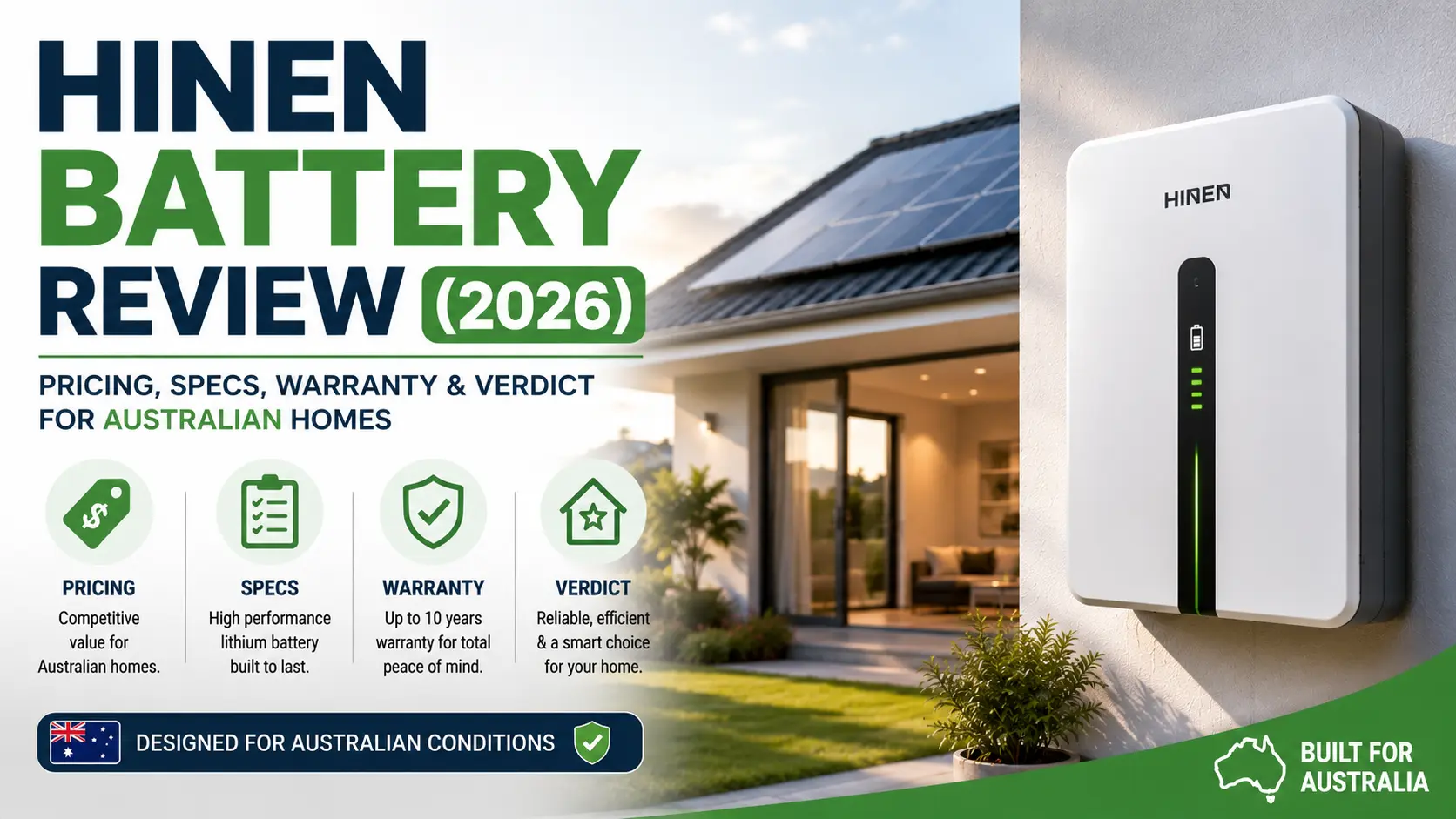
Choosing a home battery isn’t just about kWh anymore — Australian homeowners want a system that’s safe, expandable, compatible with their existing solar, and genuinely worth the money once the Cheaper Home Batteries Program rebate is factored in. Hinen, a Chinese energy storage brand that opened its Australian office in North Sydney in late 2023, is one of the newer names making a case for that shortlist.
This Hinen battery review covers the full range — the B5000/B5000-W modular battery, the B8900M-HA high-voltage system, and the A Series all-in-one hybrid unit — along with real 2026 Australian pricing, warranty terms, safety features, sizing guidance, and how Hinen stacks up against Tesla, Sungrow, SolarEdge and Sigenergy. By the end, you’ll know whether it’s the right storage solution for your home — and if not, what to compare it against.
Who Is Hinen? Company Background
Hinen Group is a Chinese electronics manufacturer founded in Dongguan in 2004, with a residential-storage subsidiary, Hinen New Energy, established in 2022. Hinen Australia Pty Ltd opened its North Sydney office in late 2023 to handle local sales support and warranty administration. The Australian range spans stackable low-voltage batteries, high-voltage cluster systems, and integrated hybrid all-in-one units for both residential and light commercial use.
Because Hinen is still a relatively new entrant locally, brand recognition and the number of accredited installers are smaller than for long-established names like Tesla or Sungrow — worth weighing alongside the specs below.
Hinen Battery Range, Specifications and Performance
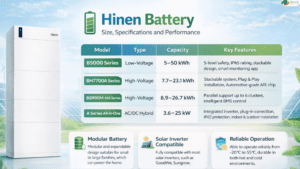
Hinen offers modular battery and all-in-one energy storage systems for different household energy and backup requirements. The table below shows the main models currently listed by Hinen Australia, along with their capacities and key features.
| Model | Type | Capacity / Power | Key Features |
|---|---|---|---|
| B5000 / B5000-W | Low-Voltage Home Battery | 5–50 kWh | 1–10 units in parallel, five-layer safety protection, IP65 rating, 1C charge/discharge rate and app monitoring |
| B8900M-HA | High-Voltage Home Battery | 8.9–26.7 kWh per cluster | 1–3 battery modules, support for up to six clusters per inverter, plug-and-play installation, intelligent BMS and five-layer safety protection |
| A Series All-in-One RESS | AC-Coupled / Hybrid Energy Storage System | 8.9–26.7 kWh battery capacity and 3.6–25 kW power output | Integrated inverter, battery modules, control box and BMS, stackable plug-in design, IP65 protection and indoor or outdoor installation |
Modular and Expandable: The B5000/B5000-W and B8900M-HA systems allow battery capacity to be expanded as household energy requirements increase.
Inverter Compatibility: Compatibility depends on the selected battery and inverter model. Hinen batteries should be paired with approved compatible systems. The A Series AC5S can also be added to an existing solar system and works with third-party PV inverters.
Reliable Operation: The B5000/B5000-W is designed to operate from -20°C to 55°C. Operating conditions for other models may vary, so the relevant Australian datasheet should be checked before installation.
Hinen’s modular batteries and all-in-one systems provide flexible energy storage options for Australian homes. The correct model should be selected based on battery capacity, inverter compatibility, backup requirements and property configuration.
How Much Does a Hinen Battery Cost in Australia? (2026 Pricing)
| System | Capacity | Approx. Price (AUD)* |
|---|---|---|
| Hinen 1-Phase System | 10 kWh | $5,293 |
| Hinen 3-Phase System | 15.4 kWh | $7,292 |
| Hinen 1-Phase System | 20 kWh | $6,473 |
| Hinen 3-Phase System | 30.8 kWh | $12,884 |
Prices are approximate and vary by location, installer and current rebate tier. Get a personalised quote for an exact figure.
Is Hinen Battery Safe? Safety Features Explained
Hinen batteries use LiFePO₄ (LFP) cell chemistry, widely regarded as the safest lithium chemistry for home energy storage due to its thermal stability. Models across the range add:
- Five-layer safety protection (temperature, over-current, over-voltage and short-circuit protection)
- Intelligent BMS (Battery Management System) monitoring
- IP65 ingress protection, suitable for many indoor and sheltered outdoor locations
- Built-in fire-safety measures on selected models
As with any battery brand, real-world safety also depends on correct installer accreditation, proper ventilation and clearance, and compliance with Australian wiring standards — the battery chemistry is only one part of the safety picture.
Hinen Battery Warranty
Hinen backs its major residential models with a warranty of up to 10 years, covering battery cell degradation, BMS failure and manufacturing defects. Before you buy, it’s worth asking your installer to confirm in writing:
- The minimum guaranteed retained capacity at the end of the warranty period
- Any ambient temperature limits that affect warranty validity
- Throughput/cycle limits that could void a claim
- Whether warranty support is handled locally through the North Sydney office
What Size Hinen Battery Do You Need?
Sizing depends on your household’s overnight electricity use and how much solar you already export.
- Small homes: roughly 5–10 kWh usually covers evening basics for one or two people.
- Average families: 10–20 kWh suits typical family usage patterns, including some backup during outages.
- Large households or EV-ready homes: 20 kWh+ (or a 3-phase multi-cluster B8900M-HA setup) suits higher daily consumption, larger solar arrays or future EV charging plans.
Because Hinen’s modular design lets you add capacity later, many installers recommend starting at a size that covers today’s usage rather than overbuying to chase a slightly larger rebate — especially now that the rebate tapers above 14 kWh.
Want to know more? Explore our detailed guide on [How Many kWh Battery Do You Need to Go Off-Grid?]
Hinen Battery Pros and Cons
Pros:
- Long-lasting life: This Battery’s LiFePO₄ chemistry provides long-term durability. It does not lose power even after years of use and works consistently reliably.
- Expandable modular design (5kWh–70kWh): These batteries can be easily increased or decreased according to the energy needs of the home. It is cost-effective for small to large families and provides users with flexibility.
- Hybrid compatible: This Battery is fully compatible with major solar inverters. It is easy to connect to inverters like GoodWe, Sungrow or Deye and the efficiency is maximum.
- All-in-one model benefits: The BH7700A or A series all-in-one models bring the inverter and battery together. This makes the installation process quick and hassle-free.
- Competitive price: Hinen Batteries are much more affordable in the market compared to Tesla or BYD. At the same time, quality and safety are maintained, making them an attractive option for Australian homeowners.
Cons:
- Relatively new to Australia: These batteries are still new to the Australian market. So brand recognition is somewhat limited.
- Limited installer network: The number of accredited installers nationwide is small, so it may take time to get an installation in some areas.
- Basic monitoring app: While Hinen’s smart app is useful, its features are still not very advanced. However, it is enough for users to monitor basic information.
Hinen vs Other Solar Batteries — How It Compares
| Battery | Capacity | Approx. Price (AUD)* | Key Benefit |
|---|---|---|---|
| Hinen B5000 | 10 kWh | $5,293 | Modular design, five-layer safety, app monitoring |
| Sungrow SBR096 | 9.6 kWh | $9,771 | DC-coupled, expandable, strong hybrid compatibility |
| Tesla Powerwall 3 | 13.5 kWh | $13,500 | Premium build, integrated smart control |
| SolarEdge BAT-10K1P | 10 kWh | $9,066 | Seamless SolarEdge inverter integration |
| Sigenergy SigenStor | 10 kWh | $8,744 | Affordable, reliable LFP technology |
Approximate pricing before rebate; confirm current figures with a quote.
Quick guidance:
- Choose Hinen if price-per-kWh and modular flexibility matter most.
- Choose Tesla Powerwall 3 if you want the most established smart-home ecosystem and are less price-sensitive.
- Choose Sungrow or SolarEdge if you already run their inverter and want guaranteed first-party compatibility.
- Choose Sigenergy if you want a similarly value-focused LFP alternative to compare Hinen against.
Final Verdict
Hinen offers a genuinely competitive, safety-focused, expandable battery range at a price point well below premium brands, backed by a 10-year warranty and LiFePO₄ chemistry. The trade-off is brand newness in Australia — a smaller installer network and less long-term local performance data than Tesla, Sungrow or AlphaESS. For homeowners prioritising value and flexibility who are comfortable with a newer entrant, Hinen is worth putting on the shortlist for a quote; for those who weight brand longevity and support history most heavily, it’s worth comparing quotes side by side before deciding.
[Get a personalised Hinen battery quote →]
FAQs
Do Hinen batteries work with all solar inverters in Australia?
No — compatibility depends on the specific battery and inverter model. Hinen batteries commonly pair with brands like GoodWe, Sungrow and Deye, but your installer needs to confirm compatibility for your exact system before purchase. The A Series AC5S is designed to be added to most existing solar setups.
What is the warranty on a Hinen battery?
Hinen’s major residential models carry up to a 10-year warranty covering cell degradation, BMS failure and manufacturing defects, subject to operating-condition limits set out in the product datasheet.
How does Hinen compare to Tesla, Sungrow or AlphaESS?
Hinen is generally priced lower per kWh than Tesla and offers comparable LFP safety credentials to Sungrow and AlphaESS, but has a shorter Australian track record and smaller installer network than all three. It suits buyers prioritising value and modular scalability over brand longevity.
Is a Hinen battery safe during a blackout?
Yes, when installed with backup-capable inverter hardware. The LiFePO₄ chemistry plus five-layer safety protection and IP65 rating are designed to support essential loads like fridges, lighting, Wi-Fi and medical equipment during an outage, though exact backup capability depends on the inverter and system design chosen.
Is Hinen a CEC-approved battery brand?
Selected Hinen models (including the B5000 and B7700M-H) are listed as Clean Energy Council approved, which is a requirement for eligibility under the federal rebate — always confirm your chosen model’s current CEC listing status before installing.

Shah Tarek is a Solar Energy Consultant with 10 years experience in solar system design and solar consultancy field at Australia. He is now a Director, Operation & Consultancy Division at Aussie Solar Tech, a leading Australian solar retailer and installer. Here he is writing informative and engaging solar content that educates the community on the benefits of solar power. His work supports Aussie Solar Tech’s mission to promote sustainable energy solutions and foster a greener future for Australia.


Seraphim Solar Panels Review: Efficiency, Reliability, and Value Unveiled

Talesun Solar Panels: Honest Review Before You Buy

Sungrow Battery VS Tesla Powerwall : Which is Best in Australia?

Leapton Solar Panels Review: Affordable Energy Solution

REC Solar Panels Review: Outstanding Efficiency & Durability

Best Hybrid Inverters for Home Solar Systems in 2025
Best Solar Battery In Australia 2026 — Complete Guide

Sigenergy VS Fox ESS Battery: Which is The Best Choice for 2026

How Much Do Solar Panel Costs in Australia? (2026 Price Guide)

